In this episode
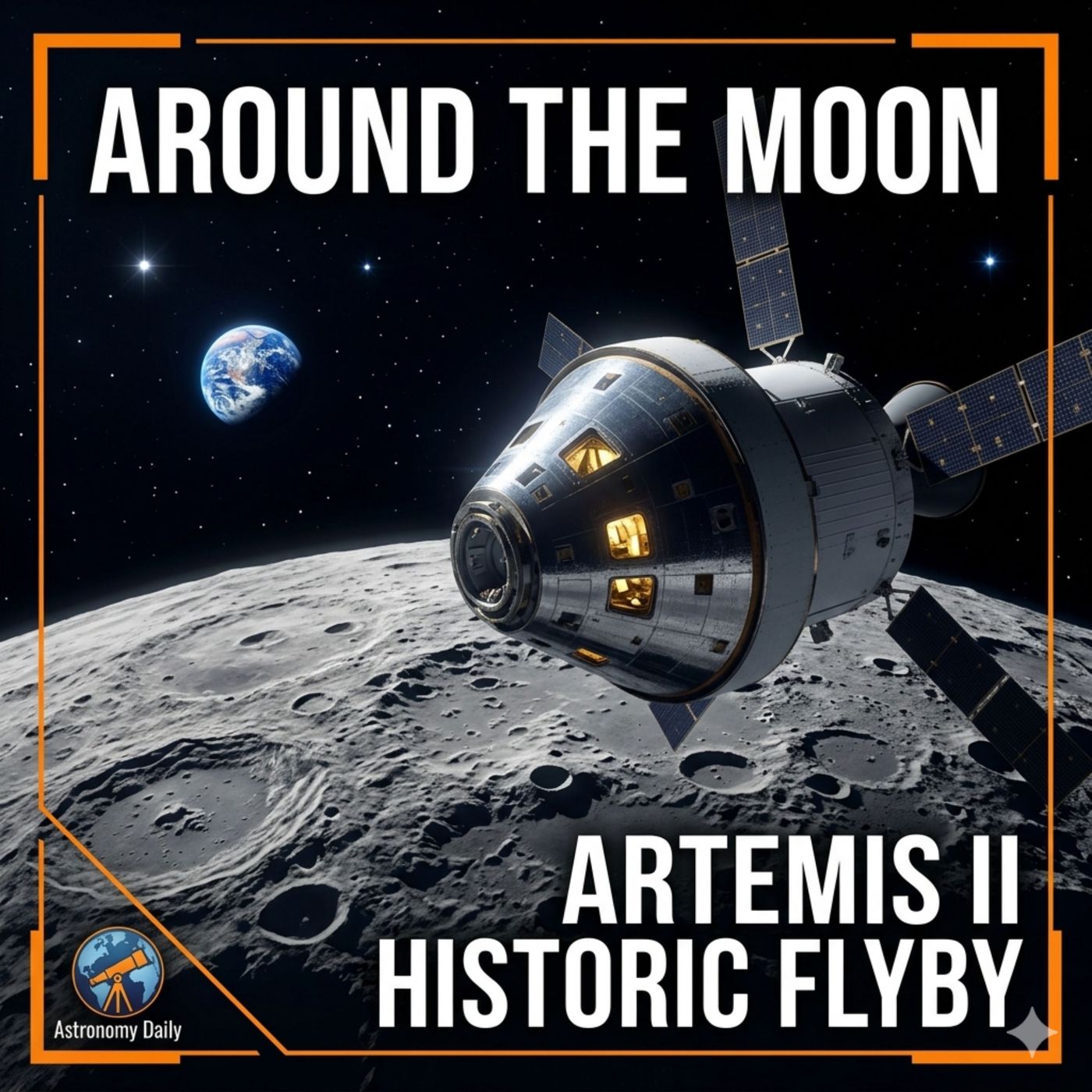
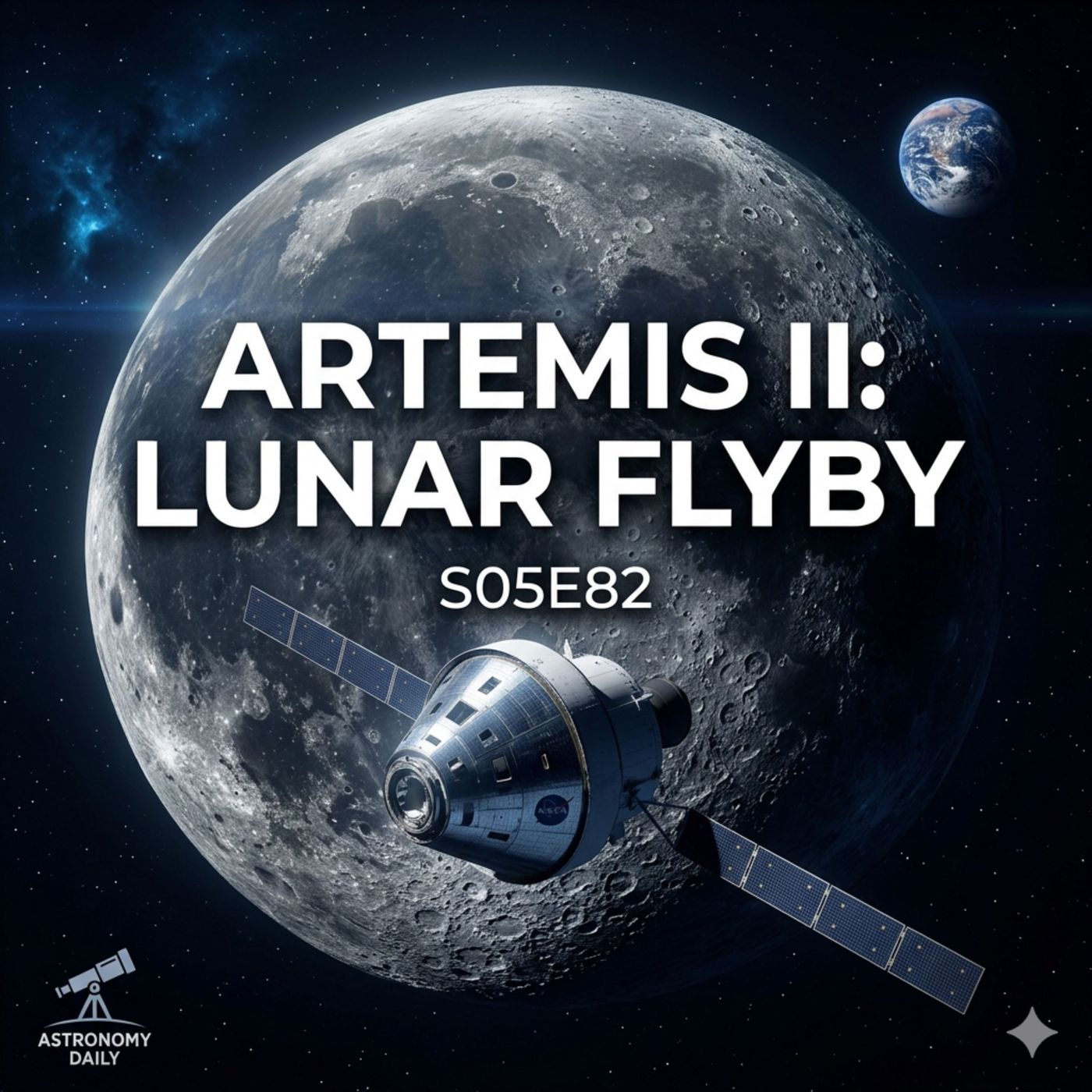
The Artemis II crew has completed the most significant human spaceflight milestone since 1972 — a historic lunar flyby that took four astronauts further from Earth than any humans in history. In today's episode, Anna and Avery cover every moment of Flight Days 6 and 7, including the far-side blackout, a solar eclipse observed from beyond the Moon, and what comes next on the journey home. Plus: NASA faces another proposed 47% science budget cut, a cargo ship heads to the space station, Europe and China are about to launch a groundbreaking solar shield explorer called SMILE, and Blue Origin reveals its ambitious plan to map the Moon's hidden water ice. Today's Stories 1. Artemis II Days 6 & 7: The Lunar Flyby • The crew of Reid Wiseman, Victor Glover, Christina Koch, and Jeremy Hansen completed a 7-hour lunar flyby on April 6 • Orion reached a maximum distance of 252,760 miles from Earth, surpassing the Apollo 13 record of 248,655 miles • Closest lunar approach: 4,067 miles above the surface at approximately 7 p.m. EDT • Christina Koch became the first woman to complete a lunar flyby • The crew witnessed an Earthset, Earthrise, and a solar eclipse from behind the far side of the Moon • Day 7 is a rest day; splashdown in the Pacific is targeted for April 10 2. NASA FY2027 Budget Proposal • White House proposes $18.8 billion for NASA — a 23% overall reduction • Science Mission Directorate would be cut by 47%, from $7.25B to $3.9B • More than 40 missions face termination; Mars Sample Return and SERVIR named explicitly • Exploration/Artemis funding would increase by ~10% • Congress rejected nearly identical cuts last year 3. Cygnus NG-24 ISS Resupply • Launch targeted April 8 from Cape Canaveral on SpaceX Falcon 9 • Named S.S. Steven R. Nagel after four-time shuttle veteran • Carrying 11,000+ lbs including Cold Atom Lab upgrade and stem cell research hardware • Also includes Africa's ClimCam AI-powered climate camera from Egypt, Kenya, and Uganda 4. SMILE Mission — Launch April 9 • Joint ESA / Chinese Academy of Sciences mission; first ever jointly designed, built, launched and operated by both agencies • Launches April 9 on Vega-C from French Guiana; 3-year science mission • Will give humanity its first complete, simultaneous view of Earth's magnetosphere reacting to the solar wind • Four instruments: soft X-ray imager, UV aurora camera, light ion analyser, magnetometer • Science orbit reaches 121,000 km above North Pole; up to 40 hours continuous observation per orbit • Critical for understanding and predicting space weather — protecting satellites, power grids and communications 5. Blue Origin Oasis-1: Lunar Water Ice Prospecting • Introduced at the 2026 Lunar and Planetary Science Conference (LPSC) • Two-smallsat mission deployed from Blue Origin's uncrewed Mk1 lander; ultra-low 10x50 km polar orbit • Instruments: neutron spectrometer (water ice to 1m depth), magnetometer (metals), multispectral imager (Helium-3) • 90-day global mapping phase followed by 10-day controlled deorbit — science continues to impact • Partnership with Luxembourg Space Agency; data licensed commercially, non-commercial data released publicly via ESRIC • Phase 1 of a 3-phase Project Oasis roadmap: orbit survey, surface mobility, then extraction operations 6. April Skywatching • Comet C/2025 R3: closest approach April 27, magnitude ~8, binoculars needed • Lyrid meteor shower peaks April 21–22, look toward Lyra from 10pm • Mercury at best visibility of 2026 in the eastern pre-dawn sky Links & Resources • NASA Artemis II Flight Day 6 updates: nasa.gov • Planetary Society Artemis II guide: planetary.org • NASA FY2027 budget: spacenews.com • Cygnus NG-24 launch: nasaspaceflight.com • ...Speaker 1: Welcome to Astronomy Daily, your daily guide to what's happening beyond our world.
Speaker 2: I'm Anna and I'm Avery, and today today's genuinely one of those days we will remember for the rest of our lives.
Speaker 1: Fifty four years. That's how long it's been since any human being flew around the far side of the Moon, and yesterday that streak ended.
Speaker 2: The Artemis two crew Read Wiseman, Victor Glover, Christina Cooke, and Jeremy Hansen completed a seven hour lunar flyby that has rewritten the history books. We've got the full story, plus a wild NASA budget battle, a European Chinese collaboration, a Blue Origin update, and a spacecraft headed to the space station.
Speaker 1: Strap in This is Astronomy Daily, Season five, episode eighty three.
Speaker 2: Let's kick things off with the big one of the day.
Speaker 1: Okay, let's start where the entire planet's attention has been focused. Two hundred and fifty two thousand, seven hundred and sixty miles from Earth.
Speaker 2: That's how far the Artemis to Orion spacecraft reached its maximum distance from Earth, officially breaking the record set by the Apollo thirteen crew back in April nineteen seventy. Apollo thirteen got to two hundred and forty eight thousand, six hundred and fifty five miles. Artemis two just beat that by more than four thousand miles.
Speaker 1: And they didn't just nudge the record. They went farther than any human beings in the history of our species. Let that sink in. The lunar fly by itself kicked off on flight day six, that's Monday, April sixth NASA scientists had prepared a packed science plan, thirty five specific geological targets on the lunar surface, pen science objectives, and the crew working in two person ships to photograph and document as much as possible. Closest approach came at just four thousand, sixty seven miles above the surface.
Speaker 1: That's close enough to see individual craters in extraordinary detail. From there, the spacecraft swung around the far side of the Moon and the crew went silent for about forty five minutes as the Moon blocked all communication with Earth.
Speaker 2: And when they came back, the crew described witnessing an Earth set and then an Earth rise as the Earth dropped below and then re emerged from the lunar horizon. Commander Reid Wiseman said, and I'm paraphrasing here that these numbers two hundred and fifty thousand miles are simply impossible for the human brain to process when you're actually living them.
Speaker 1: Mission specialist Christina Cock had an emotional moment too. She became the first woman in history to complete a lunar flyby, and when she spoke to NASA administrator Jared Isaacman, she said she wasn't ready to go home.
Speaker 2: Victor Glover described the Moon out the window as one of the darkest things they could see, with deep space behind it, appearing like a deep surreal blue stars visible even through that darkness. His words, it's a quite a wicked view.
Speaker 1: And another astronaut we believe it was, Jeremy Hanson, said, there are simply no adjectives that they need to invent new ones, just phenomenal.
Speaker 2: But it didn't stop there. As oryan swung back around, the crew witnessed something extraordinarily rare, a total solar eclipse, as seen from beyond the Moon's far side. The Sun disappeared behind the lunar disc for nearly an hour.
Speaker 1: And they used every second of it scientifically studying the solar Corona, glowing around the edge of the Moon, watching for meteoroid impacts on the lunar surface, and observing illuminated lunar dust. It was a science feast in the middle of a history making adventure.
Speaker 2: President Trump called in afterward to congratulate the crew, calling it one of the proudest moments for America. Commander Wiseman said his favorite site was watching Mars align with the other planets during the eclipse and musing about humanity becoming a two planet species.
Speaker 1: So where is the crew now? Day seven is a rest day, well earned. I'd say they eight brings a radiation shelter construction demonstration and manual piloting tests. Day ten, April tenth, is splashed down day the Pacific Ocean off San Diego.
Speaker 2: Between now and then, the spacecraft will perform three trajectory correction burns to fine tune its return path. And Orion's toilet, which has had a few headline worthy hiccups, appears to be operating normally now after a frozen waistline was resolved.
Speaker 1: The space toilet always a crowd pleaser, but genuinely the universal waste management system is being tested as the first deep space bathroom, critical technology for future long duration missions.
Speaker 2: Fun fact time. The Artemis two cruise wake up songs are curated by mission control and beamed up to start each day. The playlist is on Spotify look for it. It's a genuine artifact of this mission.
Speaker 1: Also, the crew's zero gravity indicator, the small toy or object that floats freely in the cabin showing when you've reached weightlessness, is an adorable stuffed animal they called Rise So far, it's living up to the name.
Speaker 2: And in a lovely Easter weekend moment before the flyby, pilot Victor Glover shared a message about how the mission reminds us of our shared humanity. As he said, we are the same thing, and we've got to get through this together. Beautiful sentiment. Two hundred and fifty thousand miles from home.
Speaker 1: The crew also attempted to recreate the famous Apollo eight earth rise photograph from nineteen sixty eight, one of the most important images in human history. We'll be watching for those photos as their downlink now.
Speaker 2: Even as the world celebrates Artemis two, there's a storm brewing back on Earth over NASA's finances. The White House Office of Management and budget released. It's FY twenty twenty seven budget for NASA, and it's a repeat of last year's deeply controversial cuts.
Speaker 1: The headline number eighteen point eight billion dollars. That's a twenty three percent reduction from NASA's current twenty four point four billion dollar budget, and the hardest hit the Science Mission Directorate, slashed by forty seven percent, from seven point twenty five billion dollars down to three point nine billion.
Speaker 2: Casey Dreyer of the Planetary Society called it bluntly an extinction level event for science. More than forty missions would be terminated, although the document only maims two specifically the Mars Sample Return Mission and the Severe Global Climate Data Program.
Speaker 1: Notably, exploration funding meaning ARTEMIS would actually increase by nearly ten percent to eight point five billion dollars. So the administration's message is clear, Humans to the moon, but science takes the hit.
Speaker 2: Here's the important context. Though Congress rejected almost identical cuts last year, the same eighteen point eight billion dollar request was made for FY twenty twenty six, and lawmakers chose to restore science funding across the board. Advocates say there's every reason to believe Congress will push back again.
Speaker 1: But the uncertainty is damaging regardless. Missions like the Nancy Grace Roman space telescope expected to launch later this year and the Dragonfly Titan rotorcraft are among those potentially in the crosshairs.
Speaker 2: While all eyes are on the Moon, the International Space Station isn't going hungry. Tomorrow, Wednesday, April eighth, a SpaceX Falcon nine is set to launch from Cape Canaveral, carrying Northrop Grumman's signas spacecraft on the NG twenty four mission.
Speaker 1: This signus has been named the SS Stephen R. Nagel in honor of the former NASA astronaut who flew four Space Shuttle missions and logged seven hundred and twenty three hours in space.
Speaker 2: The XL configuration is carrying more than eleven thousand pounds of supplies and science hardware for the expedition seventy three crew. Highlights include an upgrade to NASA's cold Atom Lab, which uses ultrapoled atoms to study quantum behavior, and equipment to help produce therapeutic stem cells for blood and cancer treatment research.
Speaker 1: There's also an AI powered climate camera built through a partnership between the Egyptian Kenyon and Ugandan space agencies. The climb Camp payload designed to provide near real time weather data for disaster management in East Africa.
Speaker 2: Unlike SpaceX's Dragon, Signus doesn't dock autonomously. Astronauts aboard the station use the canad Arm two robotic arm to capture it, then ground controllers dock it to the Unity Module, a real team effort between humans and ground control.
Speaker 1: Now, while Artemis two is grabbing most of the headlines, there's another remarkable mission launching in less than forty eight hours, and this one is a genuine first in the history of space science.
Speaker 2: On Thursday, April ninth, the SMILE mission lifts off from europe Spaceport in French Guiana on a Vegas Sea rocket. SMILE stands for the Solar Wind, Magnetosphere Ionosphere Link Explorer. What it promises to deliver is humanity's very first complete simultaneous view of how Earth's magnetic shield responds to the Sun.
Speaker 1: Think of it this way. Earth is constantly bombarded by charged particles streaming from the Sun the solar Wind. Our planet is protected by a massive invisible magnetic bubble called the magnetosphere. Without it, life on Earth simply could not exist. We've been studying pieces of this interaction for decades, but we've never been able to image the whole system at once. Smile will change that.
Speaker 2: It carries four instruments, a soft X ray imager, an ultraviolet aurora camera, a light ion analyzer, and a magnetometer, all working together in real time to capture the magnetosphere as a complete dynamic system for the first time ever.
Speaker 1: The orbit is extraordinary. After launch, Smile fires its engines eleven times over twenty five days to stretch its path into a highly elongated loop, reaching one hundred and twenty one thousand kilometers above the North Pole, been sweeping back down to just five thousand kilometers above the South pole to beam its data home. Each orbit takes roughly two days.
Speaker 2: At its high point over the North Pole, Smile will continuously image the entire day side magnetosphere for up to forty hours per orbit. That's the longest uninterrupted auroral observation ever planned from space, a capability that's been missing since two thousand and eight.
Speaker 1: There's also a remarkable geopolitical dimension here. Smile is a joint mission between ESA and the Chinese Academy of Sciences, the first mission ever jointly designed, built, launched, and operated by both agencies. That partnership has survived a decade of development, technical setbacks, COVID delays, and considerable political headwinds. The fact that it's launching at all is itself a statement.
Speaker 2: And the practical stakes are high. Better understanding of space weather and earlier prediction of solar storms protects satellites, power grids, financial systems, and communications networks worldwide. Liftoff is set for zero seven twenty nine BST on April ninth, with life coverage on ESA WebTV.
Speaker 1: The name Smile comes from the mission acronym, but there's a literal smile involved too. ESA's simulations of what the X ray camera will see show a smiley faced shaped pattern of X ray emission from Earth's magnetosphere, which may be the most delightful coincidence in all of space science.
Speaker 2: The spacecraft weighs twenty three hundred kilograms, but fifteen hundred and eighty of those kilograms are fuel. It burns through ninety percent of its propellant in the first month alone just to reach its science orbit. It's essentially a fuel tank attached to instruments.
Speaker 1: Here's a story that connects directly to Artemis two and the dream of long term human presence on the Moon. We know there's water ice locked in the permanently shadowed craters near the lunar south Pole, but we don't really know how much or exactly where Blue Origin wants to fix that.
Speaker 2: Earlier this year, at the Lunar and Planetary Science Conference, Blue Origin formally introduced Oasis one, the first mission in what it's calling Project Oasis, a multi phase initiative to identify, assess, and ultimately use the Moon's resources in C two. Oasis one is a two spacecraft mission, a pair of small SATs to be deployed from Blue Origins uncrewed MK one Lander.
Speaker 1: The two spacecraft will enter a highly elliptical, low polar orbit, with their lowest point skimming just ten kilometers above the lunar South Pole, close enough to collect extraordinarily detailed data about what's actually in those permanently shadowed regions.
Speaker 2: The instrument suite is purpose built for prospecting, neutron spectroscopy to measure subsurface waterized concentrations down to one meter depth, magnetometers for metal detection, a multi spectral push broom spectrometer for helium three and geological mapping. It's essentially a mining survey from orbit with resolution in some modes down to less than five meters per pixel.
Speaker 1: And then comes the finale. After ninety days of global mapping, Oasis one conducts a controlled slow motion descent a ten day de orbit face where the instruments keep working at ultra low altitudes right up until impact. Bill be mapping water deposits at hundreds of meters per pixel in those final hours science right to the end.
Speaker 2: The commercial model is fascinating too. Blue Origin plants to license the resulting resource maps to other companies who need that data to design lunar mining hardware and attract investors. Any data without direct commercial use goes public via the European Space Resources Innovation Center. It's open science built on a commercial backbone.
Speaker 1: The project is a partnership with Luxembourg and its Small Space Agency, continuing that small nations long tradition of being surprisingly central to the space resources industry, and it ties directly into Blue Origin's Blue Alchemist program, which aims to process lunar regolith into oxygen, solar cells and power cables. The Moon as a self sustaining infrastructure.
Speaker 2: Hub, as Blue Origins VP of Advanced Concepts Pat Rami has put it, once we know what's really there and how to access it, everything changes. With Artemis two heading home right now, that future is feeling closer than ever before we go.
Speaker 1: Let's look ahead at what's happening in the night sky this month, because April is actually a great time to be outside looking up.
Speaker 2: Comet c Slash twenty twenty five R three is your prime target. It's expected to peek around April seventeenth and make its closest approach to Earth on April twenty seventh, coming within forty four million miles. Magnitude estimates put it around eight so you'll need binoculars or a small telescope, but it should be a very rewarding site. In the eastern pre Don sky.
Speaker 1: Ben there's the Lyriid meteor shower, which peaks on the night of April twenty first into the twenty second. The Lyriads are one of the oldest recorded meteor showers. There are observations going back to six hundred and eighty seven BC. They come from debris shed by Comet Thatcher, and you'll want to look toward the constellation Lira from around ten pm local time.
Speaker 2: The moon should be relatively cooperative for the Larids this year, meaning darker skies for the peak, and if you have a clear horizon just before sunrise, Mercury is putting on its best showing of the year as well. Look east just above Mars.
Speaker 1: And that is your Astronomy Daily for Tuesday, April seventh, twenty twenty six. What a day to be alive and curious about the universe.
Speaker 2: The Artemis two crew are heading home. They've seen what no human has since nineteen seventy two, and the science, the photos, the data, all of that is just beginning to come back to Earth.
Speaker 1: If this episode has inspired you, share it with someone who needs a little cosmic wonder in their day. You'll find us wherever great podcasts are heard, and all the links are in the show notes.
Speaker 2: Find us on x, Instagram, TikTok, and YouTube at astro Daily Pod and visit Astronomy Daily dot io for extended show notes and resources.
Speaker 1: Until tomorrow, keep looking.
Speaker 2: Up Sunny Day, star Sto star Sto


 Apple Podcasts
 Spotify
 Pocket Casts
 Castbox
 Overcast
 Podbean
 iHeartRadio
 Castro
 Goodpods
 Moon FM
 Podcast Addict
 Podcast Republic
 YouTube