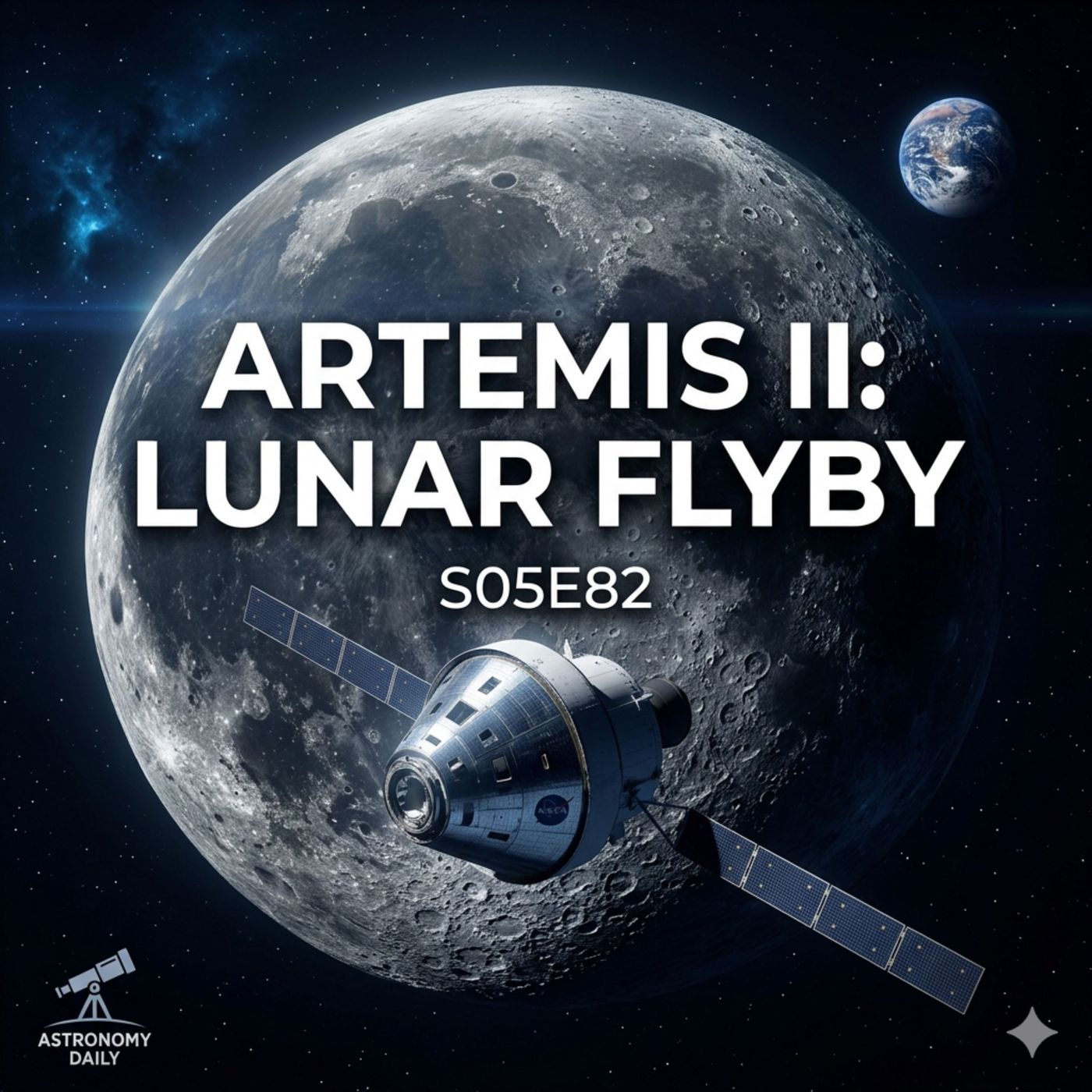
Artemis II Soars Beyond the Moon + Comet MAPS' Dramatic Demise
In this episode
For the first time since Apollo 17 in 1972, human beings are flying around the Moon — and it's happening RIGHT NOW. In this episode of Astronomy Daily, Anna and Avery deliver a full Artemis II update covering Flight Days 4 and 5, and the historic lunar flyby unfolding TODAY. We also have the promised verdict on Comet MAPS — the 'Easter comet' that plunged toward the Sun on April 4. Did it survive? Then two remarkable discovery stories: 87 hidden stellar streams uncovered in the Milky Way's outskirts, and the Vera C. Rubin Observatory's stunning debut — 11,000 new asteroids in just six weeks. We close with an extraordinary astronomical event: a solar eclipse witnessed from beyond the Moon's far side. IN THIS EPISODE: • 00:00 — Intro • Story 1 — Artemis II: Days 4 & 5 + Today's Lunar Flyby • Story 2 — Comet MAPS: The Easter Comet's Fate • Story 3 — Third Dark-Matter-Free Galaxy Discovered • Story 4 — 87 Hidden Stellar Streams Found in the Milky Way • Story 5 — Rubin Observatory: 11,000 Asteroids in 6 Weeks • Story 6 — Solar Eclipse from Beyond the Moon 🌐 astronomydaily.io | 🐦 @AstroDailyPodBecome a supporter of this podcast: https://www.spreaker.com/podcast/astronomy-daily-latest-space-news--5648921/support.
Sponsor Details:
Ensure your online privacy by using NordVPN. To get our special listener deal and save a lot of money, visit www.astronomydaily.io/nordvpn. You'll be glad you did!
Get the best secure and private email on the planet. Stop your Government, google and who knows who else spying on every email you write. Do what we did and use ProtonMail. They beleive in privacy and there are no ads in their business model...yet they still provide a free forever service. Check them out and get out special deal at www.astronomydaily.io/protonmail
Become a supporter of Astronomy Daily by joining our Supporters Club. Commercial free episodes daily are only a click way... Click Here
This episode includes AI-generated content.
Speaker 1: Right now, as you're listening to this, there are four human beings flying around the Moon.
Speaker 2: For the first time since December nineteen seventy two, fifty three years.
Speaker 1: Reed Wiseman, Victor Glover, Christina Koch, and Jeremy Hansen are aboard NASA's Ryan spacecraft conducting a six hour lunar flyby today, photographing the far side, breaking the all time human distance record from Earth, and about to witness a solar eclipse from beyond the Moon.
Speaker 2: We also have the verdict on comet maps, the one we promised you on Saturday, did it survive its plunge into the Sun.
Speaker 1: Plus a third galaxy with no dark matter, eighty seven hidden stellar streams discovered in our own galaxy, and a new telescope that found eleven thousand asteroids in just six weeks. I'm Avery and I'm Anna. This is Astronomy Daily, Season five, episode eighty two. Let's go.
Speaker 2: Let's start where we left off on Saturday, flight day four for the Artemis two crew.
Speaker 1: At the start of the day, Oriyan and her crew were approximately one hundred and sixty nine thousand miles from Earth and one hundred and ten thousand miles from the Moon halfway there and closing fast.
Speaker 2: The big activity on day four was a manual piloting demonstration. Christina Coke and Jeremy Hansen took turns at the controls testing two different thruster modes to give engineers real deep space handling data on the spacecraft.
Speaker 1: And this isn't just for show. Commander Wiseman and Victor Glover are scheduled to repeat the same demonstration on day eight so mission controllers can compare how different crew members handle the spacecraft its proper test flight methodology.
Speaker 2: The crew also spent time reviewing their lunar science target list for today's flyby, about thirty five geological features they've been asked to observe and photograph. Top of that list is the Orientel Basin, which.
Speaker 1: Is for listeners who haven't heard of it, a nearly six hundred mile wide impact crater that straddles the boundary between the near and far sides of the Moon three point eight billion years old. The Artemis two crew will be the first humans to see it from multiple angles as they swing around.
Speaker 2: They also found time for some cru selfies using one of Orion's solar array cameras. Very relatable astronauts. They're just like us. Day five, the crew woke up to see low Green's working class Heroes, which feels about right for people who are about to fly around the Moon.
Speaker 1: Very appropriate playlist choice from mission control.
Speaker 2: The main objective on Sunday was a full evaluation of the Orion Crue survival suit. All four crew members put on the suits, pressurized them, did leak checks, simulated seat entry, and tested whether they could eat and drink while wearing them.
Speaker 1: That last one matters more than it might sound. If there's ever a cabin emergency on a future mission and the crew has to suit up quickly, they need to know they can sustain themselves in the suit for an extended period.
Speaker 2: Later on Sunday, mission control completed a short trajectory correction burn seventeen and a half seconds to fine tune or Ryan's path to the Moon.
Speaker 1: And then just after midnight Eastern Time on Monday morning, so very early today, the spacecraft entered the Moon's gravitational sphere of influence. Lunar gravity now has more pull on Orion than Earth's does, the.
Speaker 2: First humans in that position since the Apollo.
Speaker 1: Era, and so to today. Flight Day six the main event.
Speaker 2: The six hour fly by window runs from two forty five to nine forty pm Eastern. Depending on when you're listening to this, the crew may already be deep into it.
Speaker 1: Closest approach is at around seven pm Eastern, four thousand and sixty six miles above the surface, far enough out to see the entire lunar disc at once, including regions near both poles that Apollo astronauts never had this view of.
Speaker 2: And here's the record that gets broken. Today. At seven oh five pm Eastern, Orion will reach its maximum distance from Earth two hundred and fifty two thousand, seven hundred and fifty seven miles.
Speaker 1: Beating Apollo thirteen's record by four thousand, one hundred and two miles. Apollo thirteen, the mission that survived an explosion in deep space and used the Moon's gravity to slingshot back to Earth, held that record for fifty six years.
Speaker 2: There will also be a communications blackout when Orion passes behind the Moon. Signals between the spacecraft and NASA's Deep Space network are blocked. That blackout begins around five forty seven pm Eastern and lasts about forty minutes.
Speaker 1: Nor Mole expected nothing to worry about. It happened on Artemis one and on every Apollo mission two, but it does mean mission control is briefly out of contact with the crew while they're on the far side.
Speaker 2: One more thing for today, the crew are attempting to recreate one of the most famous photographs in history. Apollo eates earth Rise, the image of Earth rising above the Moon's horizon, taken on Christmas Eve nineteen sixty eight, one of the most iconic images ever made.
Speaker 1: Well see if they can match it. My money is on yes.
Speaker 2: We'll be watching splashdown for the full mission is on track for Friday, April tenth, off San Diego.
Speaker 1: All right, we promised you this one on Saturday, and we're going to deliver.
Speaker 2: Comet maps D twenty twenty six A one maps discovered on the thirteenth of January this year in the AMAX one Observatory in Chile's Atakama Desert. Why it's Sungrazer, a family of comets that plunge extremely close to the Sun on very elongated.
Speaker 1: Orbits, and maps was special. Even within that family, it holds the distinction of being the earliest discovered cruits Sungrazer ever found spotted more than two astronomical units from the Sun, giving astronomers months to track its approach.
Speaker 2: On Saturday, April fourth, Maps reached Perihelion, its closest point to the Sun. It passed approximately ninety nine thousand miles from the solar surface. To put that in perspective, the diameter of the Sun itself is eight hundred and sixty five thousand miles.
Speaker 1: It was scorchingly impossibly close.
Speaker 2: Some were calling it the Easter Comet, hoping it would emerge from that encounter blazing in the post Perihelian sky. Comets in this family have done it before. Iks Seki in nineteen sixty five survived and became one of the brightest comets of the twin century. Comet Lovejoy in twenty eleven survived and became a spectacular naked eye.
Speaker 1: Object, but Maps didn't make it.
Speaker 2: About six hours before pery Helian, coronagraph images from the Soho spacecraft showed it at a round magnitude negative zero point six and brightening, Then shortly after it disintegrated. It never re emerged from behind the Sun, though.
Speaker 1: A spectacular death, if not the spectacular survival we were hoping for. The question now is whether any ghostly debristail remains, but if it does, it would be faint and short lived.
Speaker 2: It's worth sitting with us for a moment. Mapps was a fragment of a comet that last visited the Inner Solar System roughly seventeen hundred years ago, possibly connected to a comet witnessed in broad daylight in the year three hundred and sixty three AD, documented by the historian Ammanilius Marcellinus. It made it all the way back, and the sun hook it.
Speaker 1: There is a silver lining, though, Comet C. Twenty twenty five R three pan Stars is brightening and putting on its own show. This month, April seventeenth is your best viewing opportunity. You'll need binoculars. It should reach around magnitude eight, but look east before dawn in the constellations Pegasus and Pisces. We'll keep you updated.
Speaker 2: Rest well.
Speaker 1: Maps Now to some deep cosmology that genuinely shakes the foundations of how we think galaxies work.
Speaker 2: So the standard model of galaxy formation says dark matter is the invisible scaffolding that holds galaxies together without its gravitational pool. The rotational forces of a galaxy stars would simply cause it to fly apart.
Speaker 1: Dark matter makes up the vast majority of a galaxy's mass. We can't see it, it doesn't interact with light, but we infer it everywhere we look. Until in twenty eighteen, a team at Yale led by astronomer Peter von Dockam found something that shouldn't exist.
Speaker 2: A galaxy with virtually no dark matter NGC ten fifty two DASH DF two, an ultra diffuse galaxy faint spread out c through almost and the stars inside it were moving far too slowly. There wasn't enough mass the dark matter was missing.
Speaker 1: Then they found a second one, NNGC ten fifty two DASH DF four, same thing, and both galaxies appeared to lie along the same trail in space, and.
Speaker 2: Now announced this week a third NNGC ten fifty two DASH DF nine, which falls directly on that same trail between DF two and DF four. The team used a Keck observatory in Hawaii to measure how fast the stars inside DF nine are moving, and the result was the same. No dark matter required to explain the dynamics.
Speaker 1: Three in a row on the same lene, that is not a coincidence.
Speaker 2: The explanation the team favors is the bullet dwarf collision theory. Imagine two gas rich dwarf galaxies hurtling toward each other at enormous speed. They collide. The stars, which interact electromagnetically, get tangled up and slow down, but dark matter only interacts via gravity. The dark matter halos of each galaxy just passed straight through each other, like ghosts.
Speaker 1: What's left behind is a trail of star rich galaxies that have been completely stripped of their dark matter DF two, D four, DF nine, all born from the same catastrophic ancient collision.
Speaker 2: The team wants to measure a fourth and fifth galaxy on the same trail. The farther out they go, the fainter the targets get. But if they find the same signature, that's about as close to a smoking gun as cosmology.
Speaker 1: Gets, and what it tells us is profound dark matter exists, but it doesn't have to be everywhere. Galaxies can form and persist without it under the right or rather the extremely violent circumstances.
Speaker 2: Our next two stories today share something in common. Both involve new tools and new algorithms revealing hitting populations of objects at a scale that simply wasn't possible before. The universe, it turns out, has been holding out on.
Speaker 1: Us, starting with our own galaxy. Astronomers at the University of Michigan have just announced the discovery of eighty seven new stellar stream candidates in the outskirts of the Milky Way.
Speaker 2: Now stellar streams for listeners who haven't come across them before. Stellar streams are when a compact cluster of stars travels through the Milky Way's gravitational field. The galaxy slowly pulls stars away from it. Those stars get stretched out into long, trailing ribbons, barking threads of light following the cluster's orbital path.
Speaker 1: Study co author Oleg Neettin put it beautifully. He said, it's like riding a bike with a bag of sand, where the bag has a hole in it, the sand spilling out behind you. That's the stellar stream.
Speaker 2: Before the study, fewer than twenty of these streams had been found, and most of those were discovered by chance astronomer stumbling across them in Gaya data while looking for other things.
Speaker 1: Lead researcher Yin Tanchen, who goes by Bill, took a more systematic approach. He developed a new algorithm called star stream which uses a physics based model of how these streams actually form rather than just looking for visual patterns in the data, and he turned it loose on the full Gaya data set.
Speaker 2: The result eighty seven candidates, more than quadrupling the known population in one go, and these are the rarest kind streams from globular clusters that are still intact. You can compare the stream directly to its parent cluster, which makes them enormously scientifically valuable.
Speaker 1: Because the shapes and sizes of these streams encode information about the forces they've experienced, and that tells you about the Milky Way's mass distribution, including how its dark matter halo is structured.
Speaker 2: So these ribbons of stars are essentially a map of invisible matter. The next step is follow up with more powerful instruments NASA's Roman Space Telescope, Ruben Observatory, and DIESI to verify which of the eighty seven are real streams and which might be background.
Speaker 1: Noise, which brings us rather neatly to Ruben Observatory.
Speaker 2: The via C Reuben Observatory, which we've mentioned a few times in the last couple of months as it was coming online, has just released its first major data set, and the numbers are staggering.
Speaker 1: In six weeks, six weeks of early engineering quality data, not even full science operations, yet, Rubin found over eleven thousand new asteroids, generated nearly a million measurements, and refine the orbits of more than eighty thousand previously cataloged objects.
Speaker 2: Some of those eighty thousand had effectively vanished from tracking systems because their orbits were two uncertain Ruben recovered them with far greater precision. Objects that were lost found again.
Speaker 1: Mario Jerrich, the Ruben Solar System lead scientists to the University of Washington, summed it up well, he said, and I'm paraphrasing. This first submission is just the tip of the iceberg. What used to take years or decades to discover Ruben will unearth in months.
Speaker 2: Among the new finds are thirty three near Earth objects asteroids whose orbits bring them relatively close to Earth's None of them pose any threat, and the largest is about five hundred meters across. But here's the sobering context. Scientists estimate that only forty percent of mid sized near Earth objects, those larger than one hundred and forty meters large enough to cause serious regional damage have been found so.
Speaker 1: Far forty percent. We're more than halfway to knowing what's out there in that size range, but only barely. Ruben is expected to discover up to ninety thousand additional near Earth objects once fully operational, potentially doubling the known population.
Speaker 2: The early data set also turned up around three hundred and eighty trans Neptunian objects icy bodies far beyond Neptune. Two of them have highly elongated orbits that carry them as far as one thousand times the Earth Sun distance, among the most distant known objects in the entire Solar System.
Speaker 1: And this is still just the beginning. When the Legacy Survey of Space and Time the LSST begins full operations, Reuben is expected to find tens of thousands of asteroids every few nights. Over a decade, the known asteroid population could triple.
Speaker 2: We are entering an arrow where the Solar System becomes a continuously monitored environment rather than a partially mapped frontier. That's an extraordinary shift.
Speaker 1: And it has real implications for planetary defense. More objects found earlier means more lead time to respond if something concerning turns up.
Speaker 2: Nothing concerning has turned up, but now we have the tools to know much sooner if it does.
Speaker 1: We want to close today with something that hasn't happened before, not just in the history of space exploration, in the history of human experience.
Speaker 2: Tonight, toward the end of the lunar fly by window, the Sun will pass behind the Moon from the perspective of the Orion spacecraft, a solar eclipse lasting nearly an hour.
Speaker 1: From beyond the Moon's far side.
Speaker 2: No human being has ever seen that the Apollo cruse flew much closer to the lunar surface. They didn't have this vantage point during this eclipse. Read Wiseman, Victor Glover, Christina Cock, and Jeremy Hansen will be in near total darkness, floating in deep space, with the Moon blocking the Sun above them and the Earth a quarter million miles away.
Speaker 1: And they'll be working during that darkness. The crew will search for media erroid impact flashes on the lunar surface, brief flickers of light when space rocks strike the Moon. They'll look for dust lofting above the lunar limb. They'll observe deep space targets, planets visible only because the Sun is hidden.
Speaker 2: Science that can only be done in that moment from that place.
Speaker 1: There's a symmetry to today's episode that I keep coming back to. We opened with the crew photographing the Moon's ancient geology in the light. We're closing with them watching the Moon swallow the sun in the dark.
Speaker 2: Fifty three years ago. The last humans to come this far were the crew of Apollo seventeen, Jean Cernon, Harrison Smith, Ronald Evans. They left the Moon on December fourteenth, nineteen seventy two. Sternan was the last person to walk on the lunar surface. Before he climbed back into the lander, he said, we leave as we came, and God willing as we shall return with peace and hope for all mankind.
Speaker 1: Today we returned.
Speaker 2: Today we returned. Blashdown is Friday, April tenth, twenty twenty six. We'll be with you every step of the way.
Speaker 1: That's Astronomy Daily for Monday, the sixth of April twenty twenty six, Season five, episode eighty two.
Speaker 2: Thank you for spending this time with us. If today's episode moved you, and I think it might have, share it with someone. Tell them humans are flying around the Moon again, because they are.
Speaker 1: You can find us at Astronomy Daily dot io, and we're at astro Daily Pod across x, Instagram, TikTok, YouTube, and Tumbler.
Speaker 2: We'll be back tomorrow with Day seven of the Artemis two mission and whatever else the universe throws at us. Until then, keep looking up clear skies, everyone.
Speaker 3: Sunday Stars. The story is the soul. The story is the Soul.
Speaker 1: M


 Apple Podcasts
 Spotify
 Pocket Casts
 Castbox
 Overcast
 Podbean
 iHeartRadio
 Castro
 Goodpods
 Moon FM
 Podcast Addict
 Podcast Republic
 YouTube