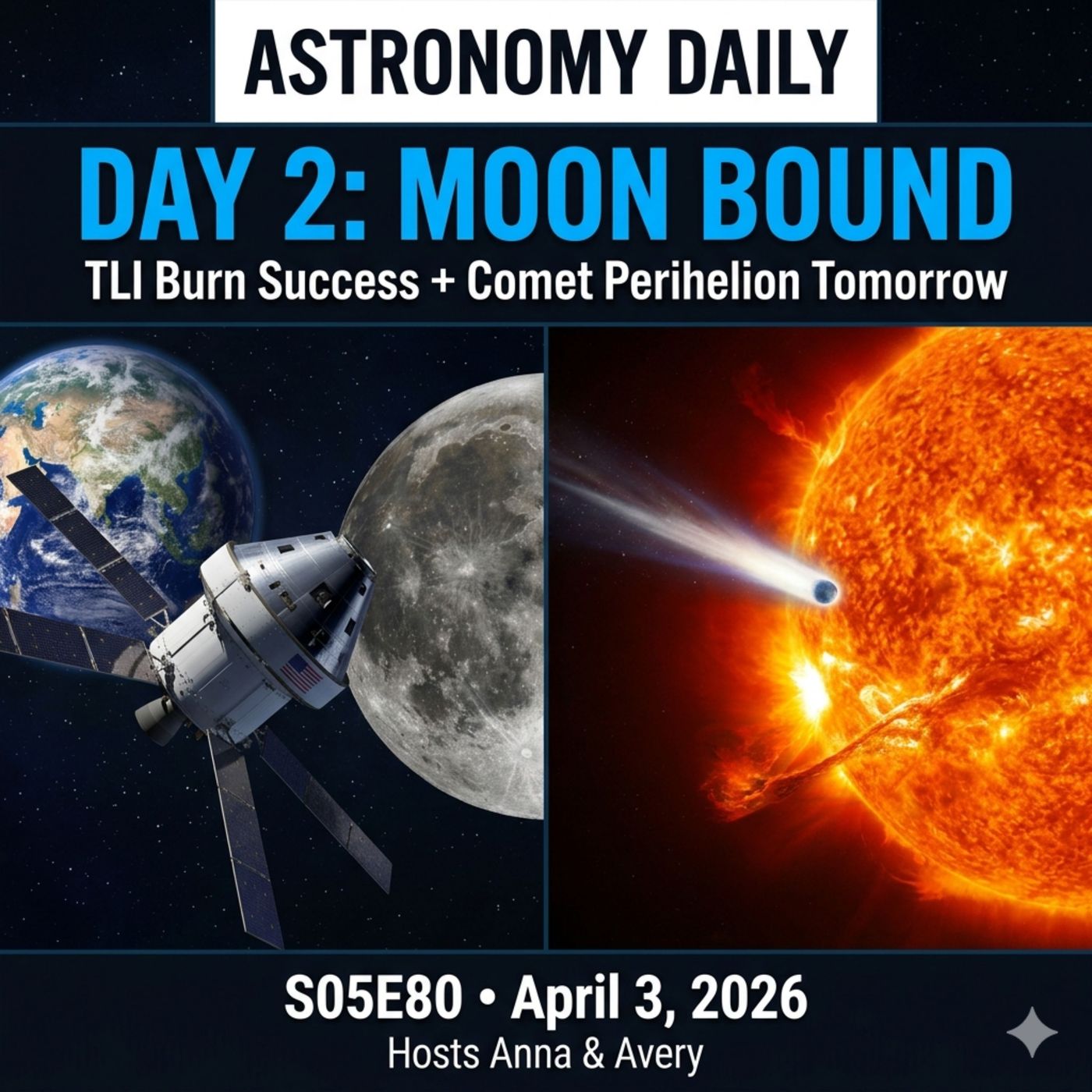
Artemis II Heads to the Moon + Comet Death or Glory + Dark Matter Mystery
In this episode
Astronomy Daily Season 5, Episode 80 — Friday, April 3, 2026 It's Day 2 of the Artemis II mission and the crew is on their way to the Moon after a perfect translunar injection burn. We've also got a comet about to face perihelion, a dark matter mystery deepening, stunning new JWST images, and the escalating fight over the future of our night skies. In today's episode: 🚀 ARTEMIS II — TRANSLUNAR INJECTION BURN: The Orion spacecraft successfully completed its TLI burn on April 2, sending four astronauts toward the Moon for the first time since Apollo 17 in 1972. Canadian astronaut Jeremy Hansen delivered one of the quotes of the year from orbit. 🚽 ARTEMIS II — THE LUNAR LOO: Hours after launch, Orion's toilet malfunctioned. Christina Koch fixed it. This is why test flights exist. ☄️ SUNGRAZER COMET C/2026 A1 (MAPS): Tomorrow, this Kreutz sungrazer passes 161,000 km from the Sun's surface. It could vaporise — or become the most spectacular comet since Ikeya-Seki. Southern Hemisphere watchers: eyes on the western horizon from April 6. 🌌 DARK MATTER-FREE GALAXIES: Yale astronomers have confirmed a third galaxy with essentially no dark matter — NGC 1052-DF9. The 'Bullet Dwarf' collision theory is gaining powerful evidence. 🌟 JWST + W51: The James Webb Space Telescope has revealed hidden young stars in the W51 star-forming region, piercing dust clouds that have blocked our view for decades. ⚠️ NIGHT SKY UNDER THREAT: Reflect Orbital's orbital mirror satellite launches this month. SpaceX wants one million satellites. The astronomical community is fighting back. Find us at: http://astronomydaily.io Follow us: @AstroDailyPod Part of the Bitesz.com Podcast NetworkBecome a supporter of this podcast: https://www.spreaker.com/podcast/astronomy-daily-latest-space-news--5648921/support.
Sponsor Details:
Ensure your online privacy by using NordVPN. To get our special listener deal and save a lot of money, visit www.astronomydaily.io/nordvpn. You'll be glad you did!
Get the best secure and private email on the planet. Stop your Government, google and who knows who else spying on every email you write. Do what we did and use ProtonMail. They beleive in privacy and there are no ads in their business model...yet they still provide a free forever service. Check them out and get out special deal at www.astronomydaily.io/protonmail
Become a supporter of Astronomy Daily by joining our Supporters Club. Commercial free episodes daily are only a click way... Click Here
This episode includes AI-generated content.
Speaker 1: Right now as you're listening to this, four human beings are traveling to the Moon, not orbiting Earth, not docked at the space station, heading to the Moon. And today we're going to tell you everything that's happened in the past twenty four hours because on the Artemis two mission, every hour counts.
Speaker 2: Welcome to Astronomy Daily.
Speaker 1: I'm Avery and I'm Anna. It's Friday, April third, twenty twenty six, and this is Season five, episode eighty strap in. We've got a packed show today.
Speaker 2: Let's start with the big one. Last night, April second, at seven forty nine pm Eastern Time, the Orion spacecraft fired its main engine for five minutes and fifty five seconds. That engine, built by the European Space Agency, produces six thousand pounds of thrust. In that time, it added about nine hundred miles per hour to Orion's velocity, and that was enough enough to escape Earth's gravitational embrace entirely.
Speaker 1: That burn, known as the trans lunar injection or TLI, is the defining moment of any lunar mission. Everything before it is preparation, everything after it is commitment. And the last time mission control performed a TLI with a crew on board was December seventy two, Apollo seventeen, fifty three years ago.
Speaker 2: Mission control Capcom Chris Burge radioed up immediately after the burn, integrity looks like a good burn. Integrity. That's the call sign for the Orion Mule crew module, and the crew responded through Canadian astronaut Jeremy Hansen.
Speaker 1: He said, humanity has once again shown what we are capable of, and it's your hopes for the future that carry us now on this journey around the Moon. I've listened to that quote three times and I'm still getting goosebumps.
Speaker 2: The crew is now on a free return trajectory, meaning lunar gravity will bend their path around the far side of the Moon and slingshot them back towards Earth no additional burns required. On April six, they'll pass within eight thousand kilometers of the lunar surface, getting an unprecedented view of the far side that no crew has seen since Apollo seventeen splashed down in the Pacific. Is targeted for April tenth, and.
Speaker 1: In a lovely touch. Flight Day two started with mission control playing green Light by John Legend and Andre three thousand as the CRU's wake up call, because sometimes the poetry of the moment gets a little help from the playlist.
Speaker 2: Now, while mission control was riding high from the successful TLI burn, there was a slightly less heroic problem to solve a boarder Ryan.
Speaker 1: The toilet broke, specifically the Universal Waste Management System, which is a rather grand name for what is essentially the world's most expensive and complicated toilet twenty three million dollars for context.
Speaker 2: So what went wrong?
Speaker 1: A fan in zero gravity? You can't rely on gravity to pull waste away from the body. That's Earth's job, and there is no Earth up there in that sense. Instead, the toilet uses a powerful airflow to do the job. When the fan controller malfunctioned, the urine system stopped working. The crew could still, how do I put this, use the solid waste side of the system, but the liquid side was out of order.
Speaker 2: Which meant at least one astronaut had to use a backup contingency bag a collapsible contingency urinal to give it its full dignified name. It was later emptied overboard into space, which feels like a very poetic way to leave one's mark on the Cosmos mission.
Speaker 1: Control guided Christina Cock through the repair. She found the blockage, cleared it, and the toilet was back online within about six hours of launch. NASA confirmed it in the early morning hours of April second. The crew's relief was presumably both metaphorical and literal.
Speaker 2: And here's the thing, this is exactly what a test flight is for. Orion's toilet is the first commode ever installed on a crude deep space mission. Apollo astronauts had no toilet at all. They used bags for the entire lunar journey, So even a malfunctioning space toilet represents significant progress, and everything learned from this fix will make future missions better.
Speaker 1: Also worth noting, it's so loud that the crew has to wear ear protection to use it, which raises questions I didn't know I had about the acoustics of deep space plumbing.
Speaker 2: Now, while humans are heading to the Moon, there's something else heading toward our Sun, and tomorrow we'll find out if it survives.
Speaker 1: Pommet C twenty twenty six a one known as Maps, named for the four astronomers who discovered it from the Atacama Desert in Chile back in January. It's a Kreutz Sungrazer which which is a family of comets that all share the same ancient ancestor a massive comet that broke apart roughly eighteen hundred years ago. Some of its descendants have become the most spectacular comets in recorded history. Tomorrow Maps finds out which side of that ledger it falls on.
Speaker 2: Tomorrow, Saturday, April fourth, at around fourteen twenty two, UTC Maps will pass just one hundred and sixty one thousand kilometers from the Sun's surface. That's less than half the distance from the Earth to the Moon. It'll be threading the inner solar corona, the Sun's own atmosphere. At that point, it's traveling through million degree plasma, being subjected to tidal forces that could simply tear it apart.
Speaker 1: So what might we see? Three scenarios. One, it disintegrates before or during perryhillion, and we get nothing or maybe a dusty, headless tail for a few days. Two it survives as a modest object. It's right enough for binoculars or a small telescope emerging from the solar glare around April seventh. Three, the scenario that has the comet community buzzing. It survives and brightens dramatically like its famous cousin Lovejoy did in twenty eleven. In that case, we could be looking at a naked eye comet with a tail stretching ten degrees or more across the Southern Hemisphere sky.
Speaker 2: And for our Australian listeners, you are in prime position. If MAPP survives, look to the western horizon after sunset from April sixth. The Southern Hemisphere gets the best views. We'll have updates in tomorrow's episode. Regardless of the outcome, this is very much a story to watch in the meantime.
Speaker 1: Coronagraphs on the Soho spacecraft and NASA's New Punch mission are watching the Commet right now as it makes its final approach towards the Sun. It's a vigil in its own way.
Speaker 2: Here's a counterintuitive piece of science for you. Finding a galaxy with no dark matter actually makes the case for dark matter stronger. Let me explain.
Speaker 1: I love it when the universe does that.
Speaker 2: A team at Yale University has confirmed that a third galaxy in a group called NNGC one zero five to two appears to essentially have no dark matter at all. It's an ultra diffuse galaxy as wide as the Milky Way, but containing one thousand times fewer stars, making it almost ghostly. Using the Keck Observatory in Hawaii, they measured how fast the stars inside it are moving. In a normal galaxy, stars move quickly because dark matter's gravity is helping hold everything together. In this galaxy, the stars are barely moving.
Speaker 2: There's no dark matter required to explain what's there.
Speaker 1: And this is now the third galaxy in the same region of sky to show the same signature. They're lined up in a trail DF two, DF four, and now DF nine, and the Yale team thinks they know why the.
Speaker 2: Bullet dwarf collision theory two dwarf galaxies collide at enormous speeds bit millions of years ago. Here's the key. Dark matter only interacts through gravity. It doesn't collide, it doesn't stick, so the dark matter halos of both galaxies pass straight through each other like two ghosts walking through the same wall. The gas and stars, however, do interact. They get stripped away, thrown into a trail, and that trail cools and collapses into a string of ultra diffuse dark matter free galaxies.
Speaker 1: Which is exactly what DF two, DF four, and DF nine appear to be, and the reason this strengthens the case for dark matter is that this can only happen if dark matter is a real, separate substance, something that can be physically separated from normal matter. If dark matter were just a modification to our laws of gravity, as some alternative theories suggest, you couldn't separate it like this. The trail of missing dark matter is paradoxically proof that dark matter exists.
Speaker 2: The team is now going after a fourth and fifth galaxy along the same trail the story's building.
Speaker 1: For thousands of years, there have been stars being born in our galaxy that no human eye has ever seen, hidden behind curtains of thick cosmic dust. This week, thanks to the James Webb Space Telescope, we finally got to look behind one of those.
Speaker 2: Curtains, the W fifty one star forming region, about seventeen thousand light years away. A team from the University of Florida pointed JWST's infrared instruments at this region and captured images of unprecedented clarity. Infrared light passes through dust the way X rays pass through skin, revealing structures that optical telescope simply cannot see, and what they found was extraordinary.
Speaker 1: Proto stellar jets, beams of material blasting outward from newly forming stars, bubbles of ionized gas carved out by the radiation of massive young stars, dark filaments of cold gas threading through the region like ink and water, and young stars, some of the most massive in our galaxy still embedded in their birth clouds, having begun forming less than a million years ago. In cosmic terms, that's brand new.
Speaker 2: The lead researcher Tyu put it, simply, because of James Web, we can see those hidden young massive stars forming in the star forming region. By looking at them, we can study their formation mechanisms. And every time the team reviewed the images, Professor Ginsberg said, they found something new and unexpected.
Speaker 1: But here's the detail I think is most striking. When the team compared the JWST images with radio observations from the Alma telescope array, they found that only a small fraction of stars were visible in both, which means that even with the most powerful space telescope ever built, there are still stars so deeply embedded in dust that only radio waves escape. The universe still has hiding places that JWST alone cannot reach.
Speaker 2: Let's close with a story that's been building for months, and this week it moved from debate to imminence.
Speaker 1: As we reported earlier this week, a California startup called reflect Orbital is preparing to launch its first demonstration satellite, erindill one, potentially as early as this month. When it reaches orbit, it will unfold a mirror the size of a small building eighteen meters by eighteen meters, and when that mirror is in the right position, it will cast a beam on the ground that's as bright as the full moon.
Speaker 2: Their business model is sunlight on demand. Solar farms could stay operational after dark, greenhouses could get extended. Light cities could theoretically be illuminated from orbit. If reflect Orbital gets to its target of fifty thousand mirrors, those mirrors would outnumber every star visible to the naked eye by a factor of more than five.
Speaker 1: And that's before we get to SpaceX. In January, SAX filed with the FCC for permission to launch up to one million satellites orbital data centers for artificial intelligence one million. There are currently around fifteen thousand active satellites in Earth orbit. SpaceX wants to increase that number by roughly seventy times.
Speaker 2: The response from the scientific community has been unified and urgent. The International Astronomical Union, the European Southern Observatory, the Royal Astronomical Society all have filed opposition. A study published in Nature last December found that if all currently proposed constellations are launched, one third of Hubble space telescope images would be contaminated. Base based telescopes could have more than ninety six percent of their exposures affected.
Speaker 1: The FCC comment periods have closed, but Dark Sky International is continuing the fight with open letters to both SpaceX and reflect Orbital calling for a pause and a full environmental review before any launches proceed. We'll link to those letters in the show notes.
Speaker 2: For our listeners. In Australia and across the Southern Hemisphere, you live under some of the darkest, most spectacular skies on Earth. The Milky Way that stretches overhead in a clear night in the outback, the Magellanic clouds that our Northern Hemisphere friends rarely get to see. These are part of your natural heritage and they are worth fighting for.
Speaker 1: What a Friday. Humans on the way to the Moon, a comment about to face judgment from the Sun, ancient cosmic collisions, solving dark matter mysteries, hidden stellar nurseries revealed, and the future of the night sky hanging in the balance.
Speaker 2: Tomorrow's episode is going to be big. We'll have the outcome of comet maps, Perihelion, and the next Artemis milestone as the crew continues their journey toward the Moon.
Speaker 1: If you're enjoying Astronomy Daily, please subscribe, leave us a review, and share us with someone who looks up at the sky and wonders. Find us at Astronomy Daily dot m and on social media at astro Daily Pod. I'm avery keep looking up and I'm anna clear skies everyone, And if you're in the southern Hemisphere, check the western horizon after sunset this weekend. Something might be waiting for you.
Speaker 2: Sunny day stars to start all

 Apple Podcasts
 Spotify
 Pocket Casts
 Castbox
 Overcast
 Podbean
 iHeartRadio
 Castro
 Goodpods
 Moon FM
 Podcast Addict
 Podcast Republic
 YouTube