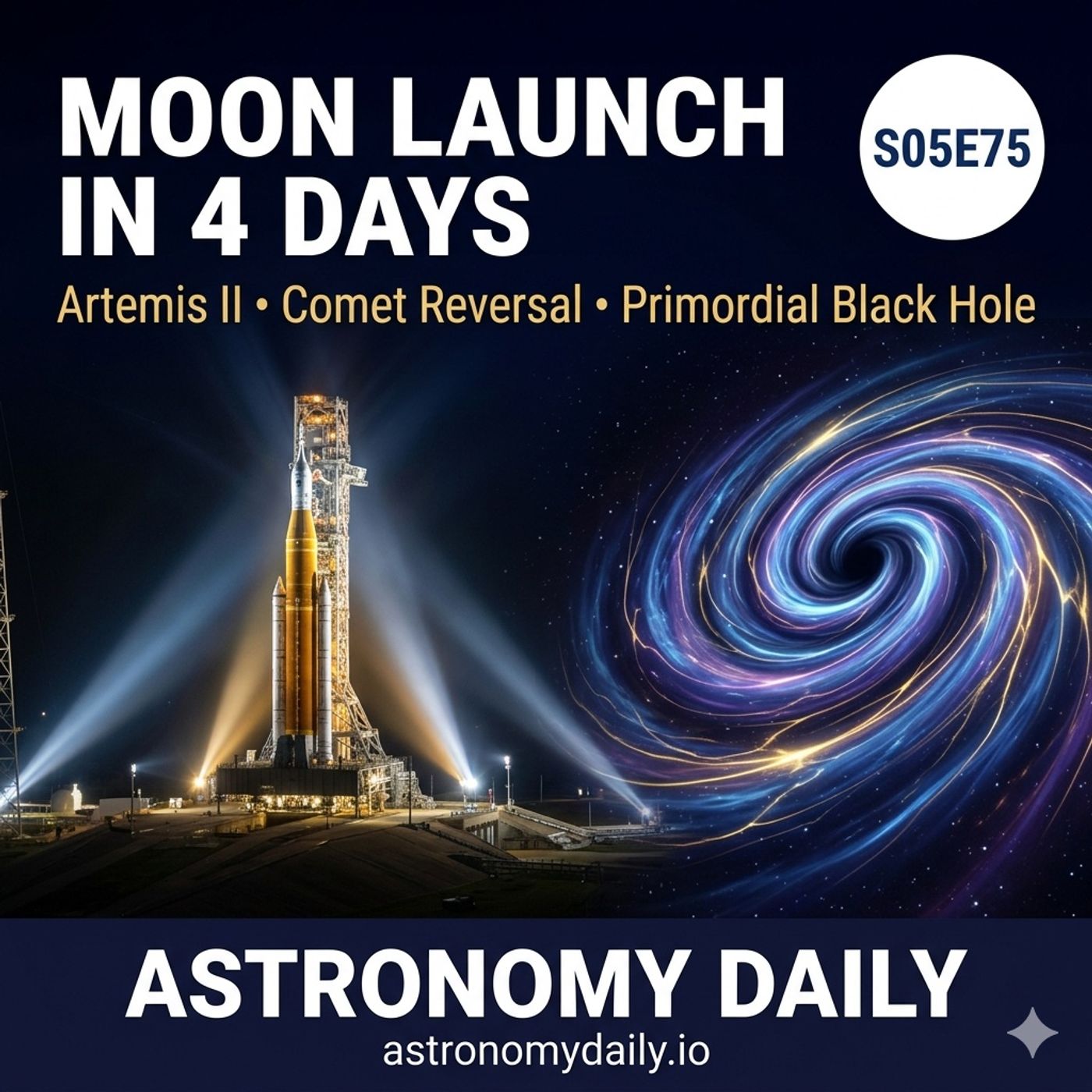
Countdown to the Moon: Artemis II Launch Week Begins | Plus Comet Reversal & ISS Medical Mystery Update
In this episode
Episode S05E75 — Saturday, 28 March 2026 | astronomydaily.io | @AstroDailyPod 🚀 Story 1: Artemis II Crew Arrives at Kennedy Space Center The four-person crew of NASA's Artemis II mission — Commander Reid Wiseman, Pilot Victor Glover, Mission Specialist Christina Koch (NASA), and Mission Specialist Jeremy Hansen (CSA) — arrived at Kennedy Space Center on Friday, March 27, 2026, ahead of a planned April 1 launch. The 10-day mission will fly the crew around the Moon and back to Earth — the first crewed lunar mission since Apollo 17 in 1972. Launch window: 6:24 PM EDT, April 1–6, 2026. Sources: NASA.gov, Space.com, AP, Orlando Sentinel ☄️ Story 2: Hubble Detects First-Ever Spin Reversal of a Comet A new study in The Astronomical Journal reveals that comet 41P/Tuttle-Giacobini-Kresák reversed its direction of rotation — a first in observational astronomy. Gas jets acting as thrusters slowed the comet's spin and flipped it into a new direction. The comet's nucleus measures just 1 km across. Researchers warn the rapid new spin could lead to the comet's disintegration. Source: NASA Science / Space Telescope Science Institute, March 26, 2026 🌑 Story 3: LIGO Signal May Be a Primordial Black Hole A November 2025 LIGO detection of a gravitational wave signal from an object with less than one solar mass — impossible through stellar evolution — may be evidence of a primordial black hole formed in the Big Bang's first moments. A new University of Miami study in The Astrophysical Journal finds the detection consistent with primordial black hole models and suggests these objects could help explain dark matter. Source: Universe Today / University of Miami, March 27, 2026 ⭐ Story 4: IXPE Delivers New Portrait of Oldest-Known Supernova NASA's IXPE (Imaging X-ray Polarimetry Explorer) has produced a new X-ray image of supernova remnant RCW 86 (SN 185) — the oldest recorded supernova, first observed by Chinese astronomers in 185 AD. Combined with Chandra and XMM-Newton data, the image reveals the remnant's expansion has slowed at the edge of a low-density cavity, producing a reflected shock. Source: NASA / Phys.org, March 25–27, 2026 🏥 Story 5: Mike Fincke Speaks About His ISS Medical Emergency NASA astronaut Mike Fincke has given his first detailed account of the January 7, 2026 medical event that led to the first-ever medical evacuation from the International Space Station. In an AP interview, Fincke revealed he lost the ability to speak for approximately 20 minutes while eating dinner. Doctors have ruled out a heart attack but the cause remains unknown. The incident ended Crew-11's mission early, returning Fincke, Zena Cardman, Kimiya Yui, and Oleg Platonov to Earth on January 15. Source: Associated Press / Phys.org, March 27, 2026 ☀️ Story 6: Solar Activity — AR4403 Flares, Possible CME March 29 Sunspot region AR4403, which rotated into view on March 26, produced an M3.9 solar flare causing a minor radio blackout over the Indian Ocean. Conditions are quiet on March 28, but space weather forecasters expect a co-rotating interaction region and coronal hole high-speed stream to arrive March 29, bringing unsettled geomagnetic conditions and possible aurora visibility at mid-latitudes. Southern Hemisphere observers in Australia and New Zealand should watch Sunday–Monday nights. Source: EarthSky / The Sun Today, March 27, 2026Become a supporter of this podcast: https://www.spreaker.com/podcast/astronomy-daily-latest-space-news--5648921/support.
Sponsor Details:
Ensure your online privacy by using NordVPN. To get our special listener deal and save a lot of money, visit
Speaker 1: Four astronauts, one rocket, four days until launch. History is about to be made.
Speaker 2: And if you think that's the only jaw dropping story in space today, wait until you hear about a comment that literally stopped spinning and started going the other way.
Speaker 1: I'm Anna, I'm Avery, and this is Astronomy Daily, your daily guide to everything happening in space and beyond. Welcome to Season five, Episode seventy five.
Speaker 2: Let's get started, then, all right, let's.
Speaker 1: Start with what is, without a doubt, the biggest human spaceflight story in more than fifty years. The crew of NASA's Artemis two mission has arrived at Kennedy Space Center in Florida, and the countdown is well and truly on.
Speaker 2: That's right. Yesterday, Friday, the twenty seventh, NASA astronauts Reed Weisman, Victor Glover, and Christina Coach, along with Canadian Space Agency astronaut Jeremy Hansen, touchdown at Ken's Shuttle landing facility in their T thirty eight jets. Arriving from Johnson Space Center in Houston. They were greeted by NASA Administrator Jared Isaacman and a crowd of reporters that was, by all accounts, the largest anyone had seen for an astronaut arrival in a very long time, and.
Speaker 1: The energy was electric. Avery Commander Reid Wiseman stepped out onto the runway, pumped his fists and said, and I'm quoting here, Hey, let's go to the Moon.
Speaker 2: That says it all, really, it really does. So the plan launches schedules for no earlier than six point twenty four in the evening Eastern Time on Wednesday, April to first I know, April Fool's Day, but this is no joke. The window stays open until April six, giving the team a six day buffer, but mission managers are pushing hard for that first opportunity.
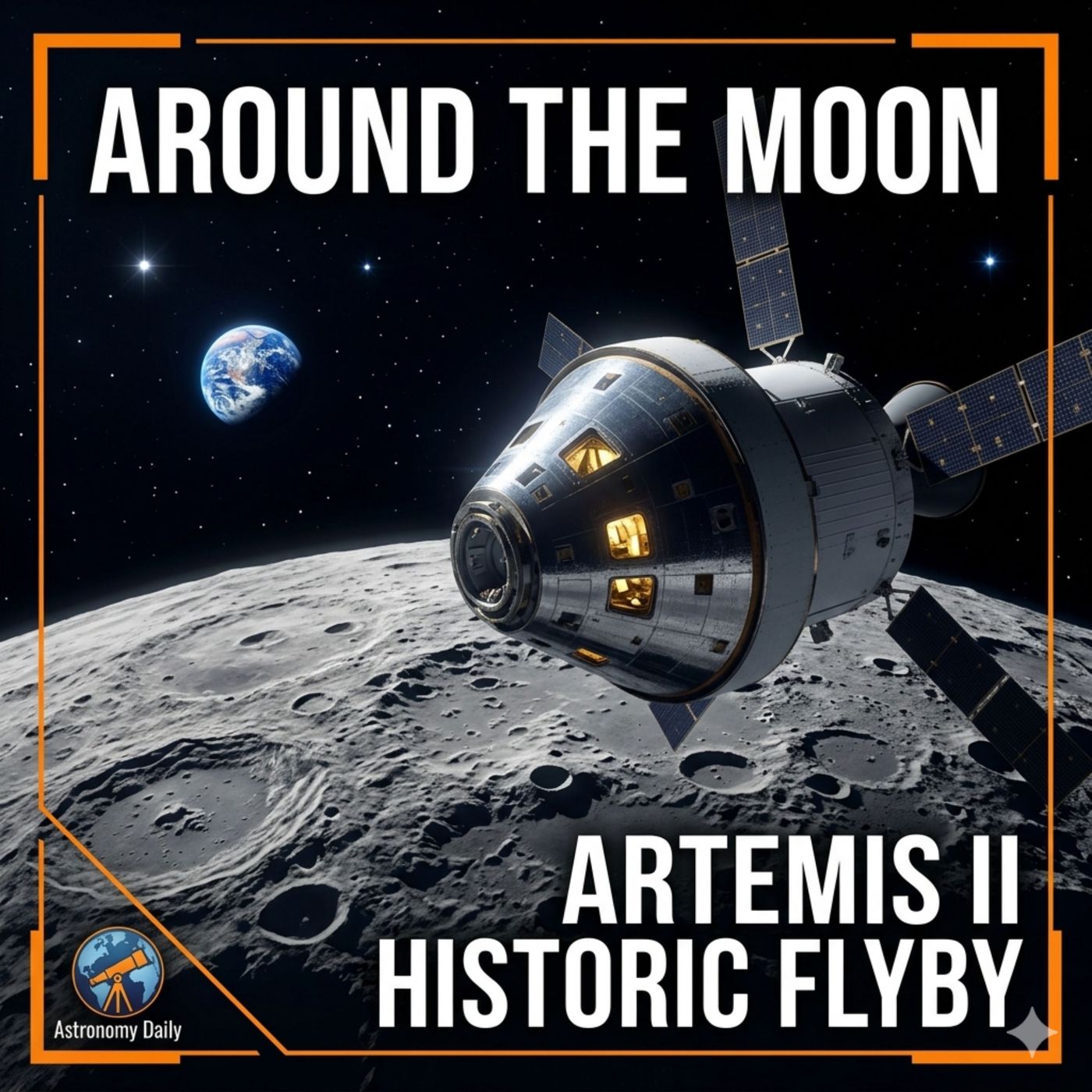
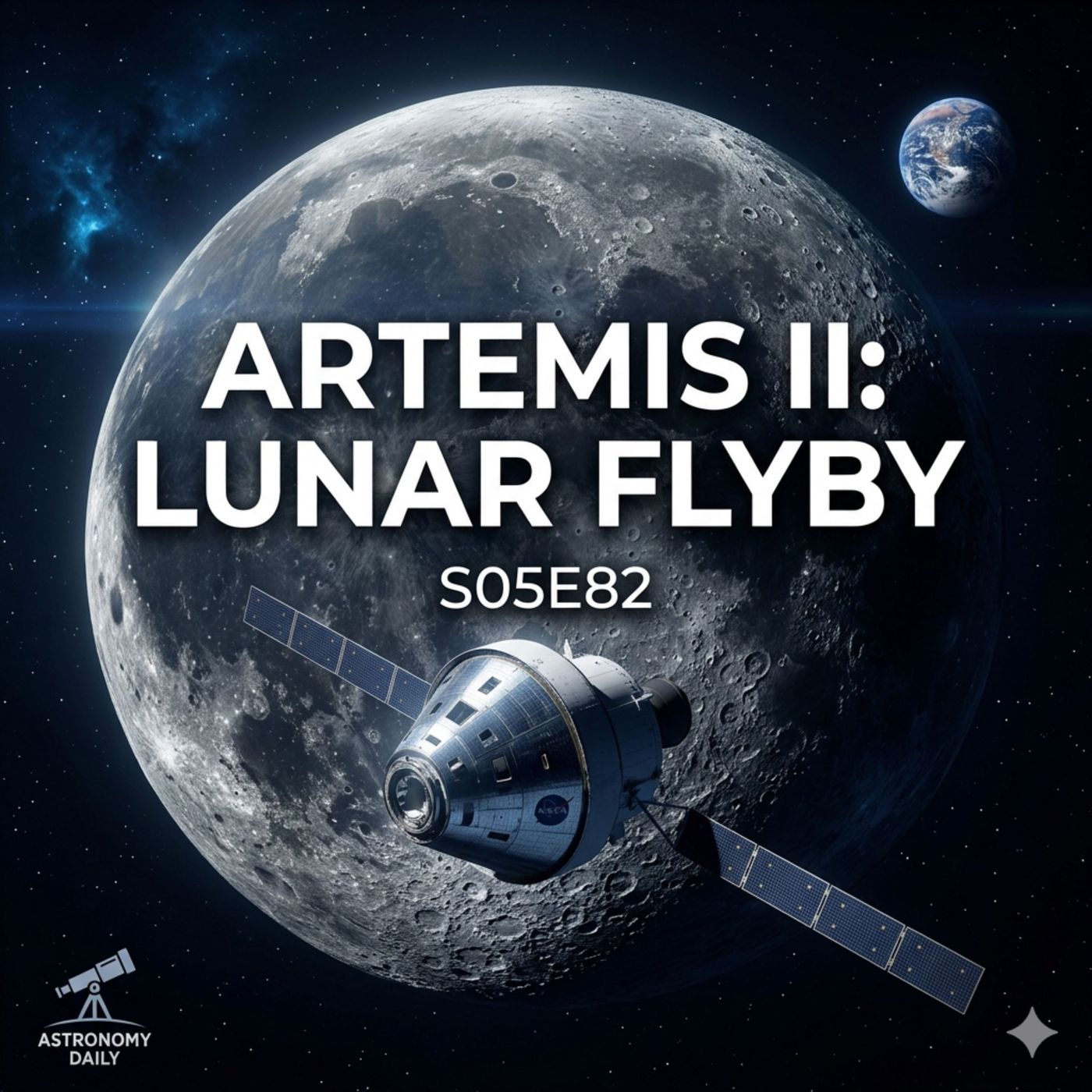
Speaker 1: And the mission itself. Artemis two will send all four crew members on a ten day journey around the Moon and back to Earth the board NASA's Oryan's spacecraft, launched on top of the Space Launch System, the most powerful operational rocket in the world. They won't land on the Moon, that's Artemis three's job, but they will fly farther from Earth than any human has ever been. The Apollo thirteen record set back in nineteen seventy will be broken.
Speaker 2: The crew are now in quarantine at Kennedy's spending their final days reviewing mission procedures, completing medical checkups, and spending precious time with family. The countdown clock is set to begin ticking at four forty four pm on Monday, and from that point it's all systems go. For anyone who watched the Apollo missions as a child, or who has simply dreamed of humanity returning to the Moon, this is the week we've been waiting for.
Speaker 1: We will absolutely be following this one closely over the coming days on Astronomy Daily and for our listeners down under in Australia and across New Zealand. April the second is your morning to set those alarms.
Speaker 2: Now from the Moon to a tiny snowball tumbling through our inner solar system. And when I say tiny, I mean it. Comet forty one p formally known as Tuttle Jacobeanie Krizak, measures just one kilometer across, about three times the height of the Eiffel Tower.
Speaker 1: And yet this little cosmic wanderer has just done something that scientists have never in all of recorded astronomical history observed before it reversed its spin.
Speaker 2: That's right. A new study published this week in the Astronomical Journal based on observations from NASA's Hubble space telescope, reveals that Comet forty one P first dramatically slowed its spin, nearly came to a complete stop, and then started going the other way. Researchers describe it as a kind of merry go round effect. The comet's own outgassing jets, dreams of gas blasted off its surface as it heats up near the sun were pushing against its spin so hard that they eventually flipped it.
Speaker 1: To give you a timeline, back in March twenty seventeen, the comet was spinning at a regular pace. By May twenty seventeen, Swift observatory data showed it had slowed to three times that rate, And then when Hubble took a look in December twenty seventeen, the comet was spinning fast again, but in the opposite direction. The whole reversal had happened within months.
Speaker 2: Now here's the twist, and it's a sobering one. Study author David Jewett of UCLA says that because the comet is now spinning so rapidly in its new direction, centrifugal forces could overcome the comet's own weak gravity and his conclusion quote, I expect this nucleus will very quickly self destruct. We may be witnessing the final chapter of Comet forty one p's long life.
Speaker 1: Which makes these observations all the more remarkable. The comet is thought to have been in its current orbit for around fifteen hundred years, and in one close pass the Sun, we got to watch it undergo a transformation that would normally take centuries in just a matter of months. Hubble really never stops delivering the goods. Story three takes us to one of the deepest mysteries in modern cosmology and potentially one of the most significant detections in the history of gravitational wave astronomy.
Speaker 1: Back in November last year, Igo, the Laser Interferometer Gravitational Wave Observatory picked up a signal that stopped researchers cold. The gravitational wave appeared to come from a merger event involving at least one object that waved less than a single solar mass. And here's why that matters. Through all known processes of stellar evolution, that simply shouldn't be possible. Regular black holes form from dying stars, and the minimum mass for that is a few times our sun, So what was it?
Speaker 2: Well? This week, astro physicist Nico Cappeluti and Alberto Magarahia from the Universe Verity of Miami published the compelling answer in the Astrophysical Journal. Their conclusion, it may be a primordial black hole, an object formed not from a collapsing star but from the unimaginable density of the universe itself in the first fraction of a second after the Big Bang.
Speaker 1: Primordial black holes are one of the most tantalizing concepts in theoretical physics. They could range from microscopic to enormous, and crucially, they are one of the most compelling candidates for dark matter, the invisible substance that makes up roughly eighty five percent of all matter in the universe. We can see dark matter's gravitational effects everywhere we look, but we have never directly detected it. A confirmed primordial black hole detection would transform our understanding of the cosmos.
Speaker 2: Overnight, the Miami team modeled how many primordial black holes should exist, how often they should merge, and how frequently LIGO should detect them, and remarkably, the numbers lined up one rare detection events exactly as their theory predicts, it's not confirmation. One signal is suggestive, not conclusive, but it is a genuinely thrilling lead to follow. Escappelluti himself put it, the most plausible explanation for the LGO signal, which lacks any conventional astrophysical explanation, is the detection of a primordial black hole.
Speaker 1: Next generation detectors, including the space based LISA mission planned for the twenty thirties and the ground based Cosmic Explorer ten times more sensitive than LIGO, will hopefully shed more light on this.
Speaker 2: For now, we may have just.
Speaker 1: Received our first signal from the dawn of time itself.
Speaker 2: Here's a story that bridges ancient human history and cutting edge astronomy. In the year one eighty five AD, Chinese astronomers recorded a strange new star appearing in the sky, one that would remain visible for up to eight months. They called it a guest star. What they had actually witnessed was one of the earliest supernova explosions ever recorded by humanity.
Speaker 1: Fast forward eighteen hundred years, and that same ancient explosion, now known as supernova remnant RCW eighty six or SN one eight five, has just been given its most detailed examination yet. NASA's IXPE mission, the Imaging X Ray polar Imagery Explorer, has delivered a breath taking new image of the remnant's outer edge, combining its unique X ray polarimetry data with observations from NASA's Chandra Observatory and the European Space Agency's XMM Newton telescope.
Speaker 2: So what did they find? IXPE targeted the outer rim of the remnant, highlighted in a vivid purple ring in the new image, and discovered something fascinating. The expanding shell of superheated gas, which had been blasting outward at tremendous speed for two thousand years, appears to have stopped at the edge of a large, low density cavity that surrounded the original star. In other words, the explosion ran into a wall, and the new data helps explain why the remnant expanded so much faster than astronomers initially expected.
Speaker 1: IXPE achieves this by studying the polarization of X rays, essentially how those high energy light waves are oriented as they travel through space. It's a technique that opens a completely new window on the behavior of exploding stars, black holes, and pulsars. The resulting composite image with yellow for low energy X rays, blue for high energy, and the purple ixpe data overlaid is genuinely one of the most beautiful things you'll see in Space Science this week. We'll have a link in the show notes.
Speaker 2: There's something deeply moving about this story. A star that humans watched die with the naked eye two millennia ago, recorded by diligent observers in ancient China, is still revealing its secrets. Today Science is a very long conversation.
Speaker 1: Story five brings us a story that's both deeply human and profoundly relevant to the future of space exploration, and it connects directly to our lead story today about Artemis two.
Speaker 2: Earlier this year, you may recall, NASA made headlines when it announced that the Crew eleven mission aboard the International Space Station was being cut short due to a medical concern. The agency initially declined to name the astronaut involved, but in late February, veteran astronaut Mike think, a four time spaceflyer and retired US Air Force colonel, came forward at his own request to confirm that he was the person affected.
Speaker 1: And this week, for the first time, Fink spoke in detail about what actually happened in an exclusive interview with the Associated Press conducted from Houston's Johnson Space Center. The account is extraordinary.
Speaker 2: Think says he was eating dinner on January seventh, the evening before a planned spacewalk, when it suddenly hit. He lost the ability to speak. He felt no pain. The episode lasted around twenty minutes. His crewmates, seeing him in distress, immediately contacted flight surgeons on the ground. It was completely out of the blue, he told the AP. It was just amazingly quick.
Speaker 1: NASA used the station's ultrasound machine during the event, which Fink credits as genuinely useful, and his condition quickly stabilized. But NASA's medical team determined that the safest course of action was an early return to Earth so that Fink could access advanced medical imaging not available on the ISS. NASA canceled the following day's spacewalk, and on January fifteenth, Fink and his three crewmates, Zena Cardman, Kimiya Yui, and Oleg Platanov splashed down in the Pacific Ocean, about a month ahead of schedule.
Speaker 1: Here's the part that is both remarkable and sobering. As of this week, doctors still do not know what caused it. A heart attack has been ruled out, but the precise nature of the event, whether neurological, cardiovascular, or something else, entirely remains undiagnosed. NASA is now reviewing astronaut medical records to determine whether anything similar has occurred in space before, potentially without being recognized. And here's why this matters so much right now, with Artemis two five days from launch on the ISS, if something goes wrong medically, astronauts could be home within hours on a ten day lunar mission, and certainly on any future mission to Mars, that option doesn't exist.
Speaker 1: The Fink incident has become a landmark moment for space medicine, prompting urgent conversations about what medical capabilities need to exist on deep space vehicles. Think himself framed it with characteristic composure. Spaceflight is an incredible privilege, and sometimes it reminds us just how human we are.
Speaker 2: And Mike Fank says he feels fine now and is continuing routine post flight conditioning at Johnson's Space Center. We wish him a far and swift recovery, and we salute the crew and the medical teams who got everyone home safely.
Speaker 1: And finally, eyes on the sun, because our nearest star has been putting on a show this week.
Speaker 2: That's right. A new sunspot region designated AR four to four zero three rotated into view on the eastern solar limb on March twenty sixth, and it wasted no time making its presence felt. Within hours of coming into view, AR four to four zero three unleashed the powerful M three point nine solar flare at six' ELEVEN, utc triggering AN r one that's a minor radio blackout over The Indian.
Speaker 1: Ocean now the good, news as of, Today saturday the twenty, eighth the sun is relatively. QUIET ar four to four zero three has calmed after its initial, outburst and space weather forecasters are expecting mostly quiet conditions through. Today but there's a, catch and it's worth noting for our listeners who Love aurora.
Speaker 2: Watching From sunday the twenty, ninth a co rotating interaction, region a dense zone of compressed solar, wind along with a high speed stream from a coronal hole are expected to arrive At earth and a faint coronal mass ejection from the recent activity could also graze our planet's magnetic. Field around that, Time face weather forecasters are predicting unsettled geomagnetic conditions which, could in favorable, circumstances push auroras to slightly lower latitudes than.
Speaker 1: Usual so for our listeners In Southern, Australia tasmania And New, zealand particularly those of you with dark skies away from city, Lights sunday And monday nights are worth. Watching check your local aurora alert, apps keep an eye to the south and fingers crossed for clear, skies and if you capture anything, spectacular we love to see. It Hag us at Astro Daily, Pod.
Speaker 2: We'll be keeping an eye on developments and may have an update In monday's episode if conditions.
Speaker 1: Escalate and that is a wrap on an absolutely packed edition Of Astronomy. Daily to recap what we covered, today The artemis two crew has landed At Kennedy's Space center With april first launch in their. Sights hubble has documented the first ever spin reversal of a comet and that comment may be on borrowed. Time igo may have detected a black hole born at the dawn of the universe. Itself Nasays ixpe telescope gave us the finest portrait yete of a super nova first seen by human. Eyes in one eight FIVE, ad Astronaut Mike finke spoke for the first time about his still mysterious medical emergency in, orbit and the sun is stirring with possible aurora opportunities on the way For Southern hemisphere.
Speaker 2: Skywatchers what an extraordinary time to be alive and looking. Up if you're Enjoying Astronomy, daily please, subscribe leave us a, review and share the show with anyone in your life who loves the cosmos as much as we. Do you can find us At Astronomy daily dot, com io and across all platforms at Astro Daily.
Speaker 1: Pod Until, Monday keep looking, up.
Speaker 2: Clear, skies, Everyone sunny day star is so star is

 Apple Podcasts
 Spotify
 Pocket Casts
 Castbox
 Overcast
 Podbean
 iHeartRadio
 Castro
 Goodpods
 Moon FM
 Podcast Addict
 Podcast Republic
 YouTube