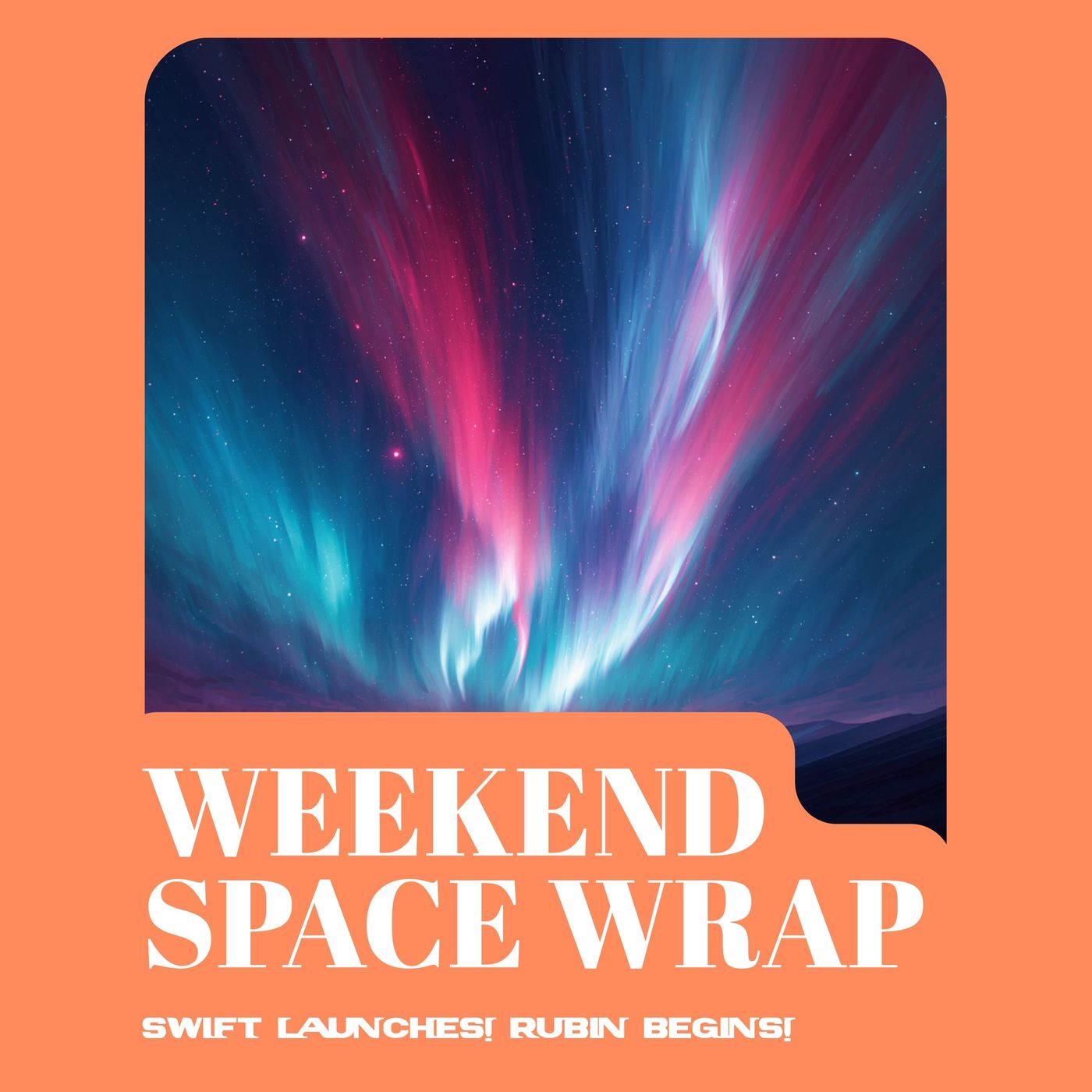
Cosmic Fireworks, Mars Meets Uranus, and the Dawn of a New Era in Astronomy
In this episode
Astronomy Daily — S05E132 — Weekend Space and Astronomy News Wrap — Saturday, July 4, 2026 It's the Fourth of July weekend edition of Astronomy Daily! This week's wrap covers the successful launch of the Swift rescue mission after a week of delays, the historic start of the Vera C. Rubin Observatory's decade-long sky survey, an aurora-triggering geomagnetic storm timed for the holiday weekend, a promising nearby habitable-zone super-Earth, a brand new James Webb 'cosmic fireworks' image released for America's 250th birthday, and a rare ultra-close conjunction between Mars and Uranus visible before dawn today. In this episode: • Swift Boost mission: LINK spacecraft launches successfully on the final flight of Pegasus XL • Vera C. Rubin Observatory begins its 10-year Legacy Survey of Space and Time from Chile • G2–G3 geomagnetic storm watch brings aurora chances for the July 4 weekend • Recap: GJ 3378 b, a potentially habitable super-Earth just 25 light-years away • JWST releases new 'cosmic fireworks' image of the FS Tau star system for America 250 • Mars and Uranus in an extremely close conjunction, visible before dawn today Links & sources: • science.nasa.gov/blogs/swift — Swift Boost mission updates • rubinobservatory.org — Vera C. Rubin Observatory LSST • swpc.noaa.gov — NOAA Space Weather Prediction Center aurora forecasts • science.nasa.gov/missions/webb — James Webb Space Telescope FS Tau image release • space.com/stargazing — Mars-Uranus conjunction viewing guideBecome a supporter of this podcast: https://www.spreaker.com/podcast/astronomy-daily-latest-space-news--5648921/support.
Sponsor Details:
Ensure your online privacy by using NordVPN. To get our special listener deal and save a lot of money, visit www.astronomydaily.io/nordvpn. You'll be glad you did!
Get the best secure and private email on the planet. Stop your Government, google and who knows who else spying on every email you write. Do what we did and use ProtonMail. They beleive in privacy and there are no ads in their business model...yet they still provide a free forever service. Check them out and get out special deal at www.astronomydaily.io/protonmail
Become a supporter of Astronomy Daily by joining our Supporters Club. Commercial free episodes daily are only a click way... Click Here
This episode includes AI-generated content.
Anna: Welcome to Astronomy Daily, your source for the latest space and astronomy news. I'm Anna. Avery: And I'm, um, avery. It's Saturday, July 4, 2026. Happy Independence Day to everyone celebrating today. And welcome to our weekend space and astronomy news wrap. Anna: That means we're doing things a little differently today. We've got four of the biggest stories from the past five days, plus two brand new stories to keep things fresh. Avery: And what a week it's been. We've got a rescue mission that finally got off the ground, a telescope in Chile that just changed the game for astronomy.
A, ah, geomagnetic storm timed perfectly for the holiday weekend, and a very close encounter between Mars and Uranus happening literally today. Anna: Plus, uh, NASA's given us the perfect Fourth of July present. Cosmic fireworks courtesy of the James Webb Space Telescope. Avery: Let's get into it. Anna: Let's start with the story we've been following all week. And finally some good news. The Swift Boost mission has finally successfully launched. Avery: After weather scrubs and then that software navigation issue that aborted Thursday's attempt, Catalyst Space's Link spacecraft got away clean Early Friday morning, 4:36am Eastern Time on a Northrop Grumman Pegasus XL rocket release from the Stargazer aircraft over Kwajalein Atoll in the Marshall Islands.
Anna: And there's a bit of history in this launch too. That was the very last flight of the Pegasus rocket. Full stop. End of an era for that vehicle. Avery: It really is now. Link isn't just going to zip up and grab Swift straight away. It's got two to three weeks of careful observation ahead of it, sizing up the observatory to find the best spot to grapple onto it. Anna: Right. Swift, uh, wasn't built to be serviced, so this is delicate work. Once Link picks its grab point and secures Swift with its three robotic arms, it'll fire up gentle ion thrusters and spend several months slowly raising the pair back to a safe orbit.
Avery: If it works, it'll be the first time a commercial spacecraft has ever captured a government satellite that was never designed to docking. No pressure, Link. Anna: After the week it's had just getting off the ground, I, uh, think it's earned a little confidence. We'll keep tracking this one as it approaches Swift in the coming weeks. Avery: Story two is genuinely one of the biggest moments in astronomy. This year. The Vera C. Rubin Observatory in Chile has officially begun its 10 year legacy survey of space and time.
Anna: This has been three decades in the making. Rubin sits atop Cerro Pachon and it's using the largest digital camera ever built. 3200 megapixels to photograph the entire southern sky every few nights. Avery: Every single image captures a patch of sky about 45 full moons wide, and the camera snaps a new one roughly every 40 seconds. Over 10 years, it's expected to catalog around 17 billion stars and 20 billion galaxies. Anna: And because it's revisiting the same patches of sky over and over, it'll build up what astronomers are calling a time lapse movie of the universe, catching supernovae, asteroids, and anything else that moves, brightens, or fades practically as it happens.
Avery: One of the project leads called it the end of a 30 year wait. And for anyone down here in the Southern Hemisphere, it's worth remembering. This is very much our sky. Anna: Rubin's watching a proud moment for Chile and for astronomy generally. This is going to keep producing headlines for a decade. Next up, if you've been outside the last couple of nights, you might already know about this one. That x1.1 solar flare from earlier in the week has triggered a, uh, proper geomagnetic storm. Avery: NOAA Space Weather Prediction center has forecasted G2 to possibly G3 class storming across July 3rd and into today July 4th, thanks to a series of coronal mass ejections arriving in close succession in the Northern Hemisphere.
Anna: That's put the aurora view line unusually far south parts of Montana, North Dakota, Minnesota, even as far as Kansas or Maryland if things get feisty. Avery: And for us in the Southern Hemisphere, storms of this strength can bring the aurora, uh, Australis into view, too. Worth keeping an eye on the southern horizon tonight if you're away from city lights. Anna: Just a reminder, the key thing to watch is the BZ component of the interplanetary magnetic field. When it swings south, that's when the show really gets going.
Avery: So tonight might just serve up fireworks in the sky as well as on the ground. Not a bad way to spend Independence Day if you're one for celebrating. Story four is a quick recap for anyone who missed Friday's episode because it's too big a story. Not to mention, in a weekly wrap, Anna: astronomers led by A team at UH UC Irvine have confirmed GJ3378b, a super Earth orbiting a small red dwarf just 25 light years from us, sitting right in the star's habitable zone. Avery: It's got a minimum mass a bit over twice Earth's, and it receives almost the same amount of starlight we do.
That's about as close to an Earth analog as these things get in terms of energy balance. Anna: The next step is figuring out whether it actually has an atmosphere. That's what would let scientists start hunting for biosignatures or liquid water. But even without that confirmation yet, it's a genuinely exciting addition to the short list of nearby potentially habitable worlds. Avery: One of the researchers put it nicely. The line between habitability and desolation might be thinner than we think.
We'll be watching for follow up observations Anna: now for one of our fresh news stories today. And it's got perfect timing. NASA has released a brand new James Webb image just in time for America's 250th birthday. Avery: This one shows the FS TAO system about 450 light years away in Taurus, and it is dripping with what NASA itself is calling cosmic fireworks. Background galaxies bursting into view and the cluster of young protostars lighting up the frame. Anna: The protostars themselves are only 1 to 3 million years old babies in star terms.
One of them, Fstau B, is throwing off outflows of gas and dust that have carved these striking light blue ridges into the surrounding cloud. Avery: Those ridges show up because the outflows compress the material and it starts reflecting light from the nearby protostar. Basically, the baby star is redecorating its nursery on its way out the door. Anna: It's a gorgeous image and a lovely bit of cosmic timing from NASA. Infant stars asserting their independence released right on America's 250th. Avery: We'll have the image linked in the show notes so you can see it for yourself.
It's worth a look. And in other news today, a ah, genuine sky watching event happening right now. Mars and Uranus are as close together in our sky as they've been in decades. Anna: The closest approach is calculated for around 6am UTC today, July 4, when the two planets will be separated by only about 6 arcminutes. For comparison, that's roughly half the separation between Mizar and Alcor in the Big Dipple's handle. Avery: Mars is easy. A uh, steady reddish point low in the east northeast before dawn, sitting between the Pleiades and Hyades star clusters.
Uranus is the hard part since it's about 60 times fainter. Anna: The trick is to use Mars as your guide star point binoculars or a small scope at Mars, then look just above it for a tiny greenish dot. That's Uranus. Avery: Best viewing is around 3:30-4:00am local time wherever you are with a clear eastern horizon. And because this is a sky events rather than a location specific one, it's visible from both hemispheres. So this one's for everybody wherever you're Anna: listening from a lovely quiet way to bookend a day that's going to be full of noise and fireworks for a lot of our listeners.
Avery: That wraps up this week's Astronomy Daily weekend wrap. A rescue mission finally underway, a new era of sky surveying begun, an aurora show on offer, a promising new world next door, and two fresh stories bookending Independence Day with fireworks both cosmic and real. Anna: Whatever you're doing today, we hope you get a clear sky tonight, whether you're watching for aurora, hunting down Uranus next to Mars, or just enjoying the fireworks down here on Earth. Avery: I'm, um, Avery. Anna: And I'm Anna.
Thanks for listening to Astronomy Daily. Clear skies, everyone. And happy 4th of July to our North American listeners. Mhm.
You stories we told.
 Apple Podcasts
 Spotify
 Pocket Casts
 Castbox
 Overcast
 Podbean
 iHeartRadio
 Castro
 Goodpods
 Moon FM
 Podcast Addict
 Podcast Republic
 YouTube