In this episode
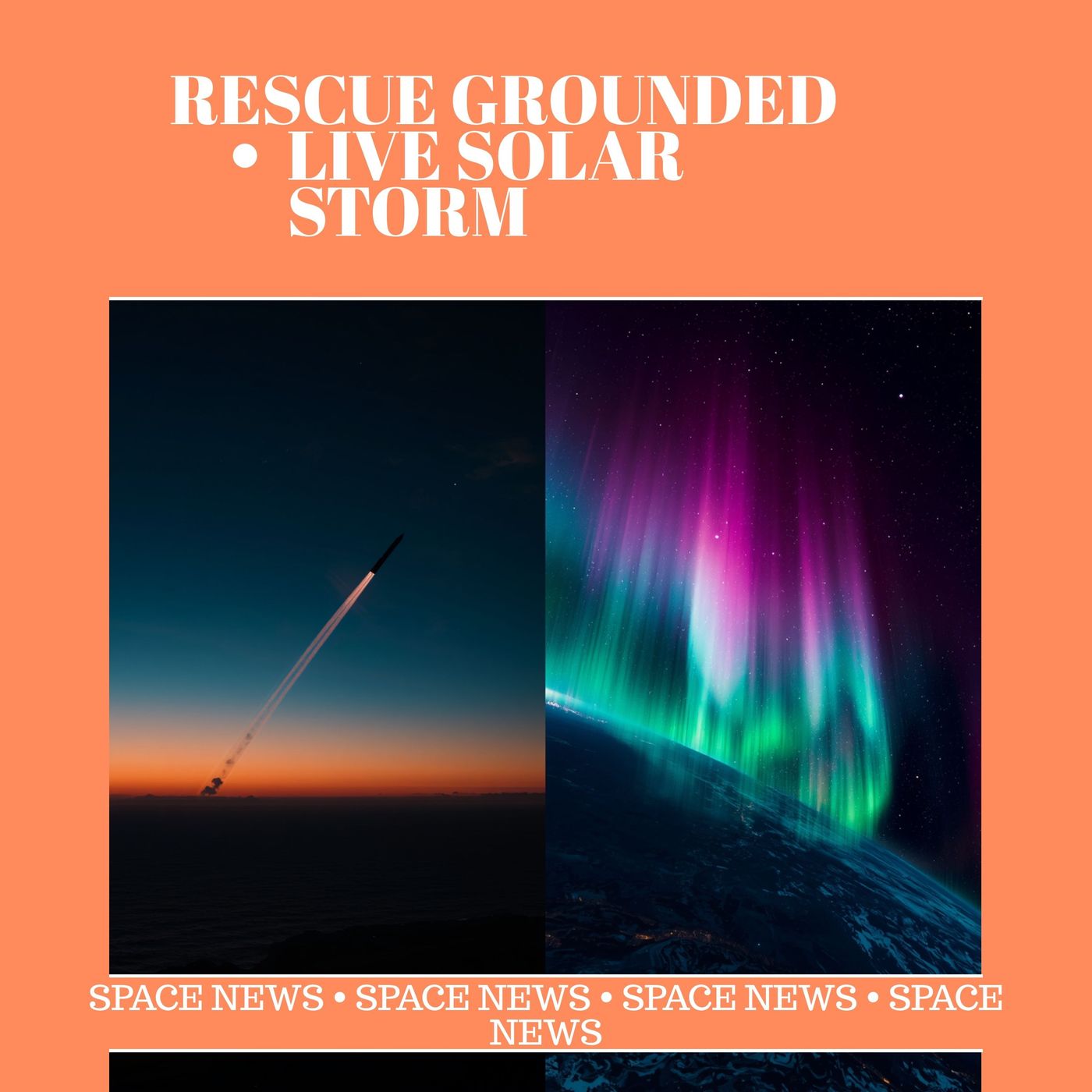
Astronomy Daily S05E131 — Friday, July 3, 2026 1. Swift Rescue Mission — Grounded Mid-Flight • Katalyst Space Technologies' LINK spacecraft was set to launch aboard a Pegasus XL rocket, air-launched from Northrop Grumman's Stargazer aircraft over Kwajalein Atoll. • Thursday's attempt (July 2) got airborne after two prior weather scrubs, but was aborted mid-flight when engineers spotted an unexplained warning. • No new launch date has been set. Swift faces uncontrolled reentry by October 2026 without a successful reboost. 2. Solar Storm Watch — G2 Geomagnetic Storm Active Today • X1.1 flare (June 30) plus 10 M-class flares in 24 hours from sunspot region AR4479. • NOAA SWPC G2 (moderate) geomagnetic storm watch in effect for July 3, easing July 4. • Aurora borealis potential as far south as Idaho/New York (US); aurora australis potential for Tasmania and southern NZ/VIC under clear, dark skies. 3. TESS's First Microlensing Exoplanet — Gaia23bra b • Super-Jupiter (~1.63 Jupiter masses) orbiting an orange dwarf ~40,000 light-years away, discovered via gravitational microlensing — a first for TESS. • Originally flagged by ESA's Gaia mission in 2023; confirmed using archival TESS data. • Published July 1, 2026 in The Astrophysical Journal Letters, led by Mallory Harris (University of New Mexico). 4. GJ 3378b — Revised Habitable-Zone Super-Earth, 25 Light-Years Away • UC Irvine team revised the planet's mass down to 2.3 Earth masses (rocky super-Earth, not mini-Neptune) and orbital period to 21.45 days. • Receives ~90% of the stellar radiation Earth receives from the Sun — squarely in the habitable zone. • Atmosphere unknown; planet does not transit, so JWST transit spectroscopy isn't possible. Published in The Astrophysical Journal, led by Paul Robertson (UC Irvine). 5. ESO Study: 1.7 Million Planned Satellites 'Devastating' for Astronomy • Study led by ESO astronomer Olivier Hainaut, accepted for publication in Astronomy & Astrophysics. • Modelled impact of proposed constellations (SpaceX ~1M for space data centres, Reflect Orbital 50,000 mirror satellites) on ESO's VLT and the Vera Rubin Observatory. • Recommends a hard cap of 100,000 satellites, all fainter than naked-eye visibility. Decision pending from the US FCC. 6. JWST Solves the WD 1856b Mystery • Gas giant (4–11 Jupiter masses) orbits a white dwarf every 34 hours, blocking 56% of its star's light during transit. • New JWST atmospheric data shows the planet is ~240K hotter than expected — evidence it migrated inward 3–5.5 billion years after the star's death, rather than surviving the red giant phase in place. • Published July 1, 2026 in Nature, led by Ryan MacDonald with Northwestern's Christopher O'Connor.Become a supporter of this podcast: https://www.spreaker.com/podcast/astronomy-daily-latest-space-news--5648921/support.
Sponsor Details:
Ensure your online privacy by using NordVPN. To get our special listener deal and save a lot of money, visit www.astronomydaily.io/nordvpn. You'll be glad you did!
Get the best secure and private email on the planet. Stop your Government, google and who knows who else spying on every email you write. Do what we did and use ProtonMail. They beleive in privacy and there are no ads in their business model...yet they still provide a free forever service. Check them out and get out special deal at www.astronomydaily.io/protonmail
Become a supporter of Astronomy Daily by joining our Supporters Club....
Anna: From the bytes.com podcast network. This is Astronomy Daily. I'm Anna. Avery: And I'm avery. It's Friday, July 3, 2026, and we've got a proper Fourth of July weekend send off for you. A rescue mission that's still grounded, a solar storm that's actually arrived, and a planet that came back from the dead sort of. Anna: Today on the show, NASA's Swift Rescue mission hits another wall, this time mid flight. The sun is genuinely kicking off right now with a geomagnetic storm watch in effect for tonight.
Hess accidentally discovers a planet it was never built to find. A red dwarf just 25 light years away might be hiding the most Earth like world we've found in ages. Astronomers sound the alarm on satellite mega constellations. And we close with a planet that shouldn't exist, orbiting the corpse of its own star. Avery: Six stories. One very busy week for the universe. Let's get into it. Anna: We start with an update to a story we've been tracking for weeks. And it's not the Update anyone wanted. NASA's mission to rescue the Swift Observatory attempted to launch on Thursday, July 2.
And for the first time, it actually got off the ground. Avery: Right, quick recap for anyone just joining us. The Neil Garrels Swift Observatory is a 22 year old Gamma ray telescope that's losing altitude fast because heightened solar activity has puffed up Earth's upper atmosphere and increased drag on its orbit. Anna: Left alone, Swift reenters and burns up by October. So NASA hired a company called catalyst space technologies, $30 million, incredibly tight timeline to build a robotic spacecraft called Link 3 articulated arms.
The plan is for Link to grapple Swift, a satellite that was never designed to be serviced, and shove it back up to a safer orbit. Avery: It launches piggyback. A Northrop Grumman Pegasus rocket tucked under the belly of the Stargazer aircraft takes off from Kwajalein Atoll in the Marshall Islands, climbs to about 39,000ft and then drops the rocket, which lights up five seconds later. This week alone, it had already been scrubbed twice for weather. Anna: So Thursday morning, Stargazer finally takes off.
It's airborne, heading for the release point. And then mid flight, the team spots a, uh, warning in the data stream and makes the call not to release the rocket at all. Avery: Which is a genuinely different failure mode than what we told you earlier this week. This wasn't weather. This was an act of abort in the air on a live vehicle. It's not even clear yet whether the warning came from the rocket or from the carrier aircraft itself. Anna: No new Launch date has been set. NASA's been very upfront that this is a race against the clock.
They've already suspended most of Swift's science operations since February just to buy time flying it in a low drag orientation to slow the decay. Avery: The stakes here go beyond one telescope. 2. If Link pulls this off, it's the first time a commercial spacecraft has docked with a government satellite that was never built for servicing. That's a template for saving Hubble one day or any number of aging observatories we'd otherwise just have to write off. Anna: So, still grounded, still no date, and the clock is still ticking towards October.
We'll keep you posted the moment there's movement. Avery: Story 2 and if you were listening earlier this week, you'll remember we flagged the big X class flare and told you to watch the skies. Well, watch the skies. It's happening. Anna: The sun has been properly busy after that X1.1 flare from Sunspot Region AR4479 on June 30. It followed up with 10m M class flares in a single 24 hour stretch. Multiple coronal mass ejections, several of them Earth directed. Avery: NOAA Space Weather Prediction center has a G2 that's a moderate geomagnetic stormwatch active for today July 3rd, with a chance of reaching G2 levels through the day as the CME arrives and interacts with Earth's magnetic field.
Anna: The key thing forecasters are watching is the BZ component of the magnetic field, basically whether the storm's magnetic orientation points south, which is what lets solar wind energy pour into our magnetosphere efficiently. Get that right and the aurora show Avery: gets a lot more dramatic in the Northern Hemisphere. That means aurora potentially visible much farther south than usual. Forecasters are talking about spots like Idaho and New York if skies stay dark and clear over the coming nights.
Anna: And for our Southern Hemisphere listeners, this is a genuine Aurora Australis opportunity too. D2 level storms can push the southern lights up into Tasmania and sometimes as far as southern Victoria and the Lower south island of New Zealand. If you've got clear, dark skies away from the coast tonight, it's worth a look. Avery: South conditions are expected to start easing back toward quieter levels tomorrow, July 4th as the CME's effects wane. So if you're chasing the lights tonight into the small hours is your best shot before the Northern Hemisphere's holiday fireworks take over as the main show.
Anna: Our third story is a lovely bit of science serendipity. NASA's Tess, the transiting exoplanet Survey satellite has notched ah, a genuine first. Its first planet found by gravitational microlensing, Avery: which is a big deal because TESS wasn't designed for that at all. Its entire job is watching for the tiny dip in starlight when a planet crosses in front of its star. Microlensing is a completely different trick. It happens when a foreground star drifts almost exactly in front of a background star and its gravity bends and briefly magnifies that background star's light, like a natural lens.
Anna: If that foreground star happens to have its own planet, the planet adds its own little flicker to that magnification event. And that's exactly what happened here. The planet's called Gaia 23 Bra, a super Jupiter, about 1.63 times Jupiter's mass, orbiting an orange dwarf star roughly 40,000 light years away out near the galactic center. Avery: It was actually the European Space Agency's Gaia mission that first flagged the brightening event back in 2023. But Gaia's observations were too sparse to confirm a planet was involved.
It was only when researchers went back and combed through tess's archival data that they realized TESS had caught the same event with enough detail to nail it down. Anna: Lead author Mallory Harris, a UH doctoral candidate at the University of New Mexico, published The findings on July 1st in the Astrophysical Journal Letters. And the tantalizing bit is what it implies. TESS has been quietly recording eight years of data and nobody was looking for this kind of signal. There could be plenty more of these hiding in the archive.
Avery: It's also a nice bit of foreshadowing. NASA's Roman Space Telescope, on track to launch August 30 this year, is being purpose built for exactly this kind of survey. It's expected to find around 1,000 microlensing planets. By staring into the crowded center of The Galaxy Gaia, uh, 23B is basically a preview of what's coming. Story four takes us a lot closer to home, just 25 light years away, which in galactic terms is basically next door. Anna: This is GJ3378B, a rocky world orbiting a faint red dwarf star in the constellation Camilo partillaris, the giraffe.
It was actually first picked up back in 2024 by French astronomers, but the original numbers pegged it as a puffy mini Neptune, five times Earth's mass, orbiting on a 25 day period, sitting right at the edge of the habitable zone. Avery: A team at UC Irvine led by Paul Robertson went back with two instruments. The Habitable Zone Planet Finder on the Hobby Eberly Telescope in Texas and the NED Spectrometer on the YIYN Telescope at Kitt Peak in Arizona and revised those numbers substantially. Robertson put it nicely this super Earth gets about 90% of the radiation Earth gets from the sun right in the sweet spot for liquid water, at least in principle.
Anna: The catch, and there's always a catch with red dwarfs, is that these stars can be vicious with stellar wind and radiation, which tends to strip atmospheres clean off nearby planets. And because GJ3378B doesn't transit its star from our point of view, we can't use transit spectroscopy to check whether it's actually kept in atmosphere, the trick JWST has been using on planets like the Trappist 1 system. Avery: So the honest answer is nobody knows yet. We'll likely have to wait for NASA's Habitable Worlds Observatory, which isn't due to launch until sometime in the 2000-40s, to get a direct look.
But for a planet this close and this promising, that's a long wait worth marking on the calendar. Anna: Dory 5 is one that hits close to home for us, quite literally given our own dark skies down here in the Southern Hemisphere. Avery: The European Southern Observatory has published the first study to actually calculate what happens to ground based astronomy if current satellite mega constellation proposals go ahead and um, the word ESO used was devastating. Anna: There are currently somewhere around 14 to 17,500 satellites in orbit.
But between SpaceX, which wants roughly a million more for space based data centers, and companies like Reflectorbital, which is proposing three 50,000 mirror satellites designed to beam sunlight down to Earth at night, the combined proposals on the table add up to over 1.7 million satellites. Avery: The study, led by ESO astronomer Olivier Hainau and accepted for publication in Astronomy and Astrophysics, modeled the actual imaging impact for a SpaceX scale constellation. Even if every satellite stayed just below naked eye brightness, the study found it would produce dozens of trails per image on ESO's Very Large Telescope, cutting usable field of view by up to 28%.
Anna: It gets worse for the Vera Rubin Observatory's new legacy survey of Space and Time, which just began full science operations. If those satellites were even a little brighter than assumed, most of Rubin's images each night could be rendered essentially unusable. Avery: And reflect orbital's mirrors are their own special problem. Even when they're not pointed directly at an observer, the scattered light alone could brighten the entire night sky three to four times over. I now describe the single one of those mirrors as being as Bright as, uh, Venus, the so called Morning Star.
Anna: ESO's recommendation is a hard ceiling, no more than 100,000 satellites total, all kept fainter than naked eye visibility. Worth noting, this study also directly informs the observatories closest to us here in the southern hemisphere, since ESO's Very Large Telescope and the Extremely Large Telescope currently under construction. Both sit in the Chilean Atacama Desert. Avery: SpaceX and reflect orbital are both still waiting for a decision from the U.S. federal Communications Commission about whether their proposed constellations get approved.
And this study is now very much part of that conversation. And for our, uh, final story today, one that's been bugging astronomers since 2020, and JWST just cracked it. Anna: Meet WD 1856 b. It's a gas giant, somewhere between 4 and 11 times Jupiter's mass. And it orbits its star every 34 hours, less than 3 million kilometers out, 50 times closer than Earth is to the Sun. When it transits, it blocks 56% of the star's light, one of the deepest transits ever recorded. Avery: Here's the problem. The star it's orbiting is a white dwarf, the collapsed Earth sized corpse of a star that has already gone through its red giant phase, where it swells up hundreds of times its original size and incinerates anything nearby.
A, uh, planet orbiting this close should have been vaporized billions of years ago when the star was still ballooning outward. Anna: So how is it still there? Using JWST, an international team including Northwestern's Christopher O' Connor and lead author Ryan McDonald measured the planet's atmosphere directly for the first time. Gas temperature and chemical composition, including methane and hydrocarbon haze, which would give it a color similar to Saturn's moon. Avery: Titanium and the temperature was the giveaway.
The planet's running at around 400 kelvin, roughly 240 degrees hotter than it should be if it were only being warmed by the faint light of its dead star. That extra heat had to come from somewhere. Anna: By modeling how giant planets cool over time, the team worked backward and found the planet was heated somewhere between 3 and 5.5 billion years after the white dwarf formed. In other words, it wasn't sitting in this tight, dangerous orbit during the red giant phase at all. It was out at a safe distance the whole time and only migrated inward billions of years later through gravitational interactions with other bodies in the system, eating up as it went.
Avery: It didn't survive the apocalypse. It arrived after the funeral. Anna: Which makes this more than just a curiosity, because our own sun is going to do exactly this in about 5 billion years swell into a red giant, almost certainly consume Mercury and Venus, with Earth sitting right on the edge of that danger zone. Jupiter and Saturn will very likely survive that phase out at a safe distance, just like WD1856B's planet originally did. Avery: And what this research suggests is that the story doesn't necessarily end there.
Over billions more years afterward, gravitational nudges could send one of our own surviving gas giants migrating inward, closer to whatever's left of the sun, just like this planet did around its white dwarf. Anna: As the researchers put it, stellar death isn't necessarily the end. Some planets get a whole second act afterwards. A nice thought to leave you with heading into the weekend. Avery: And that's a wrap on Astronomy daily for Friday, July 3. A grounded rescue mission, A solar storm right over our heads.
A planet Tess wasn't even looking for. A promising new neighbor 25 light years out, a warning about our crowding skies, and a planet that outlived its own star's death. Anna: If you're in the US have a safe and happy 4th of July weekend. And if the skies stay dark and clear, maybe let the aurora provide a few fireworks of its own tonight. Avery: If you enjoyed today's episode, please hit subscribe wherever you're listening and, uh, leave us a review. If you can spare 30 seconds, it really does help new listeners find the show.
Anna: You can find full show notes, sources and links at astronomydaily IO and follow us on socials@astrodaily pod. We're back tomorrow with more from across the universe and of course, the weekend wrap. Avery: I'm Avery. Anna: I'm Anna. Clear skies, everyone. Astronomy Day stories. Mhm. Be told.
 Apple Podcasts
 Spotify
 Pocket Casts
 Castbox
 Overcast
 Podbean
 iHeartRadio
 Castro
 Goodpods
 Moon FM
 Podcast Addict
 Podcast Republic
 YouTube