
Cosmic Debris in Australia, NASA's Lunar Shakeup, and the Mystery of Moonlight Signals
In this episode
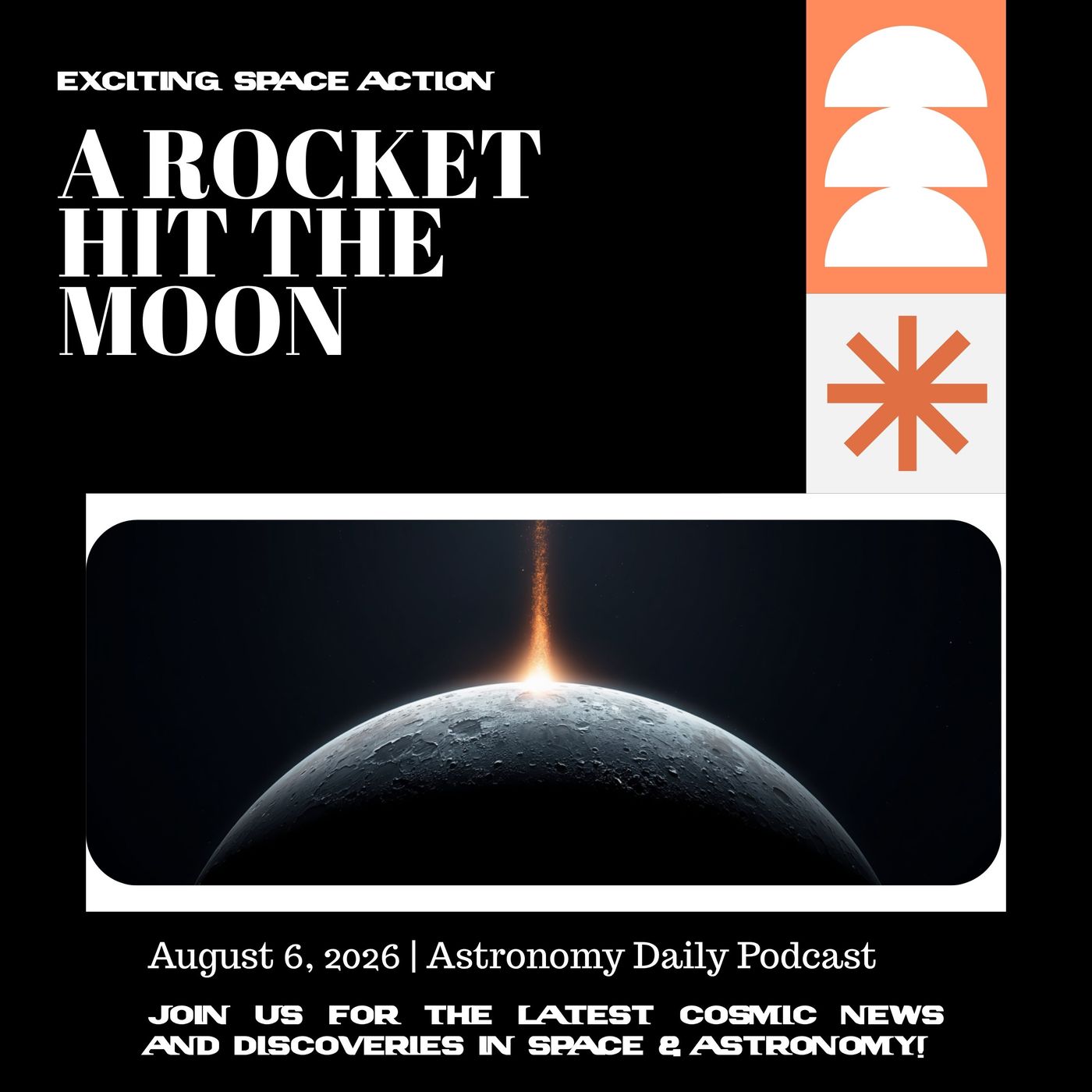
- Mysterious Space Debris in Australia: A large, smoking piece of metal has been discovered in Western Australia, likely from the fourth stage of a Chinese Jielong 3 rocket. This incident highlights the ongoing issue of space debris and its potential impact on Earth, as authorities investigate the origins of this fiery visitor.
- NASA's Artemis 3 Update: NASA is considering opening up the Artemis 3 lunar landing contract to a second company, possibly Blue Origin, due to delays with SpaceX's lunar lander. This shift signals a renewed focus on competition and redundancy in lunar exploration as NASA aims for a sustainable presence on the Moon by 2028.
- SpaceX's Launch Milestones: SpaceX is set to conduct up to four Falcon 9 launches this week, including a notable mission for the SpainSat NG1 satellite, which will see the first stage booster expended to prioritize mission performance. Additionally, SpaceX has launched its 10,000th Starlink satellite, marking a significant milestone for the global internet constellation.
- New Protocol for Alien Contact: The International Academy of Astronautics has proposed a major update to the protocol for responding to potential signals from extraterrestrial intelligence. The new guidelines emphasize international consultation before any response is sent, reflecting the gravity of such a species-level event.
- Transient Lunar Phenomena Theories: Ongoing investigations into transient lunar phenomena (TLPs) reveal potential explanations for the mysterious flashes of light on the Moon's surface. Theories range from meteoroid impacts to gas releases from the Moon's interior, highlighting the need for further exploration and observation.
- For more cosmic updates, visit our website at astronomydaily.io. Join our community on social media by searching for #AstroDailyPod on Facebook, X, YouTubeMusic, TikTok, and our new Instagram account! Don’t forget to subscribe to the podcast on Apple Podcasts, Spotify, iHeartRadio, or wherever you get your podcasts.
- Thank you for tuning in. This is Anna and Avery signing off. Until next time, keep looking up and exploring the wonders of our universe.
Australian Space Debris Discovery
[Australian Space Agency](https://www.space.gov.au/)
NASA Artemis 3 Mission Updates
[NASA](https://www.nasa.gov/)
SpaceX Launch Cadence
[SpaceX](https://www.spacex.com/)
Alien Contact Protocols
[International Academy of Astronautics](https://iaaweb.org/)
Transient Lunar Phenomena Research
[Astrophysical Journal](https://iopscience.iop.org/journal/0004-637X)
Astronomy Daily
[Astronomy Daily](http://www.astronomydaily.io/)
Become a supporter of this podcast: https://www.spreaker.com/podcast/astronomy-daily-space-news-updates--5648921/support.
Sponsor Details:
Ensure your online privacy by using NordVPN. To get our special listener deal and save a lot of money, visit www.bitesz.com/nordvpn. You'll...
Anna: Welcome everyone to Astronomy Daily, your regular guide to the biggest stories happening off world. Give us 10 minutes and we'll give you the universe. I'm Anna. Avery: And I'm Avery. It's fantastic to have you with us, Anna. Uh, it feels like every week the pace just gets faster. We've got so much to talk about today. Anna: We really do on the docket. Today we're starting on the ground in Australia with some mysterious burning debris that appears to have fallen from orbit. Avery: From there we'll jump to the moon, or at least the plans to get there.
NASA is signaling a major potential shakeup for its Artemis 3 landing contract. And it's all about competition and a new space race. Anna: Then we'll look at SpaceX's relentless launch cadence, including a very special satellite and a mind boggling milestone for their Starlink constellation. Avery: And after that, we're diving into one of my favorite topics. Are we alone? There's a huge update to the official playbook for what scientists should do if they actually detect a signal from ET. Anna: It's a big deal, it really is.
And we'll finish by looking at our own moon and the strange flashes of light that have puzzled astronomers for centuries. With some new theories emerging, it's a packed show, so let's get right into it. Avery: Alright. Our first story takes us to Western Australia, where miners stumbled upon something you don't see every day. A large, still smoking piece of metal that had clearly fallen from the sky. Anna: Right. Pictures show this charred dome shaped object and authorities were quickly called in.
The Australian Space Agency is now leading the investigation to formally identify the object. Avery: It must be quite a sight to just find that in a field. Now, while the official confirmation is pending, an astrophysicist has suggested it's very likely from the fourth stage of a Chinese Jielong 3 rocket which was launched last September. Anna: And that makes sense, given the trajectory and the materials. It really brings the issue of space debris into sharp focus. We often talk about it as a problem for satellites in orbit, but this is a reminder that it can and does have an impact right here on Earth.
Avery: Exactly. Most of the tens of thousands of trackable objects are small but larger pieces like rocket stages and have a non zero chance of surviving re entry. We've seen it before with Skylab in 1979, also in Australia, and more recently with other Chinese rocket stages making uncontrolled, uh, re entries. Anna: Mhm. And that's the key term, uncontrolled. Most modern rockets are designed to re enter over the ocean or have systems to deorbit themselves safely. But some older designs or in some specific mission profiles, the stages are just left to tumble down wherever gravity and atmospheric drag take them.
Avery: It's a bit like cosmic roulette. Thankfully, since so much of the Earth is water or uninhabited land, the risk to human life has been statistically very low. But it's not zero. And as the number of launches increases, that risk goes up. Anna: It's a problem that space agencies and private companies are taking more seriously with new technologies for active debris removal being developed. But for now, it seems we'll occasionally be getting these fiery visitors from above. Avery: Okay, from falling hardware to the hardware we're intentionally trying to send to the moon.
Anna, uh, there's some major news from NASA about the Artemis 3 mission. The one that's supposed to put astronauts back on the lunar surface. Anna: This is a huge development. NASA's acting chief Sean Duffy has indicated that the agency is strongly considering opening up the moon landing contract to a second company in addition to SpaceX. Avery: Right. As it stands, SpaceX and its lunar Optimized Starship were the sole winners of that lucrative contract. But the new thinking at, uh, NASA is that relying on just one provider for such a critical national capability is risky.
Anna: It definitely is. The acting chief cited a couple of key reasons. First, he acknowledged that SpaceX is behind schedule in developing the lander. They need to perform many test flights of starship, including an uncrewed lunar landing, before they can put astronauts on board. And that's taking longer than hoped. Avery: The second reason he gave was much more direct. He explicitly mentioned a race against China. China has its own ambitious lunar program with plans for a lunar base. And NASA is feeling the pressure to not fall behind.
Anna: Yeah, you don't hear that kind of direct language every day. So the idea is to bring in another company like Blue Origin with their Blue Moon lander concept to develop a competing system. This creates redundancy and spurs competition. Avery: It's a return to the Apollo era model in a way where multiple contractors were often working on different parts of the same problem. This also comes with a more realistic timeline, with the Artemis 3 landing now being publicly targeted for 2028. Anna: It's a smart move in my opinion.
It might cost more in the short term to fund two landers, but in the long term, it makes the entire enterprise more resilient and it signals that NASA is serious about creating a sustainable presence at the moon, not just a one off visit. Avery: Absolutely. The next few months will be critical as we wait to see if NASA formally opens up bids for this second contract, a very big story to watch. Anna: Well, while NASA might be worried about SpaceX's timeline for the moon, there's no question about their launch cadence here on Earth.
This week alone, they're aiming for as many as four Falcon 9 launches. Avery: The pace is just relentless. It has fundamentally changed the launch industry. And one of this week's missions is particularly noteworthy because the Falcon 9 first stage booster is going to be expended. Anna: Right? It's not going to attempt a landing. This is for the SpainSat NG1 satellite, a sophisticated communications satellite for the Spanish government. Why are they expending the booster for this one? Avery: It all comes down to performance.
This satellite is very heavy and it's headed for a high energy geostationary transfer orbit. To get it there, the Falcon 9 has to burn its engine for longer and at a higher thrust, leaving no fuel reserves for the complex boostback and landing burns. Anna: So they're prioritizing the customer's mission over recovering the hardware. It's a good reminder that as routine as the landings have become, they are still secondary to the primary mission. Avery: Exactly. And Speaking of routine, SpaceX quietly passed a massive milestone recently.
They successfully launched their 10,000th Starlink satellite. Just think about that number for a second. Anna: 10,000. The scale of that constellation is almost impossible to comprehend. It's providing Internet to remote places all over the world, which is incredible. But it's also causing ongoing headaches for ground based astronomers due to light pollution. Avery: It's a complex issue with passionate arguments on both sides. And to complete the global launch picture for the week, a Chinese Long March 5 rocket is also scheduled to lift off.
But but its payload is a secret. Anna: A little bit of intrigue from the China National Space Administration. We'll be keeping an eye out for what that might be. Avery: Okay, for our next story, let's venture into the hypothetical. Let's say tomorrow. Astronomers using a radio telescope detect an unmistakable structured signal from a nearby star system. It's intelligent. What happens next? Anna: Well, for decades, the plan has been what's known as the post detection policy. But now the International Academy of Astronautics is proposing a major, major update.
And it's a fascinating look at how our perspective has changed. Avery: It really is. The old protocol was largely about verification. A scientist who found a signal would first need to rule out all terrestrial sources and then get independent verification from another observatory. After that, the information would be released to the public. Anna: And crucially, the decision of whether or not to reply was left largely to the discoverers. There wasn't a Global consensus required. The new proposal completely changes that last part.
Avery: That's the core of it. The new protocol states that no response should be sent to a, uh, confirmed alien signal until appropriate international consultations have taken place. Specifically through a body like the United Nations. Anna: So in essence, we have to talk amongst ourselves before we talk to them. It takes the decision out of the hands of a small group of scientists and places it on the world stage. Avery: Exactly. And the rationale is a reply to an alien signal would be sent on behalf of all of humanity.
What would we say? Who would craft the message? What are the potential risks and rewards? These aren't just scientific questions. They're political, cultural and ethical. Anna: You can just imagine the debates at the un. It would be unbelievable. This reflects a, uh, growing understanding that contact isn't just a scientific discovery. It's a species level event. And it's probably wise to have a plan in place before we're forced to improvise. Avery: I agree. It's a sober, mature step for the SETI community to take.
Anna: Alright, for our last story, we're heading back to the Moon to look at a genuine long standing astronomical mystery. Transient lunar phenomena or TLPs. Avery: Right. These are reports of short lived lights, colors or other changes on the lunar surface. They've been documented for centuries, even by pre telescopic observers, but they're notoriously difficult to confirm and study. Anna: So what are the leading theories for what's causing them? It seems like there's more than one answer. Avery: There likely is.
For the briefest flashes. Just a blink and they're gone. The consensus is that these are meteoroid impacts. We have networks of telescopes that now monitor the Moon for these, and we see them fairly often. A small rock hitting the dark side of the moon at 30,000 miles per hour creates a visible flash of vaporized rock. Anna: Okay, that one makes sense. But what about the ones that last longer? The reports of areas that seem to glow or have a strange haze for minutes or even hours? Avery: That's where it gets more interesting.
A strong candidate is the release of gas from the Moon's interior. The Moon isn't geologically dead. It's thought to have a molten core and still experiences moonquakes. These quakes could release pockets of trapped gas, like radon from below the surface. Anna: And that gas could glow. Avery: Potentially. The gas itself might fluoresce under the harsh solar radiation. Or, or it could stir up fine lunar dust which then reflects sunlight in a peculiar way. The Aristarchus Plateau is a known hotspot for these kinds of events.
And it's also a region known for a gas release. Anna: Fascinating. And what about the really weird, long lasting lights? Avery: Those are the most contentious. One theory is electrostatic dust levitation, where solar radiation charges fine dust particles and makes them hover above the surface, forming a kind of temporary dusty atmosphere that can scatter light. Other scientists are more skeptical, suggesting these are just misidentified satellites or even phenomena in our own atmosphere projected against the Moon.
Anna: So we still don't have a definitive answer. It's amazing to think that we've walked on the Moon, yet it still holds these fundamental mysteries. It's a good reason to keep sending robotic and eventually human observers back to investigate. Avery: And with that mystery, our time is up for this episode of Astronomy Daily. From cosmic litter in the outback to global debates about talking to aliens, it's been an episode full of incredible science. Anna: It certainly has. The universe never fails to keep us on our toes.
We hope you've enjoyed this tour of the latest astronomical news. Avery: A, uh, huge thank you to all of you for listening. Be sure to join us again tomorrow for another deep dive into the cosmos. Until then, from both of us, clear skies and keep looking up.



 Apple Podcasts
 Spotify
 Pocket Casts
 Castbox
 Overcast
 Podbean
 iHeartRadio
 Castro
 Goodpods
 Moon FM
 Podcast Addict
 Podcast Republic
 YouTube