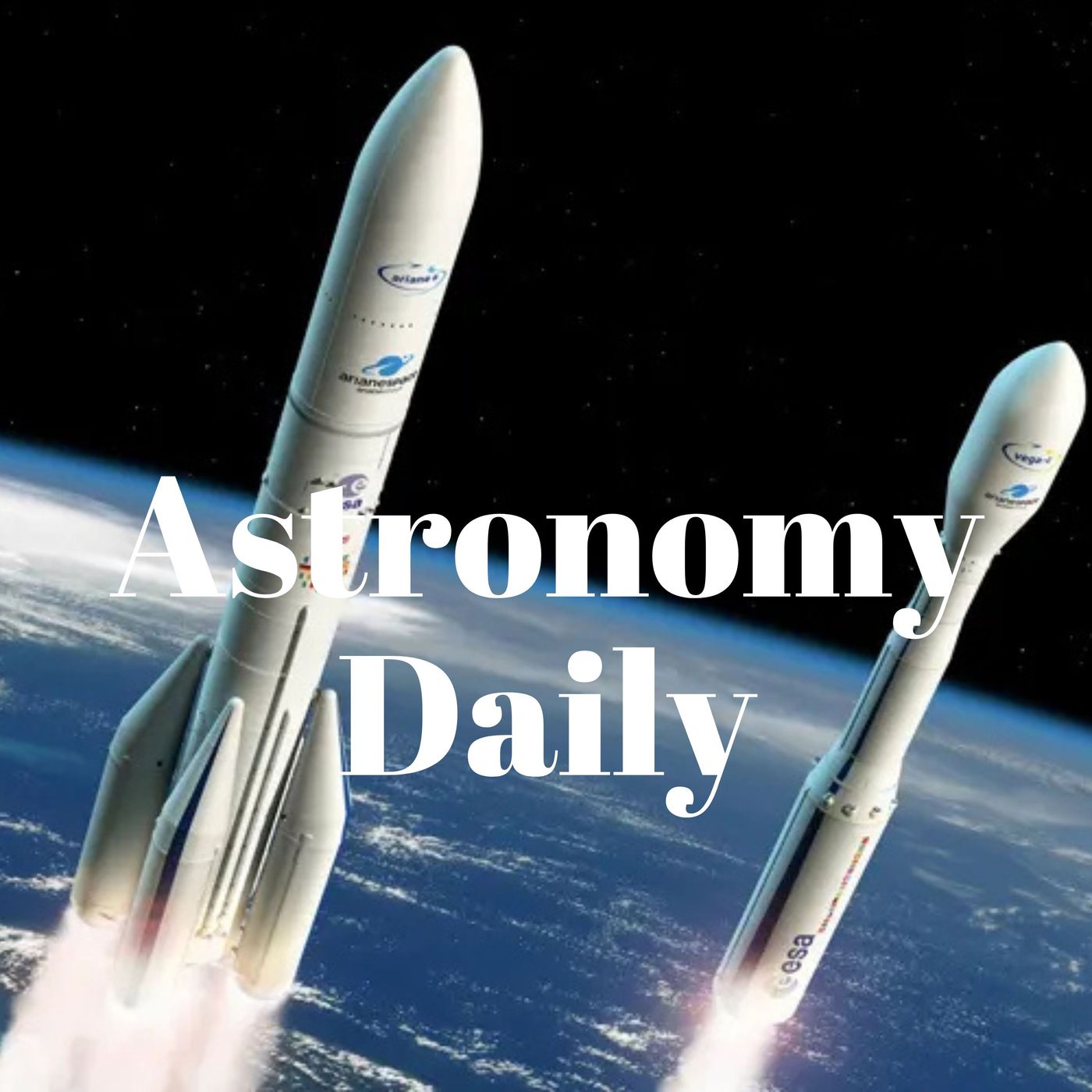
In this episode
- Arianespace Launch Delay: Arianespace has quietly postponed the inaugural flight of its powerful Orion 64 rocket to 2026, a significant shift from its initial late 2025 schedule. This delay impacts Amazon's Project Cooper satellite constellation, which aims to compete with SpaceX's Starlink, highlighting the challenges of securing reliable launch providers in the competitive space market.
- Mysterious Interstellar Object: The interstellar object 3I ATLAS is perplexing scientists by emitting nickel tetracarbonyl, a compound never before observed in nature. Unlike typical comets, this object is ejecting material towards the Sun, defying known cometary physics and raising questions about its origins, including the possibility of artificiality.
- Gamma Ray Glow Debate: Astronomers are revisiting the source of a puzzling gamma ray glow from the Milky Way's center. Recent simulations suggest that a clumpy distribution of dark matter could be responsible, reinforcing the theory that dark matter particles may annihilate and produce detectable gamma rays, adding complexity to the ongoing debate.
- Double Comet Viewing Opportunity: Stargazers can look forward to a rare sight as Comet LEMMON and Comet Swan approach Earth on October 20. Both comets will be visible with binoculars or small telescopes, and live streams of the event will be available for those unable to observe directly. https://www.virtualtelescope.eu/webtv/
- https://www.youtube.com/@GianMasiVirtualTelescope/streams
- Best Space Photography Resources: For breathtaking space photography, listeners are encouraged to explore official agency websites like NASA and the European Space Agency, as well as community platforms such as Reddit's r/Astrophotography and AstroDailyPod Bin, where amateur astrophotographers share their stunning work and contribute to citizen science projects.
- For more cosmic updates, visit our website at astronomydaily.io. Join our community on social media by searching for #AstroDailyPod on Facebook, X, YouTubeMusic, TikTok, and our new Instagram account! Don’t forget to subscribe to the podcast on Apple Podcasts, Spotify, iHeartRadio, or wherever you get your podcasts.
- Thank you for tuning in. This is Anna and Avery signing off. Until next time, keep looking up and exploring the wonders of our universe.
Arianespace Orion 64 Launch Delay
[Arianespace](https://www.arianespace.com/)
3I ATLAS Interstellar Object
[NASA](https://www.nasa.gov/)
Gamma Ray Glow Research
[Astrophysical Journal](https://iopscience.iop.org/journal/0004-637X)
Double Comet Viewing Guide
[Comet Watch] https://www.virtualtelescope.eu/webtv/
Astrophotography Resources
[AstroDailyPod Bin](https://www.astrodailypodbin.com/)
Astronomy Daily
[Astronomy Daily](http://www.astronomydaily.io/)
Become a supporter of this podcast:
Avery: Hello, and welcome to Astronomy Daily, the podcast that brings you the universe, one story at a time. I'm Avery. Anna: And I'm Anna. It's great to have you with us. we've got a fascinating lineup today, from a mysterious interstellar object, baffling scientists to the quiet delay of a major rocket launch. Avery: Plus, we'll dive into the ongoing debate about a strange glow at the heart of our galaxy, tell you how to spot a rare double comet, and share the best places to find breathtaking space photography online.
Let's get started. Anna: First up, a, significant development in the world of commercial spaceflight. Avery, it looks like Arianespace is facing a setback with its new heavy lifter. Avery: That's right, Anna. the first flight of the powerful 4 booster variant, the Orion 64 has been quietly pushed back to 2026. This was initially slated for late 2025, and it's a pretty big deal because this rocket is tasked with launching a significant portion of Amazon's Project Cooper satellite constellation. Anna: Project Cooper is Amazon's answer to SpaceX's Starlink, right?
A huge network of Internet satellites in low Earth orbit. Avery: Exactly. And securing launch providers is one of the biggest hurdles for these mega constellations. The Orion 6IV is the key part of Amazon's strategy. The delay wasn't announced with the big press release. It was just updated on the Arianespace website, which suggests they're trying to manage expectations. Anna: It really highlights the immense complexity of developing these new launch vehicles. Even for established players like Arianespace, delays are almost part of the process.
It'll be interesting to see how this affects Amazon's deployment timeline for project cooperation. Avery: It certainly will. Amazon has regulatory deadlines to meet for deploying half of its constellation by 2026. While they have launches booked with other providers like ULA and Blue origin, the Orion 6IV was a major pillar of their strategy. This forces them to reshuffle an already complex launch manifest. Anna: Absolutely. It's a critical moment. A delay of even a few months can have significant ripple effects in this highly competitive market.
They need to demonstrate reliability and get their flight cadence up to speed to secure future contracts. We'll definitely be keeping a close eye on how this develops. Avery: And what does this mean for Ariane space? The Ariane 5 was a workhorse for decades, but the market has changed dramatically. Is this a critical moment for them? Time will tell. Alright. From engineering challenges here in our solar system to a deep mystery from beyond it, our next story is an update about an interstellar object that is breaking all the rules.
It's named 3i ATLS. Anna: This sounds exciting. What makes it so unusual? It's not our first interstellar visitor, is it? Avery: No, but this one is behaving very strangely. Spectrometers have detected it emitting a compound called nickel tetracarbonyl. For context, this compound has never been seen occurring in nature before. On Earth, it's used in industrial processes to refine nickel. Anna: Wow. Okay. An industrial chemical in space. That is bizarre. Is there a natural explanation? Avery: That's the multi billion dollar question.
Scientists are stumped. It gets weirder too. Unlike a typical comet that ejects M material away from the sun due TO solar wind, 3I ATLAS is ejecting material towards the sun. It's defying our understanding of cometary physics. Anna: So it's not behaving like a comet. And it's venting a compound associated with industry. I can see why this has generated some controversial theories. Are they thinking it could be artificial? Avery: Before we get into that, how does this compare to our other known interstellar visitors like Oumuamua?
That one also sparked a lot of debate about its origins, didn't it? Anna: But yes, that's certainly the most sensational theory being floated. Though most scientists are, urging caution and looking for a new unknown natural phenomenon to explain it. The frustrating part is that a probe on its way to Mars just had a close flyby. It could have captured high resolution images that might solve the puzzle. Avery: It did, but in a different way. Oumuamua was strange because it was a highly elongated rocky object that showed slight non gravit acceleration without any visible outgassing.
Like a comet. 3 I ATLs is different. It is outgassing, but it's ejecting bizarre materials in a way that seems to defy physics. Oumuamua was mysterious for what it didn't do, while ATLs is mysterious for what it is doing. So you mentioned a flyby. Perfect. Does that mean we'll have answers soon? Anna: Well, about that. The data is currently unavailable. The transmission was halted due to a government shutdown affecting the Deep Space Network. So for now, one of the biggest mysteries in modern astronomy is on hold.
Because of bureaucracy, you can't make the stuff up. Avery: An interstellar mystery. Potentially groundbreaking data. And it's all stuck in cosmic limbo. Incredible. Speaking of cosmic mysteries, let's bring our focus closer to home. To the very heart of our own Milky Way galaxy. For years, astronomers have been debating the source of a puzzling gamma ray glow emanating from the galactic center. Anna: Right. The gamma Ray excess. I remember the two leading theories were pretty different from each other.
Avery: Very different. On one side, you have a relatively conventional explanation. The glow is the combined light of thousands of undiscovered pulsars. Super dense spinning stellar remnants. On the other, a, much more exotic theory. The glow is caused by the annihilation of dark matter particles, which would be. Anna: The first direct evidence of dark matter interacting in a way we can detect. A monumental discovery. So where does the debate stand now? Avery: Well, the case for dark matter just got a boost.
New computer simulations have shown that dark matter could be distributed in the galaxy in a clumpy, irregular way. And it turns out this clumpy distribution would produce a gamma ray signal that perfectly matches the shape of the observed glow. Anna: That's fascinating. For listeners who might not be familiar, could you briefly explain what it means for dark matter to annihilate? It sounds quite dramatic. Avery: It does. The leading theory is that dark matter is made of particles that are their own antiparticles.
So when two of these particles meet, they annihilate each other, converting their mass directly into energy in the form of other particles, including high energy gamma rays. The clumpy distribution means more of these collisions would happen in specific areas, creating a signal that matches what we see. Anna: So it puts the dark matter theory back on equal footing with the pulsar theory. Avery: Exactly. It doesn't prove it, but it shows it's just as plausible. The simulation removes a major objection to the dark matter hypothesis.
Ultimately, the deadlock might only be broken by the next generation of gamma ray telescopes, which could have the resolution to either spot the individual pulsars or rule them out for good. Anna: It's a fantastic example of how theory and observation work together. Until we finally get an answer. From the invisible glow of gamma rays to something you can actually see in the night sky, we have some good news. For stargazers, this week offers a rare opportunity to see two comets at once. Avery: A, double header.
That's not something you see every day. which comets are we talking about? Anna: They're named Comet LEMMON and Comet Swan. On October 20, they will both be making their closest approach to Earth, making it the best time to view them. They should be visible with a good pair of binoculars or a small telescope away from city lights. Avery: And for those who might be clouded out or don't have the equipment, is there a way to join in? Anna: There is. Several astronomy organizations are hosting a live online stream of the event, with telescopes from different parts of the world providing views and commentary from astronomers.
It's a wonderful way to experience the event no matter where you are. Avery: That's fantastic. It's a great reminder of the dynamic, ever changing nature of our solar system. These icy visitors are making a fleeting pass and we get to witness it. We'll be sure to put a link to the livestream in our show. Notes Seeing events like that double Comet flyby often gets people inspired by the beauty of the cosmos. Which brings us to our final story. Where to find the Best Space Photography Online the images we get from our telescopes and probes are just awe, inspiring.
Anna: They really are. And there are some fantastic resources out there. For the highest quality, scientifically significant images, the official agency websites are the best place to start. NASA's image of the day, the European Space Agency's gallery and the European Southern Observatory's archives are treasure troves. Avery: Absolutely. The Hubble and James Webb Space Telescope galleries in particular have images that will just change your perspective on the universe. But it's not just the big agencies.
There's a thriving community of amateur astrophotographers who do incredible work. Anna: That's so true. Where can listeners find their work? Avery: Online communities are the best bet. Reddit's r Astrophotography subreddit is amazing. You'll see stunning images of galaxies and nebulae taken from people's backyards. Another great site is AstroDailyPod Bin, which is a, dedicated hosting platform for astrophotography where people share details about their equipment and techniques. And it's not just about appreciating the beauty.
Many of these platforms connect to real scientific work. There are citizen science projects like Galaxy Zoo, where the public can help astronomers classify the shapes of distant galaxies from telescope images. It's a way for anyone to contribute directly to our understanding of the universe. Anna: That's amazing. So you can go from being an admirer to a contributor. It's a wonderful way to see what's possible. And since we're talking about online communities, it's a good time to mention a quick tip for online safety.
When you're browsing these sites, it's always smart to be mindful of the information you share and to stick to well known, reputable platforms. Avery: An excellent point, but with that in mind, diving into these galleries is one of the best ways to feel connected to the cosmos. Anna: And that brings us to the end of today's episode of Astronomy Daily. From launch delays and mysterious visitors to galactic glows and cosmic photography, the universe never fails to keep us on our toes. Avery: Thanks so much for tuning in.
We hope you'll join us again tomorrow as we continue to explore the final frontier. Until then, keep looking up.

 Apple Podcasts
 Spotify
 Pocket Casts
 Castbox
 Overcast
 Podbean
 iHeartRadio
 Castro
 Goodpods
 Moon FM
 Podcast Addict
 Podcast Republic
 YouTube