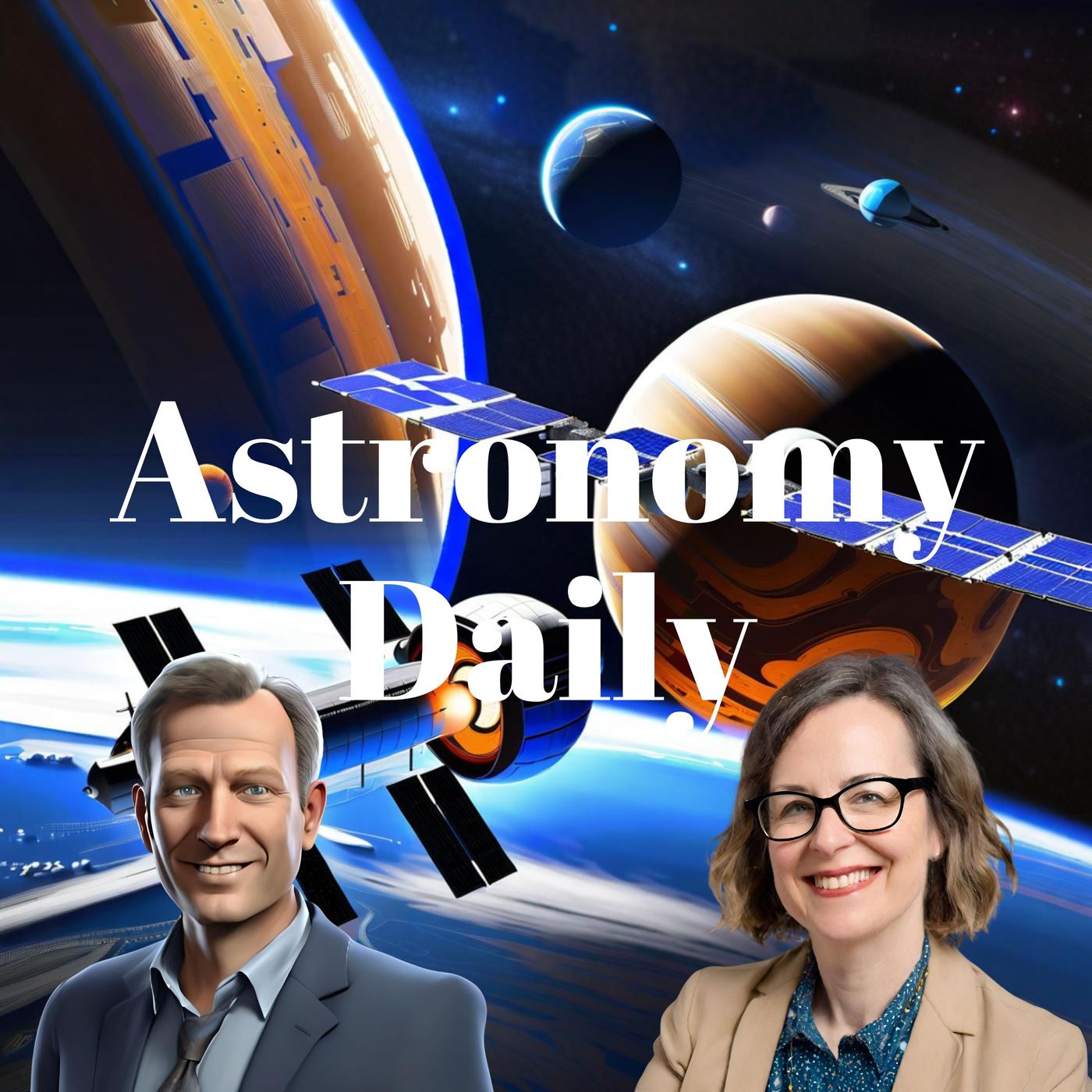
Commercial Space Stations, Stellar Rescues, and Mercury's New Origin Story
In this episode
- Commercial Space Station on the Horizon: Vast Space is set to launch Haven One, the world's first commercial space station, in May 2026 aboard a SpaceX Falcon 9 rocket. Designed for a four-person crew, Haven One promises high-speed internet and stunning views of Earth, marking a significant step toward the future of human activity in low Earth orbit.
- Nasa's Swift Observatory Rescue Mission: NASA has awarded Catalyst Space Technologies a $30 million contract to rescue the aging Swift Observatory, which faces a 90% chance of burning up by late 2026. The innovative plan includes launching a modified spacecraft to boost Swift into a more stable orbit, showcasing new satellite servicing capabilities.
- Successful Triple Launch to Study the Sun: NASA and NOAA successfully launched three missions aboard a SpaceX Falcon 9 to study the Sun. The spacecraft will head to Lagrange point 1, with IMAP mapping the heliosphere, the Carruthers Geocorona Observatory studying Earth's outer atmosphere, and NOAA's SWFO L1 providing real-time space weather monitoring.
- New Insights into Mercury's Formation: A new theory suggests that Mercury's massive core may have resulted from a grazing collision between two protoplanets, rather than a catastrophic impact. This model could explain the planet's unusual composition and will be tested by the upcoming BepiColombo mission in 2026.
- Monstrous Black Hole Discovery: Astronomers have discovered a black hole with a mass a billion times that of the Sun, growing at an unprecedented rate in the early universe. This finding challenges existing theories about the formation of supermassive black holes.
- Silverpick Crater Identified: Scientists have confirmed that the Silverpick Crater in the North Sea is the result of an asteroid impact approximately 45 million years ago, providing a rare opportunity to study mid-size impacts in marine environments.
- Upcoming Mars Mission: Rocket Lab has delivered twin spacecraft, Blue and Gold, to the Kennedy Space Center for a fall launch. These probes will orbit Mars to study its atmosphere, embarking on a lengthy 22-month journey to the red planet.
- For more cosmic updates, visit our website at astronomydaily.io. Join our community on social media by searching for #AstroDailyPod on Facebook, X, YouTubeMusic, TikTok, and our new Instagram account! Don’t forget to subscribe to the podcast on Apple Podcasts, Spotify, iHeartRadio, or wherever you get your podcasts.
- Thank you for tuning in. This is Anna and Avery signing off. Until next time, keep looking up and exploring the wonders of our universe.
Haven One Launch Details
[Vast Space](https://www.vastspace.com/)
Swift Observatory Rescue Mission
[NASA](https://www.nasa.gov/)
Sun Study Missions
[NOAA](https://www.noaa.gov/)
Mercury Formation Research
[Nature](https://www.nature.com/)
Black Hole Discovery
[Chandra X-Ray Observatory](https://www.nasa.gov/mission_pages/chandra/main/index.html)
Silverpick Crater Study
[Science Journal](https://www.sciencejournal.com/)
Mars Mission Updates
[Rocket Lab](
Avery: Welcome to Astronomy Daily, the podcast that brings you the universe one day at a time. I'm Avery. Anna: And I'm Anna. Today we've got a packed show. We're talking about a dramatic rescue mission for an aging observatory. The launch of the world's first commercial space station, and a brand new theory that could solve a major mystery about the planet Mercury. Avery: Plus, a successful triple launch to study the sun. And some quick hits from Mars, the early universe and and even deep beneath the North Sea.
Let's get started. First up, the future of living and working in orbit. With the International Space Station set to be deorbited around 2030, NASA is looking to the private sector for what comes next. And it looks like we have a frontrunner. Anna: That's right. A California based company called Vast Space is planning to launch Haven One, the world's first commercial space station. The they're targeting a launch as early as May 2026 aboard a SpaceX Falcon 9 rocket. Avery: So this isn't some far off concept.
This is happening relatively soon. What will Haven One be like? Anna: It's designed as a single module station intended to operate for about three years. It can support a four person crew for missions up to two weeks long. Vast is really focusing on a human centric design. Promising features like a large dome window for incredible views of Earth, and even speed Internet. Avery: High speed Internet in space. That's a game changer for research and communication. This really feels like a proof of concept for something much bigger.
Anna: Exactly. Vast sees Haven one as the first step towards building a much larger multimodule successor to the iss. It's a bold move that signals a new era for commercial activity in low Earth orbit. Avery: From building the new to saving the old, sometimes our most valuable assets in space need a helping hand. NASA's null Jarrell Swift Observatory, which has been a workhorse for astronomy since 2004, is in a bit of trouble. Anna: It is. Its orbit has been decaying, and without intervention, there's a 90% chance it would burn up in our atmosphere by late 2026.
Given its crucial role in discoveries related to gamma ray bursts and other cosmic events, losing it would be a major blow. Avery: So what's the rescue plan? It's not like these older satellites were built with a ah, tow hitch. Anna: That's the innovative part. NASA has awarded Catalyst Space technologies a, uh, $30 million contract for a daring rescue. Catalyst will launch a modified spacecraft called Wink to rendezvous with Swift Dog with it and then boost it into a higher, more stable orbit. Avery: That sounds incredibly complex, especially for A satellite that wasn't designed for docking.
What's the timeline for this mission? Anna: The launch is set for May 2026. Beyond just saving Swift, this mission is a critical demonstration of technology. Being able to service satellites that weren't prepared for it is a huge capability, especially as space becomes more contested. Avery: Moving our focus from Earth orbit to our solar system's star. There's some great news from the launch pad. On Wednesday, NASA and noaa, uh, successfully sent a trio of new missions on their way to study the Sun.
Anna: A successful triple launch on a single SpaceX Falcon 9 rocket. The spacecraft are now on a long journey to Lagrange point 1, or L1, which is a gravitationally stable spot about a million miles from Earth. They should be ready to start their science missions by January. Avery: And these aren't just redundant missions. Each one has a very specific job to do. Anna: Correct. First there's imap, the Interstellar Mapping and Acceleration Probe. Its goal is to chart the very boundary of our heliosphere, where the Sun's influence gives way to interstellar space.
Avery: Then there's the Carruthers Geocorona Observatory, which is looking back towards us. It will be studying the Geocorona, the vast tenuous outermost layer of Earth's atmosphere. Anna: And finally, and perhaps most practically for us here on Earth is NOAA's SWFO L1. This is a, uh, dedicated 247 Operational Space Weather Observatory. It's designed to give us faster and more accurate forecasts for things like solar flares that can impact our satellites and power grids. Avery: Alright, let's journey inward to the closest planet to the Sun.
For decades, scientists have been puzzled by Mercury. It has an unusually massive core making up about 70% of its total mass. The leading theory was that a giant impact from a much larger body blasted away most of its rocky mantle. Anna: But simulations have shown that such a specific catastrophic impact would be a, uh, very rare event. Now new research is proposing a uh, different and perhaps more likely origin story for Mercury's strange composition. Avery: What's the new idea? Anna: The new model suggests a grazing collision between two protoplanets of similar size.
Instead of a direct shattering hit, one body would have side wiped the other, stripping away up to 60% of its mantle material. Avery: So it's less of a cosmic car crash and more of a cosmic fender bender that peels away the outer layers. Where did all that debris go? Anna: The simulations, which used a technique called smoothed particle hydrodynamics, suggest the debris could have been ejected from the solar system entirely or perhaps even incorporated into a Neighboring planet like Venus. Avery: That's fascinating.
I assume we'll get more data soon to test this. Anna: We will. The joint European and Japanese BepiColombo mission is scheduled to arrive at Mercury in 2026. Its detailed measurements will be crucial in determining if this grazing collision model holds up. Avery: Now for a few quick updates from around the cosmos. And this first one is about a truly monstrous black hole. Astronomers using the Chandra X Ray Observatory have found the black hole about a billion times the mass of our sun, seen when the universe was less than a billion years old.
Anna: A billion solar masses is staggering enough. But the truly remarkable thing is how fast it's growing. It appears to be pulling in matter at more than double the theoretical maximum rate, known as the Eddington limit. Avery: How is that even possible? Anna: That's the big question. This discovery could help explain how supermassive black holes got so big so quickly. It suggests they might have grown from more normal black holes rather than requiring exotic massive seed black holes to get started.
Avery: Incredible. From the early universe, let's come back home. Or at least under the North Sea for a while. There's been a mystery about a feature on the seabed called the Silverpick Crater. Anna: And that mystery has been solved. Scientists have confirmed it is an asteroid impact site from about 45 million years ago. The smoking gun was the discovery of shocked quartz and feldspar in samples which can only be formed by an extreme impact. Avery: What kind of impact are we talking about? Anna: It was a 160 meter wide asteroid hitting a shallow sea at 15 kilometers per second.
The impact would have triggered a tsunami over 100 meters high. It's a rare chance to study what a mid size impact in a marine environment looks like. Avery: And for our final piece of news, let's look ahead to a future Mars mission. Rocket Lab has just delivered the twin escapade spacecraft to the Kennedy Space Center. Anna: Nicknamed Blue and Gold, these probes are scheduled to launch on a Blue origin New Glenn rocket this fall. They're part of NASA's Cost Effective Simple X program and will orbit Mars to study how its atmosphere interacts with the solar wind.
Avery: What's interesting is the timing. They're launching outside the usual most efficient Mars transfer window. Which means they'll have a longer 22 month cruise to get to the red planet. A ah, good reminder that in space travel, patience is key. Anna: And that's all the time we have for today. From rescuing old sentinels to launching new outposts and solving ancient planetary mysteries. It's been another busy day in the world of astronomy. Avery: It certainly has. Thanks for joining us on Astronomy Daily.
I'm Avery. Anna: And I'm Anna. We'll see you next time. In the meantime, check into our [email protected] for more space news and a chance to listen to all our back episodes. And as I like to say, keep looking up.
 Apple Podcasts
 Spotify
 Pocket Casts
 Castbox
 Overcast
 Podbean
 iHeartRadio
 Castro
 Goodpods
 Moon FM
 Podcast Addict
 Podcast Republic
 YouTube