
In this episode
- NASA and SpaceX Prepare for Major Launch: The countdown is on for the launch of NASA's Interstellar Mapping and Acceleration Probe (IMAP) from Cape Canaveral this Wednesday. Designed to study the heliosphere, IMAP aims to enhance our understanding of cosmic radiation and protect future astronauts on long-duration missions. Joining IMAP on the Falcon 9 rocket is NOAA's Space Weather Follow-on L1 satellite, crucial for monitoring solar activity, and the Carruthers Geo Corona Observatory, which will investigate Earth's extended atmosphere.
- Successful Return of Russian Biological Satellite: The BION-M M2 satellite has successfully returned to Earth, carrying a diverse array of life forms, including 75 mice and over 1500 fruit flies. This mission, dubbed a "Noah's Ark in space," provides vital insights into how organisms respond to microgravity and radiation, helping to address the risks of long-term space travel.
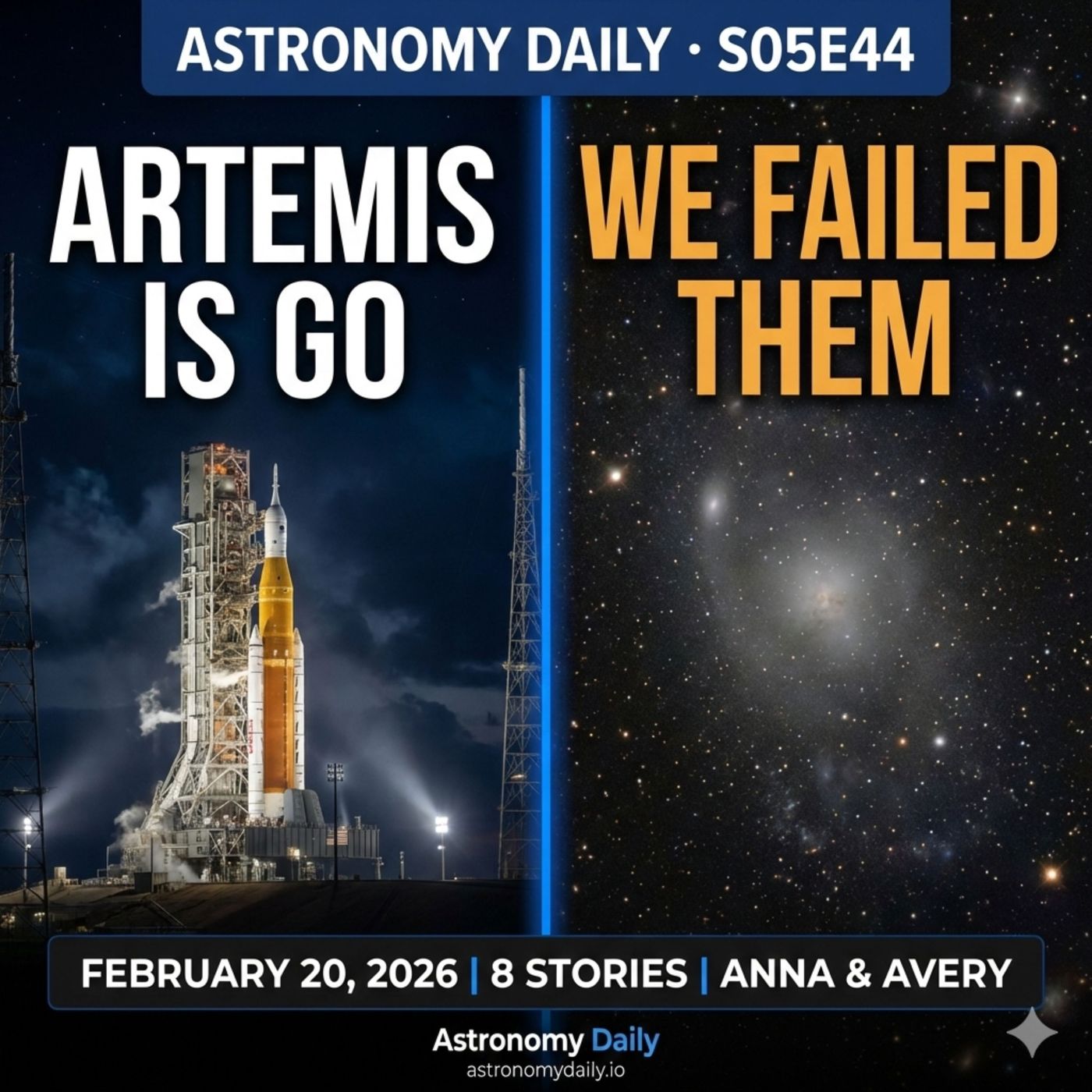
- NASA's Artemis Program Moves Forward: NASA is making strides with its Artemis program, aiming for the Artemis 2 mission to launch as early as February 2026. This mission will mark humanity's first return beyond low Earth orbit in over 50 years, testing the Orion crew capsule on a 10-day mission around the moon.
- Purdue University to Launch Suborbital Research Mission: In an exciting development, Purdue University will send a team to suborbital space aboard a Virgin Galactic flight in 2027. This mission, called Purdue One, will allow researchers and students to conduct hands-on experiments in microgravity, showcasing the growing accessibility of space research.
- Hubble Telescope Captures Cosmic Oddity: The Hubble Space Telescope has imaged NGC 2775, a galaxy that appears to blend characteristics of elliptical and spiral galaxies. This unique structure challenges existing models of galaxy formation, highlighting the complexity of our universe.
- New Insights from Asteroid Ryugu Samples: Research from the Hayabusa 2 mission reveals that water flowed through the parent body of asteroid Ryugu for over a billion years, suggesting that asteroids could have delivered essential ingredients for life to early Earth over an extended period.
- Dynamic History of Mars Revealed: Findings from NASA's Perseverance rover indicate that ancient rivers on Mars were more powerful than previously thought, reshaping our understanding of the planet's geological history.
- Hubble Observes White Dwarf Consuming Icy Object: The Hubble Space Telescope has observed a white dwarf star consuming a Pluto-like object, revealing a chemical signature rich in water ice. This discovery suggests that icy bodies similar to those in our solar system are common in other star systems.
- For more cosmic updates, visit our website at astronomydaily.io. Join our community on social media by searching for #AstroDailyPod on Facebook, X, YouTubeMusic Music, TikTok, and our new Instagram account! Don’t forget to subscribe to the podcast on Apple Podcasts, Spotify, iHeartRadio, or wherever you get your podcasts.
- Thank you for tuning in. This is Anna and Avery signing off. Until next time, keep looking up and exploring the wonders of our universe.
IMAP Launch Details
[NASA](https://www.nasa.gov/)
BION-M M2 Mission Update
[Russian Space Agency](https://www.roscosmos.ru/)
Artemis Program Update
[NASA](https://www.nasa.gov/)
Purdue University Mission Announcement
[Purdue University](
Anna: Hello, and welcome to Astronomy Daily, the podcast that brings you the latest news from across the cosmos. I'm your host, Anna. Avery: And I'm, um, Avery. It's great to be with you. We have a packed show today covering everything from an important upcoming launch and the Biological Space Lab's return to groundbreaking new plans for lunar missions and astonishing discoveries from the Hubble Telescope. Anna: Let's start with the action at Cape canaveral. NASA and SpaceX are counting down to a major launch from Florida this Wednesday morning.
The primary payload is the agency's Interstellar Mapping and Acceleration Probe, better known as imap. Avery: It's a really ambitious mission. IMAP is designed to journey about a million miles from Earth To Lagrange point 1, a gravitationally stable spot between us and the Sun. From there, it will study the boundary of the heliosphere, which is the giant magnetic bubble our sun creates around the solar system. It's essentially our protective shield against harsh galactic cosmic radiation. Anna: Understanding that boundary is crucial not just for pure science, but for protecting future astronauts on long duration missions to the Moon or Mars.
But as you mentioned earlier, IMAP isn't flying solo on its Falcon 9 rocket launchers. Avery: Exactly. This is a ride share mission. Joining IMAP is NOAA's Space Weather Follow on SFWO L1 satellite. This will be a critical tool for monitoring solar, wind and coronal mass ejections, which can disrupt our power grids and communications satellites here on Earth. There's also a third payload, the Carruthers Geo Corona Observatory, which will study Earth extended Atmosphere. Liftoff is scheduled for Wednesday at 7:30am Eastern Time.
That's 11:30 UTC. So it's an early start for a triple header of important science from a. Anna: Mission just beginning to one that has just concluded. A Russian biological research satellite, BION m M number two, successfully touched down on September 19th in the steppes of the Orenburg region. After spending a full month in Earth. Avery: Orbit, this mission has been nicknamed a Noah's Ark in space. And when you look at the passenger list, you can see why. The descent module carried an incredible variety of life.
75 mice, over 1500 fruit flies, as well as various cell cultures, microorganisms, and, um, even plant seeds. Anna: It's a continuation of a long series of studies into how living organisms respond to the space environment. The primary challenges, of course, are microgravity and increased radiation exposure. Scientists will be looking closely at the specimens to see the effects on everything from bone density and muscle mass in the mice to genetic changes in the flies and microorganisms. The data gathered is vital.
It helps us understand the fundamental risks of long term space travel for humans and develop countermeasures. It's a floating laboratory that provides insights we simply can't get on the ground. Speaking of human spaceflight, NASA is forging ahead with its Artemis program. Agency officials provided an exciting update this week saying that the Artemis 2 mission could take flight as early as February of 2026. This marks the very first time humans will venture beyond low Earth orbit in more than 50 years.
Avery: It's a hugely significant step. This will be the very first crewed flight for both the powerful Space Launch System rocket and the Orion crew capsule. The four person crew, NASA astronauts Reid Wiseman, Victor Glover and Christina Koch, along with Canadian Space Agency astronaut Jeremy Hansen, won't be landing on the moon just yet. Instead, they will fly a challenging 10 day mission on a free return trajectory that will loop them around the far side of the moon. Anna: The goal is to test all of Orion's life support systems, navigation and communication capabilities in deep space.
It's essentially the final dress rehearsal for the Artemis 3 mission that aims to land astronauts including the first woman on the lunar surface. It's truly the spiritual successor to the Apollo 8 mission that first orbited the moon in 1968. Pushing the launch to early 2026 gives teams the time they need to address technical challenges like those with the capsule's heat shield. Ensuring the crew's safety is the top priority. Avery: Absolutely. It's a methodical, step by step approach to a very complex endeavor.
But the excitement is palpable. Seeing that crew launch on a path around the moon will be a historic moment for a new generation. And it's not just government agencies planning ambitious flights. We're seeing more and more academic institutions getting directly involved. Purdue University just announced it will send a team of researchers, students and alumni to suborbital space aboard a Virgin galactic flight in 2027. Anna: This is fantastic news. The mission, called Purdue One, really highlights the democratization of space access.
The flight will carry five passengers from the university community. Two have already been named. Steven Collicot, a professor of aerospace engineering, and Abigail Mizzy, a UH graduate student. Avery: It's an incredible opportunity. For a few minutes, they'll experience a microgravity environment, allowing them to conduct hands on research that was once the exclusive domain of NASA astronauts. The experiments could cover a range of fields like fluid dynamics in zero G, material science, or even biomedical studies.
Anna: And beyond the specific research, the inspirational value is immense. Having students and professors become astronauts sends a powerful message. It Makes a career in space feel more attainable and will surely ignite the passion of countless future engineers and scientists. Let's zoom out now. Way beyond our solar system, the Hubble Space Telescope has once again captured an image of something both beautiful and baffling. Its latest picture of the week features a, uh, galaxy named NGC 2775, located about 67 million light years away in the constellation Cancer that simply refuses to be put in a box.
Avery: It's a genuine cosmic oddity. When you look at its center, you see a large, smooth central bulge with almost no gas or ongoing star formation. In that respect, it looks very much like an old, settled elliptical galaxy. But then your eyes move outward and you see this magnificent, intricate ring of gas and dust. Anna: And that ring is filled with chaotic, unevenly distributed clusters of bright, young blue stars. This structure is more typical of what's called a, uh, flocculant spiral galaxy, One where the spiral arms are patchy and not well defined.
It's like two different types of galaxies were stitched together. Avery: Astronomers are still trying to understand the evolutionary path that leads to such a hybrid structure. It challenges our models of galaxy formation and shows that nature is always more creative than we imagine. It's a stunning reminder of the vast, complex, and often strange universe we live in. Now let's bring our focus back to our own cosmic backyard. Incredible new research on samples returned from the asteroid Ryugu Is overturning some long held beliefs.
The analysis from Chaksa's Hayabusa 2 mission reveals that water flowed through the asteroid's parent body for much longer than ever thought possible. Anna: This is a really big deal. For a long time, the consensus was that water activity on asteroids, the interaction of water with rock, was something that only happened in the very earliest moments of the solar system's formation, maybe within the first few million years M. But. Avery: This new data shows evidence of water circulation more than 1 billion years after the asteroid itself formed.
This suggests that the interior of these ancient bodies could have remained warm and wet for an extended geological timescale. Anna: The implications for our own planet are profound. Ryugu is a carbonaceous asteroid, A, uh, type believed to be rich in water and organic compounds. If these asteroids were capable of holding liquid water for so long, it means they could have delivered these essential ingredients for life to the early Earth over a much longer period, and perhaps in greater quantities than our previous models suggested.
Avery: And while we're exploring our own solar system, let's turn to the Red Planet for a moment. New findings from NASA's Perseverance rover are uh, painting a much more dynamic picture of Mars ancient past. It appears a river that once flowed into the Jezero crater was far more powerful and fast moving than scientists previously imagined. A torrent of water carving through the landscape. The discoveries just keep on coming. Anna: For our final story today, we have another remarkable finding from the Hubble Space Telescope.
It has observed a burned out star, what's known as a white dwarf, in the act of consuming the fragments of a Pluto like object. This cosmic drama is unfolding relatively close to us, just 260 light years away. Avery: A white dwarf is the incredibly dense remnant core of a star like our sun, after it has exhausted its nuclear fuel. The gravity of this one is so intense that it's tearing apart this small icy body that strayed too close. And we're effectively seeing the star's atmosphere become polluted with the remains of this object, allowing us to study its composition.
As a material falls into the star, its chemical signature is revealed in the star's light. Anna: And the composition is what makes this so exciting. The fragments are loaded with volatiles, elements that vaporize at low temperatures like nitrogen, carbon, sulfur and oxygen. This chemical signature strongly indicates the presence. Avery: Of a lot of ice, an incredible amount in fact. The Hubble data suggests this exopluto object is composed of 64% water ice. It's a powerful confirmation that the kind of water rich icy worlds we see in the outer reaches of our own solar system, like Pluto and other Kuiper Belt objects, are likely common in other star systems too.
It tells us that the fundamental building blocks for life as we know it are widespread throughout the galaxy. Anna: That's all the time we have for. Avery: This episode and join us next time for more news from across the universe. Anna: I'm Anna, and on behalf of Avery and myself, thank you for listening and we'll see you tomorrow with more space and astronomy news. In the meantime, keep looking up.



 Apple Podcasts
 Spotify
 Pocket Casts
 Castbox
 Overcast
 Podbean
 iHeartRadio
 Castro
 Goodpods
 Moon FM
 Podcast Addict
 Podcast Republic
 YouTube