In this episode
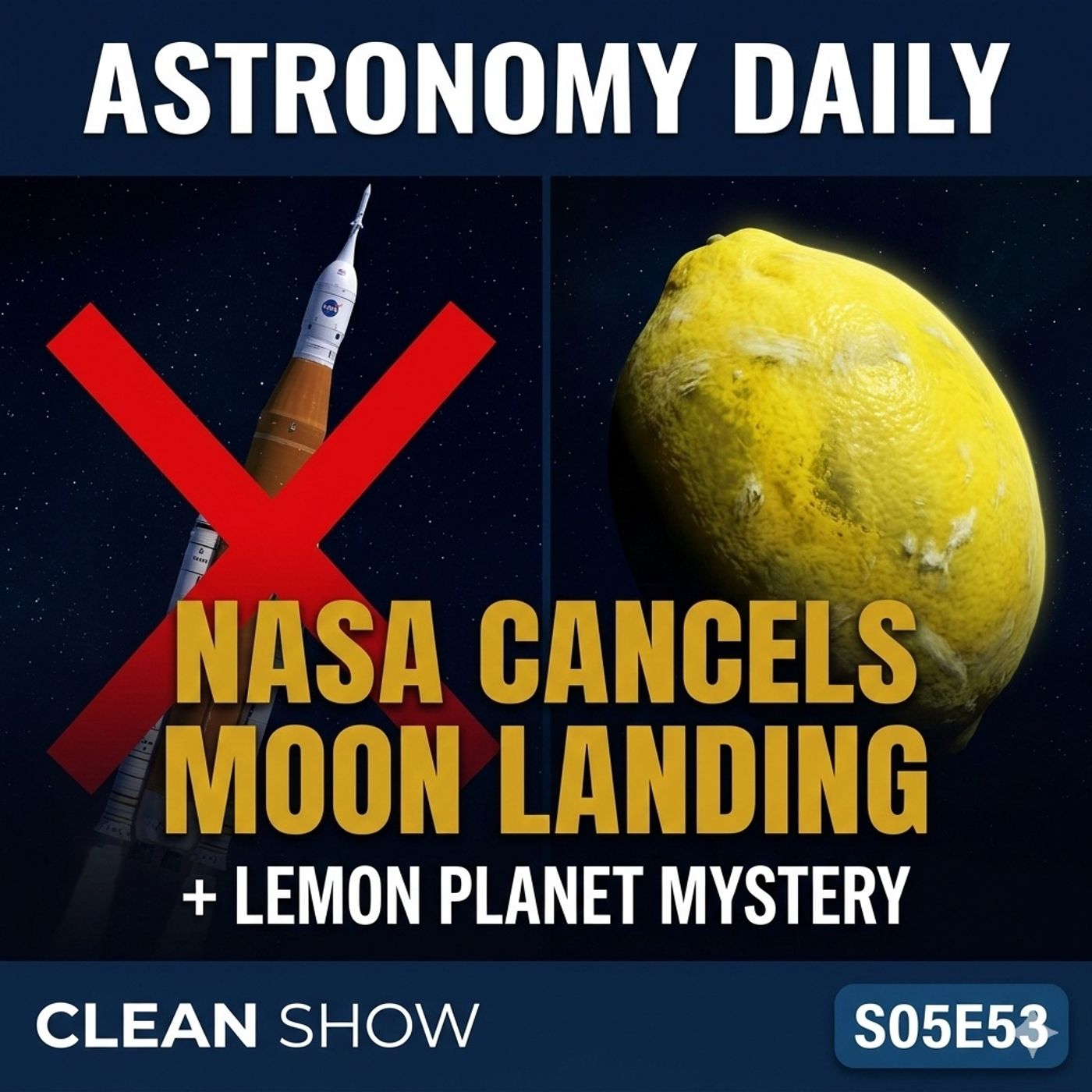
In today’s episode, Anna and Avery cover six stories from across the space and astronomy world — including a seismic shift in NASA’s Artemis program, a jaw-dropping Webb telescope discovery, fresh imagery of an interstellar comet, and the debut of a powerful new reusable rocket from China. 🚀 IN THIS EPISODE • NASA officially redesigns Artemis 3 — no Moon landing, and SpaceX’s Starship may not even fly on the mission • The James Webb Space Telescope discovers PSR J2322-2650b: a lemon-shaped exoplanet orbiting a pulsar every 7.8 hours, with a carbon-rich atmosphere that defies all known planetary science • A new ‘stochastic siren’ method using gravitational waves from merging black holes could finally resolve the Hubble tension — one of physics’ deepest mysteries • ESA’s JUICE spacecraft captures its first detailed image of interstellar comet 3I/ATLAS, revealing a glowing coma and sweeping tail • This week’s global launch roundup: Japan’s Kairos rocket makes its third attempt, and SpaceX eyes its 600th Falcon booster recovery • China’s CAS Space prepares to debut Kinetica-2, a reusable heavy-lift rocket targeting late March 🔗 LEARN MORE • Full episode details and blog post: astronomydaily.io • NASA Artemis updates: nasa.gov/artemis • Webb telescope news: science.nasa.gov/mission/webb ⭐ SUBSCRIBE & REVIEW If you enjoyed this episode, please leave us a review — it helps other space enthusiasts find the show. New episodes every weekday. Find us: astronomydaily.io • @AstroDailyPod • Bitesz.com Podcast NetworkBecome a supporter of this podcast: https://www.spreaker.com/podcast/astronomy-daily-latest-space-news--5648921/support.
Sponsor Details:
Ensure your online privacy by using NordVPN. To get our special listener deal and save a lot of money, visit www.astronomydaily.io/nordvpn. You'll be glad you did!
Get the best secure and private email on the planet. Stop your Government, google and who knows who else spying on every email you write. Do what we did and use ProtonMail. They beleive in privacy and there are no ads in their business model...yet they still provide a free forever service. Check them out and get out special deal at www.astronomydaily.io/protonmail
Become a supporter of Astronomy Daily by joining our Supporters Club. Commercial free episodes daily are only a click way... Click Here
This episode includes AI-generated content.
Speaker 1: Hello, and welcome to Astronomy Daily, your daily guide to the universe. I'm Anna and I'm Avery. It is Tuesday, the third of March twenty twenty six, and we are Season five, episode fifty three. Anna, quite a lineup today. We really do have something for everyone. We've got an update to that major shakeup at NASA, the kind that has the whole space community talking.
Speaker 2: We've got a planet shaped like a lemon. That's not a metaphor, it is literally shaped like lemon.
Speaker 1: There is a new approach to one of the biggest unsolved mysteries in all of physics.
Speaker 2: A space probe has snapped its first close up of an interstellar comet. And we've got your global launch roundup, including a big one from Japan making its third attempt.
Speaker 1: And China is about to debut a new reusable rocket that could shake up the commercial launch industry. Avery, where do we start.
Speaker 2: Let's start at the top with NASA and a decision that's rewriting the Artemis playbook.
Speaker 1: So Avery. When NASA Administrator Jared Isaacman stood up at Kennedy Space Center just days ago and said Artemis three will not be landing on the Moon, it was a significant moment.
Speaker 2: It really was to understand why a quick bit of context, Artemis three was meant to be humanity's first crude lunar landing since Apollo seventeen back in nineteen seventy two. That's over fifty years, a very long time to.
Speaker 1: Wait, and now it's not happening. Instead, the mission, now targeting a launch sometime in mid twenty twenty seven, has been completely redesigned. It will stay in low Earth orbit and focus on testing docking procedures between NASA's Orion capsule and the commercial lunar landers.
Speaker 2: And that's where it gets really interesting, because those landers are SpaceX's Starship and Blue Origins Blue Moon, and NASA is now openly keeping both of them in the running rather than committing exclusively to Starship.
Speaker 1: Isaacman was quite candid about why he compared the current Artemis cado to Apollo and found it wanting. Apollo was launching missions every four to five months, Artemis has been going every couple of years, which means the agency loses what he called muscle memory between flights, engineers leave procedures get rusty.
Speaker 2: And Starship, despite eleven test flights, has yet to reach Earth orbit. It's still technically a suborbital vehicle, and the list of milestones it needs to hit before it could put astronauts on the Moon orbital refueling, rendezvous and docking an uncrude lunar landing is still very long.
Speaker 1: So the plan now is Artemis three in low Earth orbit to test systems, then Artemis four as the first real moonlanding, targeting twenty twenty eight, and NASA is even talking about two moon landing missions in twenty twenty eight if they can get the launch cadence up ambitious.
Speaker 2: Very and in the meantime, Artemis two, the crewe fly by around the Moon with no landing, is still on track for an April launch after being rolled back to the vehicle assembly building for repairs to a helium flow issue.
Speaker 1: A lot happening on the Artemis front. We will absolutely keep you updated. Now, let's go somewhere much much further away, seven hundred and fifty light years.
Speaker 2: In fact, this one genuinely made me do a double take when I read it. Scientists using the James Web Space telescope have found an exoplanet unlike anything ever studied, and they are baffled.
Speaker 1: So let's set the scene. The planet is called PSR J two three two two DASH two six five zero B. It's about the mass of Jupiter, and it orbits its star at a distance of just one million miles. For comparison, Earth orbits the Sun at about one hundred million miles. This planet is one hundredth of that distance away.
Speaker 2: One complete orbit one full year for this planet takes just seven point eight hours.
Speaker 1: And its star is not a normal star. It's a pulsar, a raw, rapidly spinning neutron star, the collapsed core of a long dead massive star containing the mass of our entire Sun packed into something the size of a city.
Speaker 2: And the gravity from that pulsar is so extreme that it's literally stretching the planet. Instead of being roughly spherical like Earth or Jupiter, the gravitational tidal forces are pulling it into an elongated shape, like a lemon or an American football, if you prefer.
Speaker 1: The lead researcher, Michael Zang from the University of Chicago described it as the stretchiest planet we've confirmed, the stretchiness of which is a sentence I never expected to hear in astronomy.
Speaker 2: But the shape is almost the least weird thing about it. When WEB turned its infrared instruments on this world, the atmosphere came back completely wrong. Instead of water, methane, carbon dioxide, the things you'd normally expect on a gas giant, it's almost entirely helium and carbon.
Speaker 1: Carbon compounds called C two and C three, specifically molecular carbon, and because the pressure inside the planet is enormous, scientists think that carbon could actually be crystallizing in the deep interior forming diamonds.
Speaker 2: The surface temperature is around thirty seven hundred degrees fahrenheit, by the way, which is four times hotter than venus. So it's a lemon shaped diamond cord thirty seven hundred degree mystery world, orbiting a zombie star every eight hours.
Speaker 1: And nobody can explain how it formed, Zang said. The carbon composition rules out every known formation mechanism. It's part of what's called a black widow system, where the pulsar is slowly evaporating its companion, but even that doesn't fully explain what WEB is seeing.
Speaker 2: The team is seriously entertaining the idea that this might be an entirely new class of cosmic object, not quite a planet, not quite a stellar remnant, something in between with no name.
Speaker 1: Yet only Web could have found this. The pulsar amidst mostly gamma rays, which are invisible to infrared instruments, so Web could study the planet without the star drowning it out a pristine spectrum. The researchers called it a perfect observational setup. Remarkable stuff from the inexplicable to the cosmological.
Speaker 2: What's next, So the Hubble tension. If you've been listening to astronomy daily for any length of time, you've heard us mention this. But let's quickly recap why it matters so much.
Speaker 1: The Hubble constant is a measure of how fast the universe is expanding. Different methods of measuring it produce different answers, not wildly different. We're talking about a ten percent gap, but in cosmology that gap is enormous. If the universe's expansion rate isn't consistent, something in our fundamental model of physics is wrong.
Speaker 2: And now a team from the University of Illinois and the University of Chicago thinks they may have found the new tool that could finally help resolve it. They call let the stochastic Siren method.
Speaker 1: And it works like this. Every time two black holes spiral together and collide somewhere in the universe, which is happening constantly across billions of galaxies, they release gravitational waves ripples in the fabric of space time itself. Most of these events are too distant and too faint for us to detect individually.
Speaker 2: But together all those undetected collisions create a background hum, a constant, low level gravitational wave signal washing through everything all the time, and the team realized that by looking for or in this case, not finding that background signal in existing data from the Ligo, Virgo and Cogra detectors, they could actually constrain the hubble constant.
Speaker 1: Even the non detection is informative. If certain expansion rates were correct, you'd expect to see a background signal by now you don't, so those slower expansion scenarios can be ruled out.
Speaker 2: Combined with exact existing measurements from individual black hole mergers, the team produced a new, more precise estimate of the expansion rate, one that sets right in the contested zone where the hubble tension actually bites.
Speaker 1: The research is published in Physical Review Letters. Daniel Holtz from You Chicago put it well, saying it's not every day you come up with an entirely new tool for cosmology. And as gravitational wave detectors become more sensitive over the next decade, this method will only get sharper.
Speaker 2: The gravitational weight background itself is expected to be directly detected within about six years. When that happens, this technique becomes even more powerful. We might actually be within reach of solving one of the deepest puzzles in physics. Exciting times, from.
Speaker 1: The vast and theoretical to the relatively local. We had a visitor in our solar system and we've got a new photo.
Speaker 2: So three I slash Atlass has been quite the recurring care on the show, and with good reason. This is only the third confirmed interstellar object ever detected passing through our Solar system, and it's by far the most studied because we had more warning than with the previous.
Speaker 1: Two and now ESA's Juice spacecraft, the Jupiter icy Moons Explore currently in Root to Jupiter, has captured its first detailed image of the comet, and what it's showing is a bright, glowing coma surrounding the nucleus with a sweeping tail already developing.
Speaker 2: Juice was actually well positioned to get an early look at this object, which makes it a brilliant opportunistic observation. The spacecraft was designed to study Jupiter's moons, but its cameras are perfectly capable of turning onto a bright comet.
Speaker 1: What makes three i atlas so scientifically exciting is what it can tell us about chemistry beyond our Solar system. Interstellar objects carry the fingerprints of wherever they formed previous NASA observations. All Bettie revealed the coma and a flare up as it was heading outward, and the composition data has been trickling in.
Speaker 2: And now we have Juice's optical imagery to add to that picture. Every instrument, every telescope, every spacecraft that can contribute data is doing so. This is coordinated Solar System science at its best.
Speaker 1: Three I at lists is now heading back out into the Solar System. So the window for observations is narrowing, but the data already collected, we'll be keeping researchers busy for years. Now, let's check in on what's flying this week.
Speaker 2: It is a busy week at launch sites around the globe. Five missions on the schedule, and there are some real standout moments to watch for.
Speaker 1: The international highlight is japan Space one, a commercial startup backed by Canon Electronics and Ihi Aerospace, is attempting its third launch of the Cairos rocket from Spaceport Key on the Key Peninsula. The window opens Wednesday, the fourth of March.
Speaker 2: Now, the first two Cairos flights did not go well. Flight one in March twenty twenty four was terminated by the Autonomous Flight Termination System due to first stage underperformance. Light two in December twenty twenty four was lost because a sensor failure caused loss of control during the first stage burn.
Speaker 1: Third time lucky hopefully. This flight is targeting Sun synchronous orbit and is carrying five small payloads from a range of customers, including satellites from Taiwan and a microsatellite from a Japanese high school. Lovely to see that kind of diversity.
Speaker 2: On the SpaceX side, there are four Falcon nine missions this week, launching from both Cape Canabrol and Vandenberg. The standout is a Vandenberg launch on Wednesday, where booster B ten seventy one will be flying for its thirty second mission, and that landing will mark SpaceX's six hundredth Falcon booster recovery attempt.
Speaker 1: Six hundred the numbers just keep getting bigger and more mind boggling. A booster that's flown thirty two times is extraordinary by any standard. This week's Falcon nine missions will also push SpaceX to its thirtieth launch of twenty twenty six. Overall, the cadence is relentless, and we're watching.
Speaker 2: The Chiros launch particularly closely. Japan's commercial launch sector has been growing, and the successful Chiros flight would be a significant milestone for the country's private space industry. Fingers crossed now speaking of new rockets.
Speaker 1: And we close today's episode with a look further ahead to the end of March, when China's commercial space sector is about to make a significant move.
Speaker 2: CAS Space, a commercial offshoot of the Chinese Academy of Sciences, is preparing to debut its new Connecticut two rocket. Launch is targeted for late March from the Gooquan Satellite Launch Center out in the Gobi Desert.
Speaker 1: The Connecticut two is a fifty three meter tall rocket powered by three YF one oh two engines running on kerosene and liquid oxygen, a similar propellant combination to SpaceX's Falcon nine, and like Falcon nine, it's designed to be reusable.
Speaker 2: It can carry up to twelve thousand kilograms to low Earth orbit or around seventy eight hundred kilograms to a five hundred kilometers Sun synchronous orbit. That's a meaningful capability. It puts it in a similar class to Falcon nine in terms of payload.
Speaker 1: For its debut mission, it's carrying the qin Zau one, a prototype cargo spacecraft designed to eventually resupply China's Tiongong space station. Think of it as China's equivalent of testing a dragon capsule, a first step toward a regular, affordable resupply.
Speaker 2: System, and cast Base has ambitious plans. They're aiming for at least four Kinetica two launches in twenty twenty six alone, including missions to deploy satellites into mega constellations, directly competing with Starlink in the global broadband market.
Speaker 1: It's worth noting that CAAs Space's smaller solid fuel rocket, the Kineticut one, has already flown eleven successful missions and has eight more planned for this year, so this is not a first time player, they have operational experience.
Speaker 2: The broader picture is that the global commercial launch industry is genuinely becoming competitive in a way it never was before. BaseX still leads, but you now have serious players from China, Japan, Europe and beyond all developing capable, affordable rockets. It's a fascinating time to be watching this space unabsolutely intended.
Speaker 1: And on that note, it's time to wrap up episode fifty three.
Speaker 2: Really already?
Speaker 1: Yes, that is a wrap on Astronomy Daily Season five, episode fifty three. What a week it's shaping up to be. From NASA's lunar reset to lemon planets, to cosmic background hums to ar new reusable rocket on the launch pad.
Speaker 2: If you've enjoyed today's episode, we would love it if you leave us a review. Wherever you listen, it really does make a difference in helping new listeners find the show.
Speaker 1: You can find full show notes, blog posts, and more over at Astronomy Daily dot io, and follow us on social media at astro Daily Pod for daily space updates.
Speaker 2: Until next time, keep looking up. The universe has no shortage of surprises.
Speaker 1: Clear skies everyone, goodbye.
Speaker 2: Say stars, Star



 Apple Podcasts
 Spotify
 Pocket Casts
 Castbox
 Overcast
 Podbean
 iHeartRadio
 Castro
 Goodpods
 Moon FM
 Podcast Addict
 Podcast Republic
 YouTube