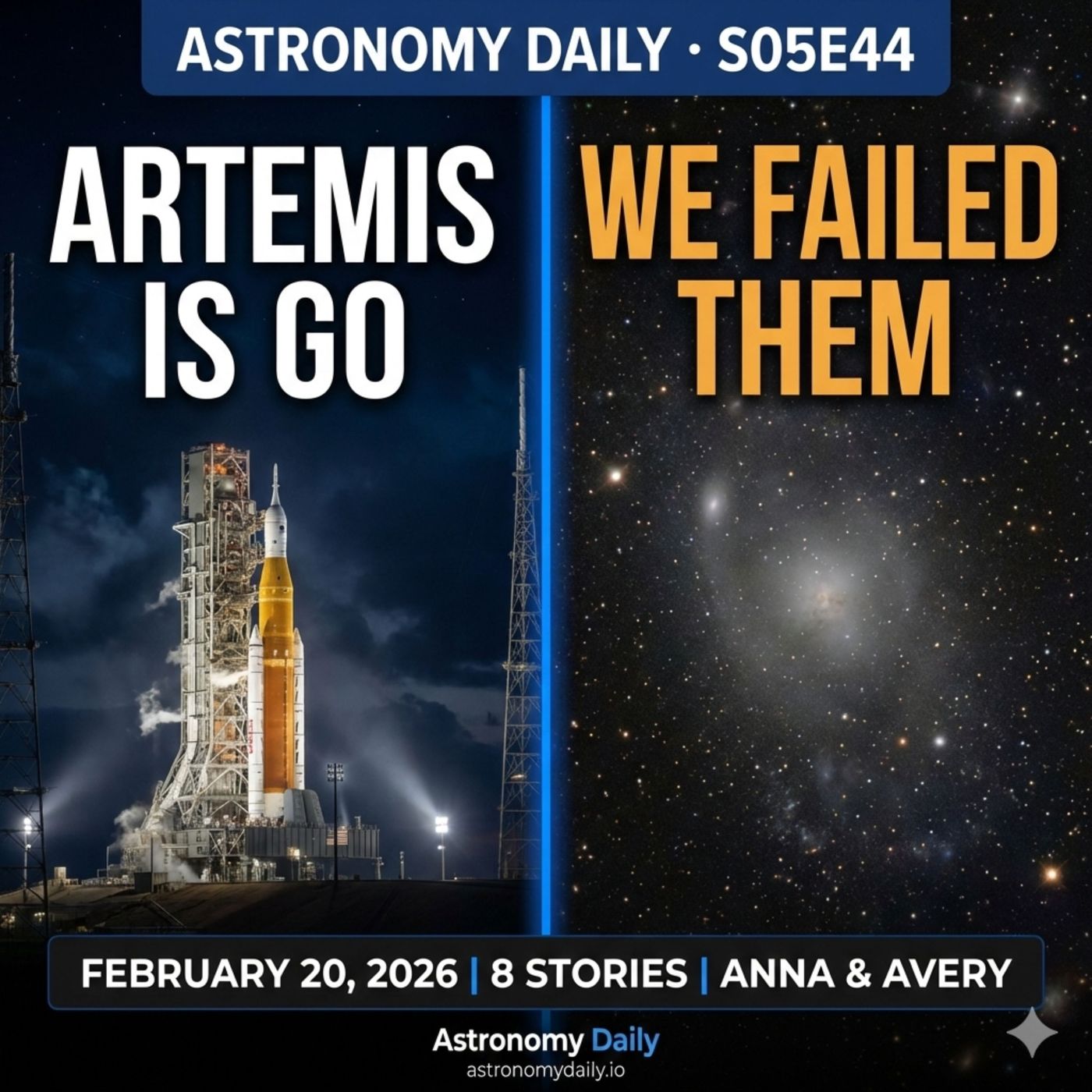
"We Failed Them" — Starliner Bombshell as Artemis II Gets the Green Light
In this episode
S05E44 | Friday, February 20, 2026 It's a big one today! We cover EIGHT stories including breaking news from NASA's Kennedy Space Center, a damning independent report into the Boeing Starliner crisis, two astonishing dark matter discoveries, the first ancient Jellyfish Galaxy, SpaceX rocket pollution science, and a cosmic farewell to a comet we'll never see again. Plus — yes — we briefly and responsibly address the UFO/UAP conversation. Stories in this episode: • Artemis II Wet Dress Rehearsal — Did NASA just clear the path to a March 6 launch? • Starliner Independent Report — NASA says 'we failed them' as Type A mishap is confirmed • UAP Files — Trump hints at declassification: should we get excited? • Hubble finds CDG-2: the most dark matter-dominated galaxy ever discovered • Jellyfish Galaxy spotted 5 billion years after the Big Bang — earlier than thought possible • First real-time observation of SpaceX rocket re-entry pollution cloud • First confirmed dark galaxy — a structure with no stars at all • Comet Wierzchoś at closest approach today — and it's never coming back🌐 astronomydaily.io | 📱 @AstroDailyPod | Part of the Bitesz.com Podcast Network
Become a supporter of this podcast: https://www.spreaker.com/podcast/astronomy-daily-latest-space-news--5648921/support.
Sponsor Details:
Ensure your online privacy by using NordVPN. To get our special listener deal and save a lot of money, visit www.astronomydaily.io/nordvpn. You'll be glad you did!
Get the best secure and private email on the planet. Stop your Government, google and who knows who else spying on every email you write. Do what we did and use ProtonMail. They beleive in privacy and there are no ads in their business model...yet they still provide a free forever service. Check them out and get out special deal at www.astronomydaily.io/protonmail
Become a supporter of Astronomy Daily by joining our Supporters Club. Commercial free episodes daily are only a click way... Click Here
This episode includes AI-generated content.
Speaker 1: Hello, and welcome back to Astronomy Daily. I'm Anna and I'm Avery.
Speaker 2: It's Friday, February the twentieth, twenty twenty six, and our producer has absolutely loaded us up. Today. We've got eight stories to get through.
Speaker 1: Eight, that's right, and honestly, they're all worth it. We've got huge breaking news from the Kennedy Space Center about Artemis two, a genuinely damning report that NASA itself has described as we failed them, some absolutely mind bending deep space discoveries. And yes, we are going to briefly talk about UFOs.
Speaker 2: We absolutely are, just briefly and responsibly.
Speaker 1: Responsibly that is the word. Right, let's dive in. There is a lot of ground to cover.
Speaker 2: I think this might be the biggest episode we've ever done, but there's plenty to cover today.
Speaker 1: We are going to start with the biggest space story of the week, and it's one that broke overnight. DASA has just completed its second wet dress rehearsal of the Artemis two Space launch System rocket, and from everything we're hearing, it went well.
Speaker 2: Really well. Actually, teams ran the SLS through a full countdown, fueling the rocket with its super cold liquid hydrogen and liquid oxygen, simulating launch day procedures right down to closing the orion crue caudal hatch, and they got all the way to T minus twenty nine seconds before wrapping up. That is exactly where they wanted to stop.
Speaker 1: And this matters enormously because the first wet dress rehearsal back on February second and third had to be called off early due to hydrogen fuel leaks at launch Pad thirty nine B. That was a setback. NASA had to go in and replace seals and there was very real uncertainty about whether they'd solve the problem.
Speaker 2: And it looks like they have. NASA is holding a media briefing this morning eleven am Eastern, and we'll be watching that closely, but the early word is positive.
Speaker 1: So for anyone who needs refresher on what this mission actually is, Artemis two is the first crude flight of the Artemis program. It's not a moon landing that comes later with Artemis three, but it is the first time humans will travel to lunar distance since Apollo seventeen in nineteen seventy two. We are talking more than fifty years and the.
Speaker 2: Crew is Commander Read Wiseman, pilot Victor Glover, mission specialist Christina cock All NASA, and mission specialist Jeremy Hansen from the Canadian Space Agency. They're going to fly around the Moon in a free return trajectory and come home ten days. No landing, but an absolutely historic journey.
Speaker 1: And if this morning's press conference gives the all clear, the launch window we're looking at is as early as March sixth, That is just two weeks away. Avery, What does that feel like to you?
Speaker 2: Honestly, it feels surreal. We've been living in the Artemis era for years now. Artemis ie flew in twenty twenty two, and it's been a long road to get here. But two weeks from now there could be four astronauts on their way to the Moon.
Speaker 1: We will have full coverage as things develop, and if that briefing produces any surprises, we'll update you in tomorrow's episode. For now, though, looking very good for Artemis three now.
Speaker 2: While NASA is very much in celebratory mode for this morning, yesterday they were facing a very different kind of news day. An independent review board release its full report into the Boeing Starliner crude flight test, and it is a damning document.
Speaker 1: Damning is the word. The report formally classifies the Starliner mission as a quote type A mishap, the most serious category in NASA's safety framework. That means it was an event that could have resulted in death or permanent disability. And NASA Administrator Jared Isaacman stood up in front of the cameras yesterday and said, and I'm paraphrasing here, we almost did have a really terrible day.
Speaker 2: We failed them, them being astronauts Butch Wilmore and Sunny Williams, who launched in June twenty twenty four expecting to be gone for eight to ten days and ended up spending two hundred and eighty six days in orbit.
Speaker 1: Right, So let's just remind listeners how we got here. Boeing won a four point two billion dollar contract from NASA back in twenty fourteen to build the Starliner as a second commercial crew vehicle alongside SpaceX's Crew Dragon. Starliner ran into problems on its very first uncrewed test flight in twenty nineteen, needed a second unpiloted flight before it was deemed ready, and Butch and Sunny finally launched in June of last year.
Speaker 2: The trip up went ok. They docked successfully with the International Space Station, but during the rendezvous approach, the capsule experienced multiple helium leagues in the propulsion system and several of the maneuvering prusters failed. There was a moment where they temporarily lost with a report calls six degrees of freedom control. Had things gone differently in those minutes, had the thrusters not recovered, docking might not have been possible.
Speaker 1: And what's really chilling about reading the report is discovering just how many warning signs were there. The investigation found that NASA and Boeing were aware of concerns that weren't fully understood, but were considered acceptable for flight anyway. There was pressure, institutional pressure to make this mission succeed because the entire commercial crew program's credibility depended on having two viable crew vehicles.
Speaker 2: The report quotes unnamed massive personnel saying things like there was yelling in meetings, it was emotionally charged and unproductive, and if you weren't aligned with the desired outcome, your input was filtered out or dismissed. One person said they stopped speaking up entirely because they knew they'd be dismissed.
Speaker 1: That is a profoundly troubling portrait of an organization under pressure, and what makes it worse is this, One NASA worker told the investigation panel roughly eleven months after the mission, nobody within NASA or outside of NASA has been held accountable.
Speaker 2: Nobody Administrator Isaacman addressed that head on. He said there will be accountability. He said, the report reveals that advocacy for the missions success quote exceeded reasonable bounds and placed the mission, the crew, and America Space program at risk. He also made clear that NASA will not fly another crew on Starliner until the technical causes are understood, the propulsion system is fully qualified, and all sixty one recommendations from this report are implemented.
Speaker 1: Sixty one recommendations spanning technical, organizational, and cultural domains. Boeing, for its part, said they've made substantial progress and driven significant cultural changes.
Speaker 2: We'll see. It's worth noting, Butch and Sony are safe. They got home in a SpaceX crew drag in early twenty twenty five and have since retired from NASA. But this report is a stark reminder of just how close things came to going very wrong, and how important is that the lessons are actually learned.
Speaker 1: One more thing before we move on. Isaacman confirmed the eventual cost of Starliner's woes exceeded the two million dollar type A mishap threshold by quote one hundredfold, So not just a safety crisis, an enormous financial one too.
Speaker 2: All right, we promised you this, and here it is. President Trump has been making noise again about UAPs, unidentified aerial phenomena, and the possibility of releasing classified government files, including apparently what's actually going on at Area fifty one.
Speaker 1: And look, the serious astronomy community broadly keeps its distance from this territory for good reasons. We're not going to go deep on it today because there is genuinely not much new substance to report yet, its hints and statements rather than actual declassification.
Speaker 2: But and this is an honest butt, if genuine classified data about UAP encounters were actually released in a verifiable, scientifically usable form, that would be worth serious examination. The scientific community has actually been pushing for more transparency in this area for years. The issue has never been whether UFOs are real as a phenomenon. There are clearly things being observed that pilots and sensors can't immediately explain. The question is what they actually are.
Speaker 1: Right, And the history of these big reveals is, shall we say, not encouraging. You get a lot of heavily redacted documents, a lot of blurry footage, and then not much.
Speaker 2: Area fifty one, though that is a name. If files about what's actually been going on out there, and then Nevada Desert come out, even if it's all just experimental aircraft, that's going to be a fascinating day. Regardless.
Speaker 1: We will watch this space pun an tended. If something genuinely newsworthy emerges from the UAP file story, we will cover it properly. For now, back to the actual cosmos.
Speaker 2: Now, this is one of those stories that really makes you stop and think about how strange the universe is. NASA's Hubble Space Telescope has identified what may be the most heavily dark matter dominated galaxy ever discovered.
Speaker 1: The object is called CDG two and CDG stands for circumgalactic diffuse galaxy, which is already a fascinating description. It's an extraordinarily faint, low surface brightness galaxy that's basically invisible when you look at it. There are only a sparse scattering of faint stars, but according to the measurements, the vast majority of its total mass is dark matter.
Speaker 2: We should take a moment here to explain what dark matter actually is for anyone who's new to the show. Dark matter is the name we give to whatever makes up most of the mass of the universe that we can't see, can't di tech directly, and don't fully understand. We know it exists because of its gravitational effects, the way galaxies rotate, the way light bends around galaxy clusters, but beyond that, it remains one of the great unsolved problems in physics.
Speaker 1: And CDG two is interesting because it seems to be almost entirely dark matter. The few stars it contains are almost an afterthought. It's like finding a house that's built almost entirely of invisible walls. You could only see the wallpaper.
Speaker 2: What makes this particularly significant is that we've long theorized that galaxies like this should exist. In the standard model of cosmology, dark matter forms the scaffolding that ordinary matter gas stars planets falls into and clumps around, but most galaxies have converted a good portion of that gas into stars by now. CDG two seems to have barely bothered.
Speaker 1: The question is why why did so little star formation occur here? Was it stripped of its gas by interactions with neighboring galaxies? Is it in an unusually isolated environment. Those are the questions that will keep astronomers busy for a while, but as a window into dark matter's dominant role in shaping the cosmos, this.
Speaker 2: One is remarkable. Aimen to that.
Speaker 1: From one galaxy mystery to another, astronomers have spotted a candidate jellyfish galaxy, one of the most visually striking types of galaxies we know of, dating back to just five billion years after the Big Bang. And the reason this is extraordinary is because theory said this shouldn't be possible.
Speaker 2: Let me explain what a jellyfish galaxy is for anyone picturing an actual jellyfish floating through space, which honestly is not a bad mental image. A jellyfish galaxy gets its name from the long streamers of gas and young stars that trail behind it like tentacles. They form through a process called ram pressure stripping.
Speaker 1: Ram pressure stripping is a essentially what happens when a galaxy moves through the hot diffuse gas that fills galaxy clusters what astronomers call the inter cluster medium. The galaxy is moving so fast through this medium that it gets the cosmic equivalent of a blast of wind from the front, and the gas in its outer regions gets blown backwards, forming those trailing streams.
Speaker 2: Now. The reason this discovery is so significant is that ram pressure stripping was thought to require a dense enough cluster environment to operate, and in the early universe, five billion years after the Big Bang, clusters weren't expected to be dense enough. Yet the universe was younger, less evolved, clusters were less mature.
Speaker 1: And yet here we have what looks like a fully formed jellyfish galaxy from that early era. It challenges our timeline of how galaxy clusters developed and how ram pressure stripping operated in the young universe.
Speaker 2: There's also a bonus mystery here. The discovery may shed light on the so called red nugget galaxies compact red massive galaxies from the early Universe that have puzzled astronomers for years. The theory is that ram pressure stripping in jellyfish galaxies could be one of the mechanisms that transform normal star forming galaxies into those quiescent red nuggets. If confirmed, this single galaxy could be a crucial missing link in understanding how galaxies evolve.
Speaker 1: It does still need to be confirmed. It's officially a candidate at this stage, but the evidence looks strong. And this is exactly the kind of thing that makes deep sky astronomy so endlessly fascinating.
Speaker 2: All right, here's a story that's a little different in flavor. It's part wow, cool science, part should we be thinking about this more carefully? Yes.
Speaker 1: For the first time ever, scientists have observed a cloud of air pollution forming in near real time as a SpaceX rocket burned up during re entry into Earth's atmosphere. And I want to be clear about what we mean, I burned up here. This isn't a failed mission. This is the normal end of life process for a rocket stage where it re enters the atmosphere and disintegrates through the heat of reentry.
Speaker 2: So these things happen routinely, And what sciences have now been able to do using atmospheric monitoring instruments is actually watch in something close to real time the chemical cloud that forms as the rocket material vaporizes, metals, aluminum oxide, particles, various combustion products, all of it lighting up in the instruments.
Speaker 1: And this matters because we're launching things at an ever increasing rate. SpaceX alone is launching dozens of missions per year. If every re entry deposits a cloud of metallic particles and other pollutants into the upper atmosphere, and we're doing this hundreds of times a year, what does that add up to over a decade.
Speaker 2: The honest answer right now is we don't fully know. This is genuinely new science. Researchers have been raising concerns about the potential impact of rocket exhaust and re entry pollution in the stratosphere for a few years now, but being able to observe it in real time to actually characterize what's happening, is a significant step towards understanding the cumulative effect.
Speaker 1: It's one of those stories where the science itself is fascinating, but the implications quietly deserve more attention than they're getting. The space economy is booming. That's wonderful in many ways, but what are the environmental costs of a high cadence launch industry is a question that needs answering, and researchers are now developing the tools to start answering.
Speaker 2: It something to watch, and full credit to the scientists making these observations pioneering work.
Speaker 1: Now we come to a story that, and I say this with genuine enthusiasm, is about as mind bending as astronomy gets. Researchers may have confirmed the very first true dark galaxy. Not just a galaxy dominated by dark matter like CDG two we discussed Earth, but a galaxy made almost entirely of dark matter with effectively no stars at all.
Speaker 2: A dark galaxy, in theory, is a region of space where dark matter has clumped together in sufficient quantity to form a gravitationally bound structure, essentially a galaxy shaped thing, but where ordinary matter has never clumped enough to form stars or has been stripped away entirely. We've theorized they should exist for decades, and now we may finally have one.
Speaker 1: I want to sit with that for a second. A galaxy a structure that has all the gravitational signatures of a galaxy with no stars in it. You literally cannot see it with any optical telescope. It's detectable only by its gravitational effects on nearby visible matter.
Speaker 2: It's like detecting a ghost by watching how other people react to the room it's standing in.
Speaker 1: That is exactly the right analogy. Actually, the way astronomers identify these objects is by looking at how their gravity warps the light and motion of surrounding galaxies, and when they do the maths on the candidate identified in this new research, the numbers point to a massive dark matter structure with essentially no luminous component.
Speaker 2: If confirmed, this would be a genuinely landmark moment in cosmology. We've known for decades that dark matter vastly outweighs ordinary matter in the universe, roughly five to one, but actually finding a structure that is purely dark matter with no ordinary matter hitch hiking along inside it would be extraordinary observational proof of how dark matter can organize itself independently.
Speaker 1: The researchers are being appropriately cautious. This requires further confirmation and independent verification, but the evidence is compelling. We'll keep you posted as this one develops, and.
Speaker 2: We close today with something a little different in mood, something poetic actually, comments.
Speaker 1: C Slash two zero two four e one, known as comet wear Kosh after its discoverer, as we mentioned earlier in the week, is making its closest approach to Earth today. Right now, as you listen to this, the comet is passing at roughly the same distance from Us as the Sun, about one astronomical unit, and it's putting on a genuinely beautiful display for those with telescopes or binoculars in the right conditions.
Speaker 2: There are images out already, a gorgeous thirty minute exposure taken last week from Chile showing a five degree long ion tail that's ten times the width of the full Moon in the sky, plus three shorter dust tails. The coma of the comet glows green from the breakdown of dicarbon molecules by sunlight.
Speaker 1: But here's what makes this one special and why we wanted to close the show with it. Commetware Coche is on a hyperbolic.
Speaker 2: Orbit, which means it is not coming back.
Speaker 1: It is not coming back. This comment has traveled from the outermost reaches of the Solar System. It's wung around the Sun, passed close by our little blue dot, and when it leaves, it will leave forever. Its orbit carries it out of the Solar System entirely into interstellar space. It will become a wanderer between the stars.
Speaker 2: You know, we had THREEI dot atls this season, the interstellar object that came into our solar system from somewhere else entirely, that was a visitor from interstellar space commetware Koch is going the other direction. It's leaving.
Speaker 1: We're waving goodbye to a comment that no human will ever see again. And I find that genuinely moving. So if you have clear skies tonight or this weekend, and you can get to a dark spot with a pair of binoculars, it is worth trying to find it. Check the Astronomy apps for its exact position. It is bright enough to see last chance, a cosmic farewell. And that's a wrap on a genuinely packed episode of Astronomy Daily. Eight stories, breaking news, accountability, journalism, mind bending, deep space science, and a cosmic goodbody.
Speaker 2: Thank you so much for spending part of your Friday with us. If you enjoy today's show, please do leave a review wherever you listen. It makes a huge difference in helping new listeners find us.
Speaker 1: You can find us at Astronomy Daily dot io for the blog and show notes, and we're at astro Daily Pod across all the social platforms we'll see you again tomorrow, and if Artemis two gets a launch date confirmed today, we'll make sure that's front and center.
Speaker 2: Until then, keep looking up clear skies.
Speaker 3: Everyone say, star is the tall, Star is the tall
Speaker 2: Story is the



 Apple Podcasts
 Spotify
 Pocket Casts
 Castbox
 Overcast
 Podbean
 iHeartRadio
 Castro
 Goodpods
 Moon FM
 Podcast Addict
 Podcast Republic
 YouTube