In this episode
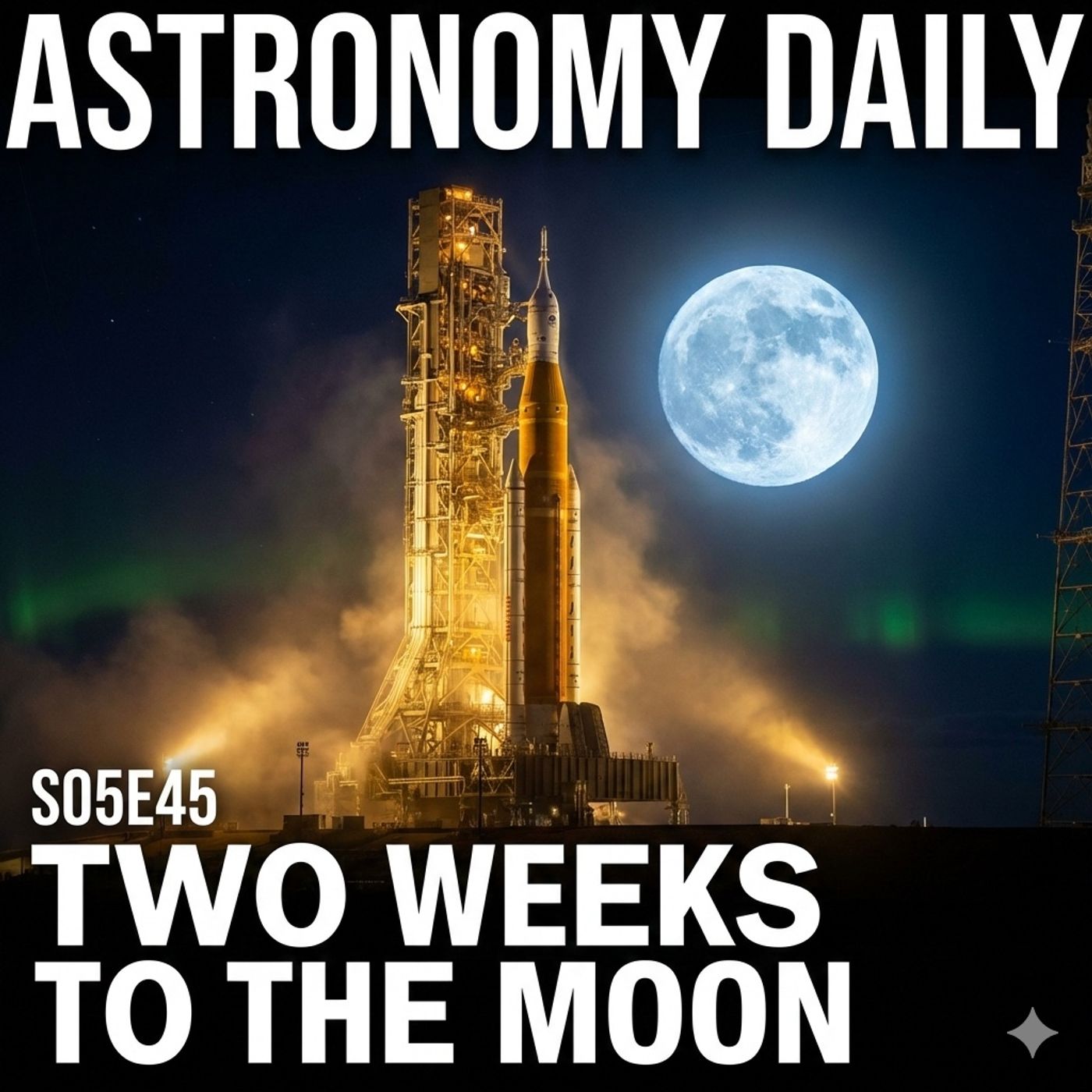
Astronomy Daily — Season 5, Episode 45 | February 21, 2026 "Countdown to the Moon: Artemis II Crew in Quarantine" The Artemis II crew — Commander Reid Wiseman, Pilot Victor Glover, Mission Specialist Christina Koch (NASA), and Mission Specialist Jeremy Hansen (CSA) — have officially entered quarantine ahead of a targeted March 6, 2026 launch. With the second Wet Dress Rehearsal completed successfully on February 19th, humanity is just two weeks away from returning to the Moon for the first time since Apollo 17 in 1972. Anna and Avery break down everything you need to know about this historic mission. Also on today's episode: • DARK MATTER UNDER PRESSURE: A new paper in Physical Review D claims its findings represent the first step toward the end of dark matter theory as we know it — researchers have found a plethora of baryonic (ordinary) dark matter signals that challenge the standard cosmological model. • AURORA WATCH: A large coronal hole on the Sun has rotated into a geoeffective position, with fast solar wind expected to reach Earth around February 22nd. Skywatchers at higher latitudes should keep their eyes on the skies tomorrow night. • MARS WATER UPDATE: New research suggests water ice on Mars may be accessible far closer to the equator than previously believed — a game-changing development for future human exploration of the Red Planet. • SERIAL KILLER BLACK HOLES: Astronomers using James Webb Space Telescope data have confirmed that active supermassive black holes don't just shut down star formation in their own galaxies — they can suppress star formation in neighbouring galaxies too. • SPACEX NEAR MISS: SpaceX successfully landed its Falcon 9 booster in The Bahamas for only the second time ever after launching 29 Starlink satellites — but someone at SpaceX admitted they 'almost did have a really terrible day.' Full show notes and episode sources available at astronomydaily.io Follow us: @AstroDailyPod on all platforms Part of the Bitesz.com Podcast NetworkBecome a supporter of this podcast: https://www.spreaker.com/podcast/astronomy-daily-latest-space-news--5648921/support.
Sponsor Details:
Ensure your online privacy by using NordVPN. To get our special listener deal and save a lot of money, visit www.astronomydaily.io/nordvpn. You'll be glad you did!
Get the best secure and private email on the planet. Stop your Government, google and who knows who else spying on every email you write. Do what we did and use ProtonMail. They beleive in privacy and there are no ads in their business model...yet they still provide a free forever service. Check them out and get out special deal at www.astronomydaily.io/protonmail
Become a supporter of Astronomy Daily by joining our Supporters Club. Commercial free episodes daily are only a click way... Click Here
This episode includes AI-generated content.
Speaker 1: Hello, and welcome to Astronomy Daily.
Speaker 2: I'm Anna and I'm Avery. It is Saturday, February twenty first, twenty twenty six, and you are locked in for Season five, episode forty five. We have got a packed show for you today.
Speaker 1: We really do. We are just two weeks away from what could be one of the most significant launches in the history of human spaceflight, and the crew is now officially in quarantine. Humanity is going back to the Moon.
Speaker 2: People beyond the Moon actually for the first time since nineteen seventy two. We'll have the full artemis to update in just a moment. Plus, scientists may be challenging the very foundations of dark matter theory. There's a solar storm brewing that could light up disguise as early as tomorrow.
Speaker 1: Night Mars is holding water a lot closer to home than we thought. Great moves if you're planning to move there. And astronomers have confirmed that super massive black holes are not content with just destroying their own galones. Apparently they've been going after the neighbors too.
Speaker 2: Serial killers of the Cosmos. We'll explain, and we'll wrap up with a SpaceX story that came very close their words not ours to being a very bad day.
Speaker 1: Let's get into it, all right, Let's.
Speaker 2: Start with the big one. As of yesterday evening, Friday, February twentieth, twenty twenty six, the four astronauts of NASA's Artemis two mission have officially entered quarantine in Houston, Texas.
Speaker 1: And if you know anything about space mission protocols, entering quarantine is one of the clearest signals you can get that a launch is genuinely imminent. BASA is targeting no earlier than Friday, March sixth, and that clock is now ticking.
Speaker 2: So let's set the scene for anyone who needs a quick refresher. Artemis two is the second mission of NASA's Artemis program, and it will be the first crude mission to travel beyond Low Earth orbit since Apollo seventeen back in December nineteen seventy two. We're talking more than fifty years.
Speaker 1: Fifty three years to be precise, and the crew that will make this historic journey consists of four astronauts Commander Reid Wiseman, pilot Victor Glover, and Mission Specialist Christina Cock from NASA and Mission Specialist Jeremy Hansen from the Canadian Space Agency.
Speaker 2: They entered quarantine at approximately five pm local time on Friday evening in Houston. The quarantine period is typically about fourteen days, during which the crew limits their exposure to other people to make sure they stay in good health before launch. They'll fly down to Kennedy Space Center in Florida about five days before launch day.
Speaker 1: And the reason NASA is feeling confident enough to put them into quarantine now is the success of the second wet dress rehearsal, which took place on Thursday, February nineteenth. Now, avery, for the uninitiated, what exactly is a wet dress rehearsal?
Speaker 2: Great question. A wet dress rehearsal is essentially a full dress rehearsal of launch day, except you don't actually light the engines. At the end, the team slowed the rocket with its full complement of cryogenic propellants in the case of the Space Launch System, that's more than seven hundred thousand gallons of super cold liquid hydrogen and liquid oxygen, and then run through the entire launch countdown sequence right down to the final seconds.
Speaker 1: And the reason they needed a second rehearsal was that the first attempt on February third had to be called off when a hydrogen leak was detected. Engineers replaced seals and a filter in the ground support equipment, and on Thursday night they ran the whole thing again, and this time hydrogen concentrations stayed within safe limits throughout.
Speaker 2: They actually ran through the terminal countdown the final ten minutes twice. The test concluded at ten to sixteen Eastern Time, stopping at T minus twenty nine seconds as planned. Now there was a minor communications glitch in the l launch control center that cause a brief delay early in the test, and a booster avionics voltage anomaly that paused a terminal countdown for a short time, but both were resolved and NASA declared the rehearsal a success.
Speaker 1: So what happens next. Data from the rehearsal is being reviewed. There's final work to complete at the launch pad, including retesting the flight termination system, and then a flight readiness review has to take place before a formal launch date can be set, but all signs are pointing to March sixth.
Speaker 2: Launch windows for lunar missions are quite tight by the way they're determined by the alignment of the Earth and Moon, so you can't just pick any day. The available windows are March sixth through ninth, with an additional opportunity on March eleventh.
Speaker 1: If Artemis two launches successfully, it will send four human beings on a ten day journey around the Moon using a free return trajectory, meaning that even if the in spacecraft's propulsion system doesn't perform as planned, the crew will still safely return to Earth they splash down in the Pacific Ocean.
Speaker 2: It will not orbit the Moon or land. That's Artemis three's job. But it will take people further from Earth than any humans have been in over half a century. And that is extraordinary, it really is.
Speaker 1: We will be following every step of this one very closely. March sixth, people mark your calendars.
Speaker 2: Now, from the very near future to the very deep past. Cosmologists have spent decades trying to understand dark matter, the mysterious invisible substance that appears to make up about twenty seven percent of the universe and which we've never directly detected, and a new paper just published in Physical Review D is making a bold claim.
Speaker 1: Bold claim is something of an understatement. The authors say their findings represent and I want to make sure I get this, right, the first step towards the end of dark matter theory.
Speaker 2: That's a sentence that would cause an awkward silence at a cosmology conference.
Speaker 1: I imagine. So, so what are they actually seeing. The paper reports the discovery of a significant number of new baryonic dark matter signals. Now, baryonic matter is essentially ordinary matter, the stuff made of protons, neutrons, and electrons, the kind of matter that makes up you, me, planets, stars, everything we can see and touch.
Speaker 2: Right, and the conventional model of dark matter says that the mysterious missing mass in the universe is made of something else, entirely non baryonic matter, exotic particles that don't interact with light, which is why we can't see it directly. We infer its existence from its gravitational effects on galaxies.
Speaker 1: So if these researchers are finding that a lot of what we've been attributing to exotic dark matter can actually be explained by ordinary barrieric matter that we just hadn't accounted for properly, that's a very significant challenge to the standard model.
Speaker 2: Now, to be clear, the paper doesn't claim dark matter doesn't exist. It claims this is the beginning of the end of dark matter theory as it currently stands. Whether that means a revision or a revolution, we'll have to wait and see.
Speaker 1: This is the kind of paper that will generate a lot of discussion in the community over the coming months. We'll be keeping a close eye on the responses and follow up research. Fascinating stuff.
Speaker 2: Now, a very timely heads up for all you skywatchers out there, and by timely, I mean you may want to check your local forecast for tomorrow night. That's right.
Speaker 1: Space weather forecasters are currently tracking a large coronal hole on the Sun that has rotated into what's called a geo effective position, beaning it is now pointing directly at Earth.
Speaker 2: So a coronal hole is a region on the Sun where the magnetic field lines open outward rather than looping back in. That configuration allows fast moving solar wind to escape directly into space, and when that fast solar wind is aimed at us, it can interact with Earth's magnetic field and trigger geomagnetic storms.
Speaker 1: And geomagnetic storms are what drive auroras the northern and southern lights. The effects from this particular coronal hole are currently expected to arrive around February twenty second that's tomorrow. Forecasters are predicting the solar wind interaction could disturb Earth's magnetic field and boost Aurora activity.
Speaker 2: Conditions today are relatively quiet. The Corona hole driven effects from a previous solar windstream are fading, but tomorrow night could be a different story. If you're in higher latitude regions northern parts of the US, Canada, the UK, Scandinavia, southern New Zealand and Australia, it's worth watching the skies after dark.
Speaker 1: We should also mention that in the past few days earth Sky has been tracking some very dramatic solar features twin prominences visible on opposite sides of the Sun simultaneously glowing in data from the Goughs nineteen satellite. Solar activity is really putting on a show right now. We're deep in solar cycle twenty five, and the Sun is reminding us whose boss.
Speaker 2: Keep an eye on spaceweather dot com and earth Sky for live updates as that solar wind approaches, and fingers crossed for clear skies.
Speaker 1: All right, let's head to the Red planet. If there's one resource that will make or break any long term human presence on Mars, it's water. You need it for drinking, for growing food, for producing rocket fuel, and new research is suggesting that accessible water ice on Mars may be closer to the equator than scientists previously believed.
Speaker 2: This matters enormously from an exploration standpoint. When we talk about water ice on Mars, we typically think of the poles. There are substantial ice caps that both Martian poles, and they're well documented. But the poles are extremely difficult to reach, they're incredibly cold, and they fall under strict planetary protection protocols because of the possibility of contaminating any potential microbial life.
Speaker 1: So the ideal scenario for human explorers and for rovers doing science has always been to find water ice at lower latitudes, closer to the equator, where temperatures are more manageable and landing is easier, and this new research from a paper published in Acta Astronautica, suggests that may be more achievable than we thought. The researchers propose new methods for dealing with one of the key challenges of equatorial water ice extraction, the jagged, clingy nature of Martian regolith or lunar dust.
Speaker 1: Martian dust gets into everything and they describe flexible electrodynamic dust shields that could help manage the dust problem and make water extraction at equatorial sites more viable. So the picture is increasingly optimistic for Mars exploration. If future missions can confirm accessible ice deposits at mid latitudes and develop the technology to extract and process that water efficiently, a long term human presence on Mars becomes significantly more realistic.
Speaker 2: One step at a time, but each of these steps matters really encouraging research.
Speaker 1: Now, I mentioned in the intro that super massive black holes have been going after the neighbors. Let me explain what I mean by that, because the new research here is genuinely striking.
Speaker 2: We've known for some time that active super massive black holes. The kind found that the centers of galaxies that are actively feeding on material can have a profound effect on their host galaxy. Specifically, they can heat and disperse gas, shutting down the conditions needed for new stars to form. Effectively, they can kill their own galaxy.
Speaker 1: But astronomers have now found evidence that the most luminous of these, called quasars, don't stop there. New research using data from the James Web telescope shows that the powerful radiation and outflows of quasars can suppress star formation in neighboring galaxies as well, galaxies that aren't even directly hosting the black hole.
Speaker 2: They're basically firing across the cosmic neighborhood. The energy output of an active quasar is so immense that its effects can extend beyond its own galaxy and reach into surrounding systems, cutting off the gas supply those nearby galaxies need to form new stars.
Speaker 1: Researchers are now calling them super massive serial killers, and honestly, given what the data shows, that label feels pretty accurate. What's particularly significant is the implication for our understanding of galaxy evolution. If black holes can shape not just their home post galaxies, but entire cosmic neighborhoods, that's a much bigger role than we previously appreciated.
Speaker 2: The James Webb Space Telescope continues to rewrite the textbooks. This research adds another compelling chapter to the story of how these extraordinary objects have helped sculpt the large scale structure of the universe we.
Speaker 1: See today, terrifying and magnificent in equal measure, which is kind of the theme of black hole research generally.
Speaker 2: And finally, let's end on a story that's part triumph, part nailbider. On Thursday, February nineteenth, SpaceX launched twenty nine Starling satellites from Cape Canaveral and successfully landed the Falcon nine first stage booster, not at their usual landing zones in Florida or their drone ships in the Atlantic or Pacific, but in the Bahamas.
Speaker 1: Now, this is only the second time ever that SpaceX has landed a Falcon nine booster in the Bahamas. The first time was not very long ago, so this is still very much a novelty. And what made this this one particularly dramatic was the quote that came out of SpaceX after the landing.
Speaker 2: Yes, someone at SpaceX said, and I quote, we almost did have a really terrible.
Speaker 1: Day, which is not the kind of post launch statement that fills you with warmth and reassurance. SpaceX haven't elaborated extensively on what almost went wrong, but the fact that the booster landed safely is obviously the key outcome here.
Speaker 2: The Bahamas landing site gives SpaceX more flexibility for certain orbital trajectories, particularly for Starlink missions launching from Cape Canaveral, where the geometry of the orbit makes a Bahamas landing more efficient than trying to bring the booster all the way back to Florida.
Speaker 1: SpaceX have now launched and landed hundreds of Falcon nine boosters. The reusability program has fundamentally transformed the economics of spaceflight, but moments like this are a reminder that rocket recovery, even after hundreds of successful attempts, still demands total precision every single time.
Speaker 2: Every landing is a controlled miracle when you think about it. Very glad this one worked out. Congratulations to the SpaceX team, and.
Speaker 1: That is your Astronomy Daily for Saturday, February twenty first, twenty twenty six. What a lineup. Artemis two on the launchpad with the crew in quarantine, dark matter theory under pressure, solar storms heading our way, water on Mars getting more accessible, black holes on a neighborhood killing spree, and a SpaceX rocket making only its second ever Bahama's landing. Not a bad day's news from the Cosmos.
Speaker 2: If you enjoyed today's episode, please subscribe wherever you get your podcasts. Leave us a review. It really does help the show grow and share us with a fellow space enthusiast. You can find all our show notes, links, and more over at Astronomy Daily dot io, and follow us on social media at astro Daily Pod.
Speaker 1: We'll be back Monday with more of the universe's finest headlines. Until then, keep looking up.
Speaker 2: And stay curious. Everyone, take care.
Speaker 3: The story day, Star is the Toll. The Star is the Toll.
Speaker 2: Story is the so


 Apple Podcasts
 Spotify
 Pocket Casts
 Castbox
 Overcast
 Podbean
 iHeartRadio
 Castro
 Goodpods
 Moon FM
 Podcast Addict
 Podcast Republic
 YouTube