Unraveling the Universe: A Planet in Peril, Webb's Breakthroughs, and UFO Origins
In this episode
In this episode of Astronomy Daily, join host Anna as she takes you on a thrilling journey through the cosmos, unveiling a series of astonishing discoveries that push the boundaries of our understanding of the universe. From a planet disintegrating in real-time to groundbreaking insights from the James Webb Space Telescope, this episode is packed with cosmic wonders that will leave you in awe.Highlights:
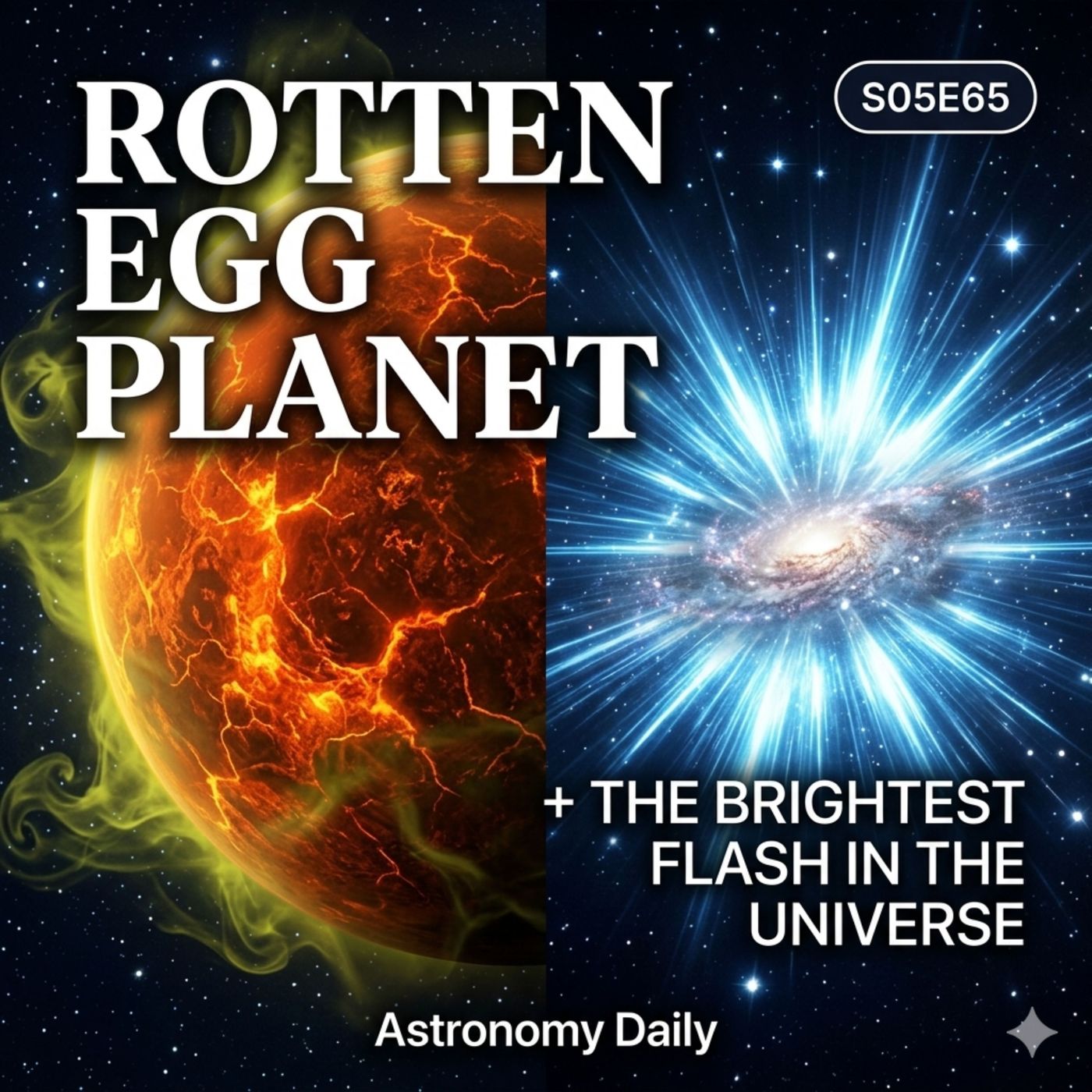
- The Doomed Planet BD+05 4868 Ab: Witness the extraordinary tale of BD+05 4868 Ab, a planet located 140 light years away in the Pegasus constellation, that is literally shedding mountains of material with each orbit. As it orbits perilously close to its star, temperatures soar to nearly 3,000 degrees Fahrenheit, turning its surface into magma and creating a massive debris tail stretching up to 9 million kilometers.
- A Hidden Supermassive Black Hole in M83: Explore the mystery of the Southern Pinwheel Galaxy (M83) as the James Webb Space Telescope uncovers evidence of a potentially hidden supermassive black hole at its center. With unexpected signs of highly ionized gas, this discovery challenges long-held assumptions and opens new avenues for exploration.
- Revolutionizing the Search for Life: Delve into how the James Webb Space Telescope is transforming our quest for extraterrestrial life by analyzing the atmospheres of rocky exoplanets. Webb's ability to detect biosignatures could bring us closer to answering the age-old question of whether we are alone in the universe.
- China's Shenzhou 20 Mission: Get the latest updates on China's ambitious space program as the Shenzhou 20 mission prepares to launch three astronauts to the Chinese space station for a six-month stay, continuing the nation's rapid advancements in space exploration.
- The Origins of the UFO Chris: Travel back in time to the late 1940s and uncover the cultural phenomenon of UFOs, from Kenneth Arnold's iconic sighting to the military's mixed messaging that fueled public speculation and skepticism.
For more cosmic updates, visit our website at astronomydaily.io. Join our community on social media by searching for #AstroDailyPod on Facebook, X, YouTubeMusic, TikTok, and our new Instagram account! Don’t forget to subscribe to the podcast on Apple Podcasts, Spotify, iHeartRadio, or wherever you get your podcasts.
Thank you for tuning in. This is Anna signing off. Until next time, keep looking up and stay curious about the wonders of our universe.
00:00 - Welcome to Astronomy Daily
01:05 - The doomed planet BD054868
10:30 - A hidden supermassive black hole in M83
17:00 - Revolutionizing the search for life
22:15 - China's Shenzhou 20 mission
27:30 - The origins of the UFO craze
✍️ Episode References
Buddy Discovery
[NASA TV](https://www.nasa.gov/tess)
James Webb Space Telescope Findings
[NASA JWST](https://www.nasa.gov/webb)
China's Shenzhou Program
[China National Space Administration](http://www.cnsa.gov.cn/)
UFO History
[Smithsonian Magazine](https://www.smithsonianmag.com/)
Astronomy Daily
[Astronomy Daily](http://www.astronomydaily.io/)
Become a supporter of this podcast:
Hello, and welcome to Astronomy Daily. I'm your host, Anna, and I'm thrilled to bring you today's exciting journey through the Cosmos. We've got an absolutely fascinating lineup of stories for you Today. We'll explore a doomed planet that's literally shedding mountains of material with each orbit, learn how the James Webb Space Telescope may have finally discovered a missing supermassive black hole, and dive into Webb's crucial role in our search for life beyond Earth. We'll also take a look at China's latest space station mission with its new three person crew, and travel back in time to explore the origins of the UFO craze that captivated America's imagination in the late nineteen forties.
So buckle up for a stellar journey through the latest and most intriguing developments in space and astronomy. Let's get started in a remarkable discovery that offers a rare glimpse of cosmic destruction. Astronomers have found a planet that is literally falling apart before our eyes. Located about one hundred and forty light years from Earth in the Pegs constellation, this doomed world named b D plus zero five four thousand, eight hundred and sixty eight AaB is experiencing what can only be described as a catastrophic demise.
This ill fated planet whips around its star once every thirty point five hours, an orbit so perilously close that its surface is being scorched to temperatures approaching three thousand degrees fahrenheit. At this extreme heat, the planet's surface is turning into magma and actively vaporizing into space. What's truly astonishing is the scale of this destruction. With each blistering orbit, BD plus zero five four thousand, eight hundred and sixty eight AB sheds as much mass of molten rock as an entire Mount Everest.
Behind it trails a gargantuan taiale of debris stretching up to nine million kilometers, roughly half the planet's entire orbital path. Mark Hahn, a post dock at MIT's Cavili Institute, described it as an epic disintegration unfolding in real time. While scientists have identified over six thousand exoplanets, this is only the fourth known disintegrating world ever discovered. What makes B D plus zero five four thousand eight hundred and sixty eight AB special is that it boasts the longest debris tail of them all, suggesting its evaporation is particularly catastrophic.
Despite its ongoing destruction, don't expect this cosmic demolition to end anytime soon. Researchers estimate it might take between one to two million years for the entire planet to fully disintegrate. As Avi Schporer from the Test Science Office put it, we got lucky with catching it exactly when it's really going away. It's like on its last breath. The discovery was actually a fortunate accident. The planet was spotted using NASA's Transiting Exoplanet Survey satellite or TESTS, which scans for periodic dips in starlight caused by orbiting planets.
The team wasn't specifically hunting for disintegrating worlds, but BD plus zero five four thousand, eight hundred and sixty eight AaB's unusual transit signal caught their attention. The star's brightness took much longer than normal to return to baseline, and the depth of the dimming changed with every transit. This doomed planet's misfortune is a scientific gold mine. Its relatively small size somewhere between our Moon and mercury, means its gravity is too weak to hold onto its mass once it starts evaporating, creating a runaway process that continuously worsens.
The James Web Space Telescope will observe the planet this northern summer, offering scientists a unique opportunity to directly measure the interior composition of a rocky planet. As the planet's material streams away in its massive tail, JWST can analyze the chemical makeup of what was once buried deep within this world, potentially revealing new insights about the diversity and habitability of terrestrial planets throughout our galaxy and in more JWST news has the James Web Space Telescope finally solved one of astronomy's most puzzling mysteries.
For years, scientists have been perplexed by the apparent at absence of a supermassive black hole at the heart of the Southern Pinwheel galaxy, more formally known as Messier eighty three or M eighty three. Conventional wisdom holds that every large galaxy should harbor a monster sized black hole at its center. These cosmic giants with masses millions or billions of times that of our Sun, are typically easy to spot when they're actively feeding. As they consume surrounding matter, they create brilliantly glowing regions called active galactic nuclei or AGNs, that can outshine entire galaxies.
Yet, despite numerous searches, no such cosmic behemoth had been detected in M eighty three, a spiral galaxy located approximately fifteen million light years from Earth. This absence presented astronomers with a conundrum. Was the black hole dormant and therefore invisible, or was it perhaps hidden behind a thick veil of cosmic dust. Now, thanks to the unparalleled sensitivity and resolution of the James Webb Space Telescope, we may have our answer. The smoking gun came in the form of clumps of highlight the ionized gas detected at the Galaxy Center.
As Svea Hernandez, the team leader and European Space Agency scientist at the Space Telescope Science Institute, explained, our discovery of highly ionized neon emission in the nucleus of M eighty three was unexpected. These signatures require large amounts of energy to be produced, more than what normal stars can generate. This excess energy strongly suggests the presence of an agn the telltale sign of a feeding, supermassive black hole that has somehow remained hidden from view until now. Even the explosive deaths of massive stars and supernovas couldn't provide enough energy to create this distinctive ionized neon signature.
What makes this discovery particularly significant is that it challenges previous astronomical assumptions. Linda Smith of the Space Telescope Science Institute noted, for years astronomers have searched for a black hole in M eighty three without success. Now we finally have a compell clue that suggests one may be present. While this evidence is compelling, scientists aren't closing the case just yet. The team still needs to rule out other potential explanations, such as shockwaves traveling through the interstellar medium.
They'll be following up with additional observations using the Hubble Space Telescope, the Atacama Large Millimeter Submillimeter Array, and the Very Large Telescope. Regardless of the final verdict, this research demonstrates the revolutionary capabilities of the James Webb Space Telescope in uncovering cosmic secrets that have eluded astronomers for decades. As Smith aptly put it, this discovery showcases how the JWST is making unexpected breakthroughs. Astronomers thought they had ruled out in agn in m eighty three, but now we have fresh evidence that challenges past assumptions and opens new avenues for exploration next.
Even more from the JWST, the James Web Space Telescope is not only revealing hidden black holes, but also revolutionizing our search for life beyond Earth. With its unprecedented infrared sensitivity and resolution, WEB is peering at rocky potentially habitable exoplanets with more detail than ever before possible. What makes Web particularly groundbreaking is its ability to detect whether these distant worlds have atmospheres, and crucially, to analyze their chemical composition. These atmospheric studies could reveal tantalizing clues about habitability and potential biosignatures, gases that might indicate the presence of life.
However, finding conclusive evidence of life presents enormous challenges. Detecting biosignatures requires potentially hundreds of hours of observing time for a single planet. Even then, the results may not be definitive due to the natural evolution of both stars and planetary atmospheres over time, and the exoplanet's web can currently study orbit stars that may be relatively inhospitable compared to our Sun. NASA scientists emphasis that discovering life elsewhere would be a process, not a single Eureka moment.
The detection of a potential biosignature would need to be followed by extensive studies, multiple lines of converging evidence, and the careful elimination of false positives, possibly requiring data from several different missions and sophisticated atmospheric modeling. One of the most intriguing frontiers in web search is the study of what scientists call hic in planets. These theoretical worlds larger than Earth could potentially support life with their relatively thin, hydrogen rich atmospheres and substantial liquid water oceans.
Web's observations of the exoplanet K two eighteen B are helping researchers investigate whether it might be such a world. The concept of hiician planets is very new, and scientists are still exploring what kinds of potential biosignatures might exist in these environments. Web's rich spectral data is rapidly advancing our understanding as this field evolves. While WEBB wasn't specifically designed as a life hunting telescope, its remarkable performance has made it the first observatory capable of characterizing the atmospheres of promising small planets orbiting cooler stars.
These pioneering observations are building the scientific and technical foundation for future missions like NASA's planned Habitable World's Observatory, which will specifically target Earth like planets around sunlike stars when it launches in the coming decades. Next up, China has just announced the crew members for its Chenho twenty mission, which will launch three astronauts to the Chinese Space Station for a six months stay. The mission continues China's ambitious and rapidly expanding presence in space.
The three person crew consists of Chendong, chen Jong Rui, and Wang Jia. Chendong, who will serve as the mission commander, is a veteran astronaut making his third trip to space, having previously served on the Shenzho eleven and Shenho fourteen missions. During his time on Shenho fourteen, he played a key role in the construction of China's space station. At a press conference, Chen expressed his feelings about returning to orbit. I feel incomparable pride and accomplishment to go to space for my country again.
Each journey to space is unparalleled. I'm looking forward to gaining more experience and more breakthroughs through this flight. His two crewmates are both first time space travelers. Chen Jong roy was previously an Air Force pilot, while Wangdiya comes to the mission as an engineer with the China Aerospace Science and Technology Corporation. The Shenzo twenty crew will launch from Jukuan, located on the edge of the Gobi Desert in northwestern China. Once in space, they'll replace the current crew, who have been aboard the station for one hundred and seventy five days and are scheduled to return to Earth on April twenty ninth.
During their half year mission, the astronauts will conduct experiments in space medicine and technology, perform space walks, and make improvements to the space station. This continues China's methodical ab approach to establishing a permanent presence in orbit. China's independent space station became necessary after the country was excluded from participating in the International Space Station due to US national security concerns over the military's involvement in China's space program. This isolation has not slowed China's progress, however.
In recent years, the Chinese space program has achieved several major milestones, including landing and explorer on Mars and sending a rover to the far side of the Moon, accomplishments only previously achieved by the United States. Looking ahead, China has set an ambitious goal to put astronauts on the lunar surface before twenty thirty, adding a new dimension to humanity's return to the Moon after decades of absence. Finally, today something a little different. While we often think of the space age beginning with Sputnik's launch in nineteen fifty seven, the space age of the imagination started a decade earlier.
On June twenty fourth, nineteen forty seven. That's when private pilot Kenneth Arnold, while searching for a downed plane near Mount Rainier in Washington State, spotted nine disc like objects flying at an estimated one thousand, seven hundred miles per hour, twice the speed of any jet at that time. Arnold described their movement as being like a saucer wood if you skipped it across the water, though he actually compared their shape to pie plates. Newspapers latched onto the saucer analogy, and the term flying saucers was born.
The Associated Press spread the story nationwide, and within weeks dozens of similar sightings were reported across America. The Army Air Force began receiving numerous reports, but interestingly, one notable sighting was instead reported to Raymond Palmer, editor of the science fiction magazine Amazing Stories. Palmer had already been blurring the lines between fiction and alleged fact through his publication of The Shaver Mystery, a series of stories claiming the existence of malevolences subterranean beings affecting life on Earth's surface.
By nineteen forty eight, the newly formed US Air Force had established Project Signed to investigate these mysterious objects. When this yielded inconclusive results, it was replaced by Project Grudge in nineteen forty nine, which seemed more focused on explaining away sightings than investigating them. The military's attempts to offer mundane explanations, including the infamous claim that pilot Thomas Mantel had crashed while pursuing Venus rather than the actual classified Skyhook balloon only intensified public skepticism into this information void stepped numerous publications and civilian research groups.
Palmer launched Fate magazine, featuring Kenneth Arnold's first hand account. Writer Donald Kehoe published Flying Saucers Are Real in nineteen fifty, popularizing what would later be called the extraterrestrial hypothesis while suggesting government cover ups, establishing two enduring narratives in UFO lore. By nineteen fifty two, when Project Blue Book replaced Grudge, the government had lost control of the narrative. Civilian saucer research clubs formed, including the International Flying Saucer Bureau and the Aerial Phenomena Research Organization.
The military's mixed messaging, rational explanations for some sightings, dishonest ones for classified aircraft, and silence where they had no answers had eroded public trust and created fertile ground for speculation about visitors from other worlds. And that's a quick summary of how it all started, and that brings us to the end of today's cosmic journey. What an incredible range of stories we've explored from a doomed planet shedding mount ever sized chunks with each orbit around its star. To the Web telescope potentially solving the mystery of M eighty three's missing black hole, to China's latest space station crew launch, We've seen how web is revolutionizing our search for life beyond Earth, while also learning about the fascinating origins of our cultural obsession with UFOs and flying saucers.
The universe continues to surprise, challenge, and inspire us with each new discovery. I'm Anna, and I've been your host on Astronomy Daily. If you're hungry for more space and astronomy news, visit our website at Astronomydaily dot io, where you'll find our constantly updating news feed with all the latest discoveries and developments, plus all our back episodes. You can also connect with us across social media. Just search for astro Daily Pod on Facebook, x YouTube, YouTube, music, Tumblr, Instagram, and TikTok.
Until next time, keep looking up Stares.


 Apple Podcasts
 Spotify
 Pocket Casts
 Castbox
 Overcast
 Podbean
 iHeartRadio
 Castro
 Goodpods
 Moon FM
 Podcast Addict
 Podcast Republic
 YouTube