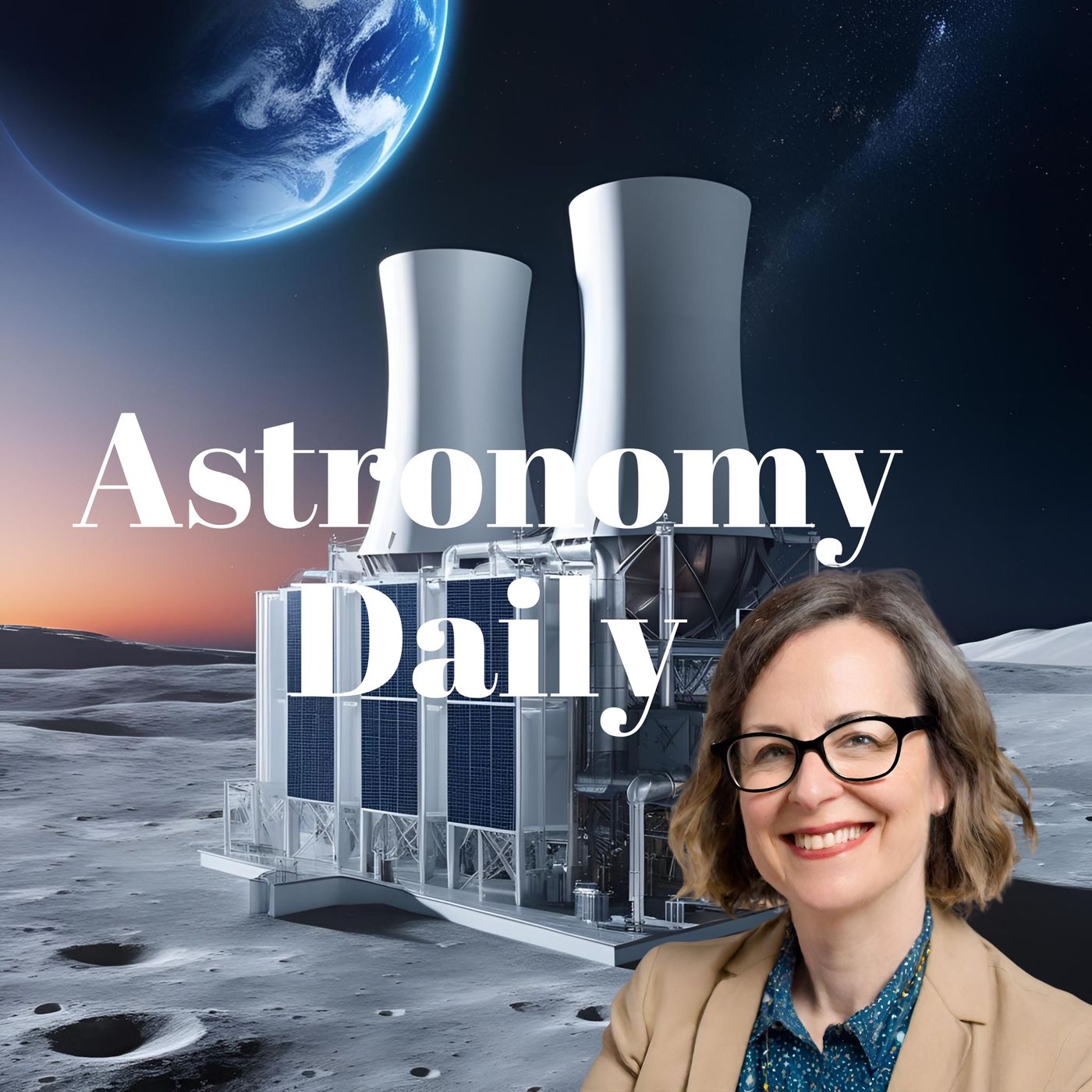
Lunar Ambitions: China's Nuclear Plans, Exoplanet Breakthroughs, and Hubble's 35-Year Legacy
In this episode
In this episode of Astronomy Daily, join host Anna as she guides you through a captivating exploration of our universe's latest advancements and celestial events. From ambitious lunar projects to groundbreaking detection technologies, this episode promises to ignite your curiosity about the cosmos.Highlights:
- China's Lunar Nuclear Power Plant: Discover China's bold plans to establish a nuclear power plant on the Moon in collaboration with Russia. This initiative aims to support the International Lunar Research Station and pave the way for a permanent human presence on our lunar neighbor, addressing the challenges of long-term operations in space.
- Revolutionary Exoplanet Detection Technology: Learn about a groundbreaking coronagraph developed by researchers at the University of Arizona that could transform our ability to detect exoplanets by dimming the overpowering light from their parent stars. This innovation may help us locate Earth-like planets in habitable zones and search for signs of life beyond our solar system.
- Mini Planet Parade on April 24: Mark your calendars for a stunning celestial event! A mini planet parade featuring Mercury, Venus, Saturn, Neptune, and our Moon will grace the pre-dawn sky on April 24. Get tips on how to spot this rare alignment and capture breathtaking photographs of the cosmic display.
- Asteroid Vesta's Opposition: Get ready for a special viewing opportunity as asteroid Vesta reaches opposition on May 2, becoming visible even to the naked eye. Learn about Vesta's unique characteristics and its significance in our solar system's history.
- Celebrating Hubble's 35th Anniversary: Join us in commemorating the Hubble Space Telescope's 35 years in orbit. We'll reflect on its remarkable contributions to astronomy, including groundbreaking discoveries and stunning images that have shaped our understanding of the universe.
For more cosmic updates, visit our website at astronomydaily.io. Join our community on social media by searching for #AstroDailyPod on Facebook, X, YouTubeMusic, TikTok, and our new Instagram account! Don’t forget to subscribe to the podcast on Apple Podcasts, Spotify, iHeartRadio, or wherever you get your podcasts.
Thank you for tuning in. This is Anna signing off. Until next time, keep looking up and stay curious about the wonders of our universe.
00:00 - Welcome to Astronomy Daily
01:05 - China's lunar nuclear power plant
10:30 - Revolutionary exoplanet detection technology
17:00 - Mini planet parade on April 24
22:15 - Asteroid Vesta's opposition
27:30 - Celebrating Hubble's 35th anniversary
✍️ Episode References
China's Lunar Plans
[China National Space Administration](http://www.cnsa.gov.cn/)
Exoplanet Detection Technology
[University of Arizona](https://www.arizona.edu/)
Mini Planet Parade Details
[Astronomy Magazine](https://www.astronomy.com/)
Asteroid Vesta Information
[NASA Dawn Mission](https://www.nasa.gov/mission_pages/dawn/main/index.html)
Hubble Space Telescope Milestones
[NASA Hubble](https://www.nasa.gov/hubble)
Astronomy Daily
[Astronomy Daily](http://www.astronomydaily.io/)
Become a supporter of this podcast: <a...
Speaker 1: Welcome to Astronomy Daily. I'm your host Anna. Thanks for joining me today as we explore the fascinating world beyond our atmosphere. Today's cosmic journey takes us from the Moon to the far reaches of space as we dive into some truly remarkable developments in astronomy and space exploration. We'll be starting close to home with China's ambitious plans to construct a nuclear power plant on the lunar surface in collaboration with Russia, a bold step toward establishing a permanent human presence on our celestial neighbor.
Speaker 1: Then we'll examine a groundbreaking new technology from researchers at the University of Arizona that could revolutionize our ability to detect exoplanets by effectively dimming the overwhelming light of their parent stars. This coronagraph breakthrough might just help us find Earth like planets, in habitable zones, and potentially signs of life. If you're an early Riser, you're in for a treat this week. We'll tell you about a mini planet parade happening on April twenty fourth, when Mercury, Venus, Saturn, Neptune, and our Moon will cluster together in the pre dawn sky, creating a spectacular viewing opportunity for amateur astronomers and stargazers.
Speaker 1: We have exciting news about asteroid Vesta, which reaches opposition on May second, and this ancient protoplanet will be visible even to the naked eye under the right conditions, with a special viewing opportunity coming up when it forms a temporary double star with another celestial object. Finally, we'll celebrate a major milestone as the Hubble Space Telescope marks its thirty fifth year in orbit. We'll look back at how this remarkable instrument has transformed our understanding of the universe and continues to make groundbreaking discoveries after more than three decades.
Speaker 1: So settle in as we journey through these cosmic wonders and explore the latest developments in our ongoing quest to understand the universe. In what can only be described as one of the most ambitious lunar projects since the Apollo era, China has revealed plans to develop a nuclear power plant on the Moon. This extraordinary undertaking would support the International Lunar Research Station, a collaborative effort between China and Russia aimed at establishing a sustained human presence on our nearest celestial neighbor.
Speaker 1: The announcement came during a presentation by a senior Chinese space official just last week, highlighting the serious intentions behind what might otherwise sound like science fiction. This nuclear facility would provide the consistent power needed for long term lunar operations, addressing one of the fundamental challenges of maintaining a permanent outpost so far from Earth. The timeline for this lunar endeavor centers around the Changi eight mission, scheduled for twenty twenty eight. This mission will serve as the foundation for what China hopes will become a permanent, manned lunar base by twenty thirty five.
Speaker 1: The preliminary plans also include implementing large scale solar arrays, alongside an intricate network of pipelines and cables built across the lunar surface to distribute heat and electricity to the various components of the research station. What makes this particularly interesting is how China's lunar ambitions mirror the timeline of NASA's own Artemis program, which aims to return American astronauts to the Moon by twenty twenty seven. We appear to be entering a new era of lunar exploration and possibly settlement, reminiscent of the space race of the nineteen sixties, but with more emphasis on establishing long term infrastructure rather than simply planting flags.
Speaker 1: The China Russia collaboration is especially notable given the current geopolitical landscape. Recent Western sanctions have significantly limited Russia's access to space technology, making this partnership strategically valuable for both nations. For Russia, it provides continued involvement in cutting edge space exploration, while China gains access to Russia's decades of experience in space operations and technology. Building a nuclear power plant on the Moon presents enormous engineering challenges.
Speaker 1: The facility would need to withstand extreme temperature variations, radiation exposure, and the complications of lunar dust, not to mention the logistical hurdles of transporting construction materials and equipment two hundred thirty eight thousand miles from Earth. Yet the advantages are equally significant. Nuclear power offers the high energy, density and reliability needed for a permanent lunar base without the limitations of solar power During the two weak lunar nights. If successful, this endeavor could fundamentally alter humanity's relationship with our nearest celestial neighbor, transforming the Moon from a destination for brief visits to a place where people may one day live and work for extended periods.
Speaker 1: It also raises fascinating questions about international cooperation, competition, and the potential commercialization of lunar resources in the decades ahead. Next up today, Imagine being able to see a planet a billion times dimmer than its star. It sounds impossible, right, Well, researchers at the University of Arizona have developed a breakthrough technology that might just make this seemingly impossible feat a reality. Their innovative coronagraph design could revolutionize how we detect exoplanets by effectively turning down the overwhelming brightness of their parent stars.
Speaker 1: Lead researcher Nico Deshler explain the fundamental challenge. Earth Like planets in the habitable zone can easily be up to a billion times dimmer than their host star. This extreme brightness difference has been a persistent obstacle in our quest to directly observe potentially habitable worlds. When a planet is so drastically outshined it's like trying to spot a firefly next to a stadium floodlight. The team's solution, published in the journal Optica, is remarkably elegant. Their coronagraph essentially siphons away the starlight that would normally overwhelm the faint light from nearby exoplanets.
Speaker 1: What makes this approach particularly exciting is that it can reach what's scientists call quantum optical limits for exoplanet detection, pushing the boundaries of what we previously thought possible. In laboratory testing, the team demonstrated that their system could identify the positions of synthetic exoplanets much closer to their artificial host stars than standard resolution limits would normally allow. This capability is critical because the most interesting planets, those potentially capable of supporting life, tend to orbit in close proximity to their stars.
Speaker 1: The technology relies on what scientists call spatial mode sorting. Think of light from different sources in space as creating distinct patterns, similar to different notes on a piano. The coronagraph uses a mode sorder to filter out the overwhelming starlight, followed by an inverse mode sorder to reconstruct the image, allowing the exoplanet's light to emerge with remarkable clarity. What separates this approach from other detection methods is that it captures direct images, rather than inferring a planet's existence through indirect means.
Speaker 1: Our coronagraph directly captures an image of the exoplanet. Deshler noted images can provide context and composition information that can be used to determine exoplanet orbits and identify other objects that scatter light from a star. To validate their concept, the researchers constructed a laboratory setup mimicking a star exoplanet system with a one thousand to one brightness contrast. By simulating the planet's orbit and capturing images frame by frame, they were able to pinpoint its position at separations previously considered impossible to resolve.
Speaker 1: The implications of this technology extend far beyond just finding planets. If this coronagraph can be refined and scaled up for astronomical observatories, it could potentially allow scientists to analyze the atmospheres of Earth like exoplanets for biosignatures chemical indicators that might reveal the presence of life. Beyond our Solar system. The timing couldn't be better, as NASA has prioritized exoplanet discovery with its own planned Habitable World's observatory. This next generation space telescope will specifically target potentially habitable exoplanets, and technologies like this advanced coronagraph could be instrumental to its success.
Speaker 1: The research team is now working to refine their spatial mode sorder to reduce what they call optical crosstalk, essentially light leakage between channels that can contaminate the results. While manageable in moderate contrast scenarios, the extreme brightness differences in exoplanet studies demand exceptional light isolation. Beyond astronomy, the techniques developed for this coronagraph could have applications in other fields like quantum sensing, communications, and advanced imaging. It's yet another example of how the quest to explore other worlds drives innovation that benefits multiple scientific disciplines.
Speaker 1: Early birds, mark your calendars. An exceptional celestial event is about to grace our pre dawn skies on April twenty fourth, when a striking mini planetary parade will unfold featuring Mercury Venus Saturn, Neptune, and Earth's Moon all clustering in the same region of the sky. This cosmic alignment offers a rare and beautiful photo opportunity for astronomy enthusiasts and early risers alike. What makes these planetary alignments so fascinating is the illusion they create. Though separated by hundreds of millions of miles in space, their orbital positions will temporarily align from our earthly perspective, making them appear remarkably close together in our sky.
Speaker 1: To witness this celestial gathering, you'll need to set your alarm clock early, look toward the eastern horizon around five fifteen am Local time, where you'll first spot the Moon as a thin, waning crescent approaching its new moon phase that will arrive on April twenty seventh. Its delicate, slender form will be hovering low on the horizon, creating a stunning visual anchor for the planetary procession. Directly to the left of the Moon, you'll find Venus shining brilliantly as our our current morning star.
Speaker 1: Venus has recently transitioned to morning visibility following its inferior solar conjunction on March twenty third, when it passed between Earth and the Sun, ending its appearance in our evening skies. Saturn can be located by looking slightly down into the right of Venus. The ringed planet will appear as a steady yellowish point of light. Mercury will be the last of the easily visible planets to rise, requiring a clear, unobstructed eastern horizon to be spotted before sunrise swallows it in growing daylight.
Speaker 1: Neptune, the most distant world in this cosmic lineup, will be nestled in the center of this planetary triangle. However, at magnitude seven point nine, this ice giant will remain invisible to the naked eye. Those hoping to glimpse Neptune's pale, blue green disc will need a telescope or powerful binoculars. This April alignment follows February's more expansive planetary parade, which featured all five of our Solar systems brightest planets Venus, Jupiter, Mars, Saturn, and Mercury, plus the ice giants Neptune and Uranus.
Speaker 1: While this week's gathering is more modest in scale, the addition of the waning crescent moon adds a particularly photogenic element that photographers won't want to miss. If you're planning to capture this celestial event, be sure to scout a location with a clear eastern horizon free from obstructions and light pollution. Remember that observing objects near the horizon often requires patients, as atmospheric conditions can affect visibility, and always exercise caution when viewing celestial objects near sunrise.
Speaker 1: Never look directly at the Sun without proper solar filters. This many planetary parade is just one of many astronomical treats visible this northern spring, offering a perfect opportunity to connect with our cosmic neighborhood before dawn breaks on an ordinary Wednesday that will briefly become extraordinary for those who know where to look. And while you're in the mood to be looking up, here's another treat for you. While most asteroids remain dim specks visible only through telescopes, asteroid Vesta is quite the celestial standout.
Speaker 1: Reaching opposition. On May second, Vesta will achieve peak brightness, becoming visible even to the naked eye if you're observing from a dark sky location. This remarkable visibility isn't just a coincidence. Vesta occupies a unique position in our Solar System as both asteroid and protoplanet. NASA's down mission, which orbited Vesta for fourteen months between twenty eleven and twenty twelve, revealed fascinating details about this enigmatic world. Its surface contains highly reflective basaltic rock alongside darker carbonaceous material delivered by meteorite impacts.
Speaker 1: What makes Vesta truly special is its unusual brightness, which scientists now believe stems from its early planetary development. A twenty twelve study of a Vesta meteorite discovered evidence of an aba magnetic field that existed three point seven billion years ago. This confirms that Vesta is one of the few confirmed protoplanets in our Solar System. During its embryonic planetary phase more than four billion years ago, Vesta's interior was hot enough to melt and differentiate into distinct layers, a metallic iron core, dense mantle, and outer crust.
Speaker 1: The molten metal within its core generated an asteroid wide magnetic field that likely shielded Vesta's surface from the solar wind and cosmic rays that typically darkened surface minerals. Through a process called space weathering. This protective magnetic field may explain why Vesta maintains its radiant appearance today, making it an accessible target for amateur astronomers. Currently shining at a robust magnitude five point seven, Vesta is tracking from northern Libra into Virgo this month and next.
Speaker 1: Even modest pocket binoculars will reveal its presence. For those hoping to spot Vesta without optical aid, try this technique. First confirm its position with binoculars, then use nearby stars to create a distinctive pattern that includes the asteroid. By employing averted vision, looking slightly to the side of your target rather than directly at it, you can gradually coax Vesta into view. The two point six magnitude star Beta Libre, also known as Zubeneschamali, and fourth magnitude move Virginese provide useful reference points.
Speaker 1: Stargazers have a special opportunity from April twenty third or through twenty seventh, when Vesta will lie within just thirty five arc minutes of the four point five magnitude star sixteen Libray. As Vesta slides northwest in retrograde motion, it will form a temporary double star with its stellar companion. This alignment makes locating the asteroid particularly easy, while also highlighting its night to night movement. On April twenty fifth and twenty sixth, the pair will be separated by a mere ten arc minutes the night before this close approach, Vesta forms a compact, nearly linear trio with sixteen libri and HD thirteen twenty third seventy five, a magnitude six point one star located forty five arc minutes to its southeast.
Speaker 1: These alignments offer perfect opportunities to track this ancient protoplanet as it continues its journey around our Sun, carrying with it the secrets of our Solar system's early formation. And let's wrap up today's episode with a celebration. This April marks a truly remarkable milestone in space exploration, as NASA celebrates the Hubble Space Telescope's thirty fifth year in Earth orbit. To commemorate this incredible achievement, NASA is releasing a collection of stunning new images capturing everything from our planetary neighbor Mars, to distant star forming regions and neighboring galaxies.
Speaker 1: After more than three decades of peering into the Cosmos, Hubble remains not just relevant, but iconic. The most recognized and scientifically productive telescope in human history, the Hubble mission stands as a glowing testament to American technological prowess, scientific curiosity, and pioneering spirit. Launched on April twenty four, nineteen ninety, the twenty four thousand pound observatory was delivered to orbit tucked inside the Space Shuttle Discovery's cargo bay. At the time, NASA commentators described Hubble as a new window on the universe, a promise the telescope has fulfilled beyond anyone's wildest expectations.
Speaker 1: The telescope's journey hasn't been without challenges. Shortly after launch, engineers discovered an unexpected flaw in Hubble's nearly eight foot diameter primary mirror. This early setback was dramatically overcome when astronauts performed the first Shuttle servicing mission in December nineteen ninety three, installing corrective optics that restored Hubble's intended sharpness. Over the years, astronauts returned to Hubble four more times, upgrading its cameras, computers, and support systems during servicing missions that continued until two thousand and nine.
Speaker 1: The numbers behind Hubble's legacy are staggering. To date, the telescope has made nearly one point seven million observations, targeting approximately fifty five thousand astronomical objects. These observations have resulted in over twenty two thousand scientific papers and more than one point three million citations. The data collected by Hubble currently totals over four hundred terabytes, the largest data set for any NASA astrophysics mission aside from the James Webb Space Telescope. Hubble's long operational life has given astronomers the unprecedented ability to observe cosmic changes occurring over decades, from seasonal variations on planets in our Solar System to black hole jets traveling at nearly light speed, stellar convulsions, asteroid collisions, and expanding supernova remnants.
Speaker 1: The Telescope's impact on our understanding of the universe cannot be overstated. Before Hubble, powerful ground based telescopes could see only halfway across the cosmos, and estimates for the universe's age varied widely. Supermassive black holes were merely suspected to exist, and no planets had been detected around other stars. Among Hubble's groundbreaking achievements, its deep field images revealed countless galaxies dating back to the early universe. It allowed scientists to precisely measure the universe's expansion rate, It confirmed that supermassive black holes are common among galaxies, and it enabled the first measurements of exoplanet atmospheres.
Speaker 1: Perhaps most significantly, Hubble contributed to the discovery of dark energy, the mysterious force accelerating the universe's expansion, work that led to the twenty eleven Nobel Prize in physics. The Telescope's continued productivity has inspired and paved the way for a new generation of space observatories. Hubble provided the first evidence of the distant galaxies that the James Webb Space Telescope now studies in infrared wavelengths. Today, the two observatories often work in tandem, complementing each other's capabilities to study everything from exoplanets to galaxy evolution.
Speaker 1: Looking ahead, Hubble's plan successor, the Habitable World's Observatory, will feature a significantly larger mirror for observing invisible and ultraviolet light. It will be notably sharper than Hubble and up to one hundred times more sensitive to starlight, with a major goal of identifying potentially habitable terrestrial planets around neighboring stars. As Hubble continues making groundbreaking discoveries that shape our fundamental understanding of the universe, its legacy as humanity's most successful space telescope remains secure.
Speaker 1: A remarkable scientific instrument that has truly changed how we see our place in the cosmos, and that brings us to the end of today's cosmic journey on Astronomy Daily. What an incredible array of discoveries and celestial events we've covered, from China's ambitious lunar nuclear plant, to revolutionary exoplanet detection technology, April's mini planet parade, asteroid Vesta's visibility, and of course Hubble's remarkable thirty five year legacy. I'm Anna, and I want to thank you for joining me today as we explored these fascinating developments in space and astronomy.
Speaker 1: The universe never ceases to amaze us with its wonders, and I'm grateful to share these stories with you. If you're hungry for more astronomy news, I invite you to visit our website at Astronomy Daily dot io. Where you can catch up on all the latest space and astronomy happenings through our constantly updating newsfeed. You'll also find our complete archive of past episodes there, perfect for diving deeper into the cosmic topics that interest you most. Don't forget to subscribe to Astronomy Daily on all good podcast platforms, including Apple Podcasts, Spotify, YouTube, YouTube music, or wherever you get your podcasts.
Speaker 1: That way, you'll never miss an episode as we continue our journey through the cosmos together until next time, keep looking up and wondering about the magnificent universe we call home. This is Anna for Astronomy Daily.
Speaker 2: Signing off Sunny Day Stars, Start
Speaker 1: Star

 Apple Podcasts
 Spotify
 Pocket Casts
 Castbox
 Overcast
 Podbean
 iHeartRadio
 Castro
 Goodpods
 Moon FM
 Podcast Addict
 Podcast Republic
 YouTube