In this episode
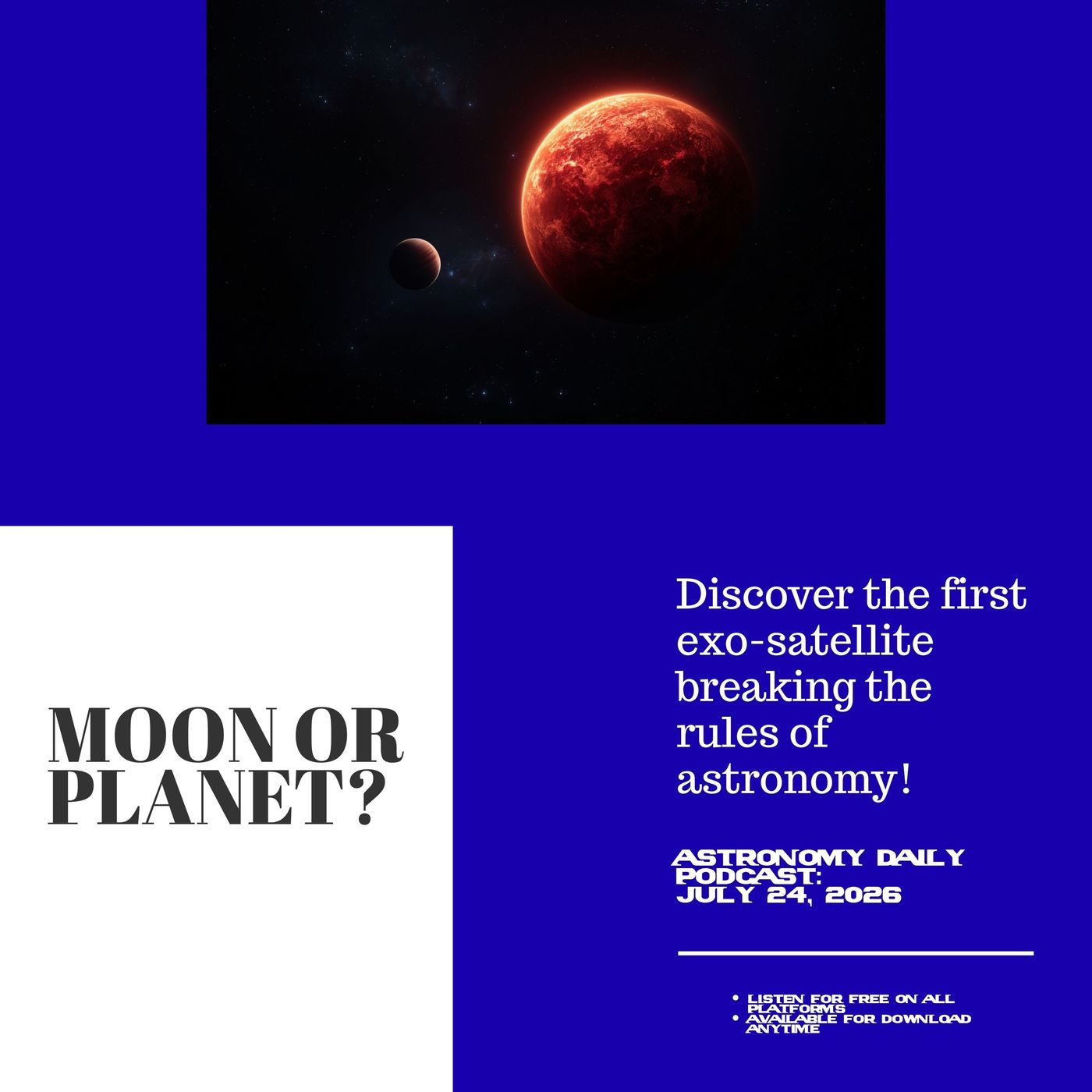
Astronomers have confirmed the first moon-like object beyond our solar system — and immediately discovered our vocabulary cannot handle it. A Jupiter-mass world orbits a brown dwarf, which orbits a red dwarf, seventy light-years away. Is it a moon? A planet? Something we have not named yet? Also on today’s show: the Milky Way’s most powerful particle accelerator is confirmed in the direction of Altair, out-punching the Large Hadron Collider by a factor of a hundred. Chandra catches a black hole starving a galaxy it does not even live in. China flies the world’s largest solid rocket from the open ocean for the first time. Starship Flight 13 gets another window. And the Moon meets the heart of the Scorpion. Chapters Time Chapter 00:00 Cold open — what is a moon, exactly? 00:35 Welcome and headlines 01:15 The first exo-satellite — CD-35 2722 05:55 The galaxy’s most powerful particle accelerator 10:00 The Red Potato galaxy and its hostile neighbour 13:35 Gravity-1 launches from the open sea 16:55 Starship Flight 13 — when and where to watch 19:10 Skywatch — the Moon and Antares 22:30 Sign-off Story sources 1. First confirmed exo-satellite • Hoy, K., Zurlo, A., Peña R, P.A. et al. “Planetary-mass exosatellite detected around the substellar companion of a star.” Nature 655, 865–869 (2026). • European Southern Observatory release eso2610a, 23 July 2026. • Observations from ESO’s Very Large Telescope, Cerro Paranal, Chile. 2. Proton PeVatron confirmed • Mizuno, T., Sano, H., Murase, T., Oka, T., Suzuki, H., Nakahara, N. “Hadronic Scenario for Galactic PeVatron LHAASO J1912+1014u Supported by Fermi-LAT Gamma-Ray Data and FUGIN CO Data.” The Astrophysical Journal, 16 July 2026. • Hiroshima University news release; instruments: Fermi-LAT, Nobeyama 45 m / FUGIN survey, Chandra X-ray Observatory. 3. The Red Potato galaxy • NASA / Chandra X-ray Observatory news release, July 2026. Wang, W., Cantalupo, S., Travascio, A. et al., University of Milano-Bicocca. • Galaxy designation MQN01 J004131.9-493704, redshift approximately 3.25. Original JWST identification announced January 2026; the Chandra jet result is the new element. 4. Gravity-1 open-sea launch • Orienspace Gravity-1 Y4, third flight. Liftoff 0254 UTC, 22 July 2026, from a launch service ship approximately 170 km east of Shanghai. • Reporting via SpaceNews, CGTN and Space.com. Nine payloads including six Huantian constellation satellites. 5. Starship Flight 13 • SpaceX; live coverage via Spaceflight Now and Space.com. Booster 20 / Ship 40, second flight of Starship V3. • Launch window opens 24 July 2026 at 6:45 p.m. EDT (2245 UTC). Payload: 20 Starlink V3 satellites. 6. Skywatch • Astronomy.com Sky This Week; timeanddate.com Moon guide; EarthSky visible planets guide. • Moon 0.6° south of Antares, 6:00 p.m. EDT 24 July. Full Buck Moon 29 July, 14:36 UTC, in Capricornus.Astronomy Daily is part of the Bitesz.com Podcast Network. Find us at astronomydaily.io and at @AstroDailyPod.
Become a supporter of this podcast: https://www.spreaker.com/podcast/astronomy-daily-latest-space-news--5648921/support.
Sponsor Details:
Ensure your online privacy by using NordVPN. To get our special listener deal and save a lot of money, visit www.astronomydaily.io/nordvpn. You'll be glad you did!
Get the best secure and private email on the planet. Stop your Government, google and who knows who else spying on every email you write. Do what we did and use ProtonMail. They beleive in privacy and there are no ads in their business model...yet they still...
Speaker 1: Here is a question that sounds simple.
Speaker 2: What is a moon something that goes around.
Speaker 1: The planet, right, and what is a planet.
Speaker 2: Something that goes around the star?
Speaker 1: So what do you call a Jupiter sized world that orbits an object that is not quite a star and not quite a planet, which is itself orbiting a star seventy light years away?
Speaker 2: I am going to need a minute.
Speaker 1: So it is the International Astronomical Union.
Speaker 2: We'll get back to that.
Speaker 1: Hello, and welcome to Astronomy Daily.
Speaker 2: I'm anna and I'm avery. It is Friday, the twenty fourth of July twenty twenty six, and this is episode one hundred and forty nine.
Speaker 1: Coming up. Astronomers confirm the first moonlike object outside our Solar system and immediately break the vocabulary trying to describe it. We have found the most powerful particle accelerator in the galaxy, and it has been sitting next to one of the brightest stars in your sky. A black hole is starving a galaxy. It doesn't even live in.
Speaker 2: Tina flies the world's biggest solid rocket from the open ocean for the first time. Starship gets another shot at flight thirteen tonight for some of you, and the moon has a date with the heart of the scorpion.
Speaker 1: Let's get into it. We have found thousands of planets around other stars, nearly six thousand confirmed, with candidates stacked up behind them, but there has always been a conspicuous gap in the catalog. No moons, not one confirmed. We know moons must be out there. Our own Solar system has close to three hundred of them, but they are small, they are faint, and they are parked right next to something far brighter. Finding one has been one of the great frustrations of exoplanet science, and now now a team publishing in Nature has confirmed the first one sort of, and the sort of is the whole story.
Speaker 1: This system is a star called C D minus thirty five twenty seven twenty two. It is a red dwarf roughly seventy light years from US, and for our listeners in Australia and New Zealand, it sits in your southern sky. Astronomers have known for years that this star has a companion because the star wobbles. That companion is called C D minus thirty five twenty seven twenty two B, and it is heavy, somewhere between twenty nine and thirty eight times the mass of Jupiter.
Speaker 2: That's well pass planet territory.
Speaker 1: It is above about thirteen to fifteen jupiter masses, an object confuse deuterium in its core. It's not doing what the Sun does. You need around ninety jupiter masses to fuse ordinary hydrogen. But it's doing something that in between category is a brown dwarf, too big to be a planet and too small to be a.
Speaker 2: Star, the thing astronomy call a failed star, which always struck me as unkind.
Speaker 1: Deeply unkind. And this particular brown dwarf is bright enough and far enough from its star that the very large telescope in Chile can photograph it directly. So the team took spectra of the brown dwarf itself and found that it wobbles too. Something is orbiting the brown dwarf. Best estimate of its mass about one jupiter.
Speaker 2: So we have a Jupiter going around the brown dwarf going around the red.
Speaker 1: Dwarf, a three tiered system, and nobody can agree on what to call the object at the.
Speaker 3: Bottom, because if the brown dwarf counts as a planet, then this thing is a moon, an exo moon, the first one confirmed. But if the brown dwarf counts as a star. Then this thing is a planet and it's not a.
Speaker 1: Moon at all, and the brown dwarf is genuinely physically both and neither. The paper hedges by calling it an exo satellite, which is honest and also a bit of a shrug.
Speaker 2: We've been here before, though. This is the Pluto argument in a fresh outfit.
Speaker 1: It really is. Pluto is not a planet because it has not cleared its orbital neighborhood. Fine, but Pluto has Sharon, and Sharon is so large relative to Pluto that the two of them orbit a point in empty space between them. So is Sharon a moon of a non planet? Are they a double dwarf planet? And our own moon is bigger than Pluto? Should it be a dwarf planet that happens to be captured?
Speaker 2: Nature does not care about our filing system.
Speaker 1: Nature does not care at all. And here's the part I find genuinely exciting. Brown dwarfs are common. If this one has a Jupiter mass companion, plenty of others probably do too. Some of those could sit in the habitable zone of the parent star. You could have a warm, temperate world with liquid water orbiting a failed star orbiting a real one.
Speaker 2: And we would not have a word for it.
Speaker 1: The team says, this is the first of its kind, not the last. I suspect the IAU is going to have a long decade.
Speaker 2: Now. If you go outside tonight and look up, one of the first bright stars you will find is Altaire. Northern listeners. It is high overhead in the evening, the southern corner of the Summer Triangle. Southern listeners, look north, it's lower down, but it's unmistakable one.
Speaker 1: Of the closest bright stars to us sixteen and a.
Speaker 2: Half light years sixteen point seven now roughly in that same direction, but nowhere near it in actual space. Sits an object that has just been confirmed as the most powerful particle accelerator in the Milky Way. By the way, I should stress the nowhere near it as the key point here.
Speaker 1: Worth being precise about that same patch of sky, wildly different distance.
Speaker 2: Wildly Altare is sixteen light years away. This thing is closer to fourteen thousand. It just happens to line up. It's called lhaa aso J nineteen twelve plus ten fourteen U, which I'm going to say exactly once. And it was picked up in twenty twenty four by a Chinese observatory high on the Tibetan Plateau.
Speaker 1: And what makes it special.
Speaker 2: It's throwing protons out at more than one thousand trillion electron volts one pev Astronomers call an object that can do that a pevotron, and it's worth pausing on what that number means. The Large Hadron Collider is twenty seven kilometers of superconducting magnets buried under the French Swiss border, and it's the most powerful machine humanity has ever built for this purpose. This object beats it by a factor of well over one hundred.
Speaker 1: With no magnets and no budget.
Speaker 2: With no magnets and no budget. Now, we've known about pevetron candidates for a while. There are dozens of them. The problem has always been proving what's actually being accelerated. Because when you detect very high energy gamma rays coming from one of these sources, there are two ways to make them. Protons smashing into gas or electrons scattering off light. Both produce gamma rays. The observatories that found these sources can't tell the two apart because their images are too blurry to see the difference.
Speaker 1: So how do you settle it, you.
Speaker 2: Stop relying on one telescope. A team led by Tsunafumi Mizuno at Hiroshima University pulled together three completely different instruments looking at three completely different kinds of light. NASA's Fermi Space Telescope for gamma rays at lower energies, a Japanese radio survey from the forty five meter dish at Nobayama, which maps the cold gas clouds in that region, and NASA's Chandra Observatory for X rays.
Speaker 1: Three views of the same patch of sky.
Speaker 2: And the pattern only works one way. Fermi found an excess of gamma rays at exactly the energies you'd expect if protons were slamming into gas, and the radio data showed the gas was right there for them to slam into. The electron explanation doesn't fit the shape of the signal, So this is a proton accelerator, confirmed in the Astrophysical Journal.
Speaker 1: What was it? Originally thought to be.
Speaker 2: A super nova remnant the expanding wreckage of a dead star, perfectly reasonable until it started putting out gamma rays above one hundred trillion electron volts and stopped being ordinary. And it is big on the sky. It spans more than one degree twice the width of the full moon.
Speaker 1: Which matters because cosmic rays are not just an abstraction. They're hating us constantly, constantly.
Speaker 2: They are a genuine hazard for astronauts and for spacecraft electronics, and they play into the chemistry of the interstellar medium. Knowing where the most energetic ones actually come from is not a trivia question. The team says, there are dozens more candidates to work through, and now they have a method that works. Expect more of these. Next up story three, The starved Red Potato.
Speaker 1: Every imagine a desert right on the coastline, stretching to the horizon on one side, and almost no rainfall for years at a time.
Speaker 2: The Atacama or the namebe.
Speaker 1: Exactly those All that water is sitting there, right there, and none of it arriving. That image is what got an astronomer in Milan thinking about a galaxy.
Speaker 2: Go on.
Speaker 1: Back in January, we got word of a galaxy nicknamed the Red Potato, named with real scientific rigor for looking like a red potato in the JWST image. It's more than eleven billion light years away. We're seeing it as it was when the universe was under two billion years old, and it sits in the southern sky at a declination of about minus forty nine.
Speaker 2: And the problem with it.
Speaker 1: The problem is that it's sitting in the middle of an enormous reservoir of cold gas, a node in the cosmic web, exactly the kind of place where galaxies are supposed to gorge themselves and blaze with new stars, and it's making almost none. It's quiet, red, old, and quiet at an age of the universe that it has no business being any of those things.
Speaker 2: Coastal desert, coastal desert.
Speaker 1: Now, the usual suspect for shutting down star formation is the galaxy's own central black hole. It fires up, blows the gas out, and the galaxy starves textbook, but the observations showed no sign of an active black hole in the Red Potato and no sign of any strong outflows. There was nothing there to blame.
Speaker 2: So what changed? This week?
Speaker 1: Tandra, the team led by Waychen Wang at the University of Milano Bikacoa, took deep X ray observations and found a long jet of particles. And it's not coming from the Red Potato. It's coming from a black hole in a neighboring galaxy, and it's pointed straight at the Red Potatoes gas cloud.
Speaker 2: What it's being starved by someone else's black hole.
Speaker 1: That's the finding. The jet doesn't appear to be doing much to its own host galaxy. It's narrow near home, and it widens out as it travels. By the time it reaches the Red Potato's neighborhood, it's wide enough to stir up that whole gas reservoir. One turbulent gas is turbulent gas. Turbulent gas will not settle down and fall in. The galaxy is surrounded by fuel. It cannot collect.
Speaker 2: What's the measured evidence for the turbulence.
Speaker 1: The gas motions are elevated. They can read that off the shape of the emission lines. It's not proof of causation, and the team is careful about that. They can't fully rule out that the Red Potato had some earlier violent episode that evtied it out, but there's no evidence for one, and there is a very obvious jet pointing at it.
Speaker 2: And this is the interesting bit for the wider picture, because Web keeps finding these quiet early galaxies.
Speaker 1: It does, and they're a genuine problem for our models. If a galaxy can be shut down by a neighbor rather than by itself, then galaxy evolution is not something a galaxy does on its own. It's something done to it by whatever happens to be nearby. That's a considerably messier universe than the one we had drawn.
Speaker 2: Let's move on to story four. Gravity one at open On Wednesday morning, Beijing time, a rocket lifted off from the deck of a ship one hundred and seventy kilometers out in the East China Sea, east of Shanghai, and put nine satellites into orbit.
Speaker 1: Fee launch is not new, but that distance is unusual.
Speaker 2: That is the story. The rocket is Gravity one, built by a commercial company called Orient Space, based in Shandong Province. This was its third flight and its third success, and its first genuine open ocean launch. The previous two went up from waters just off the coast. This time the ship sailed properly out to sea. Why does that matter conditions? The chief designer, Su Gul Kwang made the point that open sea is a different problem, different swell, different weather, no easy shore support. If you can launch out there, you can launch from almost anywhere, which means you can pick your orbit rather than being stuck with whatever your fixed past that allows.
Speaker 2: It also happens to be China's first commercial sea launch in the Yanksee River.
Speaker 1: Delta, and the rocket itself is unusual.
Speaker 2: Very Gravity one is about thirty meters tall, STUW squat four strap on boosters, around three core stages, and every single one of those motors is solid fuel, no cryogenic propellant, no complex plumbing. You build it, you ship it, you light it. That makes it the most powerful all solid fueled orbital rocket in the world, at six and a half tons to low Earth orbit.
Speaker 1: Which sounds enormous until you compare it, and we should.
Speaker 2: Falcon nine does about twenty two point eight tons, so Gravity one is roughly a third of that. The record it holds is specifically for solid fueled rockets, and that is a meaningful category. Solids are simple, storable, and quick to prepare, which is exactly what you want if your business is putting up batches of satellites on a schedule. But went up nine payloads, including six satellite for a constellation called Hwantian, two optical satellites carrying artificial intelligence hardware to do image recognition on board rather than beaming everything down first and four radar satellites designed to fly in formation.
Speaker 1: And orient space is not stopping at solids.
Speaker 2: No Gravity two is the next vehicle, liquid fueled, recoverable twenty one and a half tons to low Earth orbit MAIDE in flight, targeted for the final quarter of this year, which is ambitious and the wider context is worth noting. That launch was China's forty ninth orbital attempt of twenty twenty six. The national record is ninety two set last year. They're on pace to clear one hundred.
Speaker 1: One more from the Chinese program worth having on your radar.
Speaker 2: The big one, the long March five that will send Changa seven to the lunar South Pole, arrived in wen Chong on the thirteenth of July. Navigation warnings point to a launch window opening around the twenty fourth of August. That is a landing mission to the most contested real estate on the Moon, and it's now about a month out. In our next story, we visit an old friend for an update our Starship Flight thirteen watch guide.
Speaker 1: Quick update on a story we've been following all week, and this one is a watch guide rather than a result because as we record. It hasn't happened yet.
Speaker 2: Light thirteen has had a fortnight.
Speaker 1: It has back On the sixteenth, the countdown reached zero and the flight software called an aubort because four of the thirty three Raptor engines on the booster failed to reach acceptable starting conditions. The limit is three, so the vehicle stood itself down, which is the system working exactly as designed.
Speaker 2: Two raptors were swapped out after that.
Speaker 1: Two raptors replaced a leak check on the twenty second Ship forty stacked back on Booster twenty that evening, and SpaceX went for it yesterday and then waved off at ten past four in the afternoon Central time. Not a vehicle problem.
Speaker 2: Weather, which is a slightly unusual reason to scrub.
Speaker 1: It is, and the explanation is interesting. One of the key objectives this flight is getting clean camera footage from the ground of the heat shield while the vehicle is punching through maximum aerodynamic pressure on the way up. Cloud cover means no footage, and no footage means a lost objective. Though they waited for a clear day.
Speaker 2: So here are the times.
Speaker 1: The window opens Tonight, Friday the twenty fourth, at six forty five in the evening Eastern time. That's five forty five Central, four forty five Mountain, three forty five Pacific. The stream starts about half an hour before and.
Speaker 2: For those of us on this side of the world, that is Saturday morning, eight forty five am Eastern Australian time, ten forty five am in New Zealand. Coffee in hand, entirely civilized for once.
Speaker 1: The payload is the headline twenty Starlink V three satellites, the first time real functional V three spacecraft have gone up on Starship rather than the mass simulators of earlier flights. Six of them carry cameras aimed back at Starship's own heat shield, so the vehicle gets to inspect itself on the way through.
Speaker 2: Also raptor relay in space, a booster splashed down in the Gulf and the ship coming down in the Indian Ocean.
Speaker 1: That is the flight. We will have the result for you in tomorrow's weekend wrap, whatever it turns out to be. And finally, today let's turn our eyes skywards with our daily SkyWatch.
Speaker 2: We're talking about the sky over your head.
Speaker 1: Tonight, the moon has a close encounter with Antari's the Red Super giant at the heart of Scorpius, the star whose name literally means rival of Mars, and.
Speaker 2: This one favors the north, which is a nice change.
Speaker 1: It genuinely does, so let us be straight about it. The closest approach happens at six in the evening Eastern Time on Friday, when the moon passes about six tenths of a degree south of Antaris. For North American observer, that's right around your evening. By the time the sky is properly dark, the moon will have drifted a little, but you're still looking at a waxing gibbous moon and a bright orange red star sitting within a degree or two of each other. Bring binoculars if you have them. The color contrast is lovely.
Speaker 2: And for us in Australia and New Zealand, the exact moment falls in daylight on Saturday morning, so we get the pairing on either side of it Friday evening and Saturday evening, with the moon and ataris several degrees apart, rather than snuggled up, but.
Speaker 1: With an enormous compensation.
Speaker 2: An enormous one. In late July, Scorpius is not scraping the southern horizon for us, it's close to overhead the whole constellation, the claws, the curve of the body. The sting is laid out near the zenith in a way northern observer simply never gets a see. So take the wider pairing and enjoy the best view of Scorpius on the planet.
Speaker 1: And while you're out there, find all tear again our particle accelerator. From earlier listeners, it's high in the east to southeast in the evening, the bottom point of the summer triangle with Vega and DANEB. Southern listeners look north and about a third of the way up somewhere in that direction fourteen thousand light years past it something is flinging protons at energies. Our best machines cannot touch.
Speaker 2: Good thing to think about while you're standing in the cold.
Speaker 1: A few more for the diary. Full moon on Wednesday, the twenty ninth, the buck moon peeking at half past two in the afternoon utc over in Capricornice, which does mean the sky is brightening all.
Speaker 2: Week, though if you're chasing the delta acarids, do it now rather than waiting for the peak. We've said that all week, and it still holds.
Speaker 1: And in the pre dawn east Mars and Saturn are both up. Saturn is the brighter and easier of the two, and the rings are tilted about nine degrees at the moment, far better than the near edge on view we had at the end of last year. Worth a telescope if you are up early.
Speaker 2: And keep the twelfth of August circled total solar eclipse across Iceland and Spain, and a moonless Percy had peaked the same night. We will have plenty on both closer to the time.
Speaker 1: That is Astronomy Daily for Friday, the twenty fourth of July.
Speaker 2: You can find us at Astronomy Daily dot io and on your social platform of choice at astro Daily Pod. Astronomy Daily is part of the bites dot com podcast network.
Speaker 1: We're back tomorrow with the weekend wrap and with whatever Starship has done overnight until then from both of us Clear Skies.
Speaker 2: Sunday stars start



 Apple Podcasts
 Spotify
 Pocket Casts
 Castbox
 Overcast
 Podbean
 iHeartRadio
 Castro
 Goodpods
 Moon FM
 Podcast Addict
 Podcast Republic
 YouTube