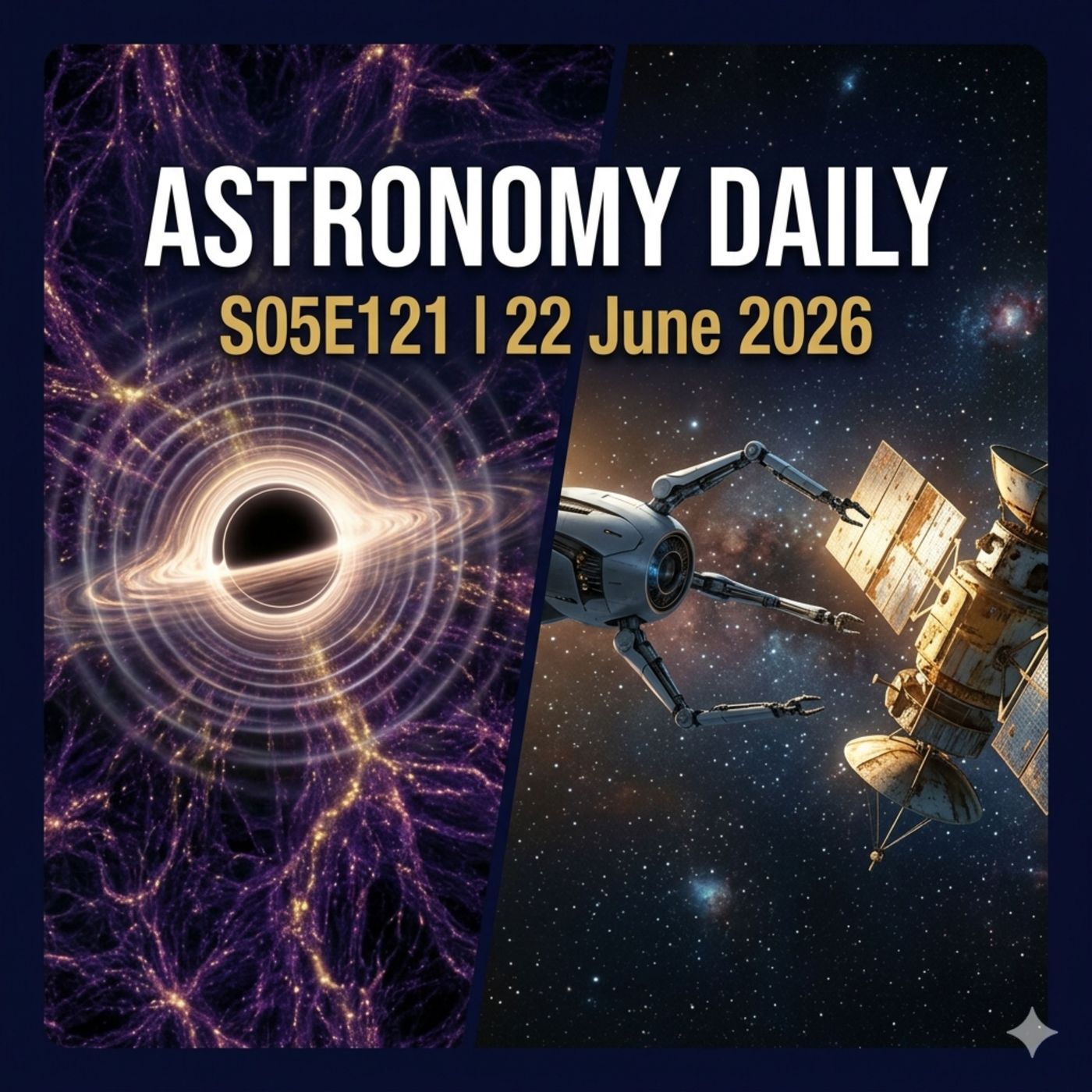
Dark Matter Revealed by Light Echoes, MAVEN's Legacy, and Groundbreaking Research on Menstruation in Space
In this episode
S05E121 | Monday, 22 June 2026 Hosts: Anna & Avery | astronomydaily.io | @AstroDailyPodStory 1 — Dark Matter Is Hugging Our Galaxy's Black Hole • Virginia Tech researchers used 'echo mapping' — light reverberations around active black holes — to detect dark matter signatures • Supermassive black holes including Sgr A* (Milky Way) appear surrounded by dense dark matter clusters • Lead researcher Mayank Sharma: 'The observational evidence for dark matter is simply undeniable' • Published in Physical Review D, June 11, 2026 • Provides a new tool for probing dark matter in the most extreme gravitational environments Story 2 — Swift Rescue Mission: Launch Date Confirmed • NASA's Neil Gehrels Swift Observatory launched 2004; has been losing altitude due to atmospheric drag — no thrusters to compensate • Katalyst Space Technologies built LINK — a robotic servicer with 3 robotic arms and xenon Hall-effect thrusters • Northrop Grumman's Stargazer aircraft departed Wallops Flight Facility June 18 carrying Pegasus XL + LINK • Launch from Kwajalein Atoll, Marshall Islands: confirmed for June 27, 2026 • LINK must chase down Swift, inspect it, and latch on — a first-of-its-kind robotic capture mission • Critical altitude threshold: if Swift drops below 185 miles (300 km), rescue becomes impossible • Success would give Swift another ~22 years of science at its original 600 km altitude Story 3 — Chandra Spots a Supernova Near the Galactic Centre • NASA Chandra, ESA XMM-Newton, and MeerKAT (South Africa) detected a 'blue blob' of X-ray emission in Sagittarius C • Sagittarius C is a star-forming region ~26,000 light-years from Earth, a few dozen light-years from Sgr A* • Estimated age: ~1,700 years — light from the explosion would have reached Earth around 300 AD • Expansion speed: approximately 2 million miles per hour • Published in The Astrophysical Journal (Zhu et al., June 11); NASA APOD June 18 • If confirmed, one of the closest supernova remnants ever found to the Milky Way's central black hole Story 4 — MAVEN: The Eulogy • MAVEN (Mars Atmosphere and Volatile Evolution) launched November 2013; arrived Mars September 2014 • Original mission: 1 year. Actual mission: 11+ years — ended June 3, 2026 • Last contact: December 6, 2025 — entered fast spin, batteries drained, unrecoverable • Key discoveries: atmospheric escape rates, solar storm acceleration of Mars atmosphere loss, atmospheric sputtering (first observed at any planet), new types of Martian aurora • Also served as communications relay for Curiosity and Perseverance rovers • PI Shannon Curry's epitaph: 'Best Mars mission ever.' — 800+ scientific publications • MAVEN will remain in Mars orbit 50–100 years before eventually entering the Martian atmosphere Story 5 — Operation Period: First-Ever Space Menstruation Study • Non-profit Operation Period, led by Manju Bangalore and Priya Abiram, announced OP-01 mission on June 19 • First dedicated scientific study of menstruation in microgravity — despite 100+ women having flown to space • Current practice: astronauts typically suppress menstruation during spaceflight with hormones — due to lack of data, not proven necessity • OP-01: suborbital Virgin Galactic flight in 2027; researchers will conduct the study on themselves • Research wing: Operation Period's 'Redshift Lab' • Data vital for longer missions — Moon, Mars — where menstrual health management matters more Story 6 — Isar Aerospace's Spectrum Rocket: Europe Keeps Trying • Isar Aerospace (Ottobrunn, Germany): Europe's most advanced commercial small launch startup — 800M+ euros raised • Spectrum rocket: 28m tall, up to 1,000 kg to LEO, 700 kg to SSO; 10 engines • First flight (March 2025): failed after 30 seconds — vent valve opened unexpectedly, rocket...
Anna: Light echoes, revealing dark matter, a race against orbital decay with days to go, a supernova ghost haunting the heart of our own galaxy. And an 11 year farewell to one of the best Mars missions we've ever flown. Avery: Plus, the first ever scientific study of menstruation in space is officially on the launchpad. And, um, Europe's plucky little rocket is trying and trying and trying again. Anna: It's Monday, the 22nd of June, 2026. You're listening to Astronomy Daily. I'm Anna. Avery: And I'm Avery.
Let's get into it. Anna: We have something genuinely new to tell you about dark matter this morning, and it involves the supermassive black hole right at the heart of our own galaxy, Avery: Sagittarius a, our galaxy's 4 million solar mass anchor. Scientists have been staring at it for decades, and, um, they just found something hiding in plain sight. Anna: Researchers at Virginia Tech have developed a technique called echo mapping, and they've used it to find hints that Sagittarius A and other supermassive black holes are surrounded by dense clusters of dark matter.
Avery: Now, dark matter makes up about 85% of all the matter in the universe. We know it's there because of how it bends light and pulls on stars. But we can't see it, touch it, or detect it directly. It just lurks. Anna: Until now, the environments immediately around supermassive black holes were basically impenetrable to dark matter searches. But echo mapping changes that. Here's how it works. Avery: When a black hole at the center of an active galaxy flares, spitting out light, that light bounces off surrounding gas and dust, creating delayed echoes that we can detect, like sonar, but using light and gravity.
Anna: Mayank Sharma, the Virginia Tech graduate student who led the study, said we are reaching a point where the observational evidence for dark matter is simply undeniable. The research was published in Physical Review D on June 11th. Avery: What they found were signatures in those echoes that couldn't be explained by the black hole lone. There appears to be extra material, extra mass huddled around it. And the leading candidate, dark matter. Anna: The implications are significant. If dark matter clumps densely around supermassive black holes, including our own Sagittarius A. That changes our models of how galaxies form, how black holes grow, and potentially how dark matter interacts at the smallest scales.
Avery: And this is an entirely new observational tool. Scientists now have a way to peer into the environments right around black hole hearts and look for the universe's most mysterious ingredient. Anna: Dark matter. Still invisible, still mysterious, but apparently very attached to the biggest objects in the cosmos. Avery: We have a major update on a story we've been following closely here on Astronomy Daily, the daring rescue mission to save NASA's Neil Jarrell's Swift Observatory. Anna: Swift launched in 2004.
It's been one of NASA's most productive telescopes, spotting gamma ray bursts, pivoting quickly to follow up targets across ultraviolet, X ray and visible light. 22 years of extraordinary science. Avery: But here's the problem. Swift was never equipped with thrusters. And after years of heightened solar activity, the atmosphere has puffed up, increasing drag. Swift has been sinking slowly but fatally towards Earth. Anna: Enter Catalyst Space Technologies, a, uh, startup that NASA commissioned to build a robotic servicer called Link, essentially a space tugboat with three robotic arms and xenon ion thrusters to grab Swift and haul it back up to safety.
Avery: And here's the new development. The launch day is confirmed June 27, just five days from now. Northrop Grumman Stargazer aircraft left Wallops flight facility on June 18th carrying the Pegasus XL rocket with Link tucked inside. And it's been making its way across the Pacific. Anna: It's now en route to Kwajalein Atoll in the Marshall Islands, a remote equatorial location chosen specifically for its orbital geometry. The Pegasus rocket will be dropped from about 40,000ft, fire its engines and deliver Link to orbit in roughly 10 minutes.
Avery: The hard part comes after launch. Link then has to chase down Swift, spending two to three weeks closing in on an observatory that was never designed to be grabbed and use its robotic arms to latch on. Anna: As of mid June, Swift was orbiting at about 225 miles altitude. If it dips below 185 miles, the rescue becomes physically impossible. Link's thrusters wouldn't be strong enough to fight the drag and boost them both to safety. Avery: If it works, Link will push Swift back up to around 600 km, its original altitude, which sustained the telescope for 22 years.
The first time. That would give Swift potentially another two decades of science. Anna: And if successful, this will be the first ever capture of an uncrewed US Government satellite by a private robotic spacecraft. The whole space industry is watching. Avery: Five days. The countdown is on. Anna: Stay near the center of the galaxy with us for a moment because we have another extraordinary discovery to share. And this one is thousands of years in the making. Avery: NASA's Chandra X Ray Observatory, working alongside ESA's XMM M M Newton and the Meerkat radial telescope in South Africa, has found what appears to be a supernova remnant lurking in a star forming region called Sagittarius C. Just a few Dozen light years from Sagittarius A. Anna: This would make it one of the closest supernova remnants ever found to the supermassive black hole at the center of our galaxy.
The research was published in the astrophysical journal on June 11, and NASA made it the astronomy picture of the day on June 18th. Avery: What they found is a bright blob of X ray emission, A blue blob in the composite images buried inside a much larger cloud of radio emission. The Sagittarius C region itself is enormous, about 50 light years across. Anna: The team think this blob is the expanding wreckage of a massive star that detonated in a core collapse supernova. When a star runs out of fuel, collapses in on itself and explodes outward in one of the universe's most violent events.
Avery: And the numbers are staggering. This remnant is estimated to be at least 1700 years old, meaning the light from that explosion would have reached Earth around the year 300 AD and it's still racing outward at about 2 million miles per hour. Anna: The team led by Zem Lin Zhu and Mark Morris at UCLA looked for chemical signatures of a supernova like elevate iron, oxygen and silicon. They didn't find a clear spike, but that may be because the debris has already mixed with the surrounding gas.
Avery: The galactic center is an incredibly dense, exotic environment. Magnetic fields, fast orbiting gas clouds, massive stars, and now possibly the ghost of a star that exploded in late antiquity, embedded just spitting distance from our galaxy's central black hole. Anna: If confirmed, this remnant adds an important data point to our understanding of how stellar cycles play out in the most extreme environments in the galaxy, and how supernovae seed the next generation of stars and planets with heavy elements.
Avery: A blue blob expanding at 2 million miles an hour for 1700 years. And we only just noticed it. Anna: We want to take a moment now to pay tribute to one of NASA's great Mars missions. Because on June 3, NASA officially declared the end of the Maven mission after 11 years in orbit at Mars. Avery: MAVEN, that stands for Mars Atmosphere and Volatile Evolution, launched from Cape Canaveral in November 2013, arrived at Mars in September 2014, and was only ever supposed to last one year. It lasted 11.
Anna: The mission was designed to answer one of planetary science's most compelling how did Mars go from a warm, wet world with rivers, lakes, and a thick atmosphere to the cold, dry desert desert we see today? Avery: And MAVEN cracked it open. It measured atmospheric escape rates, the pace at which gas is being stripped away by solar wind. It discovered that solar storms dramatically accelerate that stripping. It found a New type of aurora at Mars, one that occurs planet wide, unlike Earth's, which are confined to the poles.
Anna: It also observed a first atmospheric sputtering. That's when charged particles slam into the upper atmosphere hard enough to splash neutral gas molecules out into space. Like doing a cannonball in a pool, as the mission's principal investigator, Shannon Curry, put it. Avery: Maven also helped keep our surface rovers alive. It acted as a crucial communications relay for Curiosity and perseverance, passing messages between Earth and the Martian surface. When Maven went silent, it left a real gap.
Anna: And silent it went. On December 6 last year, Maven passed behind Mars on a routine orbit and never came back. An anomaly review board spent months searching for a signal. They found fragments of telemetry showing the spacecraft had entered a fast spin, draining its batteries beyond recovery. Avery: NASA formally ended the mission at a press conference on June 3rd. Shaman Curry, when asked what she'd put on Maven's tombstone, had an immediate answer. Best Mars mission ever. Anna: Over 800 scientific publications.
Auroras, atmospheric escape, Global dust storm studies, observations of interstellar comet 3I Atlas. Maven changed how we understand an entire planet. Avery: It will remain in Mars orbit for another 50 to 100 years before eventually burning up in the Martian atmosphere. Fitting, really. Maven studied Mars atmosphere until the very end. And one day, it will become part of it. Anna: 11 years of extraordinary science. Farewell, Maven. Avery: Now, here's a story that's surprising for one simple reason.
It's 2026. More than 100 women have flown to space, and nobody has actually ever studied menstruation in microgravity until, um, now. Anna: A nonprofit called Operation Period, led by Gen Z researchers Manju Bangalore and Priya Abhiram has announced a suborbital research mission called Operation Period Zero, or OP1, on a Virgin Galactic suborbital flight targeted for 2027. Avery: Anju Bangalore is a physicist, astronautical engineer, and former NASA researcher. Priya Abhiram is an engineer who has worked on astronaut life support systems at NASA and Blue Origin.
These are serious scientists tackling a serious gap. Anna: Here's the gap right now. Astronauts who menstruate typically choose to fully suppress their periods during spaceflight using hormonal IUDs or oral contraceptives. Not because it's dangerous, but because nobody has studied. What happens if they don't. Avery: With no data, there are no real choices. And as spaceflight missions get longer, to the moon, to Mars, the question becomes more urgent. What happens to the menstrual cycle in microgravity?
Does it change? Does Fluid dynamics behave differently. Nobody knows. Anna: Op1 will send Bangalore and Abhiram themselves to the edge of space on a Virgin Galactic suborbital flight to collect real physiological data. The specific research protocol will be announced closer to the mission. Avery: The announcement came on June 19. The team sits under Operation Period's research wing, called the Redshift Lab. And the team has been pointed out that over 750 people have traveled to space. Yet this fundamental human biology has simply never been formally studied.
Anna: It's a gap that's been hiding in plain sight. And it matters not just for the astronauts of today, but for the humans who will one day live on the Moon or spend years in transit to Mars. Avery: History is full of things that should have been studied decades earlier. Good to see this one finally getting its mission patch. Anna: And finally today, a story about persistence, ambition, and the maddening physics of getting a rocket off the ground. Avery: Europe wants sovereign access to space. Not just through Ariana Space's big launchers, but through a new generation of nimble commercial small satellite rockets built in Europe for European needs.
Anna: The leading candidate for that crown is Isar Aerospace, a German startup headquartered near Munich. They've raised over 800 million euros in private funding. They have a rocket called Spectrum, 28 meters tall, capable of hauling up to a ton to low Earth orbit. And they are trying very, very hard to fly it. Avery: Vectrum's first test flight was in March last year. It lasted 30 seconds before a vent valve unexpectedly opened. The rocket lost attitude control and it plunged into the sea near the launch pad.
Anna: But critically, it cleared the pad, proved the engines could fire, proved liftoff was possible. And, Isar learned, fixed the softw, increased margins, and came back for a second attempt. Avery: That second attempt, the Onward and Upward mission, carrying five European university cubesats and a technology demonstrator, has been trying to launch from Andoya spaceport in Norway since January. Four attempts this year alone. Anna: January scrubbed for a faulty pressurization valve. March scrubbed for fuel temperature issues.
And then a fishing vessel wandered into the hazard zone. April postponed over a suspected pressure vessel leak. June 15 halted after an anomaly in the fluid system. Avery: As of today, the launch window at Andoya has reportedly expired and no new date has been announced. ISAR is analyzing the data from the June 15th abort. Anna: To be fair, this is exactly what test flight programs look like. SpaceX had spectacular failures. Rocket lab had scrubs. Every rocket that flies reliably today once refused to fly at all.
Avery: But the backdrop matters. Europe's space sector needs a sovereign small launcher. Isar is the furthest ahead, and every delay is a reminder of just how hard the business of rocketry really is. Anna: We'll be watching. Go Spectrum whenever you're ready. Avery: Before we wrap up, let's look up what's in the winter sky tonight for our Southern Hemisphere listeners. Anna: The June Buddids meteor shower peaks Tonight right around 1am GMT, which for Eastern Australia is around midday, so Southern Hemisphere viewers will have missed the peak.
But the Bootids are famously unpredictable. Occasional outbursts have surprised observers in the past. Worth a look either way, though. Expect only a handful of meteors per hour. Avery: The Moon is in its first quarter phase, half lit, making it a great target for binoculars or a small telescope. Tonight, look for the crisp terminator line where craters and mountain ranges cast sharp shadows. Anna: Tomorrow night, the Moon will appear near Spica, the bright blue white heart of Virgo, an easy and lovely pair to spot after sunset with the naked eye.
Avery: And keep watching the western horizon after sunset for the planetary trio. Venus remains the brightest by far, with Jupiter nearby. Mercury is fading lower but still catchable if you have a clear western horizon, Anna: beautiful winter skies, Everyone rug up and look up. That's Astronomy daily for Monday 22nd June 2026. I'm Hannah. Avery: And I'm Avery. Thank you so much for spending part of your day with us in the cosmos. Anna: You'll find links and show notes@astronomydaily IO and if you're enjoying the show, leaving us a review really does make a difference.
Avery: Find us on X, Instagram, Facebook, TikTok, and Tumblr. Astrodaily Pod, we'd love to hear what you thought of today's stories. Anna: Until tomorrow, keep your eyes on the Avery: stars and your mind in the universe.
Anna: The stories.
Were told
m.



 Apple Podcasts
 Spotify
 Pocket Casts
 Castbox
 Overcast
 Podbean
 iHeartRadio
 Castro
 Goodpods
 Moon FM
 Podcast Addict
 Podcast Republic
 YouTube