
SpaceX's $1.8 Billion Boost, Busy Launch Week, and Lunar GPS Breakthroughs: S04E55
In this episode
Astronomy Daily | Space News: S04E55In this episode of Astronomy Daily, host Anna brings you the latest and most exciting developments in space exploration. From groundbreaking advancements in navigation technology to SpaceX's ambitious expansion plans, this episode is packed with stories that showcase the rapid evolution of our capabilities in the cosmos.
Highlights:
- SpaceX's $1.8 Billion Expansion in Florida: Join us as we dive into SpaceX's announcement of a massive investment aimed at transforming Florida's Space Coast. Discover the details behind the construction of the new Gigabay facility at NASA's Kennedy Space Center, which will significantly enhance the company’s Starship operations and create hundreds of jobs in the region.
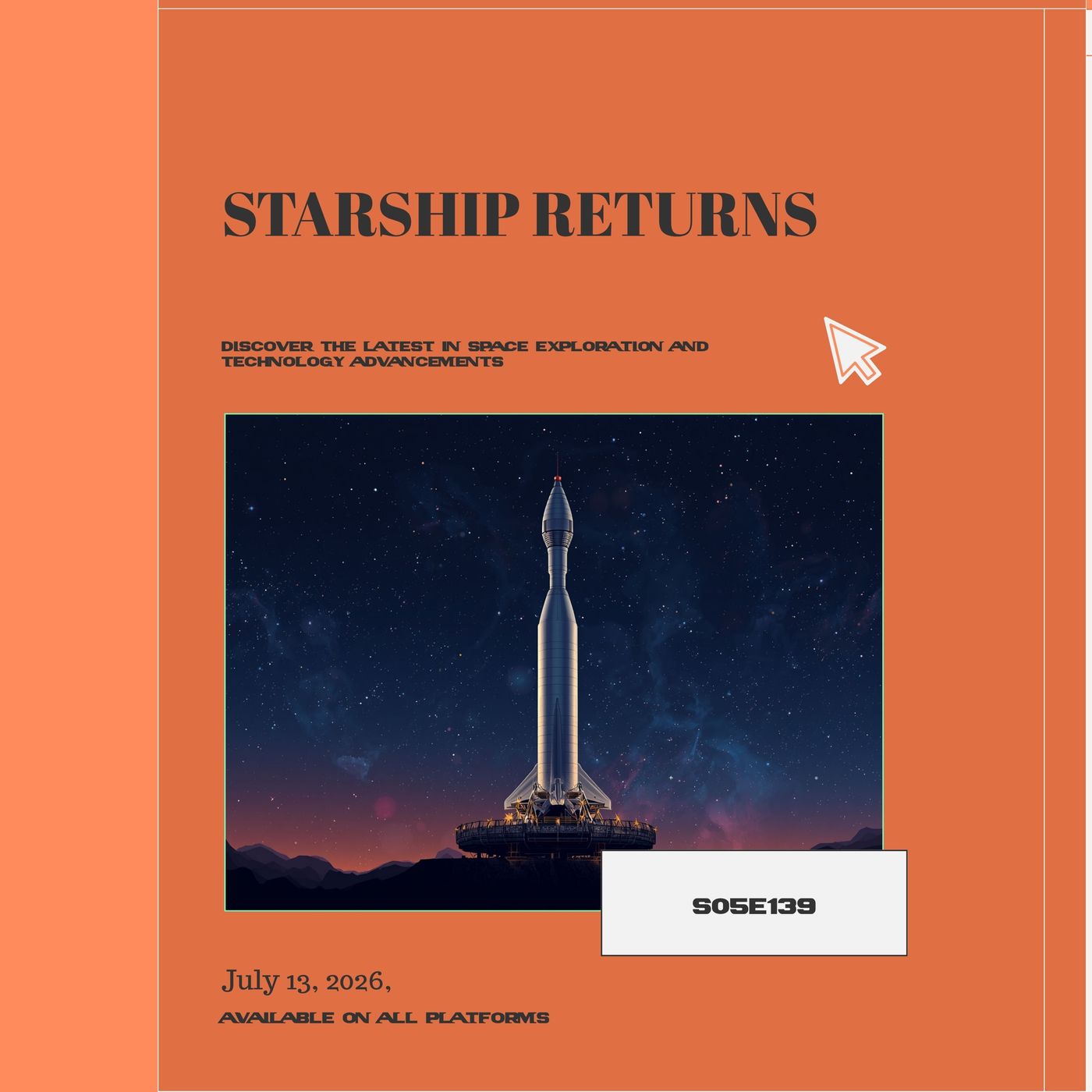
- Busy Launch Week Ahead: Get ready for an action-packed week in spaceflight, featuring multiple launches from SpaceX, including the highly anticipated eighth test flight of Starship. We’ll discuss the missions planned and what they mean for the future of space exploration and satellite communications.
- International Space Station Update: Learn about the extended stay of NASA astronauts Butch Wilmore and Suni Williams aboard the ISS, following unexpected technical issues with the Starliner spacecraft. We’ll explore the implications of their extended mission and the ongoing scientific research being conducted in the station.
- Historic GPS Signal Reception on the Moon: Exciting news from NASA and the Italian Space Agency as they successfully demonstrated GPS signal reception on the lunar surface for the first time. We discuss how this groundbreaking achievement could revolutionize lunar navigation for future missions.
- New Theories on Cosmic Rays: Explore a new theory regarding the origin of ultra high energy cosmic rays, suggesting they may be produced during the mergers of binary neutron stars. We’ll delve into the significance of this research and its potential to enhance our understanding of the universe.
- Citizen Science Revolution: Discover how a network of over 15,000 Wi-Fi enabled telescopes is empowering amateur astronomers to contribute to significant discoveries in space research. We highlight the remarkable achievements of these citizen scientists and their role in expanding our knowledge of the cosmos.
For more cosmic updates, visit our website at astronomydaily.io. Join our community on social media by searching for #AstroDailyPod on Facebook, X, YouTubeMusic, and TikTok. Don't forget to subscribe to the podcast on Apple Podcasts, Spotify, iHeartRadio, or wherever you get your podcasts.
Thank you for tuning in. This is Anna signing off. Until next time, keep looking up and stay curious about the wonders of our universe.
00:00 - Welcome back to Astronomy Daily
01:05 - SpaceX's expansion plans
07:30 - Upcoming launch week overview
12:15 - ISS astronaut updates
18:00 - GPS signals on the Moon
22:30 - Theories on cosmic rays
27:00 - Citizen science contributions
32:00 - Conclusion and upcoming content
✍️ Episode References
SpaceX Expansion Details
[SpaceX](https://www.spacex.com)
NASA's Lunar GNSS Receiver Experiment
[NASA](https://www.nasa.gov)
International Space Station Research
[ISS](https://www.nasa.gov/iss)
Cosmic Ray Research
[NYU](https://www.nyu.edu)
Citizen Science Telescope Network
[Citizen Science](<a href="https://www.citizenscience.gov/" target="_blank"...
Welcome to Astronomy Daily. I'm your host Anna with today's most fascinating developments from the world of space exploration and astronomy. We have an action packed episode ahead covering some major stories that showcase just how rapidly our space capabilities continue to advance. Coming up, we'll dive into SpaceX's ambitious expansion plans in Florida, with a massive one point eight billion dollars investment that's set to transform the space coast. We'll also look at an incredibly busy launch week featuring multiple missions from various launch providers, including the highly anticipated eighth test flight of Starship.
We'll check in on the International Space Station, where there have been some interesting developments with the extended stay of astronauts which Wilmore and Sunny Williams. Plus, we've got exciting news about a historic achievement on the lunar surface where NASA has successfully demonstrated GPS signal reception for the first time. And in our science segment, we'll explore some groundbreaking discoveries, including a new theory about the origin of the universe's most to energetic particles, and how a network of citizen scientists with backyard telescopes is making meaningful contributions to astronomical research.
It's a reminder that we're living in an extraordinary era of space exploration, where technological breakthroughs and scientific discoveries are happening at an unprecedented pace. Let's get started with today's stories. In a major development for Florida's Space Coast, SpaceX has announced plans for a significant expansion of its starship operations. The company will invest one point eight billion dollars to construct new launch and landing infrastructure at NASA's Kennedy Space Center and Cape Canaveral Space Force Station, pending environmental approval.
At the heart of this expansion is the construction of a massive new integration facility called Gigabay, which will provide over forty million cubic feet of vehicle processing space. This facility will be crucial for preparing starship vehicles for their missions to Earth, orbit, the Moon, Mars, and beyond. The economic impact of this expansion cannot be overstated. SpaceX's investment is expected to create approximately six hundred new full time jobs in the Space Coast region by twenty thirty, further cementing Florida's position as a leader in the aerospace industry.
This development comes at a time when Florida's space sector is experiencing remarkable growth. The state set a new record with ninety three launches in twenty twenty four, up from seventy four to twenty twenty three, and this expansion suggests that trend will continue. The project represents a collaborative effort between SpaceX, Florida Commerce, the Florida Department of Transportation, and space Florida. SpaceX's Vice president of Launch, Kiko Dnceev, emphasized that this expansion is directly aligned with the company's ultimate mission of making humanity multiplanetary.
Starship, being the first fully reusable launch vehicle of its kind, is designed to be the cornerstone of this ambitious goal. The expansion will complement space X's existing Starship facilities in Texas, creating a dual coast capability for the world's largest rocket system. This redundancy will be crucial for increasing launch frequency and reliability as Starship moves from testing to regular operational flights. This investment represents more than just infrastructure growth. It's a clear signal of SpaceX's long term commitment to Florida and their confidence in Starship's future role in space exploration.
As the company continues to push the boundaries of what's possible in space travel, This expansion will play a vital role in turning those ambitious plans into reality. Next up, let's take a look at this week's launch schedule. It's shaping up to be an incredibly busy week in spaceflight, with multiple launches scheduled across several different launch providers. SpaceX has an ambitious schedule ahead, with no fewer than five Falcon nine launches planned. Three of these missions will carry Starlink satellites, continuing the expansion of their Global Internet constellation.
The company is also scheduled to launch the fascinating SPHEREx and Punch missions for NASA this week, two telescopes that will help us better understand both the origins of our universe and the behavior of our Sun. Perhaps the most anticipated launch of the week is Starship's eighth test flight from Texas. This mission aims to demonstrate several crucial capabilities, including the first ever payload deployment from Starship, four Starlink satellite simulators. The super heavy booster will attempt another landing at Starbase while the spacecraft itself is targeting a splash down in the Indian Ocean.
The Transporter thirteen mission rounds out SpaceX's packed schedule, carrying over forty small satellites from various customers to orbit as part of their ride share program. This mission highlights the growing accessibility of space, with launch costs starting at just three hundred thousand dollars for small satellite operators. Rocket Lab is also joining the action with their Electron rocket scheduled to launch from New Zealand. Their mission, cleverly named the Lightning god Rains, will deploy synthetic aperture radar satellites for IQPS, marking the first of eight planned launches for this customer.
This intense launch cadence demonstrates just how far the space industry has come. What would have been considered an extraordinary month of launches just a few years ago is now being attempted in a single week, showcasing the rapid evolution and growing capabilities of modern spaceflight. The success of these missions will contribute to various aspects of space exploration and utilization, from expanding global communications to advancing our scientific understanding of the cosmos. It's a testament to the increasingly dynamic and capable state of the global space industry.
Next, let's get an update from the International Space Station. Three NASA astronauts and a Russian cosmonaut are preparing for their journey home aboard a Crew Dragon spacecraft. But for two of them Butch Wilmore and Sunny will Williams, this mission has taken some unexpected turns. What began as an eight day mission on Boeing Starliner spacecraft has stretched into an eight month stay aboard the International Space Station. The extended duration came after technical issues with Starliner forced NASA to modify their plans.
During the spacecraft's flight to the ISS, it experienced thruster problems in concerning helium leaks. This led to the decision in August to return Starliner to Earth uncrewed, leaving Wilmore and Williams to join the Crew nine mission. Their stay was further extended when SpaceX encountered development issues with their Crew Dragon spacecraft, pushing the return date out another month to March. This situation has recently attracted attention beyond the space community, becoming somewhat politicized after comments from various public figures During a news conference this week from orbit, Wilmore addressed these developments head on.
He expressed respect for all parties involved, while emphasizing that politics played no role in their extended stay. As he explained, they had prepared for the possibility of a longer mission, even though the original plan was for a short stay. This kind of contingency planning, he noted, is standard practice in human spaceflight. His crewmate Sonny Williams, took the opportunity to highlight the ongoing value of the International Space Station. Drawing on her extensive experience, including helping construct the station during the Shuttle era, she described it as being in its prime.
The laboratory, she explained, is operating at full capacity, with all power systems and facilities running, conducting world class science that benefits both American tax payers and international partners. This mission, while longer than initially planned, demonstrates the flexibility and resilience required in space exploration. It also showcases the importance of having multiple crew transportation options, and the continuing significance of the International Space Station as a platform for scientific research and international cooperation.
Next up, NASA and the Italian Space Agency just achieved a remarkable breakthrough in space navigation. For the first time ever, they successfully received and tracked GPS signals on the lunar surface, approximately two hundred twenty five thousand miles from Earth. This historic achievement came through their Lunar GNSS Receiver Experiment, or lou Gray, which touched down on the Moon aboard Firefly Aerospace's Blue Ghost Lunar Lander. The implications of this success are truly game changing for future space exploration.
Until now, spacecraft navigation has relied heavily on Earth based tracking stations and on board sensors, but this demonstration proves that missions as far away as the Moon could potentially use GPS signals for autonomous navigation, significantly reducing their dependence on ground control. The experiment didn't just break records on the lunar surface. During its journey to the Moon. LUGRI set new altitude records for GPS signal reception, reaching an astounding two hundred nine thousand, nine hundred miles from Earth while in transit, and later extending that record to two hundred forty three thousand miles in lunar orbit.
This means that spacecraft operating in cis lunar space. The vast region between Earth and the Moon could also benefit from this navigation capability. The Lugri payload will continue operating for fourteen days on the lunar surface, collecting data nearly continuously. This extended operation period will provide NASA and the Italian Space Agency with valuable insights into how GPS and GALILEO signals can be utilized for lunar navigation. It's particularly significant for future Artemis missions and other exploration initiatives, as it opens up new possibilities for precise positioning and navigation on and around the Moon.
This breakthrough represents another crucial step in establishing the infrastructure needed for sustainable lunar exploration and eventual missions to Mars. The ability to use familiar navigation technology from Earth all the way to the Moon brings us one step closer to making space exploration more accessible and reliable. In other exciting scientific developments, researchers may have finally cracked a sixty year old cosmic mystery about the origin of ultra high energy cosmic rays, the highest energy particles known in the universe.
These particles pack energies more than a million times greater than anything we can create in our most powerful particle accelerators. According to new research from New York University, these incredible cosmic rays might be created during the violent mergers of binary neutron stars. The theory suggests that just before these stellar corpses collide and form a black hole, they generate powerful magnetic outflows that accelerate particles to these extreme energies. What makes this theory particularly compelling is that it's testable through current technology, as these mergers also produce detectable gravitational waves.
Speaking of astronomical discoveries, a remarkable citizen science project is revolutionized how we study the cosmos. A network of over fifteen thousand Wi Fi enabled telescopes spread across six continents is enabling amateur astronomers to make significant contributions to space research. Just this January, an astronomy enthusiast in Mexico managed to catch a glimpse of a potential Jupiter sized planet crossing in front of a distant star, all from his backyard. This global telescope network has already helped discover hundreds of asteroids, comets, and exoplanets.
The system works by observing occultations brief moments when objects like asteroids or planets block the light from background stars. By measuring these events from multiple locations, scientists can determine these objects sizes, shapes, and trajectories with impressive accuracy. The network has proven invaluable for major space missions too. When NASA intentionally crashed a spacecraft into an asteroid in twenty twenty two, these citizen astronomers helped track the resulting debris cloud. While the telescope's cost can be a barrier for some, various organizations are working to make them more accessible, particularly in underrepresented regions, by donating equipment to universities and astronomy clubs worldwide.
This blend of professional and amateur astronomy is transforming our understanding of the Cosmos, proving that significant scientific discoveries don't always require massive observatories or billion dollar budgets. Sometimes they can happen right in someone's backyard. Well that brings us to the end of another packed episode of Astronomy Daily. Whether it's SpaceX's ambitious expansion plans, groundbreaking missions, or citizen scientists making discoveries from their backyards, the space industry continues to amaze and inspire us with each passing day.
If you want to stay up to date with all the latest developments in space and astronomy, head over to Astronomy Daily dot io. There you'll find our constantly updating news feed covering all the latest space news as it happens, plus our complete archive of past episodeisodes. For those who haven't already, make sure to subscribe to the podcast so you never miss an episode. You can find us wherever you get your podcasts, including Apple Podcasts, Spotify, YouTube, and Podbeam. This has been Anna, and I'll see you tomorrow for another journey through the fascinating world of space exploration and discovery.
Until then, keep looking up Sunday star Is Start

 Apple Podcasts
 Spotify
 Pocket Casts
 Castbox
 Overcast
 Podbean
 iHeartRadio
 Castro
 Goodpods
 Moon FM
 Podcast Addict
 Podcast Republic
 YouTube