
Starship Milestones, Terraforming Mars Possibilities, and Betelgeuse's Cosmic Secret
In this episode
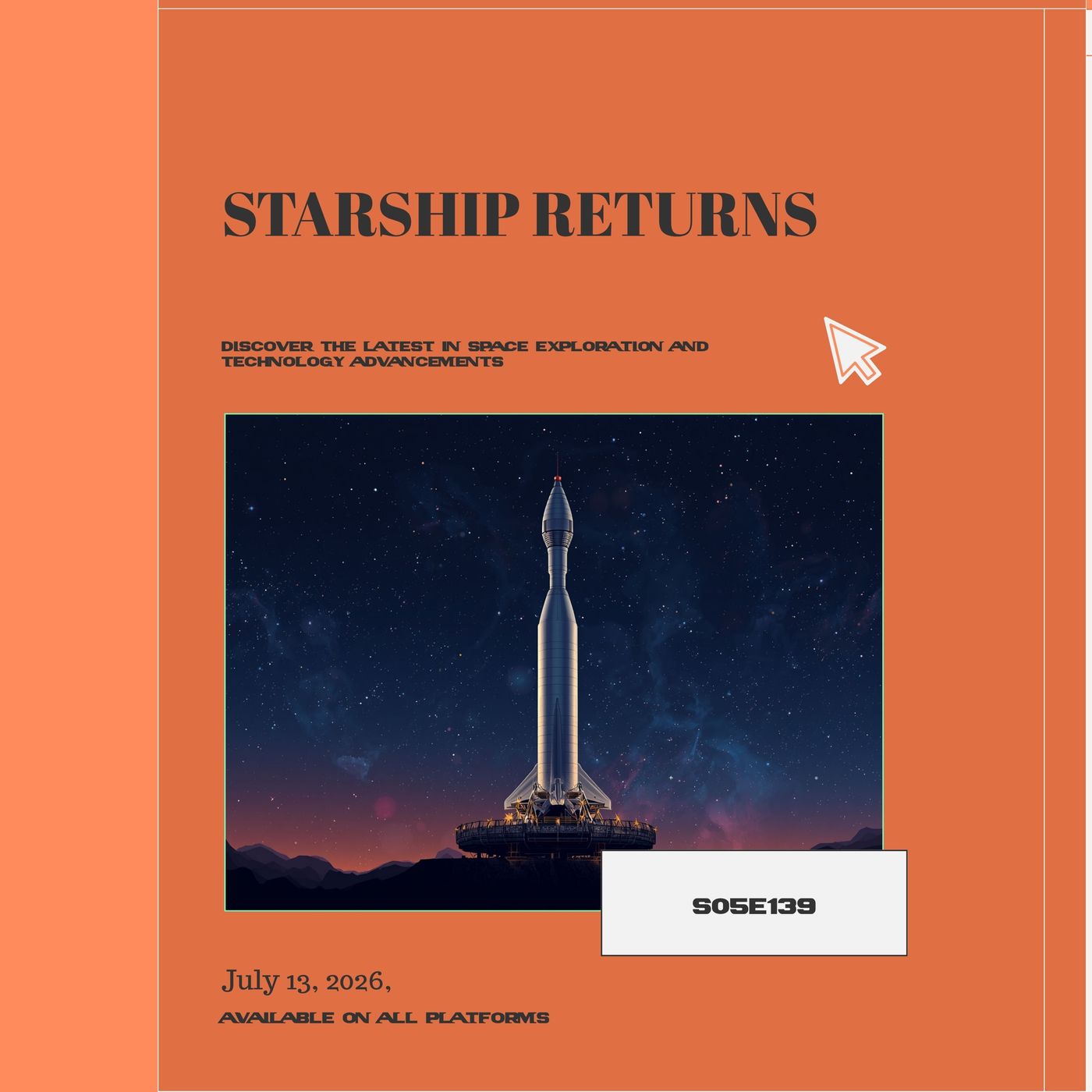
- SpaceX's Starship Flight 11: NASA spaceflight has reported that SpaceX is gearing up for Starship Flight 11, marking the final launch from Pad 1A in its current configuration. This mission will transition SpaceX to the advanced Block 3 designs, utilizing booster 152 and ship 38 to test engine redundancy and heat shield performance.
- Terraforming Mars Feasibility: A recent workshop summary suggests that advancements in launch costs, synthetic biology, and climate modeling have made the dream of terraforming Mars more feasible than ever. The proposed process includes warming the planet, introducing extremophiles, and eventually creating an oxygen-rich atmosphere for complex life.
- Discovery of Betel Buddy: Researchers have confirmed the existence of a companion star to Betelgeuse, affectionately named Betel Buddy. This discovery, utilizing advanced instruments like the Hubble Telescope, sheds light on the mysterious dimming cycles of Betelgeuse and challenges existing binary star formation theories.
- Microbial Resilience in Space: A groundbreaking study from RMIT University reveals that Bacillus subtilis spores can survive the extreme conditions of spaceflight, demonstrating resilience that could support astronaut health and sustainable life support systems on long-duration missions to the Moon and Mars.
- Mysterious Sounds in Space: The Daily Galaxy revisits the eerie knocking sounds reported by China's first astronaut, Jingle during his 2003 mission. These sounds, described as akin to a wooden hammer, have been echoed by other astronauts and remain an unsolved mystery in the realm of space exploration.
- For more cosmic updates, visit our website at astronomydaily.io. Join our community on social media by searching for #AstroDailyPod on Facebook, X, YouTubeMusic, TikTok, and our new Instagram account! Don’t forget to subscribe to the podcast on Apple Podcasts, Spotify, iHeartRadio, or wherever you get your podcasts.
- Thank you for tuning in. This is Anna and Avery signing off. Until next time, keep looking up and exploring the wonders of our universe.
Starship Flight 11 Details
[NASA Spaceflight](https://www.nasaspaceflight.com/)
Terraforming Mars Insights
[Universe Today](https://www.universetoday.com/)
Betel Buddy Discovery
[Carnegie Mellon University](https://www.cmu.edu/)
Microbial Resilience Study
[RMIT University](https://www.rmit.edu.au/)
Mysterious Sounds in Space
[The Daily Galaxy](https://www.dailygalaxy.com/)
Astronomy Daily
[Astronomy Daily](http://www.astronomydaily.io/)
Become a supporter of this podcast: https://www.spreaker.com/podcast/astronomy-daily-latest-space-news--5648921/support.
Sponsor Details:
Ensure your online privacy by using NordVPN. To get our special listener deal and save a lot of money, visit www.astronomydaily.io/nordvpn. You'll be glad you did!
Get the best secure and private email on the planet. Stop your Government, google...
Avery: Welcome to Astronomy Daily, your cosmic compass guiding us through the latest in space exploration and celestial discoveries. I'm Avery, and it's fantastic to have you joining us today. Anna: And I'm Anna. We've got an absolutely packed show lined up, delving into everything from groundbreaking starship developments to the ambitious idea of, uh, terraforming Mars. And even some truly bizarre and mysterious sounds reported from orbit. Avery: It's going to be a captivating journey through the universe's headlines.
Let's kick things off with some big news from SpaceX. NASA spaceflight has published an intriguing article discussing Starship Flight 11, which is slated to be the final Launch utilizing Pad 1A in its current operational configuration. This truly signals a major turning point for SpaceX's Starship program. Anna: Wow, that's a significant milestone, isn't it? So this specific pad has been a workhorse, and now it's getting a retirement. Avery: Of sorts of you could say that it marks the culmination of the block one and two vehicle flight tests.
After this mission, we're transitioning fully to the more advanced block three designs. The powerful Raptor 3 engines, and a completely new optimized launch pad design. It's an evolution in real time. Anna: Block 3, Raptor 3 and a new pad. That's a lot of upgrades all at once. What are the specific vehicles they're using for flight 11? Avery: For this mission, we're looking at booster 152 and ship 38. Both have histories of successful testing and impressive performance, so it's fitting they're taking on this final Block two mission.
Anna: Okay, so proven vehicles for a pivotal flight. What exactly are they hoping to achieve with this particular launch? Beyond just getting off the ground, of course. Avery: Well, the primary objectives are critical for the next iteration. They're heavily focusing on testing engine redundancy for the Block three vehicles, ensuring that Starship can withstand engine failures during ascent. And crucially, they're gathering more data on heat shield tile performance during RE entry, which is vital for safe and reusable operations.
Anna: Engine redundancy and heat shield performance, those are absolutely key for reliability and reusability, especially for future crewed missions. Avery: Absolutely. Every flight is a learning opportunity. And this one is designed to maximize data collection for the path forward. And a target launch date, for those of you wanting to watch history in the making is October 13th. Anna: So anytime now, definitely mark your calendars for that one. It sounds like the end of one chapter and the exciting beginning of another.
From the very near future of spaceflight, let's cast our gaze far, far into the future with A ah, truly captivating piece from Universe today. Could we really turn Mars green? Avery: Mars terraforming has always felt like the ultimate sci fi dream. Or perhaps a uh, distant impossible fantasy. Anna: It certainly did. But the article, based on a workshop summary by Dr. Erica de Benedictis from Pioneer Labs, proposes that with recent staggering advancements, terraforming Mars has shifted from impossible to merely very difficult.
Avery: Merely very difficult is a huge leap. What are these advancements that are changing the game? Anna: She points to three key areas. Plummeting launch costs, largely thanks to innovators like SpaceX and their Starship program, significant breakthroughs in synthetic biology and much more sophisticated climate modeling. These combined factors create a new feasibility. Avery: So cheaper access to space, better ways to engineer life, and clearer understanding of how planetary systems work. That makes a compelling argument.
Anna: Exactly. The process would involve several phases. The first would be warming the planet using aerosols and greenhouse gases. The goal here is to melt the polar ice caps and subsurface ice, which would release vast amounts of liquid water onto the surface. Avery: Melting the ice to get liquid water. That's foundational. Then what? Introduce plants. Anna: Not immediately plants, but microbial life, specifically extremophiles, organisms that thrive in harsh conditions. These microbes would begin the critical work of atmospheric transformation through photosynthesis, slowly converting the Martian atmosphere.
Avery: Mm mhm. A biological engine for atmospheric change. That's ingenious. And eventually an oxygen rich atmosphere for more complex life. Anna: Precisely. The long term vision is an atmosphere capable of sustaining complex life, potentially starting with domed habitats as stepping stones. It's a multi century project, but the theoretical framework is increasingly robust. Avery: It also brings up serious ethical considerations. Should we as a species fundamentally alter another planet, even if it's for human expansion?
Anna: Absolutely. Those ethical discussions are a crucial part of the debate. Alongside the practical benefits like pioneering technologies that could also help solve environmental challenges here on Earth. Avery: Moving from hypothetical Martian futures to a very real, very bright star in our night sky, Betelgeuse. This red supergiant has been full of surprises. And Universe Today has just reported on another incredible discovery. Anna: Betelgeuse. The star that had us all on edge a few years ago, wondering if it was about to go supernova, suddenly dimming so dramatically.
Avery: That's the one. It turns out researchers have finally confirmed the existence of a secret companion star to Betelgeuse. They've affectionately and quite aptly nicknamed it Betal Buddy. Anna: Bettle Buddy. That's wonderful. I mean, trying to spot a companion next to a red supergiant that huge and bright must have been an immense challenge. Avery: An incredible challenge indeed. A team from Carnegie Mellon University led by Anna O', Grady utilized some of our most advanced instruments. NASA's Chandra X Ray Observatory and the venerable Hubble Telescope, to confirm its existence.
Anna: X rays and visible light. Smart. So how big is this Betel Buddy and what does its discovery tell us about Betelgeuse itself? Avery: Betel Buddy is a relatively young stellar object, surprisingly roughly the size of our own Sun. Its presence is now theorized to be the key to understanding Betelgeuse's puzzling six year cycle of brightening and dimming. Anna: Ah. Uh, so it's not just a coincidence the companion affects the supergiant. Avery: Exactly. The prevailing theory is that Betel Buddy is gravitationally interacting with Betelgeuse in a way that periodically clears away vast clouds of light blocking dust that surround a larger star.
That dust is what caused the dimming we observed. Anna: Wow. So it's essentially acting like a cosmic dust bunny sweeper. That makes so much more sense than some random stellar event causing the dimming. Avery: A cosmic dust sweeper. I love that. And what's really fascinating is this discovery also presents a significant challenge to current binary star formation models is that because. Anna: Of the vast difference in their masses, Betelgeuse is what, like 16 or 17 times the mass of our own Sun?
Avery: Spot on. We're talking 16 to 17 solar masses for Betelgeuse, compared to roughly one solar mass for Betel Buddy. That vast mass ratio simply doesn't align neatly with existing theories of how binary star systems like this are supposed to form. Anna: So it's not just solving a mystery about Betelgeuse, but potentially rewriting a bit of our understanding of stellar evolution. Incredible. Let's shift our focus now to something absolutely vital for the future of human space exploration. And it involves some of the smallest, yet most resilient forms of life.
Space.com has some incredibly good news for future astronauts. Avery: Ooh. Good news is always welcome, especially when it concerns the health of our space travelers. Anna: It definitely is. The research conducted by RMIT University confirms that microbes essential for human health can actually survive the intense stress of spaceflight. They sense spores of Bacillus subtilis, a common bacterium vital for our gut health and general well being on a sounding rocket flight. Avery: So our tiny biological co pilots, these Bacillus subtilis spores, were deliberately put through the ring of a rocket launch.
Anna: Exactly. And the results are hugely encouraging. The study found these microscopic spores could withstand extreme accelerations up to 13 times Earth's gravity during launch, survive the microgravity conditions of space and then endure harsh decelerations of up to 30G during reentry into the atmosphere. Avery: 13G'S and 30G's. That's astounding. Those are forces that would absolutely crush a human. Anna: Precisely. And despite all that, the spores showed no physical damage and remarkably grew normally once they returned to Earth.
This is monumental because it's the first study to test bacteria in actual real world spaceflight conditions, not just simulations. Avery: Wow, that really changes the game for long duration missions, doesn't it? Anna: It offers immense hope. This kind of resilience is crucial for maintaining astronaut health on those arduous journey journeys to the Moon and Mars. Imagine being able to rely on these robust microbes for various biological processes needed to keep a crew healthy. Avery: And, um, not just health, but it could also be a cornerstone for developing truly sustainable life support systems in space.
Right. If these tiny workhorses can endure the journey, they could help process waste to generate oxygen. Anna: Absolutely. It points towards a future where our journey into deep space isn't just about rockets and hardware, but also about integrating living systems that can thrive alongside us. Avery: Now let's turn our attention to something a little more mysterious, perhaps even unsettling. From the annals of space history. The Daily Galaxy revisits the strange experience of China's first astronaut, Yang Liwei.
Anna: Oh, I think I remember hearing about this. He heard a strange noise, didn't he? Alone in space, hearing something unexpected that gives me chills. Avery: It's truly a chilling account. During his Shenzhou 5 mission in 2003, Yang Liwei reported hearing unexplained knocking sounds. He vividly described it like someone was hitting the body of the spaceship with a wooden hammer. Anna: A wooden hammer that's so distinct. Not just a creak or a pop, but a deliberate knocking. Avery: Exactly. What makes it even stranger is that other Chinese astronauts have reported similar occurrences on subsequent missions.
It's not an isolated incident. Anna: Other astronauts too. That really deepens the mystery. Avery: It does. And it brings to mind other famous unexplained sounds. Like the space music heard by Apollo 11 astronauts. So what are the leading theories for this knocking sound? Anna: I'd imagine thermal expansion and contraction of the spacecraft. Materials that always makes strange noises or micrometeoroid impacts. Avery: Those are indeed the primary scientific explanations. Thermal stress as the spacecraft expands and contracts in extreme temperature shifts.
Or the impact of tiny dust particles or micrometeoroids. But Yang Liwei and others felt these theories didn't fully explain the consistent and distinct nature of the wooden hammer sound. Anna: It's the consistency and the specific timbre of the sound that makes it so perplexing, it suggests something more than just random physical processes. Avery: The article also broadens the discussion to remind us that space isn't truly silent. We've recorded electromagnetic signals, plasma waves with probes like NASA's Van Allen, and even audio from Jupiter's moon Ganymede by the Juno probe.
Anna: So space is full of sounds, just not always the kind we expect or, uh, can directly hear. But that specific noggin sound from inside the capsule, it really remains one of those enduring space enigmas. Avery: Precisely. It's a testament to the fact that even with all our technological advancements, space still holds secrets that can truly baffle us. Anna: And that brings us to the end of another captivating episode of Astronomy Daily. From the ambitious future of starship and terraforming Mars to the cosmic ballet of Betelgeuse and those mysterious space knocks, it's been a stellar show.
Avery: It truly has. Anna. Thank you all for joining us on this exploration of the universe's latest and greatest happenings. Anna: We hope you found today's news as fascinating as we did. Don't forget to look up tonight and marvel at the endless wonders above. Avery: We'll be back tomorrow with more cosmic insights and space stories. Until then, keep your eyes on the stars and keep exploring.


 Apple Podcasts
 Spotify
 Pocket Casts
 Castbox
 Overcast
 Podbean
 iHeartRadio
 Castro
 Goodpods
 Moon FM
 Podcast Addict
 Podcast Republic
 YouTube