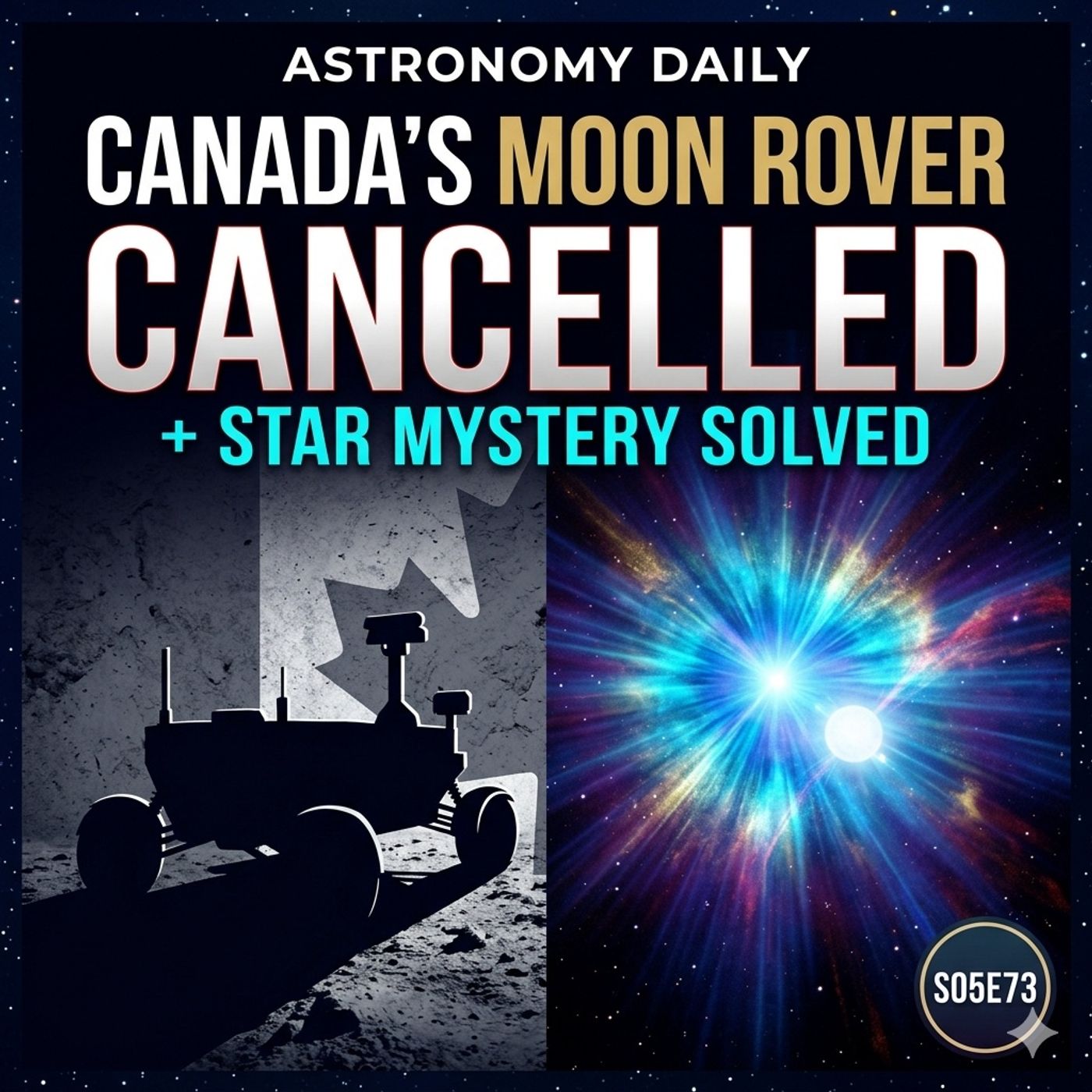
Spectrum Aborts at T-3 | Canada Loses Its Moon Rover | Triton Tilted Neptune
In this episode
Episode Summary Today's episode opens with a brief update on the Isar Aerospace Spectrum rocket, which aborted at T-3 seconds on March 25 — just before engine ignition — with no new launch date yet announced. The main stories cover Canada's cancellation of its first lunar rover mission; the century-old mystery of Gamma Cassiopeiae's anomalous X-ray emissions finally solved by the XRISM space telescope; new research suggesting Neptune's axial tilt may have been caused by its captured moon Triton; NASA's Dragonfly rotorcraft entering full integration and testing ahead of a 2028 launch to Saturn's moon Titan; Russia returning to orbit from Baikonur Cosmodrome following last November's structural collapse; and the new SPHEREx telescope detecting a bipolar hydrogen shell around the remnant of Nova Persei 1901.Story Sources Update — Isar Aerospace Spectrum NASASpaceFlight.com — Isar Aerospace scrubs second launch of Spectrum rocket https://www.nasaspaceflight.com/2026/03/isar-onward-and-upward/ Isar Aerospace Mission Updates https://isaraerospace.com/mission-updates-overview Story 1 — Canada Cancels Moon Rover Space.com — Canada cancels its 1st moon rover: 'It's hopefully not a lost cause' https://www.space.com/space-exploration/artemis/canada-cancels-its-1st-moon-rover-its-hopefully-not-a-lost-cause Canadian Space Agency — Spending Plan 2026-27 https://www.asc-csa.gc.ca/eng/publications/dp-2026-2027.asp Story 2 — Gamma Cassiopeiae Mystery Solved Space.com — Scientists finally solve century-old mystery of star with unexpected X-ray emissions https://www.space.com/astronomy/stars/scientists-finally-solve-century-old-mystery-of-star-with-unexpected-x-ray-emissions ESA / EurekAlert — XRISM solves famous star's 50-year mystery https://www.eurekalert.org/news-releases/1120872 ScienceDaily — Astronomers solve 50-year mystery of a naked-eye star's extreme X-rays https://www.sciencedaily.com/releases/2026/03/260325041723.htm Story 3 — Neptune's Tilt & Triton Astrobiology.com / arXiv — Neptune's Obliquity Was Likely Engendered By Triton's Tidal Evolution https://astrobiology.com/2026/03/neptunes-obliquity-was-likely-engendered-by-tritons-tidal-evolution.html Story 4 — Dragonfly Integration Testing NASA Science — NASA's Dragonfly Mission Begins Rotorcraft Integration, Testing Stage https://science.nasa.gov/blogs/dragonfly/2026/03/10/nasas-dragonfly-mission-begins-rotorcraft-integration-testing-stage/ Johns Hopkins APL — Dragonfly Mission Begins Rotorcraft Integration, Testing Stage https://www.jhuapl.edu/news/news-releases/260312-dragonfly-integration-begins Story 5 — Russia Returns to Orbit from Baikonur Universe Today — Russia Returns to Orbit from Baikonur Following Structural Collapse https://www.universetoday.com/ Story 6 — SPHEREx & Nova Persei 1901 Phys.org — Using NASA's SPHEREx space telescope, astronomers observe remnants of the eruption of Nova Persei 1901 https://phys.org/space-news/
Become a supporter of this podcast: https://www.spreaker.com/podcast/astronomy-daily-latest-space-news--5648921/support.
Sponsor Details:
Ensure your online privacy by using NordVPN. To get our special listener deal and save a lot of money, visit www.astronomydaily.io/nordvpn. You'll be glad you did!
Get the best secure and private email on the planet. Stop your Government, google and who knows who else spying on every email you write. Do what we did and use ProtonMail. They beleive in privacy and there are no ads in their business model...yet they still provide a free forever service. Check them out and get out special deal at
Speaker 1: Before we dive into today's main stories, we have a quick update on a mission we've been following closely. I saw Aerospace's second Spectrum rocket launch onward and upward.
Speaker 2: And unfortunately it's not the news we were hoping for. On the evening of March twenty fifth, the Spectrum rocket was sitting on the pad at Hanoya Spaceport in Norway Countdown running world watching and the flight aborted at T minus three seconds, three seconds from ignition.
Speaker 1: The launch window closed without a second attempt, and as of right now, no new launch date has been announced. The cause of the abort hasn't been made public yet either. This was already a mission that had been delayed multiple times by bad weather, and now this for context.
Speaker 2: Spectrum's first flight last March ended about thirty seconds after liftoff when a vent valve opened unexpectedly and the rocket came down into the sea near the pad. Isar fixed the issue past static fire tests, loaded up five CubeSats and a science payload and went back to the pad and they got to T minus three seconds.
Speaker 1: Which, as painful as it is, does suggest the vehicle is healthy and the abort system is doing its job. We'll keep following this one for now. Isar's European dream of reaching orbit is still waiting.
Speaker 2: And we're going to stay in the world of difficult space news for our first main story today, because Canada has just canceled its first ever moon rover mission.
Speaker 1: The Water Seeking Lunar Rover project, which the Canadian Space Agency first announced back in twenty twenty one, has officially been terminated in Canada's spending plan for twenty twenty six to twenty twenty seven. It was a mission designed to explore the Moon's south pole, hunt for water ice, and probe the geology of our closest neighbor in space, and.
Speaker 2: It came remarkably close to being real. The rover was being built by Ontario company Canondenz's Aerospace under a forty three million Canadian dollar contract. It was at fhasee of development, approaching its critical design review later this year. That's not a concept on a whiteboard. That's hardware being built in a lab.
Speaker 1: The mission lead scientist Gordon Ozinski from Western University, known in a lunar community simply as oz told space dot Com that his team received the news back in February and spent a month trying to fight the cancelation, he said, and I love this quote. It's hopefully not a lost cause.
Speaker 2: The rover was expected to ride to the Moon on Firefly Aerospace is twenty twenty nine commercial Lunar Payload Services mission landing on the rim of Howarth Crater at the South Pole. Six instruments, twenty years of Canadian rover expertise wrapped into a thirty five kilogram vehicle. Gone.
Speaker 1: Canada says the knowledge and expertise built up through the program can be repurposed. There's a planned Canadian Lunar Utility rover in the pipeline, essentially a cargo vehicle to support future Artemis astronaut missions no earlier than twenty thirty three. Three companies are already doing preparatory studies for that vehicle.
Speaker 2: But there's a bigger picture here too. This news landed the same week NASA announced it was pausing the Gateway Lunar space station, and Gateway was supposed to be maintained by Canada's CANADARM three. That's a lot of uncertainty hitting the Canadian space program all at once. MBA Space, which makes Canada ARM three, has set its contract with the Canadian Space Agency is continuing and the ARM is still in the design phase, so there's flexibility to adapt. But still, and all.
Speaker 1: Of this is unfolding less than a week before the Artemis two launch, which includes Canadian astronaut Jeremy Hansen on the crew pill be the first non American to fly on a Moon mission. Canada is simultaneously about to hit one of its highest ever moments in space exploration while quietly canceling its lunar rover.
Speaker 2: Space is complicated, but we'll raise a glass for Oz on his team. They did remarkable work and that knowledge doesn't just disappear.
Speaker 1: All right. Let's switch from the geopolitical and the heartbreaking to the genuinely thrilling, because astronomers have just solved a mystery that has been haunting the field for over one hundred and fifty years.
Speaker 2: The star at the center of all this is called Gamma Cassiopeia or Gamma cast for short. It's actually visible to the naked eye. It forms the central peak of the W shape in the constellation Cassiopeia. And back in eighteen sixty six, an Italian astronomer named Angelo Seki noticed something very strange about.
Speaker 1: It its hydrogen signature. The hydrogen fingerprint that appears in a star's light was bright, where in stars like our own sun it normally shows up as a dark line.
Speaker 2: That was so so.
Speaker 1: Unusual it actually created a whole new classification of stars, the so called B stars, B for the hot blue white type and E for the peculiar emission. Gamma Cass was the first of its kind, and it's been mysterious ever since. Then.
Speaker 2: In the nineteen seventies, the mystery got bigger. Astronomers discovered Gamma Cass was pumping out incredibly intense X rays, the kind of X rays you'd expect from plasma, burning out around one hundred and fifty million degrees for context, that's about ten times hotter than the core of our own sun. It shone forty times brighter in X rays in a typical star of its size. Nobody could explain it.
Speaker 1: Two competing theories emerged. Either the X rays were being produced by magnetic interactions between the star and the disk of material spinning around it, or there was a hidden companion star pulling matter from Gamma Cass and heating it to extreme temperatures as it fell in the problem was no telescope was precise enough to settle the debate until now.
Speaker 2: Enter XRIISM, the X ray Imaging and Spectroscopy mission run by Japan's Space Agency JOCKXA in collaboration with NASA and ISSA. Using its Ultra High Precision Resolve instrument. The team observed gamma cast three times in December twenty twenty four, February twenty twenty five, and June twenty twenty five, and tracked how the X ray signature changed between observations, and.
Speaker 1: The result was definitive. The X ray emissions follow the orbital motion of the companion, not the b star itself. The hidden companion is a white dwarf, a dead star roughly the size of Earth, orbiting gamma casts on a two hundred and three day cycle and slowly siphoning material from the larger star. As that material falls onto the white dwarf, it heats to extraordinary temperatures and blazes in X rays.
Speaker 2: Team leader Yaile Nazi of the University of Liege called it extremely satisfying to finally have direct evidence after so much effort across so many research groups over so many decades. And this isn't just about one weird star. It confirms a whole class of binary systems that theorists predicted existed but had never been clearly identified. Yamma Cass is now the prototype for the Bee plus white dwarf binary family.
Speaker 1: A mystery that started in eighteen sixty six finally closed in twenty twenty six. That's the kind of scientific patience that makes you feel very small and very odd at the same time.
Speaker 2: Here's the question that sounds simple but turns out to be surprisingly tricky. Why is Neptune tilted?
Speaker 1: Neptune has an axial tilt of about twenty eight degrees, not as extreme as Uranus, which is basically rolling around on its side, but still a significant lean. For decades, the standard explanation was that Neptune must have been hit by something large during the Solar system's chaotic early period. It off axis big collisions with planetary embryos, that kind of thing.
Speaker 2: But new research is proposing a very different culprit, one that's been sitting right there in Neptune's own backyard all the time.
Speaker 1: Triton Creighton is Neptune's largest moon, and it's one of the strangest objects in the Solar System. Unlike virtually every other large moon, it orbits backwards in the opposite direction to Neptune's rotation. That alone tells you it wasn't born there. It was captured, probably from the Kuiper Belt, billions of years ago.
Speaker 2: And the new research suggests that capture event and specifically the weight Triton's orbit evolved after being captured, may have been enough to tilt Neptune's entire spin axis. The mechanism involves what's called a spin orbit resonance. As train's orbit gradually decayed due to tidal forces and circularized, it passed through a resonance with the fundamental frequency of the Solar System, and that resonance torqued Neptune's access over The simulations show tilt exceeding fifty degrees in some cases.
Speaker 1: So rather than a catastrophic external collision, the tilt could have been an inside job, Neptune's own rebellious moon slowly nudging its parent planet off kilter over millions of years, just by the gravitational dynamics of its captured backwards orbit.
Speaker 2: It's a beautiful piece of celestial mechanics, and it's a reminder of just how much one object can quietly reshape the world around it without anyone noticing. Over deep time.
Speaker 1: Brighton has always been my favorite chaotic moon. This just cements it now.
Speaker 2: This one is a genuine milestone, and one that's had a long road to get here. NASA's Dragonfly mission has officially entered the integration and testing phase. The rotorcraft lander that will one day fly over the surface of Saturn's moon, Titan, is being assembled right now.
Speaker 1: The work is happening at the Johns Hopkins Applied Physics Laboratory in Laurel, Maryland, APL which is leading the mission. And when we say rotorcraft, we mean a full car sized nuclear powered drone, not a prototype, not a model, the actual flight vehicle that is going to launch in twenty twenty eight and spend six years traveling to Titan.
Speaker 2: The early weeks of integration have focused on two critical components, the integrated electronics module essentially Dragonfly's brain, housing the core avionics including command, data handling, guidance, and navigation, and the power switching units that control the flow of electricity to all the instruments and systems, both past their first power on tests connected to the spacecraft's wiring system.
Speaker 1: Principal investigator Elizabeth Turtle called it, and this is a great line, the birth of our flight system, because that's really what integration is. All the components that have been designed and tested and refined separately are now coming together as one machine for the first time, and.
Speaker 2: The rest of the vehicle is taking shape. Two. The aeroshell and cruise stage are being integrated and tested at Lockheed Martin in Colorado, when tunnel testing at NASA Langley has been completed. The foam insulation that will protect Dragonfly from Titan's minus one hundred and eighty degree surface temperatures is being tested in a dedicated Titan chamber at APL. The flight radio has been delivered, the science payload is coming together at institutions around the world.
Speaker 1: Integration and testing will continue at APL through this year and into early twenty twenty seven, when system level testing moves to Lockheed Martin. Then it returns to APL for final environmental testing before heading to Kennedy's Space Center in spring twenty twenty eight for launch on a SpaceX Falcon Heavy.
Speaker 2: And why is Titan worth all of this? Because it is one of the most extraordinary places in the Solar System. It has a thick nitrogen atmosphere, lakes and rivers of liquid methane and ethane, complex organic chemistry on its surface, and likely a subsurface ocean of liquid water. It looks in many ways like a frozen early Earth, and studying it may help us understand how the chemistry of life got started. Dragonfly is going to fly to dozens of locations across its surface, sampling, imaging, sniffing the atmosphere.
Speaker 1: We are literally building the thing right now, and in twenty thirty four it lands on another world. That's extraordinary.
Speaker 2: Story five takes us to Kazakhstan and a moment that's been a long time coming for Russia's troubled space program.
Speaker 1: Baikanor Cosmodrome is one of the most storied launch sites in history, the place where Sputnik launched, where Yuri Gagarin launched, where the Soviet and then Russian space program wrote some of its most legendary chapters. But last November, one of its launch structures suffered a catastrophic structural collapse. It was a major blow to an already struggling program.
Speaker 2: The repairs are now complete, a fresh cargo mission has launched successfully from the same pad that failed, and Russia is back in orbit. On the surface, it looks like a recovery story, and in some ways it is.
Speaker 1: But the broader context is hard to ignore. The Russian space program that once put the first human in space, that was neck and neck with the United States in the greatest technological race in history, is now a shadow of what it was. Budget pressures, geopolitical isolation, brain drain, the loss of international partnerships, all of it has compounded over the years into a program that is struggling to find its footing.
Speaker 2: The successful launch from Baikunor is genuinely good news for the cosmonauts who depend on cargo resupply and for the engineers who work through the repairs, but it doesn't resolve the deeper questions about where the Russian space program goes from here, or whether it can rebuild its place among the stars.
Speaker 1: Base exploration has always been at its most powerful when it's collaborative, and whatever your views on geopolitics, there's something genuinely sad about watching a program with such an extraordinary legacy find itself so diminished. We hope the trajectory turns around and.
Speaker 2: We're closing today with something that is a combination of deep history and cutting edge astronomy, because NASA's brand new sphere X space telescope has just made a striking observation of the remnant of a nova that exploded over one hundred and twenty years.
Speaker 1: Ago, Nova Perseus nineteen oh one. On February the twenty second, nineteen oh one, astronomers watched a star in the constellation Perseus suddenly blaze to life, becoming one of the brightest objects in the nights. People all over the world could see it for a few days.
Speaker 2: It was dazzling, unlike a supernova, which destroyed the star. A nova is a thermonuclear explosion on the surface of a white dwarf in a binary system, triggered when it accumulates enough material from a companion. The star survives, but the explosion blasts material out into space at enormous velocity.
Speaker 1: SPHEERX, the spectro Photometer for the History of the Universe, Epoch of Reionization and ICE's explore, which is a mouthful even by NASA standards, launched earlier this year and is already delivering science pointed at the remnant of nova persee. It detected something remarkable, a bipolar molecular hydrogen shell surrounding the nova, two lobes of hydrogen gas expanding outward from the explosion in opposite directions.
Speaker 2: This kind of structure tells astronomers about how the explosion expanded, how it interacted with surrounding material, and what the environment around the nova looked like before it erupted. And detecting molecular hydrogen specifically requires the kind of infrared sensitivity that sphex was built for.
Speaker 1: It's a lovely early result for a telescope with enormous ambitions. SPHEREx is designed to survey the entire sky in infrared over its mission, mapping hundreds of millions of galaxies and probing the physics of the early universe. But starting with one hundred year old nova in our own galactic neighborhood is a pretty charming way to get going.
Speaker 2: A star exploded in nineteen oh one, a farmer in England looked up and pointed at it, and in twenty twenty six we're building detailed maps of what it left behind. That's science across generations.
Speaker 1: That is everything for today's Astronomy Daily. What a lineup, a dramatic abort in Norway, a canceled moon rover, one hundred and fifty year mystery cracked open Neptune's mysterious lean potentially explained by its own moon, a spacecraft being assembled for a world of methane lakes, a Russian comeback from a crumbles launch pad, and a hundred year old nova being macked by a brand new telescope.
Speaker 2: There is never a dull day in space. You can find all of today's source links in the show notes, and if you've been enjoying the show, please leave us a review or share the episode. It makes an enormous difference.
Speaker 1: We're on x, Instagram, TikTok, Facebook and tumbler at astro Daily pod and you can find us at Astronomy Daily dot io for more. Until tomorrow, keep watching the Skies, Clear Skies, Everyone.
Speaker 2: Sunday Stars Starz



 Apple Podcasts
 Spotify
 Pocket Casts
 Castbox
 Overcast
 Podbean
 iHeartRadio
 Castro
 Goodpods
 Moon FM
 Podcast Addict
 Podcast Republic
 YouTube