In this episode
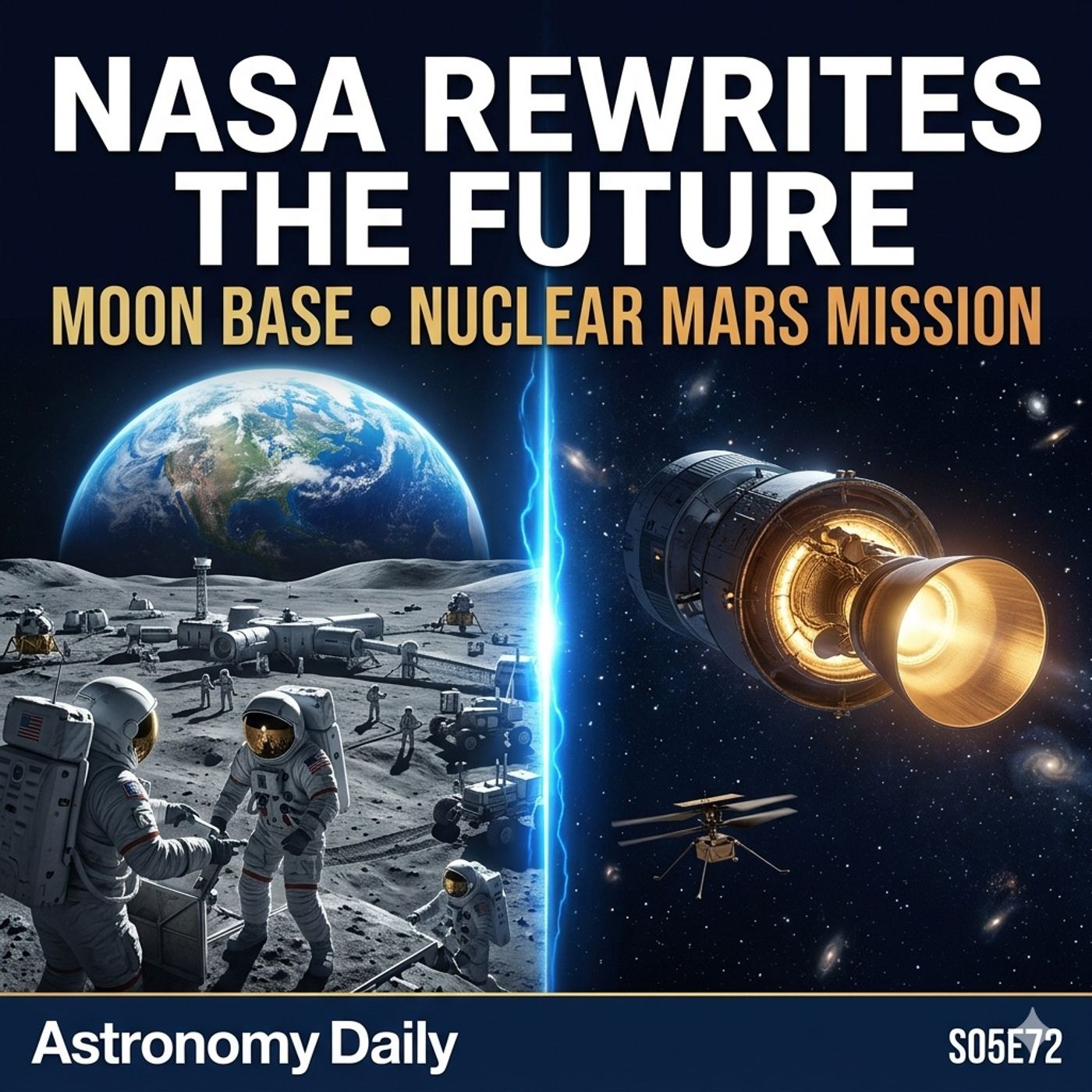
Wednesday, March 25, 2026 In today's episode of Astronomy Daily, Anna and Avery cover six major stories from the last 24 hours in space and astronomy — including two landmark NASA announcements that could reshape the future of human space exploration. Story 1: NASA Cancels Lunar Gateway — Pivots to $20 Billion Moon Base NASA Administrator Jared Isaacman announced at the agency's 'Ignition Day' event that the Lunar Gateway orbital space station has been paused, with resources redirected toward a phased $20 billion base on the lunar surface. The three-phase plan runs from 2026 to beyond 2032 and involves international partners including JAXA, the Italian Space Agency, and the Canadian Space Agency. Source: https://www.space.com/space-exploration/artemis/nasas-lunar-gateway-space-station-is-out-moon-bases-are-in Story 2: NASA's SR-1 Freedom — The First Nuclear-Powered Interplanetary Spacecraft Also announced at Ignition Day, Space Reactor-1 Freedom is planned for a December 2028 launch to Mars. It will use Nuclear Electric Propulsion and carry the Skyfall payload — three Ingenuity-class helicopters designed to scout future human landing sites and map subsurface water ice. Source: https://www.space.com/astronomy/mars/nasas-1st-nuclear-powered-interplanetary-spacecraft-will-send-skyfall-helicopters-to-mars-in-2028 Story 3: Two Planets Forming Around Infant Star WISPIT 2 Astronomers using the ESO's Very Large Telescope have directly imaged two gas giant planets forming around the 5.4-million-year-old star WISPIT 2, located 437 light-years away in Aquila. The system is described as a mirror of our early solar system, with potential for more planets yet to be discovered. Published in The Astrophysical Journal Letters. Source: https://www.space.com/astronomy/exoplanets/scientists-discover-mirror-of-our-solar-system-in-2-exoplanets-forming-around-a-star Story 4: Hubble Revisits the Crab Nebula — 25 Years On NASA has released new Hubble Space Telescope images of the Crab Nebula, taken 25 years after the telescope first observed the object. The images reveal the nebula's continued expansion — the still-evolving remnant of a supernova first observed by astronomers in 1054 AD. Source: https://www.space.com/astronomy/hubble-revisits-a-cosmic-crab-after-25-years-space-photo-of-the-day-for-march-23-2026 Story 5: Fiber-Optic Cables Could Detect Moonquakes Two new studies from Los Alamos National Laboratory suggest that fiber-optic cables deployed directly on the lunar surface could detect moonquakes using Distributed Acoustic Sensing (DAS). The technique could replace expensive individual seismometers, with a single cable acting as thousands of sensors across hundreds of kilometres of lunar terrain. Source: https://www.space.com/astronomy/moon/future-artemis-missions-could-use-fiber-optic-cables-to-monitor-moonquakes Story 6: Rocket Lab 'Daughter of the Stars' — Europe's First Celeste Navigation Satellites Rocket Lab's Electron rocket launched the first two satellites for ESA's Celeste LEO-PNT constellation from Māhia, New Zealand on March...Speaker 1: Hello, and welcome to Astronomy Daily.
Speaker 2: I'm Anna and I'm Avery, and our producer has handed us quite a lineup today.
Speaker 1: He really has. NASA just rewrote the future of human spaceflight, not once, but twice in a single day.
Speaker 2: We're talking a twenty billion dollar moon base, the first nuclear powered spacecraft heading to Mars, a star system that looks just like our own solar system did four billion years ago, plus.
Speaker 1: A brand new look at one of the most iconic objects in the night sky, a clever technology that could protect future moonwalkers, and a rocket company celebrating another milestone launch.
Speaker 2: It's Wednesday, the twenty fifth of March twenty twenty six. This is Astronomy Daily.
Speaker 1: We start with what is genuinely a landmark moment in the history of space exploration policy. NASA has officially canceled, or rather paused, the Lunar Gateway program.
Speaker 2: For anyone who needs a quick refresher, the Lunar Gateway was a planned space station that would have orbited the Moon. The idea was that astronauts aboard the Orion spacecraft would dock with Gateway before descending to the lunar surface. It's been in development for years, with major contractors like Northrope Grumman already deep into building it.
Speaker 1: And now NASA's new administrator, Jared Isikman, who took the top job back in December, has announced their shelving it. The announcement came on Tuesday at what NASA called its Ignition Day event at headquarters in Washington, and.
Speaker 2: It wasn't exactly a shock to those following the program closely. Isikman's exact words were, it should not really surprise anyone that we are pausing Gateway in its current form and focusing on infrastructure that supports sustained operations on the lunar surface.
Speaker 1: So instead of an orbital station, NASA is going all in on building an actual base on the Moon. The plan comes with a twenty billion dollar price tag over seven years, and it's structured in three phases.
Speaker 2: Phase one, running from twenty twenty six to twenty twenty eight, is described as getting to the Moon reliably. That means ramping up robotic lander missions, testing technologies, and scouting potential base locations at the lunar South Pole.
Speaker 1: Phase two, from twenty twenty nine through twenty thirty one, starts physically building the base communications, navigation, power infrastructure, larger cargo landers, and the goal of two crude missions per year. Japan's Space Agency JACKSA is contributing a pressurized rover for.
Speaker 2: This phase and Phase three from twenty thirty two onwards is when it all comes together, bong duration human presence on the lunar surface with multipurpose habitats from the Italian Space Agency and the Lunar Utility Vehicle from the Canadian Space Agency.
Speaker 1: What about the gateway hardware that's already been built that's not going to waste. NASA says it will repurpose components for the Moon base and for other programs, including, as we'll hear shortly, a very exciting Mars mission.
Speaker 2: There are political dimensions here too. Isaac Man was direct about the competitive pressure from China, whose space program is targeting a lunar landing by twenty thirty. He said, and I'm quoting, we find ourselves with a real geopolitical rival, challenging American leadership in the high ground of space.
Speaker 1: DASA also confirmed it intends to land astronauts on the Moon before the end of President Trump's term, with Artemis four and five targeting the lunar surface as early as twenty twenty eight.
Speaker 2: Now the international partners who had committed to the Gateway are understandably going to have questions. This is a significant reshaping of an agreement that involved space agencies around the world.
Speaker 1: Absolutely, but the message from NASA seems to be the destination hasn't changed. It's just how we get there that's being reimagined, a permanent base rather than a way station in orbit.
Speaker 2: It's a bold, ambitious pivot. Whether the timeline proves realistic, that's the big question.
Speaker 1: But wait, that wasn't the end of the big announcements, was.
Speaker 2: It certainly not, And that segues perfectly into our second story, which was also announced at the same Ignition Day event, and honestly, it might be even more mind bending.
Speaker 1: NASA is planning to launch the world's first nuclear powered interplanetary spacecraft in December twenty twenty eight. It's called Space Reactor one Freedom or SR one Freedom for short.
Speaker 2: Let's just sit with that for a second. The first nuclear powered craft ever to leave birth sphere of influence. We've had nuclear powered surface rovers and probes using radioactive decay for power, but this is different. This is a fission reactor propelling a spacecraft to another planet.
Speaker 1: The technology is called nuclear electro propulsion or NEP. Rather than using the reactor's heat directly for thrust, as a nuclear thermal propulsion would, NEP uses a fission reactor to generate electricity, which then powers highly efficient ion thrusters. It's described as extraordinarily efficient for moving large amounts of cargo across deep space, and.
Speaker 2: SR one Freedom will actually be built partly from repurposed lunar gateway hardware, specifically the power and propulsion element that was already under development, so nothing is going to waste.
Speaker 1: The spacecraft will carry a payload called Skyfall, a fleet of three small helicopters modeled on NASA's ingenuity the famous rotocraft that flew seventy two times on Mars after arriving with the Perseverance rover.
Speaker 2: These Skyfall helicopters will be deployed mid air during Mars atmospheric entry, no skycrane required, and will land themselves on the Martian surface to scout potential future human landing sites, map hazards, and use ground penetrating radar to locate subsurface water ice deposits that.
Speaker 1: Last point is crucial if we're going to put humans on Mars, which is clearly the long term ambition. Knowing exactly where the water is, how deep it is, and how accessible it might be for incitu resource utilization is absolutely foundational.
Speaker 2: NASA's Program Executive Steve Sinecor also left a door open for SR one Freedom to continue flying after it drops off the skyfall payload. Whether it heads deeper into the Solar System is still an open question.
Speaker 1: And there's a broader strategic logic here. SR one Freedom isn't just a Mars mission, it's a pathfinder. The plan is that what we learn from it will inform Lunar Reactor one, a future fission power system for the Moon base. The same nuclear technology that will power the Moon base could one day power missions to the outer Solar ste System.
Speaker 2: Not everyone is convinced the twenty twenty eight timeline is achievable. Some prominent voices in the planetary science community have been skeptical. The timeline is extraordinarily tight for a first of its kind nuclear spacecraft, but the ambition is undeniable. For me.
Speaker 1: The exciting thing is that this mission was conceived to also do real science NASA's science chief Nikola Fox, made the point that sr I freedom is a great opportunity to carry science instruments to Mars, and researchers are being invited to propose what instruments could.
Speaker 2: Fly nuclear propulsion, Mars, helicopters, water ice mapping. This is the space program firing on all cylinders.
Speaker 1: Let's travel four hundred and thirty seven light years away now to the constellation Aquilla, where astronomers have made a discovery that is genuinely remarkable, a time capsule of what our own solar system may have looked like over four billion years ago.
Speaker 3: Using the u S European Southern Observatories very large telescope in Chile, researchers have directly observed two planets in the process of forming around a baby star called PDS seventy and I mean baby. This star is only around five point four million years old. Our Sun is about four point six billion years old, so we're talking about a system that is barely a toddler in cosmic terms.
Speaker 1: The two planets, designated wisp it to B and wisp it to C are both gas giants more massive than Jupiter, and crucially, they're actively carving out gaps in the disk of gas and dust that surrounds their parent star. That's actually how astronomers spotted them by the telltale lanes they're clearing in what's called the proto planetary disc.
Speaker 2: Wispit to B sits at about sixty times the distance between Earth and the Sun. Whisp it to See is closer in at around fifteen Earth Sun distances, so about four times closer to the star than its sibling.
Speaker 1: The team used multiple cutting edge instruments to confirm the discovery, including sphere and gravity plus on the VLT, and The lead researcher, Chloe Lawler from the University of Galway in Ireland, called wisp it to the best look into our own past that we have to date.
Speaker 2: There's also hints in the disk structure of potentially a third forming planet, possibly of Saturn's mass. The researchers think there may be more worlds yet to be detected.
Speaker 1: What makes this so significant isn't just that we've found planets forming, we've seen evidence of that before, but that we can directly image them at this early stage. With this level of detail, it's like watching a solar system being assembled in real time.
Speaker 2: And the comparison to our own system is striking two large gas giants forming at the outer edges, potentially more planets inward. It does rhyme with the architecture of our own Jupiter, Saturn, and the rest.
Speaker 1: The research was published this week in the Astrophysical Journal Letters, and I think we can expect a lot more observations of Wispit too in the coming years, including potentially with JWST.
Speaker 2: Now we have a story that is equal parts science and nostalgia. NASA has released stunning new Hubble space telescope images of the crab Nebula, and they were taken exactly twenty five years after Hubble first pointed at this iconic object.
Speaker 1: For those new to the crab Nebula, it's the remnant of a supernova explosion that was observed from Earth in the year ten fifty four. Chinese and Arab astronomers at the time recorded a new star so bright it was visible in daylight for weeks. We're looking at today is the expanding wreckage of that explosion, a roiling cloud of gas and dust about six thousand, five hundred light years away in the constellation Taurus.
Speaker 2: It's one of the most studied objects in the entire sky, and Hubble has been watching it for a quarter of a century. The new images reveal something beautiful and slightly eerie. You can actually see the nebula changing. The cloud is still expanding, still in motion, nearly one thousand years after the original explosion.
Speaker 1: Astronomer William Blair from Johns Hopkins University, who was involved in the study, put it beautifully. He said, we tend to think of the sky as unchanging, immutable. However, with the longevity of the Hubble Space Telescope, even an object like the crab nebula is revealed to be in motion, still expanding from the explosion nearly a millennium ago.
Speaker 2: What I love about this story is that it's a reminder of just how extraordinary Hubble's lifespan has been. This telescope launched in nineteen ninety it has now been watching the sky, watching the crab nebula, specifically for twenty five years. The ability to compare images over that timescale and actually see change is something no single astronomer's career could deliver.
Speaker 1: The new images are published in the Astrophysical Journal, and they are frankly gorgeous. All those blues and golds and reds, the intricate filaments of the shell, the pulsar at the heart of it, all still spinning away. If you haven't seen them, do look them up.
Speaker 2: The crab nebula, still expanding, still spectacular, still teaching us things after nearly a millennium.
Speaker 1: Here's a story that combines elegant simplicity with genuinely important science. Researchers from Los Alamos National Laboratory have published two new studies suggesting that fiber optic cables laid directly on the surface of the Moon could be used to detect moonquakes.
Speaker 2: Now on Earth, fiber optic cables used for sensing have to be buried because even a gentle breathe can vibrate the cables and create noise in the data. But the Moon has virtually no atmosphere, there's no wind, and it turns out that means you don't need to bury them at all.
Speaker 1: The technique is called distributed acoustic sensing or DAS. Essentially, you send rapid laser pulses through a fiber optic cable, and tiny imperfections in the glass scatter light back to a detector. By analyzing those reflections, you can measure vibrations along the entire length of the cable, which means a single fiber could function like thousands of individual sensors at once.
Speaker 2: Compare that to what we had during Apollo five. Seismometers place that specific points on the near side of the Moon between nineteen sixty nine and nineteen seventy seven, incredibly valuable data, but enormously emitted in coverage. A fiber optic network could cover hundreds of kilometers of the lunar surface with a rover simply unspooling cable as it drives.
Speaker 1: And moonquakes are a fascinating phenomenon in their own right. Unlike earthquakes, which are driven by tectonic plate movement, moonquakes are caused by tidal forces from Earth's gravity, meteorite impacts, and extreme temperature swings. The lunar surface swings from over one hundred degrees celsius during the day to minus one hundred and seventy degrees at night, And because the Moon is geologically quieter in some ways, seismic energy doesn't dissipate as quickly. A moonquake can ring on for much longer than an equivalent event.
Speaker 1: On Earth.
Speaker 2: Researchers also pointed out that fiber networks could monitor hazards beyond moonquakes. When the rocket lands or takes off the Moon, particles get blasted off the surface at up to two kilometers per second. For future bases and infrastructure, understanding how far that debris travels is genuinely important for safety planning.
Speaker 1: Lead researcher Carl Donahue from Los Alamos summed it up, fiber optic cables are lightweight, robust, and inexpensive. In the world of space exploration, where every kilogram to the lunar surface costs of fortune, that combination is extremely attractive.
Speaker 2: A small, elegant solution with big implications for how we understand and operate on the Moon. We love a story like that.
Speaker 1: There is certainly no shortage of Moon planning stories around at the moment, and.
Speaker 2: We close today with a launch story, one that's about much more than just putting two small satellites into orbit.
Speaker 1: Rocket Lab launched two pioneering navigation satellites for the European Space Agency this morning in a mission called Daughter of the Stars. The Electron rocket lifted off from Rocket Labs complex on the Mahia Peninsula in New Zealand, targeting a circular orbit five hundred and ten kilometers above Earth.
Speaker 2: The two satellites are the first of an eventual eleven satellite demonstration consolation called Celeste, and Celeste itself is the first ever satellite navigation initiative that Europe has launched into low Earth orbit.
Speaker 1: Most people will be familiar with Galileo, Europe's answer to GPS, which operates from medium Earth orbit several thousand kilometers up. Cleste is something different. The idea is to add a complementary low Earth orbit layer that flies much closer to Earth, enhancing Galileo's performance, stronger signals, faster time to fix, better resilience against jamming and spoofing.
Speaker 2: There is also a geopolitical dimension here. The Baltic Sea region has seen significant GPS jamming and spoofing incidents in recent years. L EO navigation satellites broadcast stronger signals across multiple frequency bands, which makes them far harder to interfere with.
Speaker 1: Now. The mission name Daughter of the Stars is absolutely beautiful and it's not a coincidence. Thelest is named after Maria Celeste, the daughter of Galileo GALILEI the seventeenth century astronomer whose name already graces Europe's main navigation constellation. There's a lovely continuity there.
Speaker 2: This is also the first ever dedicated rocket Lab mission for the European Space Agency, and rocket Lab has been having a remarkable year. Their electron rocket is becoming one of the most reliable small launch vehicles on the planet, and missions like this show just how far New Zealand space industry has come.
Speaker 1: There was actually a practical urgency behind this launch. ESA had a deadline at the International Telecommunication Union. They needed to put their allocated frequency bands into operation by May twenty twenty six to secure them for the future operational system. The launch today wasn't just scientifically significant, it was technically necessary.
Speaker 2: ESA hopes to have the full eleven satellite demonstration constellation operational by twenty twenty seven, with a much larger operational system to follow. Three hundred satellites in orbit by twenty third is the eventual target.
Speaker 1: From a hilltop launch site in New Zealand, Europe takes its first steps towards its own low orbit navigation network. Rocket Lab as always getting it done.
Speaker 2: Rocket Lab is fast becoming the little company that could congratulations all round on today's successful launch.
Speaker 1: And that is our show for Wednesday, the twenty fifth of March. What a day it's been for space News.
Speaker 2: NASA reimagining its entire lunar architecture, the first nuclear interplanetary spacecraft on the drawing board, Planets forming around the Baby Star four hundred and thirty seven light years away, Hubble still delivering awe after thirty five years in orbit, fiber octic cables on the Moon, and Rocket Lab heading to five hundred and ten kilometers above Earth for ESA.
Speaker 1: If you enjoyed today's episode, please subscribe, leave us a review, and share it with someone who loves space as much as we do. You can find us at Astronomy Daily dot io and across social media as at astro Daily Pod.
Speaker 2: We're on Instagram, TikTok, Facebook, and Tumblr. Come find us wherever you prefer to hang out online.
Speaker 1: This is Astronomy Daily.
Speaker 2: Keep looking up and we'll see you tomorrow. Day Star is to start is

 Apple Podcasts
 Spotify
 Pocket Casts
 Castbox
 Overcast
 Podbean
 iHeartRadio
 Castro
 Goodpods
 Moon FM
 Podcast Addict
 Podcast Republic
 YouTube