
SpaceX's Test Turbulence, Blue Origin's Orbital Triumph, and India's Docking Debut: S04E15
In this episode
Astronomy Daily - The Podcast: S04E15Welcome to another exhilarating episode of Astronomy Daily, your premier source for the latest in space exploration and cosmic discoveries. I'm Anna, and today we have a stellar lineup of stories that highlight major developments across the space industry.
Highlights:
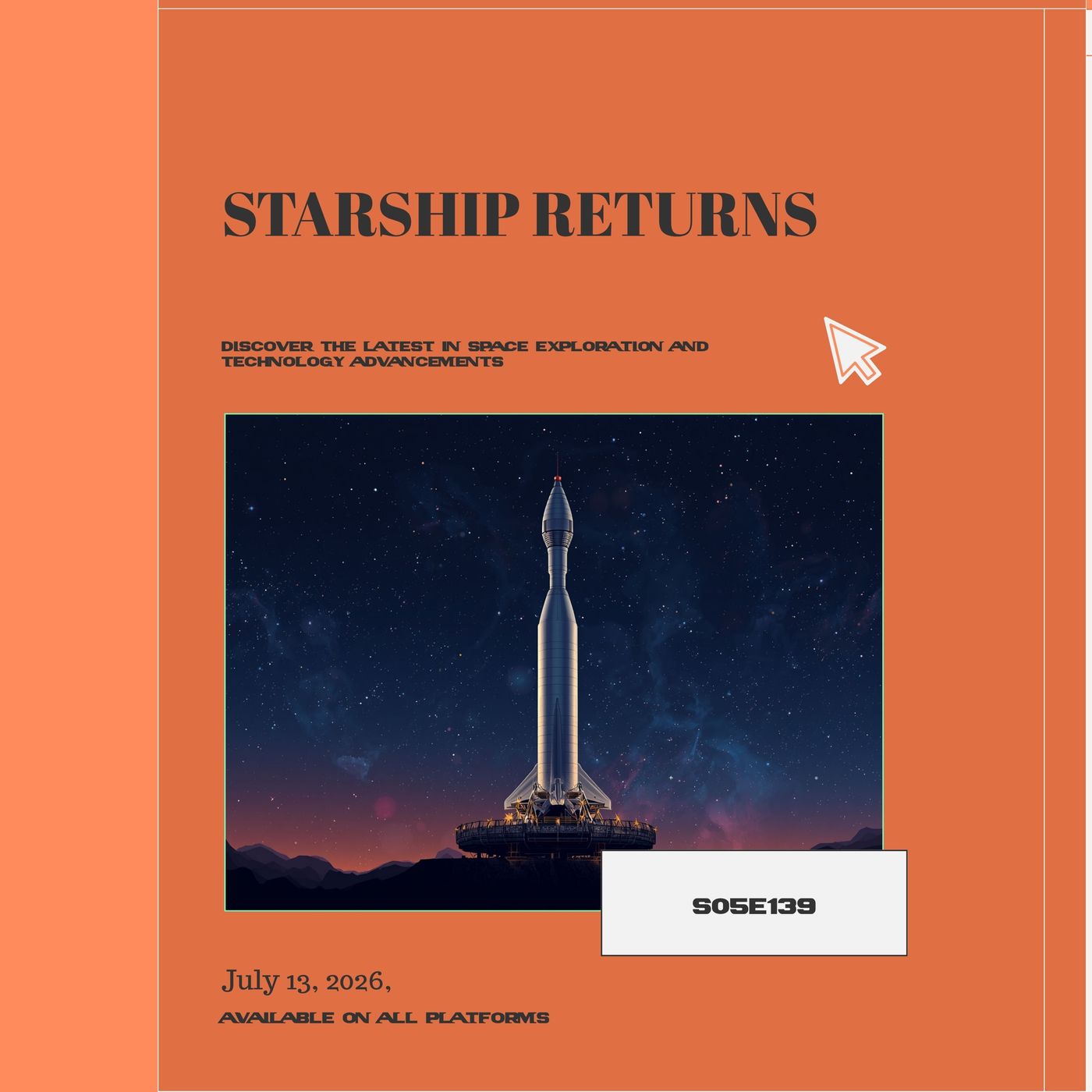
- SpaceX's Starship Test Flight: SpaceX's seventh test flight of the Starship launch system brought both triumph and setback. Discover how the super heavy booster achieved a successful catch with the Mechazilla arms, despite the upper stage experiencing a rapid unscheduled disassembly.
- Blue Origin's New Glenn Rocket Success: Blue Origin celebrated a milestone with the successful orbital flight of the New Glenn rocket. Learn about this significant leap in commercial spaceflight and the challenges faced during booster recovery.
- International Space Station Updates: NASA astronaut Suni Williams completed a critical spacewalk, performing essential maintenance on the ISS. Find out how Williams and her crewmates have adapted to unexpected mission changes.
- India's Space Docking Milestone: India has joined an elite group of nations by successfully docking two satellites in orbit. Explore the implications of this achievement for India's ambitious space plans.
- Hubble's Andromeda Survey: The Hubble Space Telescope has unveiled an unprecedented portrait of the Andromeda Galaxy, revealing hundreds of millions of stars. Discover how this survey reshapes our understanding of galaxy evolution.
- Remembering David Lynch: We pay tribute to visionary filmmaker David Lynch, who brought the epic novel Dune to the big screen. Reflect on his impact on science fiction and cinema.
For more cosmic updates, visit our website at astronomydaily.io. Join our community on social media by searching for #AstroDailyPod on Facebook, X, Tumblr, YouTubeMusic, and TikTok. (Yes, we're still there). Share your thoughts and connect with fellow space enthusiasts.
Thank you for tuning in. This is Anna signing off. Until next time, keep looking up and stay curious about the wonders of our universe.
00:00 - This week's Astronomy Daily features some major developments in the space industry
00:45 - SpaceX's seventh test flight of their massive starship launch system failed
02:52 - Blue Origin's New Glenn rocket successfully reached orbit for the first time
04:50 - NASA astronaut Suni Williams completed her eighth career spacewalk yesterday
08:25 - The Hubble Space Telescope has just completed its most ambitious survey yet of Andromeda
10:30 - David Lynch, the visionary filmmaker who brought Dune to the big screen
11:57 - This is the end of today's episode of Astronomy Daily
✍️ Episode References
SpaceX
https://www.spacex.com/
Blue Origin
https://www.blueorigin.com/
International Space Station
https://www.nasa.gov/mission_pages/station/main/index.html
Suni Williams
https://www.nasa.gov/astronauts/biographies/sunita-l-williams
Indian Space Research Organization
https://www.isro.gov.in/
Hubble Space Telescope
https://www.nasa.gov/mission_pages/hubble/main/index.html
David Lynch
https://www.imdb.com/name/nm0000186/
Dune (1984 film)
https://www.imdb.com/title/tt0087182/
Starlink
https://www.starlink.com/
New Shepard
https://www.blueorigin.com/new-shepard/
Become a supporter of this podcast: https://www.spreaker.com/podcast/astronomy-daily-latest-space-news--5648921/support.
Sponsor Details:
Ensure your online privacy by using NordVPN. To...
Speaker 1: Hey, space fans, you're tuned into another exciting episode of Astronomy Daily. We've got an absolutely packed show for you today with some major developments from across the space industry that you won't want to miss. We'll be diving into SpaceX's latest Starship test flight that saw both triumph and setback and Blue Origins milestone achievement with their new Glen rocket. We've also got updates from the International Space Station, where astronaut Sunny Williams has been busy with a critical spacewalk.
Speaker 1: India's space program has hit a remarkable new milestone that puts them in a very exclusive club. And we've got stunning new revelations about our galactic neighbor Andromeda from the Hubble Space Telescope. Plus, we'll remember a visionary filmmaker who brought one of sci Fi's greatest stories to the big screen. Let's blast off into today's space news. SpaceX's seventh test flight of their massive Starship launch system brought both excitement and disappointment to space enthusiasts worldwide. The test, which took place at their Texas launch facility, marked only the second successful catch of a super heavy booster using the launch tower's mechanical arms nicknamed Mechazilla, a remarkable achievement in rocket reusability, The super heavy booster, equipped with thirty three methane fueled Raptor engines generating an incredible sixteen point seven million pounds of thrust, performed flawlessly during its return to the launch site.
Speaker 1: This massive thrust output makes Starship the world's most powerful launch system, surpassing both the historic Saturn five rocket and NASA's current Space launch system. However, the celebration was tempered when the upper stage, designated as Ship thirty three, experienced what SpaceX diplomatically called a rapid, unscheduled disassembly during its ascent burn. According to Elon Musk, preliminary data suggested an oxygen and fuel leak above the ship's engine firewall led to the breakup. The incident caused some disruption to commercial air traffic as debris fell back to Earth, though normal operations resumed quickly.
Speaker 1: Ship thirty three had been upgraded with new avionics, propulsion systems, and forward control flaps, along with next generation heat shield tiles. The mission had ambitious goals, including the planned deployment of ten Starlink satellite simulators, and a controlled splash down in the Indian Ocean. Despite the setback, SpaceX maintains its characteristic optimism. The company views each test flight as a learning opportunity, with plans to implement improvements including enhanced fire suppression and increased vent capacity.
Speaker 1: They're already looking ahead to their next launch, potentially as soon as next month. This testing program represents crucial steps towards SpaceX's broader ambitions, including large scale satellite deployments, NASA's Artemius lunar missions, and eventually Musk's vision of establishing a self sustaining city on Mars within the next two decades. Earlier in the day, in a historic moment for commercial spaceflight, Blue Origin's New Glen rocket successfully reached orbit for the first time, launching from Cape Canaveral Space Force Station in Florida.
Speaker 1: The early morning launch marks a significant milestone for Jeff Bezos's space company, which has been developing this powerful rocket since twenty thirteen. Standing over three hundred twenty feet tall, New Glen represents a massive leap forward from Blue Origins suborbital New Shepherd rocket. The launch vehicle features seven engines, in its first stage and three in its second stage, demonstrating impressive technological advancement from a company that has taken a methodical, step by step approach to rocket development.
Speaker 1: While the orbital insertion was successful, the mission wasn't without its challenges. During the recovery attempt, the first stage booster was lost while trying to land on the ocean going platform. However, company officials had previously noted that booster recovery, while desired, wasn't critical for this inaugural flight success. This achievement positions Blue Origin as a serious competitor in the orbital launch market, much needed competition in a field largely dominated by SpaceX. The successful flight demonstrates that Blue Origin can now offer services for heavy satellite launches, deep space missions, and potentially future crude flights.
Speaker 1: Named after John Glenn, the first American to orbit Earth, the rocket is part of Blue Origin's broader vision of making space more accessible and ultimately enabling millions of people to live and work in space. This successful orbital flight represents a crucial step toward realizing that ambitious goal. With both New Glen and their planned projects like the Blue Moon Lunar Lander and orbital reef space station Blue Origin is rapidly establishing itself as a major force in the commercial space industry.
Speaker 1: This successful launch opens new possibilities for satellite deployment, space exploration, and the growing commercial space economy. Meanwhile, up on the International Space Station, NASA astronaut Sunny Williams has been keeping busy despite an unexpected extended stay in orbit. William who arrived at the station aboard Boeing Starliner spacecraft several months ago, completed her eighth career spacewalk yesterday, demonstrating that even unplanned circumstances won't slow down the essential work being done in space.
Speaker 1: During the six hour extra vehicular activity, Williams worked alongside astronaut Nick Haig to perform critical maintenance on the orbiting laboratory. Their tasks included replacing a faulty rate gyro assembly, a crucial component that helps maintain the station's proper orientation in space. They also installed protective patches on damaged light filters for an X ray telescope, and upgraded a reflector device used for navigation during spacecraft docking procedures. Williams and her crewmate Butch Wilmore have been stationed aboard the ISS longer than initially planned.
Speaker 1: Due to technical issues with their Starliner spacecraft's thrusters, NASA made the difficult decision to return the spacecraft to Earth unmanned, leaving the experienced astronauts to wait for their next ride home. The good news news is that both Williams and Wilmore are scheduled to return to Earth next month, traveling back with fellow astronaut Nick Haig and Russian cosmonaut Alexander Gorbunov. Fingers are crossed. This latest space walk adds another impressive achievement to Williams's already distinguished career.
Speaker 1: As a veteran of multiple ISS missions, she continues to demonstrate the dedication and flexibility required of astronauts, especially when faced with unexpected challenges in the demanding environment of space. In a major milestone for India's space program, the nation has successfully demonstrated its ability to dock two satellites in orbit, joining an elite group of spacefaring nations. The Space Docking Experiment or SPADEX, saw two four hundred eighty five pound satellites successfully rendezvous and connect in Earth orbit on January fifteenth, making India only the fourth country to achieve this sophisticated feat, after the United States, Russia and China.
Speaker 1: The mission, which launched onto said Mber thirtieth aboard an Indian PSLV rocket, utilized two spacecraft designated as Target and Chaser. After several days of careful testing and simulation, the satellites executed a precise choreography, first maintaining position at fifty feet apart, then closing to just ten feet before completing the final docking maneuver. The Indian Space Research Organization confirmed that post docking operations are preceding as planned, with both satellites now functioning as a single unit.
Speaker 1: This achievement represents more than just a technical milestone. It's a crucial stepping stone for India's ambitious future space plans, including lunar sample return missions and the construction of their own space station, the Baratia Antarich Station, targeted for completion by twenty thirty five. The ability to dock spacecraft in orbit is essential for complex missions that require multiple launches to achieve their objectives. While other space agencies like ESA and JACKSA have demonstrated similar capabilities through their cargo missions to the International Space Station.
Speaker 1: Achieving autonomous docking in open orbit puts India in a unique position to expand its space capabilities. The success of SPADEX paves the way for their upcoming Chandrion four mission, a robotic lunar sample return mission planned for twenty twenty eight, and establishes India as an increasingly prominent player in the global space arena. In other news today, the Hubble Space Telescope has just completed its most ambitious survey yet of our galactic neighbor, the Andromeda Galaxy, creating an unprecedented portrait that reveals hundreds of millions of stars in extraordinary detail.
Speaker 1: This remarkable achievement took over a decade to complete, combining more than six hundred separate observations into a stunning mosaic containing two point five billion pixels. Looking at Andromeda through Hubble's eyes has given us a unique window into not just the galaxies present, but its hidden history as well. The telescope's sharp vision has managed to resolve over two hundred million individual stars, each brighter than our sun, appearing like countless grains of sand scattered across cosmic shores.
Speaker 1: And that's just what we can see. Astronomers estimate Andromeda's total stellar population at around one trillion stars. What makes this survey particularly fascinating is how it's reshaping our understanding of galaxy evolution. Despite forming around the same time as our Milky Way, Andromeda appears to have followed a notably different developmental path. The new data shows it has a higher proportion of younger stars and distinctive stellar streams, suggesting a more turbulent history of galactic mergers and interactions than our own galaxy.
Speaker 1: One potential culprit in Andromeda's dramatic past might be its compact companion, Messia thirty two, which appears to be the remnant core of a once larger galaxy that had a close encounter with Andromeda. Such cosmic collisions can dramatically affect a galaxy star formation patterns and overall structure, leaving lasting fingerprints that astronomers can now read in unprecedented detail. The survey itself was a massive undertaking, requiring more than one thousand Hubble orbits and combining two major observing programs, the Panchromatic Hubble Andromeda Treasury and its southern counterpart Fast.
Speaker 1: Together, they've given us the most complete view ever of this magnificent spiral galaxy, which spans roughly twenty five times the diameter of our Milky Way and lies about two and a half million light years from Earth. To wrap up today's episode, we have some sad news from the world of science fiction cinema to share. David Lynch, the visionary filmmaker who brought Frank Herbert's epic novel Doune to the big screen in nineteen eighty four, has passed away at the age of seventy eight due to complications from emphysema.
Speaker 1: While space enthusiasts might know him best for his ambitious adaptation of Doune, Lynch's influence extended far beyond science fiction. Born in Missoula, Montana, Lynch was a true Renaissance art who left an indelible mark on cinema with his unique storytelling style. His forty million dollars interpretation of Doom, while controversial, showcased his distinctive visual flare and helped pave the way for future adaptations of this beloved science fiction classic. The film's bold artistic choices and striking imagery, though divisive, demonstrated how science fiction could push creative boundaries.
Speaker 1: Lynch's passing was announced by his family, who shared a touching message that captured his singular spirit, keep your eye on the doughnut and not on the whole. His contributions to cinema earned him four Oscar nominations and an Academy Award for Lifetime Achievement in twenty twenty, cementing his legacy as one of the most innovative filmmakers of his generation. His unique vision and artistic courage continue to inspire creators across all mediums, including those who explore the frontiers of space in both fact and fiction.
Speaker 1: RIP and that brings us to the end of today's episode of Astronomy Daily. What an incredible day of space news. We've covered from groundbreaking achievements in commercial spaceflight to revolutionary astronomical discoveries. I'm Anna and I've been thrilled to share these fascinating stories with you. If you want to stay up to date with all the latest developments in space and astronomy, head over to Astronomy Daily dot io. There you'll find our constantly updating news feed and can listen to all our previous episodes.
Speaker 1: We're also very active across social media. You can find us as Astro Daily Pod on Facebook, x, Tumblr, YouTube, YouTube music, and TikTok. Thanks for joining me today on this journey through space. Until next time, keep looking up and stay curious about the Cosmos.
Speaker 2: Star story is control h


 Apple Podcasts
 Spotify
 Pocket Casts
 Castbox
 Overcast
 Podbean
 iHeartRadio
 Castro
 Goodpods
 Moon FM
 Podcast Addict
 Podcast Republic
 YouTube