Solar Sentinel Reaches L1, Challenger's 40-Year Legacy, and AI's Hubble Discoveries
In this episode
## Today's Headlines:🛰️ **NOAA Solar Observatory Reaches L1**
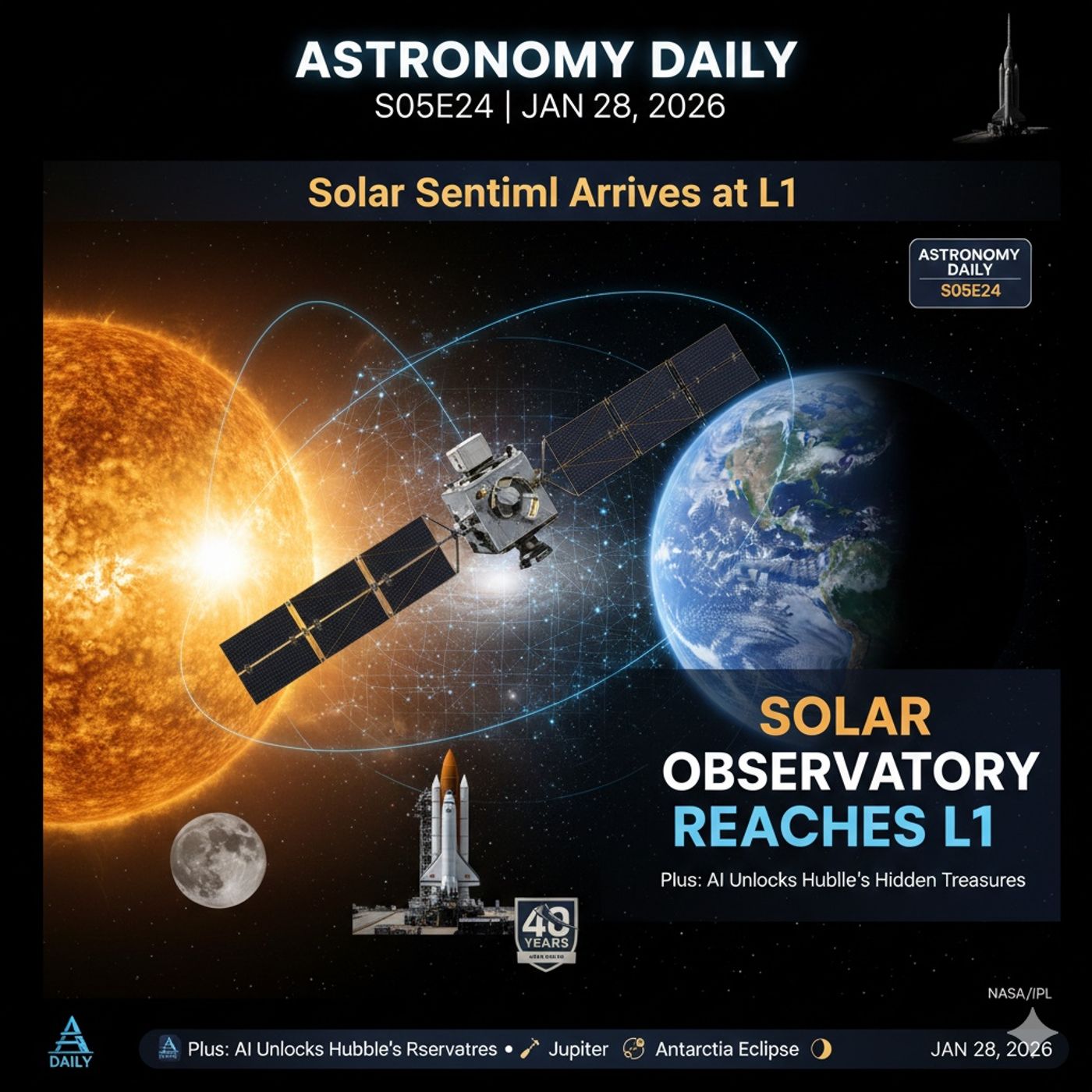
NOAA's Space Weather Follow-On satellite successfully arrived at Lagrange point 1 on January 21st, establishing the first component of a future constellation designed to provide early warning of solar storms and coronal mass ejections. The satellite offers 15-60 minutes advance notice of space weather events that could impact Earth's infrastructure.
🚀 **Challenger Disaster: 40 Years Later**
Marking four decades since the Space Shuttle Challenger tragedy, we examine how unseasonably cold weather and O-ring failures led to the loss of seven crew members. The disaster fundamentally changed NASA's safety culture and decision-making processes, lessons that continue to influence spaceflight today.
🤖 **AI Uncovers Cosmic Treasures in Hubble Archive**
Advanced artificial intelligence algorithms have identified hundreds of previously undetected gravitational lenses in Hubble Space Telescope data. These discoveries include rare Einstein rings and exotic lensing configurations that provide windows into the early universe and dark matter distribution.
☄️ **Venus's Potential Meteor Shower**
Astronomers predict Venus may experience a significant meteor shower in July 2026 from debris of asteroid 2002 VT37. The event offers a rare opportunity to study how meteor showers interact with Venus's dense carbon dioxide atmosphere.
🌌 **Stellar Fireworks at the Galactic Center**
New observations reveal intense stellar activity near Sagittarius A*, our galaxy's supermassive black hole, including star formation, supernovae, and tidal disruption events in one of the most extreme environments in the Milky Way.
📡 **Watch Artemis 2 Rocket Live**
NASA has launched a 24-hour livestream of the Artemis 2 Space Launch System rocket on Launch Pad 39B as crews prepare for the first crewed lunar mission since 1972, currently targeting April 2026. https://www.youtube.com/watch?v=nrVnsO_rdew
#### Resources & Links:
- Story Sources: SpaceNews, Spectrum Local News, NASA Science, Space.com, Universe Today
- Website: astronomydaily.io
- Social Media: @AstroDailyPod (all platforms)
Become a supporter of this podcast: https://www.spreaker.com/podcast/astronomy-daily-latest-space-news--5648921/support.
Sponsor Details:
Ensure your online privacy by using NordVPN. To get our special listener deal and save a lot of money, visit www.astronomydaily.io/nordvpn. You'll be glad you did!
Get the best secure and private email on the planet. Stop your Government, google and who knows who else spying on every email you write. Do what we did and use ProtonMail. They beleive in privacy and there are no ads in their business model...yet they still provide a free forever service. Check them out and get out special deal at www.astronomydaily.io/protonmail
Become a supporter of Astronomy Daily by joining our Supporters Club. Commercial free episodes daily are only a click way... Click Here
This episode includes AI-generated content.
Anna: Welcome to Astronomy Daily, your source for the latest space and astronomy news. I'm Anna. Avery: And I'm Avery. Today is Wednesday, January 28, 2026, and we've got a fantastic lineup of storeys for you. Anna: We certainly do. We'll be covering NOAA's new solar observatory reaching its destination, looking back at how weather played a tragic role in the Talinger disaster 40 years ago, and discovering how AI is uncovering hidden cosmic treasures in Hubble's AR Plus, Venus might be. Avery: In for a spectacular meteor shower this July.
We'll explore stellar fireworks at the heart of our galaxy. And NASA is giving us a live view of the Artemis 2 moon rocket on the launch pad. Anna: Let's dive right in. Avery: Our top storey today takes us about a million miles from Earth, where NOAA's Space Weather Follow on Lagrange 1 Observatory has just arrived at its permanent home. Anna, uh, this is a pretty significant milestone for space weather monitoring, isn't it? Anna: Absolutely, Avery. This observatory reached Lagrange Point 1, or L1, on January 21, after launching back in June 2024.
Now, uh, for our listeners who might not be familiar, L1 is this special gravitational sweet spot between Earth and the sun, about 1.5 million kilometres from our planet. Avery: And what makes this location so ideal for watching the Sun? Anna: Well, at L1, the observatory maintains a constant view of the sun while orbiting in sync with Earth. It's like having a cosmic early warning system. The satellite can detect solar storms and coronal mass ejections headed our way, giving us that crucial advance notice, typically about 15 to 60 minutes before these events impact Earth.
Avery: That advance warning time is critical, isn't it? I mean, we're talking about protecting everything from power grids to satellites. Anna: Exactly right. And here's what's really exciting. It's not just one observatory, it's a constellation. NOAA is planning four more satellites for L1, plus additional ones at, uh, Lagrange point five. Together, they'll create this comprehensive solar monitoring network. The second satellite is already scheduled to launch in 2027. Avery: So we're looking at a much more robust space weather forecasting capability in the near future.
Anna: Precisely. And given how dependent our, uh, modern infrastructure is on satellites and power grids, this kind of monitoring becomes more important every year. The observatory is now beginning what NOAA calls an extended checkout period before it becomes fully operational. Avery: Moving to a More sombre note, January 28th marks 40 years since the space Shuttle Challenger disaster. Anna, uh, there's been renewed focus on how weather and engineering decisions played into that tragedy. Anna: Yes.
And it's a powerful reminder of how critical environmental factors are in spaceflight. You know, Avery, the night before that launch, temperatures at Kennedy Space Centre dropped to just 28 degrees Fahrenheit. That's minus 2 Celsius for Florida. That was exceptionally cold. Avery: And, um, those cold temperatures were at the heart of the problem, weren't they? Anna: They were. Engineers from Morton Thykol, the company that built the solid rocket boosters, were deeply concerned about the O rings, these critical rubber seals in the boost joints.
They'd never been tested below 53 degrees Fahrenheit, and the engineers warned that the cold could make them too stiff to seal properly. Avery: But the launch went ahead anyway. Anna: It did. Despite the engineering concerns, there was enormous pressure to maintain the launch schedule. NASA had already postponed the mission several times, and there was this institutional momentum to proceed. 73 seconds after liftoff, hot gases escaped through a failed O ring seal, leading to the catastrophic breakup of Challenger.
Avery: It's heartbreaking. Seven crew members lost, including Christa McAuliffe, who would have been the first teacher in space. Anna: The tragedy fundamentally changed how NASA approached decision making. The Rogers Commission investigation that followed was incredibly thorough, and it led to major reforms in safety, culture and communication. One of the key findings was that engineering concerns need to override schedule pressures. Always. Avery: And those lessons still resonate today, don't they?
I mean, we see NASA taking extra time with Artemis missions being very methodical. Anna: Absolutely. The Challenger disaster taught us that in spaceflight, there's no such thing as a routine launch. Every mission requires the same level of scrutiny and respect for engineering limits. It's a lesson paid for with seven lives and one we must never forget. Avery: On a brighter note, let's talk about some exciting discoveries from the Hubble Space Telescope. Anna? Uh, artificial intelligence has just helped astronomers uncover hundreds of previously undetected cosmic objects in Hubble's vast archives.
Anna: This is fascinating stuff, Avery. So researchers have developed this AI algorithm that can sift through decades of Hubble observations. And it's finding things that human astronomers missed. Avery: Exactly. The algorithm focuses on something called gravitational lensing. When a massive object like a galaxy cluster bends light from more distant objects behind it. Einstein predicted this effect. And it's like having a natural cosmic magnifier. Anna: And these lensed objects can tell us a lot about the early universe, right?
Avery: They can. The AI has identified hundreds of gravitational lens candidates, including some exceptionally distant galaxies from when the universe was very young. What's really clever about this approach is that the algorithm was trained on existing verified gravitational lenses. So it knows what to look for. Anna: So it's not just finding more of the same, it's finding rare and unusual examples too. Avery: That's what makes this so exciting. The AI is uncovering exotic lensing configurations that would be extremely time consuming for humans to find manually.
We're talking about complex multi image systems arc like structures, even Einstein rings where the background object is perfectly aligned. Anna: And Hubble has been collecting data for over 30 years now. So there's this enormous archive to mine. Avery: Right. It's like having a treasure trove that we're only now learning how to properly search. These discoveries will help us understand dark matter distribution in galaxy clusters, study extremely distant galaxies that would otherwise be too faint to detect and refine our models of cosmic evolution.
Anna: It really shows how AI and human astronomers can work together. The AI does the heavy lifting of searching through millions of images and then human experts verify and study the most interesting candidates. Avery: Exactly. It's not replacing astronomers, it's amplifying what they can achieve. And as these AI tools get more sophisticated, who knows what other cosmic secrets might be hiding in plain sight in our archives. Anna: Now for something you don't hear every Venus might be getting a meteor shower.
Avery, tell us about this cosmic event coming this July. Avery: This is a really cool storey, Anna. Uh, astronomers had determined that Venus could experience a significant meteor shower in July 2026. And it uh, all traces back to an asteroid breakup that happened long ago. We're talking about debris from asteroid 2002 VT37. Anna: Though an asteroid broke apart and now its debris is going to hit Venus? Avery: Essentially, yes. When asteroids collide or break apart, they create streams of debris that continue orbiting the Sun.
Earth regularly passes through these debris streams. That's what causes our meteor showers like the Perseids or the Geminites. Anna: But we don't usually think about other planets having meteor showers. Avery: We don't, and that's partly because we can't observe them as easily. But mathematical modelling shows that Venus's orbit will take it through this particular debris stream in July. The timing and geometry appear to line up for a genuine meteor shower event. Anna: What would that look like?
I mean, Venus has that incredibly thick atmosphere, right? Avery: It does. Venus's atmosphere is about 90 times denser than Earth's and is mostly carbon dioxide. Any meteors entering that atmosphere would experience tremendous heating and friction. They'd likely burn up at, uh, much higher altitudes than meteors do on Earth, creating bright streaks across the Venusian sky. Anna: Though I suppose nobody's going to be on the surface watching this Light show? Avery: No. Surface conditions on Venus are pretty inhospitable.
We're talking temperatures hot enough to melt lead and crushing atmospheric pressure. But spacecraft in orbit around Venus, or even Earth based observations with certain wavelength might be able to detect evidence of the meteor shower. Anna: Could this tell us anything scientifically valuable? Avery: Absolutely. Studying how meteor showers interact with Venus's unique atmosphere could give us insights into atmosphere chemistry and dynamics. Plus it helps us understand the distribution of debris throughout the inner solar system.
And it's just a reminder that these dramatic cosmic events aren't exclusive to Earth. Anna: Speaking of dramatic cosmic events, let's head to the centre of our own galaxy. Avery. Astronomers have been observing what they're calling stellar fireworks at the heart of the Milky Way. Avery: The galactic centre is such a wild place, isn't it? I mean, we've got that supermassive black hole, Sagittarius A, and all sorts of extreme phys going on there. Anna: It really is cosmic chaos in the best way possible.
The region around Sagittarius A is incredibly dense with stars, gas and dust. And what astronomers are seeing is a spectacular display of stellar activity. Massive stars being born, living out their brief but brilliant lives and dying in supernova explosions. Avery: And all of this is happening in a, uh, relatively small region of space, right? Anna: Exactly. The galactic centre is an incredibly compact environment. You've got stellar densities that are millions of times higher than what we see in our solar neighbourhood.
Stars are packed so tightly that gravitational interactions are common and the radiation environment is intense. Avery: What kind of observations are revealing these fireworks? Anna: Astronomers are using multiple wavelengths, infrared x ray and radio observations to peer through the thick dust that obscures, um, the galactic centre in visible light. What they're seeing are energetic outbursts, shock waves from supernova remnants, and evidence of stars being torn apart by intense tidal forces near the black hole.
Avery: That sounds pretty dramatic, stars being torn apart. Anna: Yes. There's this phenomenon called tidal disruption, where a star that ventures too close to Sagittarius A gets stretched by gravitational forces, sort of like cosmic spaghettification. The star literally gets pulled apart and some of that material falls into the black hole while the rest is ejected at tremendous speeds. Avery: And, um, we're also seeing new stars forming in this extreme environment. Anna: You're. Despite the harsh conditions, or perhaps because of them, there are regions of intense star formation.
The gravitational compression from all that mass can trigger the collapse of gas clouds, leading to new stellar births. These tend to be very massive, hot stars that burn bright and die young. Avery: It's almost like the galactic centre is this constant cycle of creation and destruction. Anna: That's a perfect way to describe it. And study in this region helps us understand how galaxies evolve, how supermassive black holes influence their surroundings, and what conditions were like in the early universe when star formation was much more vigorous everywhere.
Avery: For our final storey, let's come back closer to home. NASA has launched a 24 hour livestream showing the Artemis II moon rocket on the launch pad at Kennedy Space Centre. Anna: This is pretty exciting for space enthusiasts. Avery. The Space Launch System rocket with the Orion spacecraft is now stacked and standing on launch pad, um, 39B. And anyone can watch it live whenever they want. Avery: This is the mission that will send astronauts around the moon, right? The first crewed lunar mission since Apollo 17.
Anna: That's right. Artemis II will carry four astronauts, NASA astronauts Reid Wiseman, Victor Glover, Christina Koch and CSA astronaut Jeremy Hansen, on a journey around the moon. They won't land, but they'll perform a lunar flyby before returning to Earth. Avery: And having the rocket on the pad now. That means we're getting close to launch. Anna: Well, the current target is no earlier than April 2026. Though space missions often face schedule adjustments, right now the rocket is on the pad for integrated testing, making sure all the systems work together properly before committing to a launch attempt.
Avery: What kind of testing are they doing? Anna: They're running through what's called a wet dress rehearsal, which involves loading the rocket with propellants and going through the countdown sequence, stopping just short of ignition. It's essentially a, ah, full launch simulation to verify that all systems, ground, equipment and procedures work as planned. Avery: And the livestream lets us watch all this happening in real time? Anna: Exactly. It's a continuous feed, so you can cheque in at any time, day or night, and see the rockets standing there on the pad.
Sometimes you'll catch technicians working, other times you might see weather rolling through. It's a unique behind the scenes look at the preparation for this historic mission. Avery: I have to say there's something awe inspiring about seeing that massive rocket just standing there, ready to take humans beyond Earth orbit for the first time in over 50 years. Anna: There really is, and it represents years of work by thousands of people. After Artemis 2's lunar flyby, Artemis 3 will attempt the first crewed lunar landing since 1972, including landing the first woman and first person of colour on the moon.
Avery: It's a new chapter in lunar exploration and we're watching it unfold in real time, literally. We'll put a link in the show notes if you'd like to cheque it out. Anna: And that wraps up today's episode of Astronomy Daily. From solar observatories reaching their cosmic outposts to remembering hard learned lessons from AI discoveries in telescope archives to potential meteor showers on Venus, stellar fireworks at our galactic centre, and moon rockets on the launch pad, it's been quite a journey through the cosmos today.
Avery: It certainly has. If you want to stay up to date with all the latest space and astronomy news, make sure you're subscribed to Astronomy Daily. You can find us on your favourite podcast platform. Anna: And don't forget to visit our website at astronomydaily IO for additional content, show notes and links to all the storeys we covered today. Avery: You can also connect with us on social media astrodaily Pod across all major platforms. Anna: Until next time, keep looking up Clear skies, everyone.
 Apple Podcasts
 Spotify
 Pocket Casts
 Castbox
 Overcast
 Podbean
 iHeartRadio
 Castro
 Goodpods
 Moon FM
 Podcast Addict
 Podcast Republic
 YouTube