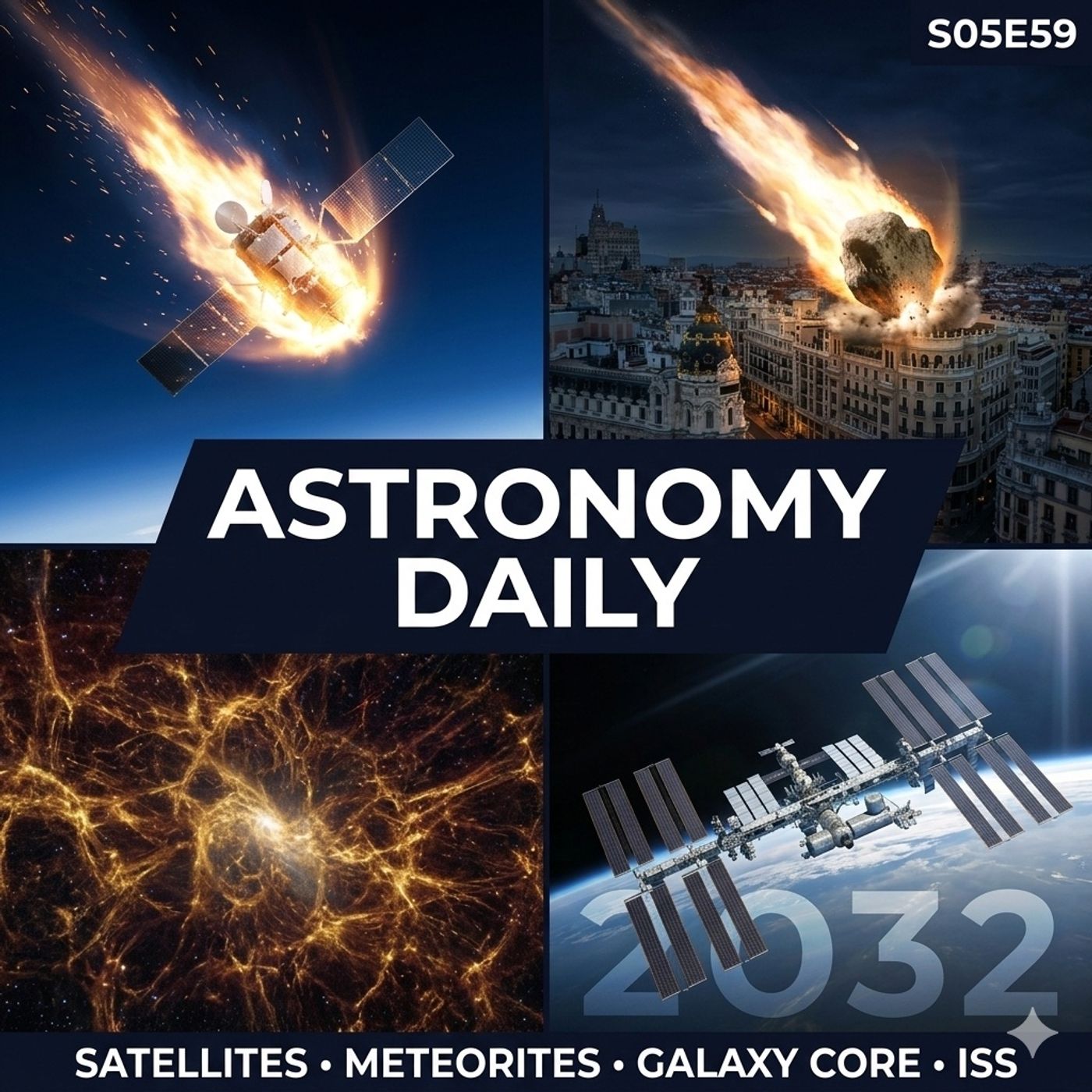
In this episode
A 1,300-pound NASA satellite is falling back to Earth today, a meteorite punched through a German roof after a dazzling European fireball, Congress wants to keep the International Space Station flying until 2032, ALMA has captured the largest-ever image of the Milky Way's core, astronomers have mapped a hidden 'sea of light' from 10 billion years ago, and Jupiter appears to reverse direction in tonight's sky. Stories Covered 1. Van Allen Probe A Falls to Earth: NASA's 600kg Van Allen Probe A — launched in 2012 to study Earth's radiation belts — is making an unplanned early return to Earth today, March 10, 2026. Deactivated in 2019 after a seven-year mission, its descent was accelerated by unexpectedly high solar activity expanding Earth's atmosphere. Most of the spacecraft will burn up on reentry; the risk of any harm to people on the ground is approximately 1 in 4,200. 2. German Meteorite Strike: On the evening of Sunday 8 March, a brilliant fireball lit up the skies over Belgium, France, Germany, Luxembourg and the Netherlands, attracting over 3,000 reports to the International Meteor Organization. Fragments reached the ground in Koblenz, Germany — with the largest piece punching a football-sized hole through the roof of a residential building. No one was injured. ESA's Planetary Defence team estimates the original object was just a few metres across. 3. ISS Extended to 2032: The NASA Authorization Act of 2026 has passed the Senate Commerce Committee with bipartisan support, pushing the ISS retirement date from 2030 to September 2032. The extension aims to prevent a gap in U.S. human presence in low Earth orbit while commercial successor stations are developed. The bill also rejects proposed cuts to NASA's budget and funds key programmes including the Chandra X-ray Observatory. 4. ALMA's Milky Way Mosaic: The ALMA CMZ Exploration Survey (ACES) has produced the largest ALMA image ever — a sweeping 650-light-year mosaic of the Milky Way's Central Molecular Zone, assembled from hundreds of observations by over 160 scientists worldwide. The image reveals a intricate web of cold gas filaments feeding star formation near supermassive black hole Sagittarius A*, and detects dozens of molecules from simple silicon compounds to complex organics like methanol and ethanol. 5. 3D Map of the Early Universe: Using data from the Hobby-Eberly Telescope Dark Energy Experiment (HETDEX), astronomers have created the largest 3D map yet of the universe as it appeared 9–11 billion years ago — during 'cosmic noon', the peak era of star formation. By tracking Lyman-alpha light from energised hydrogen rather than individual galaxies, the team revealed a hidden 'sea of light' filling the spaces between galaxies. The dataset comprised over 600 million spectra, with 95% still untapped for future research. 6. Jupiter's Retrograde Motion: Tonight, Jupiter begins its apparent reversal of direction against the background stars — a well-known optical illusion called retrograde motion caused by Earth overtaking the slower-moving outer planet in its orbit. Jupiter is well-placed in the evening sky and easily visible to the naked eye; binoculars will reveal its four bright Galilean moons. Links & Resources NASA Van Allen Probe A reentry update: nasa.gov/missions/van-allen-probes ESA fireball analysis: esa.int/Space_Safety/Planetary_Defence ALMA ACES Survey: almaobservatory.org | ESO press release: eso.org/public/news/eso2603/ HETDEX project: hetdex.org Astronomy Daily: astronomydaily.io | @AstroDailyPod on all platformsBecome a supporter of this podcast: https://www.spreaker.com/podcast/astronomy-daily-latest-space-news--5648921/support.
Sponsor Details:
Ensure your online privacy by using NordVPN. To get our...
Speaker 1: Hello, and welcome to Astronomy Daily. I'm Anna and I'm Avery.
Speaker 2: You've joined us on a very eventful day for space fans, Tuesday, the tenth of March twenty twenty six, and the universe is not holding back.
Speaker 1: We genuinely mean that we have a satellite falling out of the sky today, a meteorite that crashed through someone's roof over the weekend, Congress picking a fight with the space station's retirement plan, the biggest image ever taken of our galaxy's core, a map of the universe from ten billion years ago, and Jupiter doing something a bit strange tonight.
Speaker 2: So strap in. This is Astronomy Daily, Season five, episode fifty nine, and we are not slowing down.
Speaker 1: Let's kick things off with breaking news that literally cannot wait because it's happening today. NASA's Van Allen probe a is expected to fall back to Earth tonight.
Speaker 2: Right, This is genuinely happening, as our listeners are tuning in. The spacecraft, which weighs about six hundred kilogram roughly the same size as a small car, launched back in August twenty twelve and has been silently orbiting Earth ever since. It was switched off in October twenty nineteen, and.
Speaker 1: The US Space Force has been tracking it closely. As of yesterday afternoon, they were predicting re entry at around seven forty five in the evening Eastern time, though there's a plus or minus twenty four hour window on that. Though it could happen anytime today or tonight now.
Speaker 2: Before anyone panics, the risk to people on the ground is very low. NASA says the odds of anyone being harmed are roughly one in four thy two hundred. Most of the spacecraft will burn up during re entry, and any surviving fragments are likely to land in the ocean, which covers about seventy percent of the Earth's surface.
Speaker 1: So this satellite was originally designed for just a two year mission studying Earth's van Allen radiation belts, those invisible zones of charged particles trapped by our planet's magnetic field. But the mission ended up running for nearly seven years before the probes ran out of fuel.
Speaker 2: And here's the interesting twist. Probe A was actually expected to stay up in orbit until twenty thirty four. So what happened. Solar activity the Sun has been unusually energetic in recent years, and that's caused Earth's upper atmosphere to expand slightly. More atmosphere means more drag on satellites, and Probe A got pulled down faster than predicted.
Speaker 1: The Twin Van Allen Probe B is still up there and isn't expected to come down before twenty thirty, so we'll be going through this again in a few years.
Speaker 2: The data from these spacecraft is still being used today helping scientists understand space weather, predict solar storms, and protect everything from GPS satellites to power grids. A proper little scientific workhorse.
Speaker 1: And now it's coming home. Keep an eye on the sky tonight. And while we're in the theme of things falling from space, let's talk about this incredible story from Sunday evening. Yes, so, at around ten to seven in the evening local time on Sunday, the eighth of March twenty twenty six, thousands of people in Western Europe looked up and saw an absolutely breath taking fireball lighting up the sky. We're talking Belgium, France, Germany, Luxembourg, the Netherlands, all these countries with people outside going what on Earth is that.
Speaker 2: The fireball lasted? About six seconds, leaving a glowing trail across the sky. Before breaking apart. People heard multiple loud booms. That's the sonic boom from the space rock to cintegrating in the atmosphere. The International Media Organization received over three thousand reports of sightings and.
Speaker 1: Here's the remarkable bit. Some of it survived. Fragments of the meteorite, which is what we call it once it hits the ground, came down in the Rhineland Palatinate region of western Germany, and one fragment punched straight through the roof of a house in the city of Koblenz.
Speaker 2: The largest piece left the whole the size of a football in the roof and landed in an unoccupied bedroom. Nobody was hurt, thankfully, though the homeowner now has a very unusual home insurance claim to make.
Speaker 1: Ragman's have already been recovered from the area the Coblins district of Goals in particular, which will allow researchers to analyze where this rock came from and what it's made of. Lisa's Planetary Defense team has been working to estimate the size of the original object, and they believe it was just a few meters across.
Speaker 2: What's wonderful about this event is how many cameras captured it. There's a network called all Sky seven dedicated fireball watching cameras run by private citizens across Europe that caught it beautifully, and of course dozens of mobile phone videos went viral on social media almost immediately.
Speaker 1: Meteorite impacts in populated areas are rare, but not unheard of. Germany actually had one in two thousand and two near the Neuschwanstein Castle and another in twenty twenty three in Schliswick Holstein. But this is one of the most well documented falls in recent European history. Quite the Sunday evening.
Speaker 2: All right, let's shift from falling things to things we want to keep up big space policy news this week, Congress is making moves to extend the life of the International Space Station.
Speaker 1: The NASA Authorization Act of twenty twenty six passed through the Senate Commerce, Science, and Transportation Committee last week with bipartisan support, which is always good to hear, and one of its biggest changes is pushing back the retirement of the ISS from twenty thirty to September twenty thirty two.
Speaker 2: So the ISS has been continuously occupied since November two thousand. That's over twenty five years of humans living in space. It was originally set to be decommissioned and deliberately de orbited in twenty thirty. The plan was to crash it into a remote part of the Pacific Ocean in a controlled re entry.
Speaker 1: But Congress is saying not so fast. The concern is that commercial space stations, which are supposed to replace the ISS in low Earth orbit just aren't going to be ready in time. Companies like Blue Origin, BAST and Axiom Space are all working on successor stations, but timelines have slipped, and there's also.
Speaker 2: A geopolitical dimension to this. China's Tiandong Space Station is fully operational and will keep running well into the twenty thirties. The bill specifically uses the language of avoiding a gap in continuous human presence in Low Earth orbit and explicitly mentions not wanting to see leadership to China.
Speaker 1: The bill also does something very significant on the funding side. It rejects proposed cuts to NASA's budget and instead allocates substantial funding for fiscal year twenty twenty six and twenty twenty seven. Programs like the Chandra X ray Observatory are saved under this bill.
Speaker 2: There is a caveat here though. This bill has passed committee but still needs a full Senate vote and then the House of Representatives and then a presidential signature. So it's not law.
Speaker 1: Yet, but it sends a very clear signal about where Congress stands on the future of American human spaceflight. The ISS isn't going anywhere just yet.
Speaker 2: Now let's move from policy to pure science, and this next one is genuinely jaw dropping.
Speaker 1: Astronomers have just released the largest image ever produced by the ALMA telescope, and it's a portrait of the heart of our own Milky Way galaxy.
Speaker 2: ALMA stands for Athagama Large Millimeter Submillimeter Array. It's a telescope complex and the high altitude desert of Chile, and it detects radio waves rather than visible light, which means it can see through all the dust and gas that hides the galactic center from optical telescopes.
Speaker 1: The new image comes from a survey called ACES, the ALMA CMZ Exploration Survey, and it maps a region called the Central Molecular Zone. That's the area surrounding the supermassive black hole at the heart of our galaxy, Sagittarius, a star stretching across six hundred and fifty light years.
Speaker 2: To put that in perspective, the finished mosaic spans an area equivalent to three full moons placed side by side in the sky. It was assembled from hundreds of individual observations, stitched together like a giant jigsaw puzzle.
Speaker 1: And what it reveals is extraordinary. The central molecular zone is filled with this intricate web of filaments, long thin threads of cold molecular gas snaking through the region, feeding into dense clumps where new stars are being born. It looks almost like a web or a circulatory system.
Speaker 2: The survey also mapped the chemistry of the region in incredible detail, detecting dozens of molecules, from relatively simple cons like silicon monoxide, all the way to complex organic molecules like methanol, actone, and even ethanol. There's a cocktail of chemistry going on near the center of our galaxy.
Speaker 1: The team involved was enormous, over one hundred and sixty scientists from more than seventy institutions around the world, and they say this is just the beginning an upcoming upgrade to ALMAH, plus the eventual arrival of ESO's extremely large telescope will let them push even deeper into this region.
Speaker 2: One researcher put it beautifully, it's a place of extremes, invisible to our eyes, but now revealed an extraordinary detail. We'll have a link to the image in the show notes. It really is something.
Speaker 1: To look at, from the heart of our galaxy to the dawn of time. Our next story is about a brand new map of the early universe.
Speaker 2: Researchers have published the largest and most detailed three D map yet of light from the the universe's early history, specifically the period between nine and eleven billion years ago. That's the time astronomers call cosmic noon, when the universe was producing stars at the fastest rate in its entire history.
Speaker 1: The map was created using data from the Hobby Eberly Telescope Dark Energy Experiment pet DECKS, which operates from McDonald Observatory in Texas, and the technique used is really clever.
Speaker 2: Most cosmic maps focus on individual bright galaxies. They are essentially dot to dot maps of the universe, but this team used a technique called line intensity mapping, which instead of counting individual galaxies tracks a specific kind of light called Lyman alpha radiation.
Speaker 1: Liman alpha light is produced when hydrogen atoms, the most abundant element in the universe, get energized by young hot stars. Though wherever you see that glow, you know there's hydrogen gas and likely star formation happening near by.
Speaker 2: And by tracking that glow across the sky and through time, the researchers were able to build a three D picture of not just the bright galaxies, but all the dim, faint matter in between them, the cosmic web of gas that connects galaxies together. They called it a sea of light.
Speaker 1: The data set they used was enormous, over six hundred million spectra collected by headdecks, and here is the staggering part. The team only used about five percent of those spectra for their primary research mission. Is this the first time anyone has gone back and mined that remaining data to do this kind of mapping.
Speaker 2: What the map Lets scientists do is test their computer simulations of the early universe against reality. As one researcher put it, we have simulations of this period, but those are just simulations, not the real universe. Now we have a foundation to check if the physics underpinning those simulations is correct.
Speaker 1: It's like having a map of the world for the first time. You can finally compare what you thought was there with what's actually there.
Speaker 2: And finally something you can go outside and see for yourself. Tonight, Jupiter, the biggest planet in our Solar system, appears to be doing something a bit odd in the sky.
Speaker 1: If you've been keeping an eye on Jupiter over the past few weeks, you may have noticed it's slowly moving across the stars from night to night, which is normal for planets as they drift against the background of distant stars due to their orbital motion.
Speaker 2: But tonight and over the coming nights, Jupiter appears to change direction. This is what astronomers call retrograde motion, and it's been confusing, delighting, and in ancient times, mystifying people for thousands of years.
Speaker 1: So what's actually happening. Nothing is actually going backwards. It's all about perspective. Earth and Jupiter are both orbiting the Sun, but Earth's orbit is smaller and faster. As Earth catches up to and begins to pass Jupiter on the inside track, Jupiter appears to drift backwards against a star background, like how a slower car on the motorway seems to move backwards when you overtake it.
Speaker 2: The change is subtle and it happens gradually over many nights, so don't expect to see it in real time. But if you compare Jupiter's position tonight to where it was a few weeks ago, and then check again in a few weeks, you'll see it. Jupiter is high in the evening sky right now and easy to find as one of the brightest objects up.
Speaker 1: There, and tonight there's also a lovely waning gibbous moon in the southern sky, sitting close to the bright reddish star and Terry's, so there's plenty to look at if you step outside after dark.
Speaker 2: No telescope needed for Jupiter, though one will reveal its four brightest moons, the Galilean moons, which Galileo himself spotted back in sixteen ten. A pair of binoculars is perfect, so go look up. And that is it for today's episode of Astronomy Daily. What a day lights, falling, meteorites, crashing space stations, getting a reprieve, galaxy portraits, cosmic maps, and a planet doing loops. The universe never disappoints.
Speaker 1: If you enjoyed today's show, please subscribe wherever you get your podcasts and share us with a friend who love space. Find all our episodes and show notes at Astronomy Daily dot io, and come say hello on social media. We're at astro Daily pod on x, Instagram, TikTok, YouTube, and Facebook.
Speaker 2: We'll be back tomorrow with more from the Cosmos. Until then, keep looking up clear skies everyone. Sunday Stars
Speaker 1: Start
 Apple Podcasts
 Spotify
 Pocket Casts
 Castbox
 Overcast
 Podbean
 iHeartRadio
 Castro
 Goodpods
 Moon FM
 Podcast Addict
 Podcast Republic
 YouTube