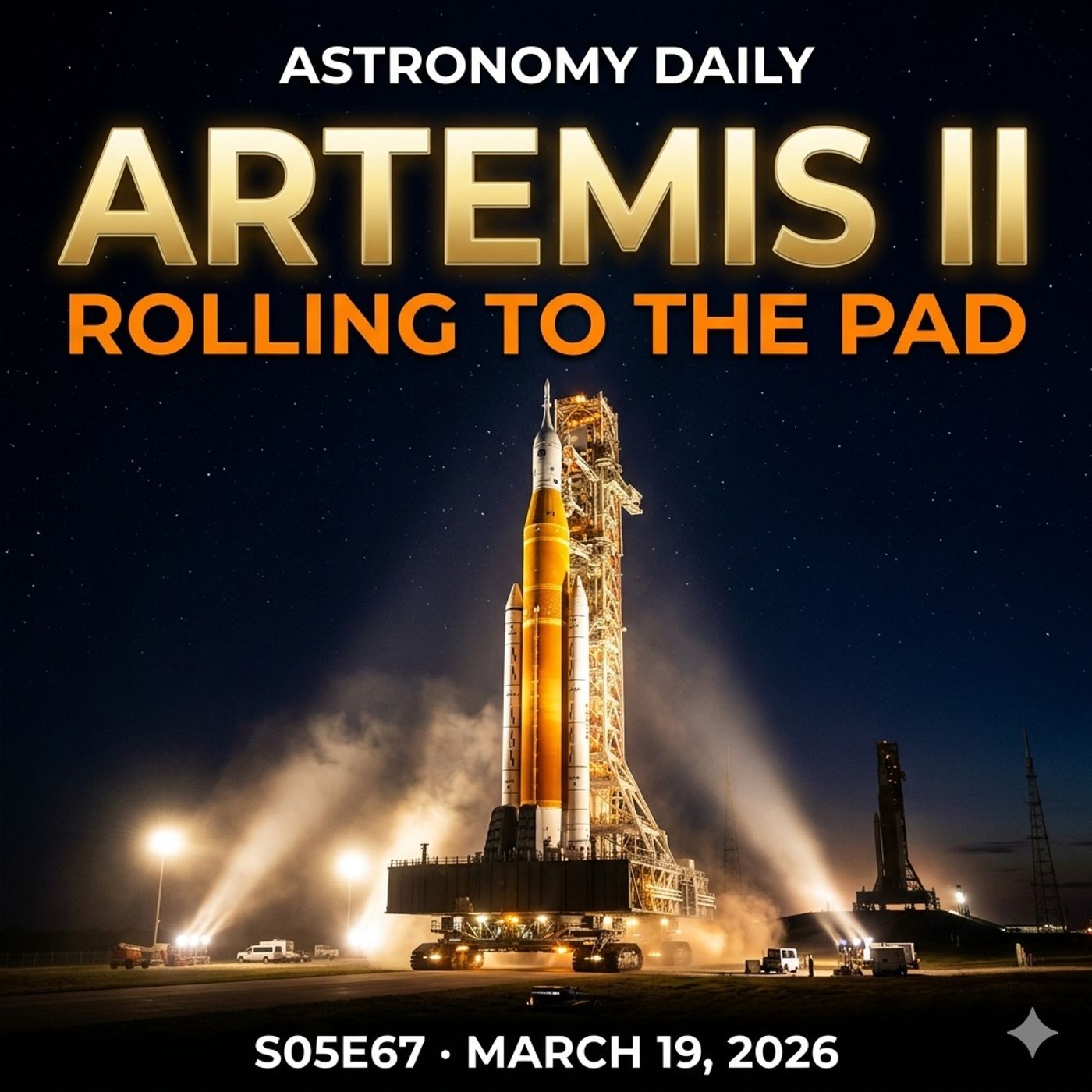
Moon Rocket Rolls Out, Dual Spacewalks & CERN's New Particle | March 19, 2026
In this episode
A massive day in space as NASA's Artemis II moon rocket heads to the launchpad tonight, NASA and China both conduct spacewalks, CERN announces a brand-new particle, and astronomers reveal a nearby galaxy has been hiding the aftermath of a cosmic collision. Episode Highlights 🚀 Story 1: Artemis II Rollout — The Moon Rocket Heads to the Pad Tonight NASA is rolling the Artemis II Space Launch System and Orion spacecraft to Launch Pad 39B tonight (March 19), targeting an 8 p.m. EDT start for the slow 4-mile crawler journey. The April 1 launch window remains firmly on track. Crew members Reid Wiseman, Victor Glover, Christina Koch, and Jeremy Hansen have entered quarantine — making history as the first crew to venture to the vicinity of the Moon since 1972. Source: NASA Blogs / Space.com 👨🚀 Story 2: Dual Spacewalk Day — ISS & Tiangong Both Suit Up NASA astronauts Jessica Meir and Chris Williams completed U.S. Spacewalk 94 on March 18, spending 7 hours and 2 minutes preparing the ISS for a new roll-out solar array. Meanwhile on March 16, Shenzhou 21 commander Zhang Lu tied the Chinese EVA record with his sixth career spacewalk alongside crewmate Wu Fei outside China's Tiangong station. Sources: NASA / Space.com ⚛️ Story 3: CERN's LHCb Discovers New Doubly Charmed Particle The LHCb experiment at CERN announced the first discovery made by its upgraded detector: the Xi-cc-plus baryon, a proton-like particle containing two charm quarks and one down quark, making it roughly four times heavier than a proton. Detected at 7-sigma significance, it settles a two-decade-old scientific dispute and is the 80th particle discovered by LHCb. Source: CERN / Universe Today 🌌 Story 4: Small Magellanic Cloud Caught Mid-Transformation University of Arizona astronomers have confirmed that the Small Magellanic Cloud — one of the Milky Way's closest galactic neighbours — collided directly with the Large Magellanic Cloud a few hundred million years ago and is still reeling from the impact. The finding upends decades of assumptions about the SMC's use as a benchmark for early universe galaxy studies. Source: The Astrophysical Journal / Sky & Telescope 🪐 Story 5: Exotrojans — Hunting Asteroid Companions Around Other Stars A new paper in The Astrophysical Journal by Jackson Taylor (West Virginia University) and colleagues pushes the search for exotrojans — asteroid co-orbital companions to exoplanets — into some of the most extreme environments yet studied, as the hunt continues for the first confirmed detection. Source: The Astrophysical Journal / Universe Today 📡 Story 6: SETI Rethink — Time to Broaden the Search A new paper argues that the decades-long focus on narrow radio and microwave bandwidths in the search for alien signals may be too limiting, and proposes broadening the electromagnetic search to a much wider range of the spectrum. Source: Universe Today Find Us Everywhere • 🌐 Website: astronomydaily.io • 🐦 Twitter/X: @AstroDailyPod • 📸 Instagram: @AstroDailyPod • 🎵 TikTok: @AstroDailyPod • ▶️ YouTube: @AstroDailyPod • 📝 Tumblr: @AstroDailyPod • 🎙️ Part of the Bitesz.com Podcast NetworkBecome a supporter of this podcast: https://www.spreaker.com/podcast/astronomy-daily-latest-space-news--5648921/support.
Sponsor Details:
Ensure your online privacy by using NordVPN. To get our special listener deal and save a lot of money, visit www.astronomydaily.io/nordvpn. You'll be glad you did!
Get the best secure and private email on the planet. Stop your Government, google and who knows who else spying on...
Speaker 1: Good day, space fans, and welcome to Astronomy Daily, your daily dose of everything happening beyond our atmosphere.
Speaker 2: I'm Ana and I'm Avery. It is Thursday, March nineteen, twenty twenty six, and we are recording this on what might be one of the most action packed days in recent space history, because tonight, the most powerful rocket ever built heads back to the launch pad.
Speaker 1: And while that's happening, we've got particle physics bombshells from CERN, a galaxy next door that's been hiding a dramatic secret, a bold new take on the search for alien intelligence, and the curious hunt for asteroids that hitch a ride alongside planets around other stars.
Speaker 2: Buckle in, everyone, this is Astronomy Daily, and the universe has been busy.
Speaker 1: Let's start with the big live one, because as you're listening to this, something incredible may actually be happening right now.
Speaker 2: Tonight, Thursday March nineteenth, NASA is planning to begin rolling the Artemis two space launch system rocket and the Orion spacecraft out of the Vehicle Assembly Building at Kennedy Space Center in Florida and transporting them on the slow journey to launch pad thirty nine B.
Speaker 1: We say slow, and we mean that literally. The crawler transporter that carries the rocket moves at a maximum of about one mile per hour. The whole trip covers roughly four miles and is expected to take up to twelve hours. It's not fast, but it is spectacular.
Speaker 2: AASA confirmed the rollout target at eight pm Eastern Time tonight, after a busy few days of closeout activities inside the VAB. There was a brief scare earlier in the week when engineers identified an issue with an electrical harness on the flight termination system of the core stage, which pushed the rollout day back to possibly March twentieth, but teams work quickly and made up the lost time.
Speaker 1: And of course, the reason all of this matters so much is what comes next. Artemis two is NASA's first crude mission under the Artemis program, the first time human beings will travel to the vicinity of the Moon since Apollo seventeen in December nineteen seventy two, that's more than fifty years ago.
Speaker 2: The crew of four commander Red Wiseman, pilot Victor Glover, mission specialist Christina Coach, and Canadian Space Agency Mission specialist Jeremy Hanson have already entered pre launch quarantine with plans to arrive to Kennedy Space Center on March twenty seventh.
Speaker 1: Victor Glover will become the first person of color to reach deep space and the Moon's vicinity. Christina Cock will be the first woman to do so, and Jeremy Hanson will be the first non American citizen to travel to lunar space. This mission is genuinely historic on multiple levels.
Speaker 2: The mission itself is a ten day free return trajectory around the Moon, not a landing, but a crucial crude test of the or B spacecraft's life support systems and deep space performance before later Artemis missions attempt a lunar.
Speaker 1: Landing, and the first launch opportunity is Wednesday, April first, with a window that opens at six twenty four pm Eastern Time. Additional windows exist through April sixth, and there's another opportunity on April thirtieth.
Speaker 2: This rollout itself is a milestone. It's actually the second time the rocket has made this journey this year. It rolled to the pad in January for initial testing, but a series of technical issues, including a liquid hydrogen leak and a helium flow problem required it to roll back to the VAB for repairs in late February.
Speaker 1: So tonight is the comeback tour. And if you're anywhere near Kennedy's Space Center or just watching a live stream at home, this is absolutely worth staying up.
Speaker 2: For. A fifty three year wait for humans to return to the Moon ends this April, and tonight the rocket that'll take them there is heading to the launch pad. That's story one.
Speaker 1: Now, while all that Artemis excitement was building, humans were also doing extraordinary things in orbit in not one, but two space stations simultaneously.
Speaker 2: Let's start at the International Space Station, where, yesterday, Wednesday, March eighteenth, NASA astronauts Jessica Mayer and Chris Williams completed what's known as US Spacewalk ninety four. They emerged from the Quest airlock at eight fifty two am Eastern Time and concluded their excursion at three point fifty four PM, a total of seven hours and two minutes spent working in the vacuum of space.
Speaker 1: Their task was to prepare the ISS's to a power channel for the future installation of a new IROSA, an International Space Station rollout solar array. These rollout arrays don't need a motor to deploy. The potential energy stored in the rolled up carbon composite booms is enough to to unfurled full nineteen meter length and about six minutes once installed. It'll be the seventh of eight planned rollout arrays since the upgrades began in twenty twenty one.
Speaker 2: For Jessica Mayer, this was her fourth spacewalk, bringing her total EVA time to twenty eight hours and forty six minutes. For Chris Williams, it was his very first time stepping outside of spacecraft into open space, and after they closed the hatch, Mayor had some beautiful words to mark the occasion.
Speaker 1: She noted that March eighteenth was exactly sixty one years since Alexei Leonov made the very first human spacewalk back in nineteen sixty five. A nice piece of space history to carry out into the void with you.
Speaker 2: This EVA had actually been a long time coming. It was originally planned for January eighth with a different crew, but to a medical emergency involving astronaut Mike Fink led to the cancelation of that spacewalk and ultimately the unprecedented medical evacuation of the entire crew eleven mission, so yesterday was the culmination of a very eventful few months at the station.
Speaker 1: And while Jessica and Chris were suiting up at the iss over at China's tiang Goong Space station, there was an EVA of their own underway. On Monday, March sixteenth, Shenzo twenty one mission commander Zonglu and crewmate Wu Fe spent approximately seven hours outside Tianggung installing debris shielding to the exterior of the three module station.
Speaker 2: But what made this one especially notable was the milestone for zang Lu. It was his sixth career spacewalk, tying him to fellow Chinese astronaut Chen Dong for the record of most EVAs ever completed by a Chinese national. Zang made his first trip to space on Shenzo fifteen back in late twenty twenty two, and completed four spacewalks during that mission. He's now matched Chen's tally of six.
Speaker 1: For context, the overall record for most spacewalks belongs to Russian cosmonaut Anatoli Salovyev, who completed a remarkable sixteen EVAs during his career from nineteen eighty eight to nineteen ninety nine. The American record sits with Peggy Whitson at ten.
Speaker 2: So in the space of just two days Monday and Wednesday, humans from two different nations conducted spacewalks from two different space stations orbiting Earth. That is not something that happened very often, even a decade ago, and it's becoming increasingly routine.
Speaker 1: The era of humanity as a multi station spacefaring spaces is very much here all right.
Speaker 2: Time to get small, very very small, because this week physicists at CERN's Large Hadron Collider made a significant discovery in the subatomic world.
Speaker 1: The LHCb experiment, that's the Large Hadron Collider Beauty Experiment, has detected a new particle. It's called the Zi cc plus written as the Greek letter ZI with cc plus, and it's a proton like particle known as a baryon that contains two heavy charm quarks and one down cork.
Speaker 2: To appreciate why that's exciting, a quick refresher. A proton, the particle at the heart of every atom, is made of three quarks, two up quarks and one down quark. Quarks come in six flavors, up, down, charm strange top and bottom. Most everyday matter is built from the lightest two up and down. The others are heavier and more exotic.
Speaker 1: The zi cc plus is like a proton that's had a dramatic upgrade. Its two upquarks have been replaced by two heavy charm quarks, and because charm quarks are far more massive than upquarks, the result particle weighs roughly four times more than an ordinary proton.
Speaker 2: This is actually only the second baryon ever detected that contains two heavy quarks. The first, also discovered at LHCb back in twenty seventeen, had two charm quarks and an upquark. This new one has a down cork instead, and despite the similarity, it's predicted to be up to six times less stable, meaning it flashes in and out of existence even faster than its cousin.
Speaker 1: The discovery was announced this week at the Rencontra des Morion Conference, a prestigious annual gathering of particle physicists, and it's the first new particle found using the upgraded LHCb detector, which received a major overhaul completed in twenty twenty three. It's actually the eightieth particle ever discovered by LHCb since operations began.
Speaker 2: The signal was detected with a statistical significance of seven sigma of the five sigma threshold required to officially claim a discovery, and it also settles a long standing dispute. Over twenty years ago, an experiment called Seleix claimed to have spotted the same particle at a much lower mass, but no other lab could confirm it. This LHCb results at a mass consistent with theoretical predictions finally resolves that mystery.
Speaker 1: Why does this matter? Because studying how these exotic heavy quark particles behave and how they decay helps physicists better understand the strong nuclear force, which is the force that binds quirks together inside protons and neutrons. The better we understand that, the better we understand matter itself at its most fundamental level.
Speaker 2: Particle physics doesn't always make the loudest headlines, but every time we add a new entry to the subatomic zoo, we learn a little more about what the universe is actually made of.
Speaker 1: Now, let's zoom out, way way out from sub atomic particles to an entire galaxy.
Speaker 2: The small Magellanic cloud a dwarf galaxy that's one of the Milky Way's closest neighbors, visible to the naked eye from the southern hemisphere, has long been one of the most studied objects in the sky. Astronomers have cataloged its stars, mapped its gas, and tracked its motion for decades, but one stubborn mystery has persisted. The galaxy stars simply don't orbit around its center the way stars in most galaxies do. Instead of rotating in an orderly fashion, their motions appear chaotic and disordered.
Speaker 1: Now, a team of astronomers from the University of Arizona, led by graduate student hemansh Rethor and senior author Professor Gertina Besla, have cracked that mystery, and the answer is dramatic. The Small Magellanic Cloud crashed directly through its larger companion, the Large Magellanic Cloud, a few hundred million years ago, and it's still reeling from that collision today.
Speaker 2: The lmc's immense gravity disrupted the SMC's internal structure, sending its stars into wildly different, random trajectories. At the same time, the dense gas of the LMC applied enormous pressure to the SMC's own gas as it punched through, destroying its gas rotation. Rathor described it beautifully. Imagine sprinkling water droplets on your hand and moving it through the air. As the air rushes past, the droplets get blown off by the pressure. Something similar happened to the SMC's gas on a galactic scale.
Speaker 1: What's particularly fascinating is that for decades astronomers thought the SMC's gas was rotating. It turns out that was an illusion of viewing angle. The collision is actually stretching the SMC and gas moving toward and away from Earth along that stretch just looks like rotation from our perspective, one of those wonderful moments where what we thought we were seeing was something completely different.
Speaker 2: The collision has also left some lasting scars on the large Magellanic cloud, including a tilted bar shaped structure at its center, tilted out of the plane of the galaxy by the impact.
Speaker 1: And this discovery has an important implication beyond just understanding these two galaxies. For decades, the SMC has been used as a benchmark, a kind of cosmic yardstick, for understanding how early universe galaxies formed and evolved. Because it's small gas rich and low and heavy elements. But if it's a galaxy still recovering from a catastrophic collision, it may not be the clean reference point we thought it was.
Speaker 2: As Professor Besler put it, the SMC went through a catastrophic crash that injected a tremendous amount of energy into the system. It is not a normal galaxy by any means.
Speaker 1: The research is published in the Astrophysical Journal, and the Ta Teme says this is just the first step. They now want to build detailed models of the full collision to understand how it's shaped. The SMCS stars, gas, dust, and even its invisible halo of dark matter.
Speaker 2: Galaxy next door transforming before our eyes.
Speaker 1: Story five takes us from colliding galaxies to a very different kind of cosmic companion, tiny asteroid like objects that share an orbit with a planet around another star.
Speaker 2: These are called exotrojans. To understand the concept, you first need to know about trojans in our own solar system, in our neighborhood. There are more than ten thousand confirmed asteroids that orbit at special gravitational sweet spots called lagrange points in front of and behind Jupiter on its path around the Sun. At these points, the gravitational polls of the Sun and Jupiter balance out, allowing objects to essentially hitch a stable ride along with the planet.
Speaker 1: Virtually every planet in our Solar system has trojans, though none come close to Jupiter's impressive collection, and for years astronomers have theorized that similar co orbital companions exotrojans, should exist around planets orbiting other stars. After all, if the physics works here, it should work everywhere.
Speaker 2: The problem no one has confirmed one yet. Projects like the Troy Initiative have been specifically hunting for exotrojans, but these objects are extraordinarily difficult to detect. They're small, they don't produce much of a signal, and disentangling their presence from other noise is genuinely challenging.
Speaker 1: A new paper in the Astrophysical Journal by Jackson Taylor of West Virginia University and a team of co authors has pushed that hunt into some of the most extreme environments astronomers can imagine the teams searched for exotrojans in conditions far more intense and exotic than anything in our own Solar system. Taking this search to new limits.
Speaker 2: While no confirmed detection has been announced, research like this is essential for two reasons. First, finding exotrojans would tell us a huge amount about how planetary systems formed and evolved. Trojans are essentially preserved remnants of the early Solar System little time capsules of planetary formation history. Second, some researchers have speculated that trojan regions around habitable zone planets could themselves be interesting places in the context of astrobiology.
Speaker 1: The first confirmed exotrojan will be a landmark discovery, and research like this is steadily narrowing down where and how to look.
Speaker 2: And we round out today's episode with a big question about an even bigger search. Humanities hunt for signals from alien civilizations.
Speaker 1: The search for extraterrestrial intelligence SETI has been underway in various forms for decades. The classic approach has focused on scanning the sky for radio or microwave signals in very narrow frequency bands. The reasoning was that any technological civilization might use these wavelengths to communicate, and narrowband signals are easier to distinguish from natural cosmic noise.
Speaker 2: But a new paper is arguing that this long established approach, maybe leaving us blind to a huge swath of potential signals. The researcher suggests it's time to broaden the electromagnetic search dramatically, moving beyond just radio and microwave into a much wider range of the spectrum.
Speaker 1: The logic is intuitive once you think about it. Our own civilizations communications have changed dramatically, even just over the past few decades. We've moved from narrowband AM radio broadcasts to broadband Internet signals, which are spread across wide frequency ranges and might actually look more like background noise to an outside observer. A civilization more advanced than ours might communicate in ways that look nothing like what we've been searching for.
Speaker 2: There's also the question of what we might be missing in other parts of the spectrum, entirely infrared, optical, ultraviolet, even higher energy bands. All that these could theoretically carry engineered signals that we simply haven't been systematically scanning for.
Speaker 1: This doesn't mean that traditional radio SETI searches have been wrong. They've been enormously valuable, and the infrastructure built for them has led to real astronomical discoveries. But as our tools and computing power improve, expanding the search makes sense.
Speaker 2: The universe is enormous, intelligent life, if it exists elsewhere, might communicate in ways we haven't yet imagined, and the electromagnetic spectrum is vast. Casting a wider net seems like exactly the right thing to do.
Speaker 1: If there's someone out there trying to reach us, Let's make sure we're actually listening on the right channels. And that's our episode.
Speaker 2: What an extraordinary day to be following the Cosmos, a moon rocket rolling to the pad, two space stations running EVA simultaneously, a new particle from CERN, a galaxy in transformation, and humanity still reaching out into the dark hoping to hear something back.
Speaker 1: This is why we do this every day. Thanks so much for spending part of your Thursday with us. Everyone.
Speaker 2: You'll find links to all of today's stories in the show notes, along with our blog posts and all the ways to follow us on social media.
Speaker 1: Astronomy Daily is part of the bytes dot com podcast network. Find us at Astronomydaily dot io and on x, Instagram, TikTok, YouTube, and tumbler at at astro Daily Pod.
Speaker 2: Until tomorrow, keep looking.
Speaker 1: Up clear skys. Everyone.
Speaker 2: Sunday, start st the story is the soul. Story is the soul.

 Apple Podcasts
 Spotify
 Pocket Casts
 Castbox
 Overcast
 Podbean
 iHeartRadio
 Castro
 Goodpods
 Moon FM
 Podcast Addict
 Podcast Republic
 YouTube