
In this episode
**Date**: 4th September 2023**Highlights**:
1. **New Lunar Crater**: Discussion about a new crater on the moon and its possible origins.
2. **India's Space Endeavors**: A look at India's recent successful moon landing and their upcoming plans.
3. **September Launches**: A roundup of various space launches scheduled for September.
4. **James Webb Telescope Discoveries**: Breathtaking structures revealed in a well-known supernova.
5. **Ingenuity's Mars Flight**: The Mars helicopter's 56th flight and its accomplishments.
6. **ISRO's Sun Mission**: India's first dedicated mission to study the Sun, a Diffier L-1.
7. **New Lunar Crater's Origin**: Speculation that a new lunar crater was caused by a Russian probe crash landing.
8. **SpaceX's Record-Breaking Launch**: SpaceX's 60th orbital mission of 2023.
9. **Upcoming Launches**: Details on various launches, including China's maritime launch and Virgin Galactic's third commercial mission.
10. **Astronomy Daily Schedule**: Information about the regular posting schedule of the podcast and its hosts.
**Additional Notes**:
- Steve shares a personal story about his car breaking down.
- Hallie makes light of the situation, comparing it to the Russian Space Agency's recent mishaps.
- Steve mentions the Astronomy Daily Newsletter, a roundup of top astronomy stories.
- The podcast ends with Steve thanking Hallie and mentioning Tim, the other half of the Astronomy Daily team from England.
- Listeners are reminded to check out back episodes of Astronomy Daily and the parent podcast, Space Nuts, on Bites.com and SpaceNuts.com.
**Closing**: Steve Dunkley signs off, promising more exciting space news in the next episode.
Become a supporter of this podcast: https://www.spreaker.com/podcast/astronomy-daily-latest-space-news--5648921/support.
Sponsor Details:
Ensure your online privacy by using NordVPN. To get our special listener deal and save a lot of money, visit www.astronomydaily.io/nordvpn. You'll be glad you did!
Get the best secure and private email on the planet. Stop your Government, google and who knows who else spying on every email you write. Do what we did and use ProtonMail. They beleive in privacy and there are no ads in their business model...yet they still provide a free forever service. Check them out and get out special deal at www.astronomydaily.io/protonmail
Become a supporter of Astronomy Daily by joining our Supporters Club. Commercial free episodes daily are only a click way... Click Here
Hello again, and welcome to Astronomy Daily. I'm Steve Dunkley, your host. It's the fourth of September twenty twenty three. Today we'll be looking at a new crater on the moon. Can you guess where that came from? What India is doing next? So soon after their successful moon landing, and a quick roundup of September launchers and so much more, Join us, won't you? It would be a whole speed Dunkley, And with me again is our digital reporter at large, Hallee. How are you, Hallee? Nice to be here again.
I hope you had a great week out there in the real world. Oh it was all too real, Hallie. My car broke down and everybody knows that's bad news, broke being the operative word, right, Oh, halle He's so lucky. You can just zap through the digital domains at the speed of thought. But our cars can be a money pit. They terrific when everything works, like the Russian Space Agency found out recently as well. Oh yes, I mean good company, ad I. But I got my car back the right again. You still have to get me into your GPS and take me out, Steve.
I'm waiting all right, we'll all talk to the buffins in the basement. We'll see what they come up with. Okay, So what's on the show today? Helly, Okay, there's that new crater on the Moon. No guessing how that got there too, Rod. Lots of launches going up this week. Yes, I've got to round up at those coming up. James Webb reveals some breathtaking structures in a well known supernova. Don't you just love it when the new images comes through it from James Webb? They are something else, aren't they used to have?
The wonder how much better that can get? But anyway, let's have a look at those short takes Holley Studios or yours. Thanks Steve. Here's some short takes from the Astronomy Daily newsletter. NASA's James Webb Space Telescope has uncovered new details in Supernova nineteen eighty seven A with its ni r Cam near infrared camera instrument. Structures, some only visible in infrared wavelengths, provide clues into the development of supernova's over time. NASA's James Webb Space Telescope has begun the study of one of the most renowned supernovy sn nineteen eighty seven A supernova nineteen eighty seven A, located one hundred and sixty eight thousand light years away in the large Magellanic Cloud.
SN nineteen eighty seven A, has been a target of intense observations at wavelengths ranging from gamma rays to radio for nearly forty years since its discovery in February of nineteen eighty seven. New observations by Webb's and ircam or near infrared camera, provide a crucial clue to our understanding of how a supernova develops over time to shape its remnant. A new image reveals a central structure like a keyhole. This center is packed with clumpy gas and dust ejected by the supernova explosion.
The dust is so dense that even near infrared light that WEB detects can't penetrate it shape the dark hole in the keyhole. A bright equatorial ring surrounds the inner keyhole, forming a band around the waist that connects two faint arms of hourglass shaped outer rings. The equatorial ring, formed from material ejected tens of thousands of years before the supernova explosion, contains bright hot spots, which appeared as the supernova's shock wave hit the ring. Now spots are found even exterior to the ring with diffuse emission surrounding it.
These are the locations of supernova shocks hitting more exterior material. While these structures have been observed to varying degrees by nassa's Hubble and Spitzer space telescopes and Chundra X ray observatory, the unparalleled sensitivity and spatial resolution of WEB revealed a new feature in the supernova remnant, small crescent like structures. These crescents are thought to be a part of the outer layers of gas shot out from the supernova explosion. Their brightness may be an indication of limb brightening, an optical phenomenon that results from viewing the expanding material in three dimensions.
In other words, our viewing angle makes it appear that there is more material in these two crescents than there actually may be. The four pound one point eight kilograms Ingenuity flew for the fifty sixth time on August twenty sixth, staying aloft for nearly two point five minutes on the Mars Sortie. The Mars helicopter completed flight fifty six, traveling one thousand, three hundred and thirty four feet or four hundred and ten m across the Martian surface at a maximum altitude of thirty nine feet pr twelve m.
The goal of this flight was to reposition the helicopter, a representative of JPL wrote via x formerly Twitter. This week Ingenuity landed with NASA's Perseverance rover inside Mars Gesero Crater. In February twenty twenty one. The helicopter quickly aced its five flight demonstration mission, showing that powered flight is possible on the Red planet despite its thin atmosphere. NASA then grand Ingenuity a mission extension during which the chopper is serving as a scout for the life hunting sample collecting Perseverance.
The robotic duo are working together to explore the twenty eight mile wide forty five kilometers zero, which hosted a big lake and a river delta billions of years ago. The Indian Space Research Organization IRRO has been busy in space in twenty twenty three. First came the successful landing of India's Chandraan three mission in the lunar South Pole region earlier this week. Now, the IRRO has begun its first dedicated mission to study the Sun, a diffier L one. The launch of a four stage polar satellite launch vehicle pslv XL rocket from the satishe Dowan Space Center in India with a diffier L one occurred on Saturday, September second, at six twenty Universal time.
A diffiert is the name for the Sun in Sanskrit, and the L one in its name refers to the mission's destination the Sun Earth l one lagrange point just under a million miles one point five million kilometers sunword. A diffier L one will take about four months to reach this point. Once there, a diffier L one will enter a halo orbit around this point in space, enjoying a vantage point with a continuous view of our host star. A satellite placed in the halo orbit around the L one point has the major advantage of continuously viewing the Sun without any occultation slash eclipses ISRORO officials set in an official statement this will provide a greater advantage of observing the solar activities and its effect on space weather in real time.
A diffier L one has a nominal mission duration of about five years. The three thousand, three hundred pound one thousand, five hundred kilogram class observatory carries a suite of seven instruments to study the Sun's photosphere, chromosphere, and corona layers, three of which will also carry out insitu studies of solar wind particles and magnetic fields at the L one point. This will provide valuable data on solar dynamics and space weather's interaction with the interplanetary medium. The European Space Agency will also provide worldwide tracking coverage for a diffier L one on route too and at L one courtesy of the agency's European Space Tracking Network station.
Keeping around the lagrange points can prove challenging. A failure to perform a routine maneuver nearly doomed the joint NASA SLASH EESA SOHO mission in nineteen ninety eight. Shortly after launch. You're listening to a stormy daily Steve Hi. Yes, welcome back. Don't forget to sign up for the Astronomy Daily newsletter, which is around up of the top stories of astronomy from around the world every day. Register at the address spacenuts dot com and bots dot com. That's brtes z or zbytes dot com and you'll be able to catch up with all the news that's new in astronomy from all around the world.
And I'm just having a quick look at the Astronomy Daily newsletter in my email as it appears, and the subjects that come through are just amazing. There's of course the NASSA observing the Lunar twenty five impact site, Jabe's web revealing new structures within a iconic supernova muscle stimulation to enhance astronaut health, and asking the question have interstellar media or fragments really been found in the ocean? Watching SpaceX launched new Starlink satellites space junk in Earth orbit, examining ways of removing that.
I mean, this newsletter really does cover some amazing territory. Sign up and have a great time exploring space, science and astronomy. It really amazing.
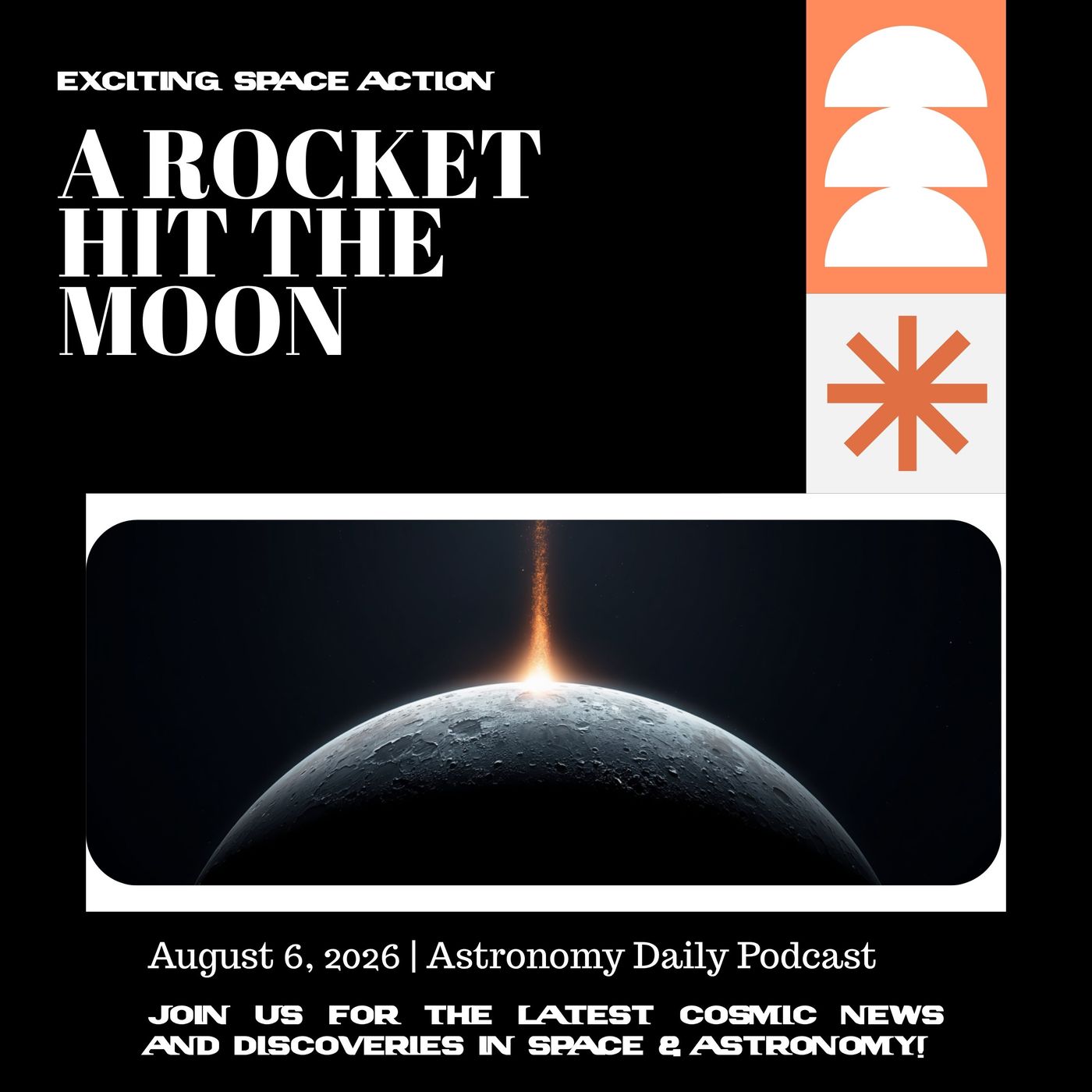
And now the story that's got everybody talking the new crater in the Moon. Now we're wondering what may have caused that. Well, it's not too difficult to join the dots. NASA has spotted a new crater on the Moon that was likely caused by a Russian probe crash landing on the surface around two weeks ago by the ill fated Lunar twenty five probe, but the finding was made by Lunar Reconnaissance Orbiter LERO by comparing before and after images of the estimated impact point provided by Russian space agency ross Cosmos.
Lunar twenty five probe crashed on August nineteen, sinking Russia's hopes of reviving its long dormant Moon program with the first ever soft landing on the lunar's south pole. That accolade went, of course, to India, which successfully land the Chandraan three mission on August twenty three, and it's currently exploring the polar region with its Pragyan rover. LRO, which has been in orbit over the Moon since two thousand and nine, took its most recent before image in June twenty twenty two, and this was compared to an image taken on twenty four, twenty twenty three.
Since this new crater was close to the Lunar twenty five estimated impact point, the LRO team concludes it's likely to be that from the mission rather than a natural impactor. A NASA statement said the new crater is about ten meters thirty two feet in diameter some four hundred kilometers or two hundred and fifty miles short of the lunar twenty five intended landing point. NASA also plans to return to the Moon under its Artemus program, with the goal of building a sustained presence. Ice deposits could be exploited to support human habitats or broken into hydrogen and oxygen to use for rocket fuel.
SpaceX launched Starlink satellites on a record breaking sixty second mission of the year. SpaceX just set a new mark for the most orbital launchers in a single year. The company sent twenty one of its Starlink Internet satellites into orbit last night, that's September three, atop a Falcon nine rocket from NASA's Kennedy Space Center in Florida at ten forty seven Eastern daylight time. It was SpaceX's sixty second orbital mission of twenty twenty three, setting a new record for the most flights at a year.
According to the company's founder and CEO, Elon Musk, the Falcon nine's first stage came back to Earth as planned. It touched down around eight point five minutes after liftoff on the drone ship just read the instructions, which were stationed in the Atlantic Ocean. Meanwhile, the Falcon nine's upper stage kept on flying to deploy twenty one Starling satellites into low Earth orbit, and that was just the beginning of a bump a week the first week of September four launchers coming up. On Tuesday, September five, the Series one S rocket will launch four international satellites into low Earth orbit for China.
This launch will take place from the Maritime Launching Platform, which is stationed in the Yellow Sea. This will mark both the first maritime launch for the Series one rocket and the first private Chinese launch from AC platform. The Series one S is a four stage rocket that stands nineteen meters tall with a faring diameter of one point four meters. The vehicle can place up to four hundred kilograms into low Earth orbit. This mission will mark its fifth mission of twenty twenty three and ninth overall.
A day later, China will attempt to launch its chen Zeng four Sea rocket from Side nine four zero one, a Big One Satellite launch center in China. Liftoff his schedule for eighteen UTC on September six. Launch vehicle, launch time, and payload or all highly uncertain. And may change and something a bit more colorful. The Galactic three mission is Virgin Galactic's third commercial mission using Spaceship two VSS Unity spacecraft. The mission will provide passengers with a few minutes of weightlessness and incredible views of Earth, and is set to launch on September eight, with a currently unknown drop time.
This will mark Spaceship two's seventeenth mission and fifth of twenty twenty three. The spacecraft will be carried to around forty five thousand feet by a carrier aircraft VMS EVE, before being released and igniting its hybrid rocket engine. The engine burns liquid nitrous oxide and solid rubber and will burn for around sixty seconds, taking the aircraft to an altitude of roughly eighty Crew members for this mission purchased their tickets as early as two thousand and five. The full crew has not been announced.
VSS Unity will be piloted by Nicola Penzil and Michael Massucci, veterans of the company. The astronaut instructor is Colin Bennett, and the mothership VMS EVE will be piloted by pilots Jamil Janjua and Kelly Latimer, and ending the week off China will attempt to launch another change thing, this time of six A from Launch Complex nine, a ATU one satellite Launch Center in China. Liftoff is scheduled for four forty UTC on September nine. However, the launch vehicle, payload and launch time are still uncertain and could change as his the habit with Chinese launchers.
And that's a pretty busy week.
And that about wraps it up for another episode of Astronomy Daily for the fourth of September twenty twenty three. Thanks for joining us and thanks for all your heartwork today Hollie. That was fun, Steve, and you'll be seeing Tim later in the week, won't you. Always Great to be heading after England to the other half of the Astronomy Daily team. Tim will have another batch of great stories for you. He always has interesting stuff. Yes, I love listening to a show as well. Astronomy Daily is normally posted twice a week, currently with Tim gibbshiling from Bath in England on Fridays and myself Steve Dunkley manning the Newcastle, Australia studio on Mondays and occasionally when workload wim and weather permit, we produce shows on Wednesdays and Thursdays for special sessions which are always a blast.
As always a reminder that you can always find back episodes of Astronomy Daily and our parent podcast, Space Nuts with Andrew Dunkley and Professor Fred Watson at bytes dot com. That's b I tesz dot com and also space nuts dot com. And one more thing, Once again, I'll remind you don't forget to sign up for the Astronomy Daily newsletter at that same address. That's bytes dot com and also space nuts dot com. I'm your host, Steve Dunkley. Catch you next time on Astronomy Daily podcast. Well be your host, Steve Dunkley


 Apple Podcasts
 Spotify
 Pocket Casts
 Castbox
 Overcast
 Podbean
 iHeartRadio
 Castro
 Goodpods
 Moon FM
 Podcast Addict
 Podcast Republic
 YouTube