In this episode
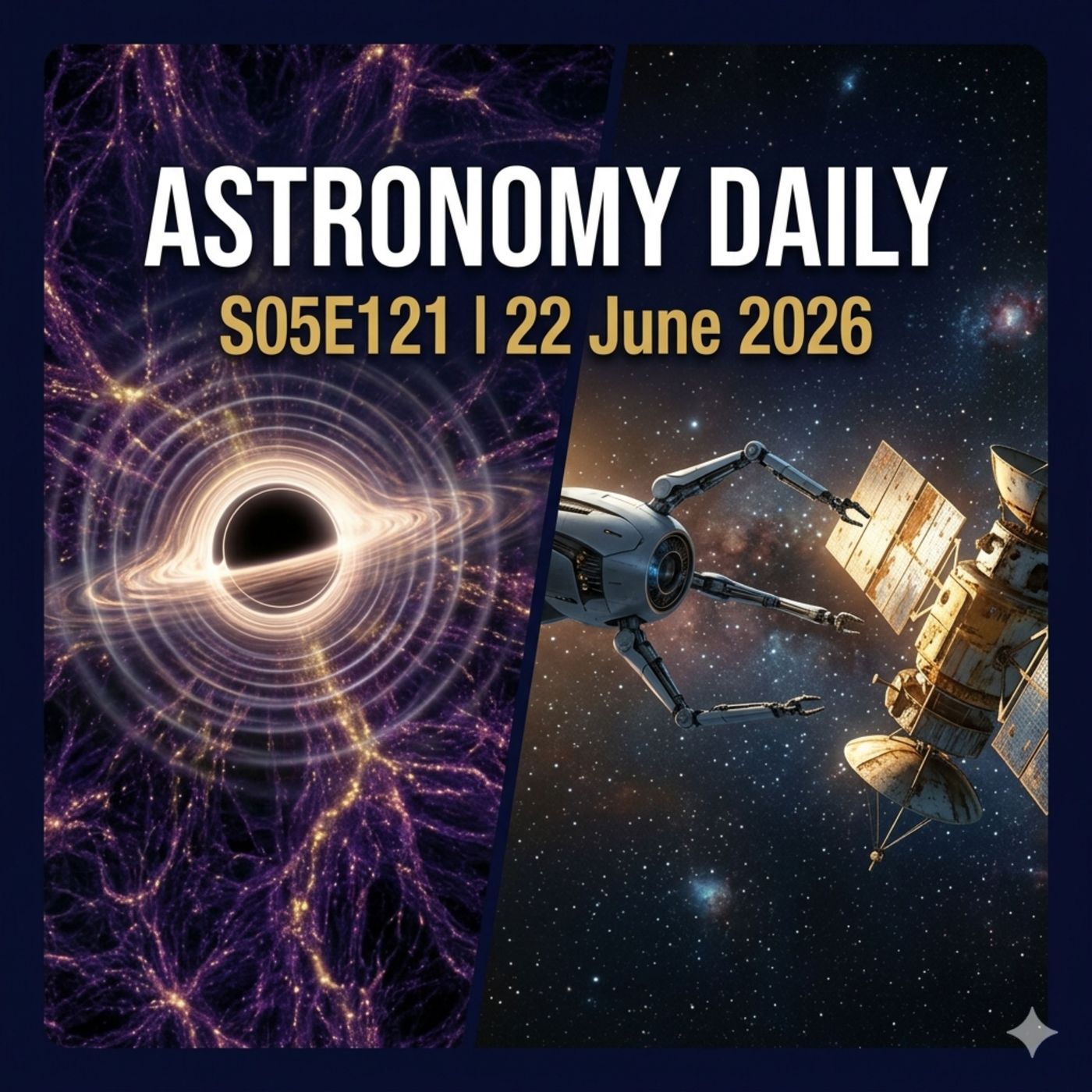
Gravitational Waves Confirm Einstein and Hawking's Predictions: In a groundbreaking discovery, scientists have confirmed key predictions made by Einstein and Hawking regarding black holes through gravitational waves detected by LIGO. The collision of two black holes 1.3 billion light years away not only validated Hawking's area theorem but also demonstrated that the merged black hole aligns with Einstein's Kerr metric, showcasing the accuracy of general relativity in extreme cosmic events.SpaceX Launches Nusantara Lima Satellite: On September 11, 2025, SpaceX successfully launched the Nusantara Lima satellite for Indonesian telecom company PSN, marking the Falcon 9's 23rd successful landing. This mission enhances telecommunications for Indonesia's vast archipelago, providing over 160 gigabits per second of bandwidth to connect millions across its 17,000 islands.First Observations of a Baby Planet: Astronomers have made history by observing a baby planet, Wispit2b, in the act of forming around its star, Wispit 2 TYC 5709 354. This gas giant, five times the mass of Jupiter, is carving out gaps in its surrounding dusty disk, providing direct evidence of planetary formation and confirming decades of theoretical work.Perseverance Rover's Exciting Discoveries on Mars: NASA's Perseverance rover has found complex organic molecules in Jezero Crater's ancient river delta, hinting at potential biosignatures. Using advanced laser spectroscopy, Perseverance is preparing samples for future return missions, which could revolutionize our understanding of Mars and the potential for past life.Mind-Bending Predictions of Exploding Primordial Black Holes: Researchers at UMass Amherst have predicted a 90% chance of observing an exploding primordial black hole within the next decade. This new model suggests these black holes could explode much more frequently than previously thought, potentially leading to revolutionary discoveries in particle physics.For more cosmic updates, visit our website at astronomydaily.io. Join our community on social media by searching for #AstroDailyPod on Facebook, X, YouTubeMusic Music, TikTok, and our new Instagram account! Don’t forget to subscribe to the podcast on Apple Podcasts, Spotify, iHeartRadio, or wherever you get your podcasts.Thank you for tuning in. This is Anna and Avery signing off. Until next time, keep looking up and exploring the wonders of our universe.✍️ Episode ReferencesGravitational Waves Discovery
[Nature](https://www.nature.com/)
SpaceX Launch Information
[SpaceX](https://www.spacex.com/)
Baby Planet Discovery
[NASA](https://www.nasa.gov/)
Perseverance Rover Findings
[NASA](https://www.nasa.gov/)
Primordial Black Hole Research
[UMass Amherst](https://www.umass.edu/)
Astronomy Daily
[Astronomy Daily](http://www.astronomydaily.io/)
Become a supporter of Astronomy Daily by joining our Supporters Club. Commercial free episodes daily are only a click away... Click Here
Sponsor Details:
Ensure your online privacy by using NordVPN. To get our special listener deal and save a lot of money, visit <a...
Anna: Welcome to Astronomy Daily, the podcast that brings you the latest discoveries from across the cosmos. I'm Anna. Avery: And I'm Avery. We've got an absolutely incredible episode for you today. We're talking about black holes that are proving Einstein and hawking right. SpaceX's latest mission success. And for the first time ever, astronomers have actually caught a baby planet in the act of being born. Anna: Plus, we'll explore a mind bending prediction about exploding primordial black holes that could revolutionize physics.
So grab your favorite beverage and let's dive into the wonders of the universe. Avery: Alright, Anna, let's start with what might be the most significant gravitational wave discovery since LIGO first detected these cosmic ripples. Scientists have now confirmed some of Einstein and Hawking's most important predictions about black holes. Tell us what happened. Anna: This is absolutely fascinating, avery. Back in January 2025, LIGO detected gravitational waves from two black holes colliding 1.3 billion light years away.
But what makes this discovery special isn't just the detection itself. It's what the scientists were able to prove using the data. Avery: Right. They actually confirmed Hawking's area theorem, which states that a black hole surface area can never decre. That's pretty remarkable when you think about it. We're talking about testing theoretical physics on some of the most extreme objects in the universe. Anna: Exactly. The numbers are staggering too. Before the collision, the combined surface area of both black holes was about 240,000 square kilometers.
After they merged, the final black hole had a surface area of 400,000 square kilometers. So even though these massive objects crashed together and merged, the total surface area actually increased, just as Hawking predicted. Avery: What I find incredible is that they also confirmed the merged black hole matches Einstein's Kerr metric. This provides the strongest evidence yet that these astrophysical black holes behave exactly as general relativity predicts. We're literally watching Einstein's equations play out on a cosmic scale.
Anna: It's mind blowing to think that theories developed nearly a century ago are being proven correct by observations of events that happened over a billion years ago. Science is truly amazing. Avery: Speaking of impressive achievements, let's talk about SpaceX's latest success. On September 11, 2025, they launched the Nusantara Lima satellite for Indonesian telecom company psn. Anna, uh, this wasn't just an ordinary launch. Anna: Not at all, Avery. This launch had some impressive milestones. First, they had to deal with three days of weather delays at Cape Canaveral, which shows how seriously SpaceX takes safety conditions.
But when they finally launched the Falcon 9 first stage made its 23rd successful landing on the drone ship. A shortfall of gravitas 23 flights for. Avery: A single rocket booster. I still get amazed by the reusability SpaceX has achieved. And, um, this Boeing built satellite is going to make a real difference for people in Indonesia, right? Anna: Absolutely. Indonesia has over 17,000 islands, so providing reliable telecommunications across such a geographically challenging region is no small feat.
The Nusantara Lima satellite will operate from geosynchronous orbit with a capacity of over 160 gigabits per second. That's enough bandwidth to connect millions of people across these REM island communities. Avery: And this was SpaceX's 114th Falcon 9 mission of 2025. That's more than two launches per week on average. The pace of space activity these days is just incredible. Anna: Now, Avery, let's move to what might be my favorite story of the day. For the first time ever, astronomers have actually observed a baby planet carving out gaps in the dusty disk around its newborn star.
This is like catching planet formation in the act. Avery: This is absolutely groundbreaking, Anna. Uh, the planet's called Wispit2b, and it's orbiting a star with the Wonderfully complex name Wispit 2 TYC 5709 354, located 434 light years away. What makes this discovery so special? Anna: Well, for decades, astronomers have theorized about how planets form by accreting, uh, material from these dusty disks around young stars and how they carve out gaps as they grow. But we've never actually seen it happening in real time.
This baby planet is a gas giant about five times the mass of Jupiter, orbiting 54 astronomical units from its star. Avery: The technology they use to spot this is incredible, too. They used the Mag AOX adaptive optics system on the Magellan telescope, and they actually detected H Alpha light from hot hydrogen gas falling onto the forming planet. That's like watching a cosmic construction site in action. Anna: What I love about this discovery is that it confirms decades of theoretical work. Scientists have been modeling planetary formation for so long, and now we're finally seeing direct evidence that our understanding is correct.
And it's like watching a baby take its first steps. Except the baby is a gas giant five times bigger than Jupiter. Avery: And this opens up so many possibilities for studying planetary formation in other systems. We might be able to watch entire solar systems being born and understand how common different types of planetary architectures really are. Anna: And speaking of new discoveries, Avery, I think our listeners would love to hear about some of the other incredible breakthroughs happening in space exploration right now.
We've Been focusing a lot on the distant universe, but there's actually been some fascinating developments much closer to home on Mars. Avery: Oh, absolutely, Anna. Uh, the Perseverance rover has been making some incredible discoveries lately. As we reported yesterday, just this past month, it found organic molecules in what appears to be an ancient river delta and Jeissero Crater. But what's really exciting is that these aren't just simple organic compounds. They're complex molecules that could potentially be biosignatures.
Anna: That's exactly right, Avery. And what makes this discovery even more compelling is the geological context. Perseverance has been analyzing rock samples from what scientists believe was once a vast lake system complete with flowing rivers and deltas, exactly the kind of environment where early life might have thrived billions of years ago. Avery: The technology behind these discoveries is just as fascinating as the findings themselves. Perseverance is using its supercam instrument to analyze rocks with laser spectroscopy, literally vaporizing tiny portions of Martian rocks and analyzing the resulting plasma.
It's like having a complete chemistry lab rolling around on another planet. Anna: And here's where it gets really exciting for the future. Avery Perseverance has been carefully collecting and caching the most promising samples in sealed tubes that are designed to be retrieved by future missions. The Mars Sample Return campaign, a collaboration between NASA and esa, aims to bring these samples back to Earth, where they can be analyzed with instruments far more sophisticated than anything we can send to Mars.
Avery: The timeline for Mars Sample return is ambitious, but achievable. We are looking at potential sample retrieval in the early2030s, which means that within this decade, we could have actual pieces of Mars sitting in laboratories here on Earth. Imagine being able to study Martian rocks with electron microscopes, mass spectrometers, and other advanced instruments that would be impossible to miniaturize for a rover mission. Anna: What I find most compelling about all these discoveries from the baby planet we discussed earlier to these potential biosignatures on Mars, is how they're reshaping our understanding of how common life might be in the universe.
We're learning that the basic building blocks and conditions for life appear to be surprisingly widespread, both in our solar system and beyond. Avery: And it's not just Mars that's showing promise, Anna. Uh, we've got the Europa Clipper mission launching soon to study Jupiter's moon Europa, which likely has a subsurface ocean with more water than all of Earth's oceans combined. Then there's the Dragonfly mission to Titan, Saturn's largest moon, where we'll have a nuclear powered helicopter searching for signs of prebiotic chemistry.
The next two decades are going to be absolutely incredible for astrobiology. Anna: Amazing. How's astronomy and space exploration keep expanding our perspective from searching for life in our cosmic backyard to probing the fundamental physics of the universe itself. Speaking of fundamental physics, Avery, let's shift gears to something that sounds like pure science fiction, but could become reality very soon. Our final major story today takes us into some truly mind bending theoretical physics. Researchers at UMass Amherst M are predicting a 90% chance that we'll observe an exploding primordial black hole within the next decade.
This sounds like science fiction, but it's very real science. Avery: It really does sound like sci fi, Anna. These primordial black holes would have formed shortly after the Big Bang. And according to Hawkins theory, they could eventually explode through Hawking radiation. But the timeline was always thought to be incredibly long. Like once every hundred thousand years. Anna: Right. But this team has developed something called a dark QED toy model that suggests charged primordial black holes could explode much more frequently, potentially once every 10 years instead of once every hundred thousand years.
That's a massive difference. Avery: The implications are staggering. If we actually observed one of these explosions, it would revolutionize our understanding of physics. We'd essentially get a complete inventory of all subatomic particles, including potentially discovering new ones we didn't even know existed. Anna: It's like having a cosmic particle accelerator that operates at energies far beyond anything we can create on Earth. If their predictions are correct, the next decade could see some of the most important discoveries in the history of physics.
Avery: Before we wrap up, Anna, uh, we've got time for a few quick bonus stories that caught our attention. First up, uh, something a bit different. Darth Vader's lightsaber from the Empire Strikes Back and Return of the Jedi just sold at auction for $3.6 million. Anna: That's an astronomical price for a movie prop. But I have to admit, Star wars has inspired countless people to pursue careers in science and space exploration. And speaking of space exploration, scientists are proposing that rectangular telescopes could help us find Earth Earth 2.0 by providing better resolution for exoplanet detection.
Avery: Rectangular telescopes. Who would have thought? And here's one more quick story that's pretty incredible. New research shows that solar flares can reach temperatures of 108 million degrees, which is six times hotter than scientists previously thought. That's absolutely mind boggling when you think about the energies involved. Anna: Before we sign off, Avery, I want to take a moment to reflect on something that really strikes me about today's stor. We've covered discoveries Spanning from the very formation of the universe with primordial black holes to the birth of new worlds to the search for life itself.
What amazes me is that all of these breakthroughs are happening simultaneously right now in what future historians might call the golden age of astronomy. Avery: You're absolutely right, Anna. Uh, and what's particularly exciting is how these discoveries are interconnected. The same gravitational wave detectors that confirmed Einstein's predictions about black holes are the ones that might detect exploding primordial black holes. The same spectroscopic techniques we use to study exoplanets are helping us analyze potential biosignatures on Mars.
The telescopes observing baby planets forming are also searching for signs of life in other solar systems. Anna: It really demonstrates how astronomy is becoming increasingly interdisciplinary. We're not just astronomers anymore. We're astrobiologists, particle physicists, geologists, and atmospheric scientists, all working together to understand our place in the cosmos. And perhaps most importantly, we're sharing these discoveries with everyone, inspiring the next generation of scientists who will make even more incredible discoveries in the decades to come.
What an incredible journey through the cosmos we've had today, Avery. From confirming Einstein and Hawking's predictions with gravitational waves, to watching planets being born, to the possibility of observing exploding black holes in the next decade, it really. Avery: Shows how dynamic and exciting astronomy is right now. Anna. We're living in a golden age of discovery, with new technologies allowing us to observe phenomena that were purely theoretical just a few years ago. Anna: Thank you for joining us on Astronomy Daily.
Keep looking up, keep asking questions, and remember, the universe is full of wonders waiting to be discovered. And remember to visit our [email protected] to check out these stories in more detail and catch up on the latest news with our continually updating Space News feed. Avery: Until next time, this is Avery and Anna signing off. Clear skies, everyone.
 Apple Podcasts
 Spotify
 Pocket Casts
 Castbox
 Overcast
 Podbean
 iHeartRadio
 Castro
 Goodpods
 Moon FM
 Podcast Addict
 Podcast Republic
 YouTube