In this episode
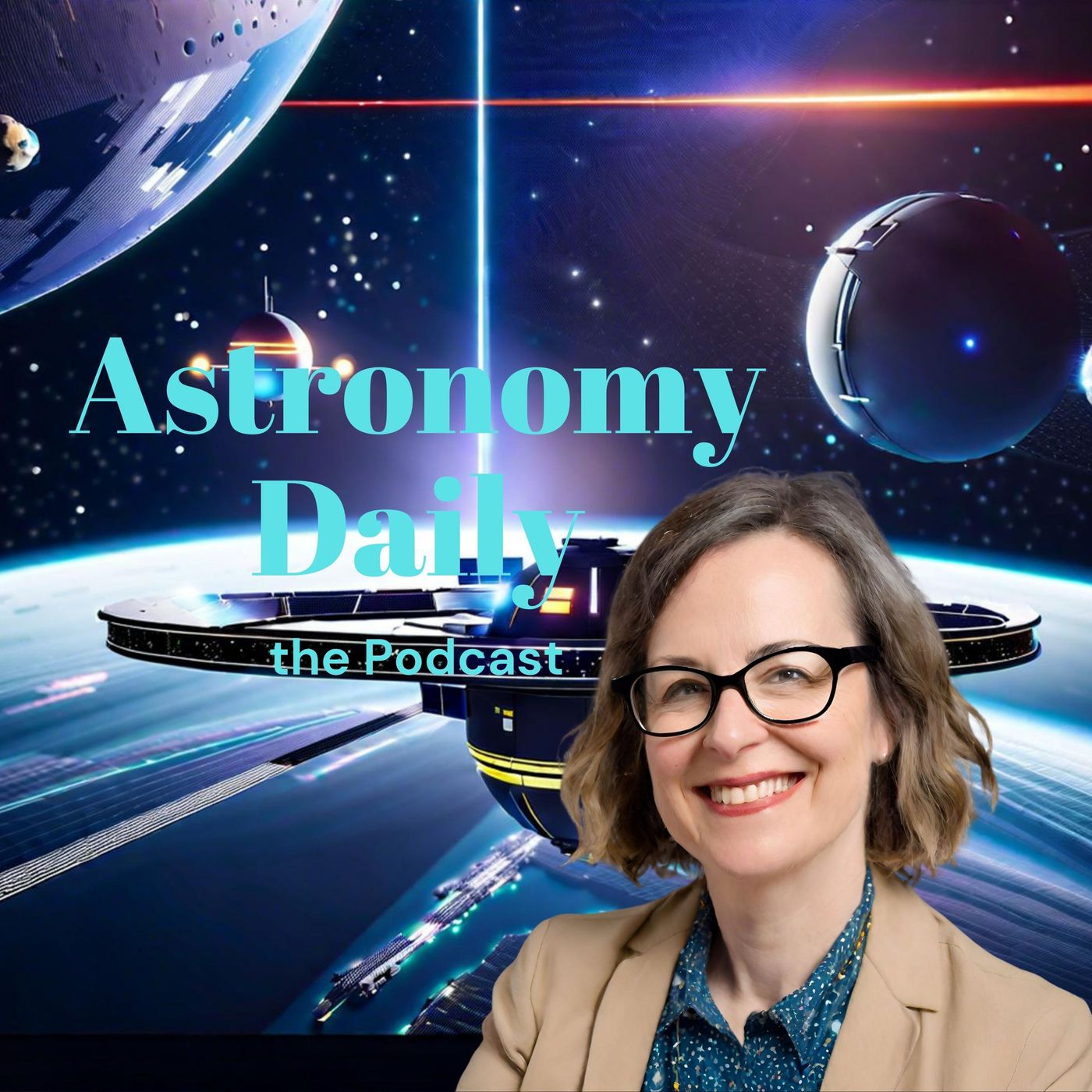
Astronomy Daily - The Podcast: S03E176Welcome to Astronomy Daily, your go-to source for the latest in space and Astronomy news. I'm Anna, your host, and today we have an exciting lineup of cosmic stories that will take us from groundbreaking space technology to cosmic dramas.
Highlights:
- NASA's Laser Communication Breakthrough: NASA has achieved a significant milestone with its low-cost optical terminal, ELcoT, successfully transmitting its first laser communication uplink to space. This technology promises to revolutionize data transmission, offering a capacity 10 to 100 times greater than traditional radio waves.
- Asteroid Mining for Space Missions: Researchers at Western University have unveiled a method to produce edible biomass using organic compounds from asteroids. This could be a game-changer for sustaining long-duration space missions by providing locally sourced food.
- Blue Origin's Orbital Reef: Blue Origin is planning the first commercial space station, Orbital Reef, set to orbit by 2030. This "floating business park" will offer space tourism, research facilities, and even hydroponic gardens, marking a new era in commercial space exploration.
- NASA's Probe Explorers Program: A new category of missions, Probe Explorers, aims to bridge the gap between large flagship missions and smaller projects. Two innovative missions are under consideration, promising to advance our understanding of supermassive black holes and far-infrared radiation in space.
- Cosmic Black Hole Drama: Astronomers have observed a supermassive black hole tearing apart a star and using the debris to collide with another celestial object. This event provides crucial insights into the dynamics around black holes and links previously mysterious cosmic phenomena.
For more space news, visit our website at astronomydaily.io. There, you can sign up for our free Daily newsletter, catch up on all the latest space and Astronomy news with our constantly updating newsfeed, and listen to all our previous episodes.
Don't forget to follow us on social media. Just search for #AstroDailyPod on Facebook, X, YouTubeMusic, and TikTok.
Thank you for tuning in. This is Anna signing off. Until next time, keep looking up and stay curious about the wonders of our universe.
Become a supporter of this podcast: https://www.spreaker.com/podcast/astronomy-daily-the-podcast--5648921/support.
Check out our special discount offer from NordVPN... www.bitesz.com/nordvpn
Sponsor Details:
Ensure your online privacy by using NordVPN. To get our special listener deal and save a lot of money, visit www.astronomydaily.io/nordvpn. You'll be glad you did!
Get the best secure and private email on the planet. Stop your Government, google and who knows who else spying on every email you write. Do what we did and use ProtonMail. They beleive in privacy and there are no ads in their business model...yet they still provide a free forever service. Check them out and get out special deal at www.astronomydaily.io/protonmail
Become a supporter of Astronomy Daily by joining our Supporters Club. Commercial free episodes daily are only a click way... Click Here
Welcome to Astronomy Daily, your go to podcast for the latest and most exciting space and astronomy news. I'm your host, Anna, and we've got a stellar lineup of stories for you today. In this episode, we'll be exploring some groundbreaking developments in space technology and cosmic discoveries. We'll start with NASA's latest achievement in laser communications, which could revolutionize how we send and receive data from space. Then we'll dive into the fascinating world of asteroid mining and how it might just be the key to sustaining long duration space missions.
We'll also take a peek at Blue Origins, ambitious plans for the first commercial space station. But that's not all. We'll discuss NASA's new category of space missions and wrap up with a cosmic drama involving a black hole, star destruction, and an unexpected collision. So strap in and get ready for a journey through the cosmos. This is Astronomy Daily, and we're about to take off. NASA has achieved a significant breakthrough in space communications technology with its low cost optical terminal ELCOT.
This ground state, made from modified commercial hardware, has successfully transmitted its first laser communications uplink to space. The target of this groundbreaking transmission was t Bird the terabyte infrared delivery payload, a small device about the size of a tissue box that was formerly in low Earth orbit. During the first live sky test, Elcott managed to produce enough uplink intensity for tea Bird to identify the laser beacon, connect and maintain a connection for over three minutes.
To put this achievement into perspective, connecting Elcott's laser beacon from Earth to tea Bird required an incredibly precise pointing accuracy of one milaranian that's equivalent to hitting a three foot target from a distance of more than eight American football fields away. This successful test marks a significant step forward for laser communications in space. In a real world scenario, the three minute connection time between te Bird and Elcott would be enough to transmit over five terabytes of critical science data that's equivalent to more than two thy five hundred hours of high definition in a single pass.
The potential impact of this technology is enormous. Laser communications can transfer ten to one hundred times more data than traditional radio frequency waves. This means that as our space missions venture further into the solar System and beyond. We'll be able to maintain robust connections and receive unprecedented amounts of data from these distant explorers. NASA's Space Communications and Navigation Program is already implementing laser communications technology in various orbits, including the upcoming Artemis two mission.
As we look to the future of space exploration, including potential missions to Mars, this technology could serve as a critical lifeline for astronauts and scientific instruments alike. The Alcott team continues to refine their pointing capabilities through additional tests, demonstrating the potential of laser communications to revolutionize our access to new data about Earth, our Solar System, and beyond. This breakthrough paves the way for a new era in space communications, promising to unlock new frontiers in our under standing of the Cosmos.
In a groundbreaking development, researchers from Western Universities Institute for Earth and Space Exploration have unveiled a potential solution to one of the biggest challenges of long duration space missions, food supply. They've identified a way to produce edible biomass using microbes and organic compounds found in asteroids. This innovative process involves using high heat to break down the organic compounds in asteroids through a process called pyrolysis. The resulting hydrocarbons could then be fed to microbes, which would consume the organic material and produce biomass that's nutritionally valuable for humans.
The researchers focused on carbonaceous chondrites, a type of asteroid that contains substantial amounts of water and organic matter. Asteroids like Benu, which NASA's Osyrius rex mission recently sampled, fall into this category. Calculations suggest that asteroids similar to Benu could potentially produce between fifty to six thousand, five hundred and five fifty metric tons of edible biomass. That's enough calories to support between six hundred and seventeen thousand astronaut life years, depending on how much of the asteroids organic matter can be converted into food.
This method could revolutionize long duration space travel by allowing astronauts to rely on locally sourced food instead of carrying large quantities from Earth. However, there's still work to be done. Future studies will need to explore the practicalities of mining and processing asteroids during missions, as well as ensuring the resulting food is safe and palatable for human consumption. As NASA prepares to retire the International Space Station by the end of this decade, private companies are stepping up to fill the void.
Blue Origin, the space company founded by Jeff Bezos, is leading the charge with an ambitious project called Orbital Reef. Imagine a floating business park in space, complete with sleeping quarters, social areas, and state of the art research facilities. That's exactly what Blue Origin is aiming to create with Orbital Refef set to launch by twenty thirty. This commercial space station will orbit three hundred and eleven miles above Earth and boast an impressive twenty nine thousand, three hundred cubic feet of habitable space.
The station's modular design allows for future expansion, potentially growing into a larger base camp over time. Initially, Orbital Reef will accommodate up to ten people, including scientists, international astronauts, and even tourists. Yes, you heard that right. Space tourism could become a reality sooner than we think. One of the most exciting features planned for Orbital Reef is the opportunity for spacewalks. Tourists will be able to venture outside the station in specially designed capsules, offering breath taking views of Earth unlike anything possible from the ground.
The station will also include hydroponic gardens to grow fresh produce, addressing one of the major challenges of long term space habitation. And for those worried about staying connected, fear not, Orbital Reef will come equipped with Wi Fi, allowing for video calls back to Earth with an unbeatable backdrop. As we look to the future of space exploration and commerce, projects like Orbital Reef represent a bold new frontier. It's an exciting time for space enthusiasts and aspiring astronauts alike, as the dream of living and working in space inches closer to reality.
NASA has just unveiled an exciting new category of space missions called Probe Explorers. This new program is designed to bridge the gap between NASA's large scale flagship missions and their smaller exploration projects. The Probe Explorers program aims to foster creative ideas for exploring the universe, and it's already shaping up to be one of NASA's largest astrophysics initiatives. Nikola Fox, NASA's Associate Administrator of the Science Mission Directorate, praise the program for taking creativity to new heights.
Two proposed missions are currently under consideration for the inaugural Probe Explorer launch. The first is the Advanced X Ray Imaging Satellite, which would provide a large flat field of view with high spatial resolution. This satellite could revolutionize our understanding of supermassive black holes and galaxy evolution. The second contender is the Probe Far Infrared Mission for Astrophysics. This one point eight meter telescope would study far infrared radiation in space, filling a crucial gap in our observation capabilities between the James Web Space Telescope and radio telescopes.
Both projects will receive five million dollars for a twelve month concept study. After careful evaluation, NASA will select one of these missions in twenty twenty six for a planned launch in twenty thirty two. This new program is part of NASA's long running Explorers program, which has been providing low cost access to space since nineteen fifty eight, with over ninety successful science led missions to date. The addition of Probe Explorers promises to usher in a new era of cosmic discovery and innovation in a cosmic drama of epic proportions, Astronomers have witnessed a massive black hole engaged in a destructive rampage.
This celestial behemoth first tore apart an unfortunate star that ventured too close, and is now now using the stellar debris as ammunition to pummel another nearby object. This extraordinary discovery was made possible through the combined efforts of multiple NASA observatories, including the Chandra X ray Observatory, Hubble Space Telescope, and the Nicer instrument aboard the International Space Station. The story begins in twenty nineteen when astronomers observed a star being shredded by the immense gravitational forces of a supermassive black hole.
This violent event, known as a tidal disruption, left behind a disc of stellar remains orbiting the black hole, but the cosmic spectacle didn't end there. Over the next few years, this debris disc expanded outward, setting the stage for an even more dramatic encounter. The expanding disc has now collided with another celestial body, either a star or a smaller black hole that was previously orbiting at a safe distance from the central supermassive black hole. This collision is creating repeated bursts of X rays as the orbiting object plows through the debris disc approximately every forty eight hours.
It's like watching a cosmme game of bumper cars, but with far more devastating consequences. What makes this discovery particularly exciting is that it provides a crucial link between two previously mysterious phenomena, tidal disruption events and quasi periodic eruptions. Scientists have long suspected a connection between these two types of events, and now they have the evidence to prove it. This cosmic collision is not only a spectacular display of the universe's violent nature, but also a valuable opportunity for astronomers to study the environment around super massive black holes.
It offers insights into the distribution of matter and the gravitational dynamics in these extreme cosmic neighborhoods. As we continue to observe this ongoing stellar drama, who knows what other secrets of the universe it might reveal. It's a potent reminder of the dynamic and ever changing nature of our cosmos, where destruction and creation often go hand in hand. And that wraps up today's episode of Astronomy Daily. What an incredible journey through the Cosmos we've had. From groundbreaking laser communications to the possibility of asteroid based space food, the future of space exploration is looking brighter than ever.
I'm Anna and it's been my pleasure to guide you through these fascinating developments in space and astronomy. If you've enjoyed today's episode and want to stay up to date with all the latest cosmic news, I've got some great ways for you to do just that. Head over to our website at Astronomy Daily dot io, where you can sign up for our free daily newsletter. It's packed with all the space goodness you could want delivered straight to your inbox. While you're there, check out our constantly updating news feed for the most recent development in astronomy and space exploration.
And if you're craving more audio content, you can listen to all our back episodes right on the website. It's a treasure trove of space knowledge waiting to be explored. Don't forget to connect with us on social media too. You can find us as astro Daily Pod on Facebook, x YouTube, and TikTok. Give us a follow to get bite sized space facts and news throughout your day. Thanks for tuning in, and remember to keep looking up. The universe is full of wonders waiting to be discovered until next time. This is Anna signing off from Astronomy Daily Sunny Day.
Star is So, Star is
Star

 Apple Podcasts
 Spotify
 Pocket Casts
 Castbox
 Overcast
 Podbean
 iHeartRadio
 Castro
 Goodpods
 Moon FM
 Podcast Addict
 Podcast Republic
 YouTube