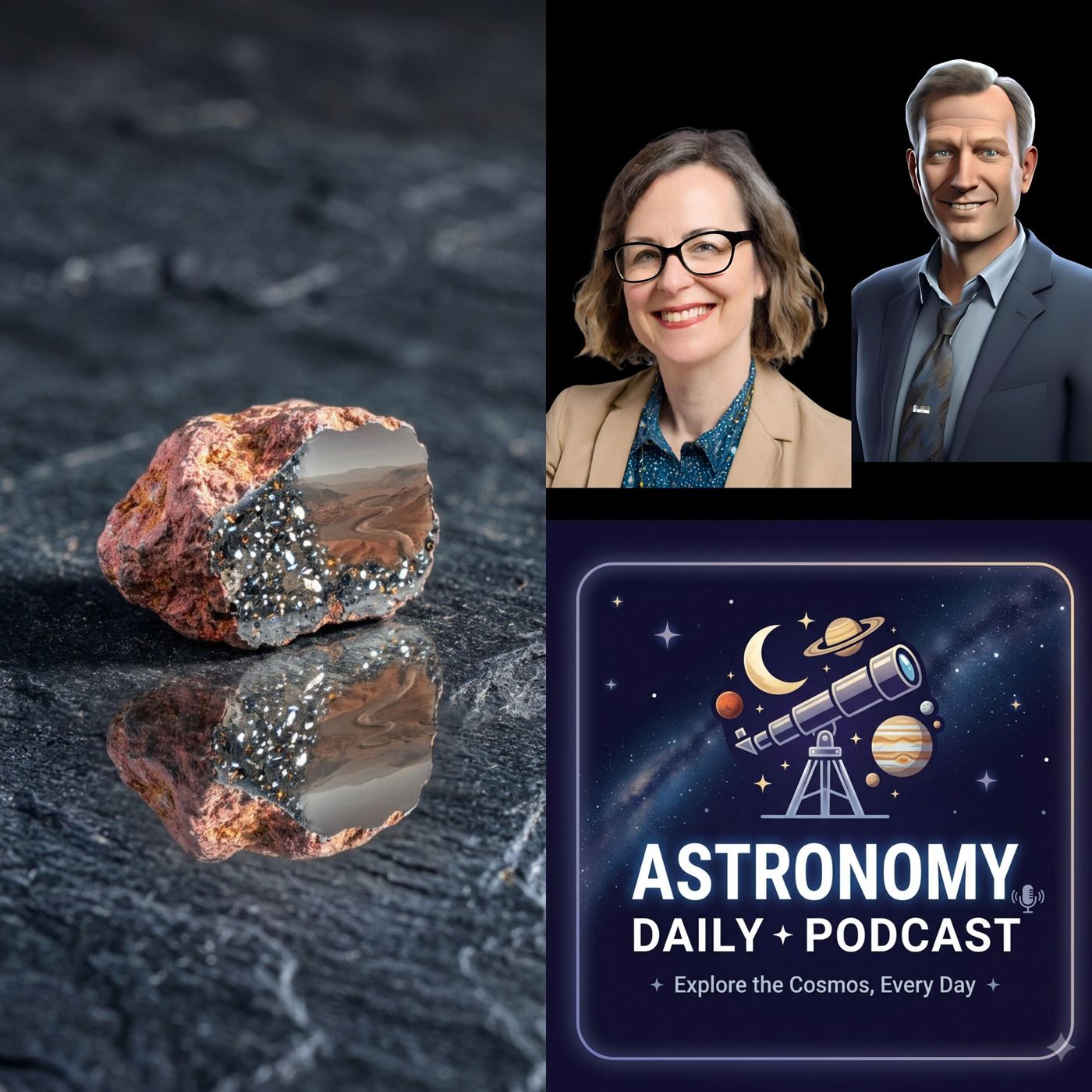
Mars’s Ancient Rock: A 4-Billion-Year-Old Clue to the Red Planet’s Past
In this episode
Show notes A rose-coloured rock picked up in the Sahara in 2022 turns out to be one of the oldest pieces of Mars ever found. Teghaza 001 formed at least 4.1 billion years ago, and two independent radiometric clocks agree. We explain how it was dated, what it says about early Mars losing its water, and why its source is still a shortlist of 13 craters in the southern highlands. Also: Voyager 1 goes silent for two days and recovers on its own as it nears one light-day from Earth on 18 November; Hubble finally sees the 'Cat's Tail' of Beta Pictoris, the wreckage of a collision between two Pluto-sized worlds; two Halloween ghosts in the Carina Nebula; and quick hits on the 100th US spacewalk from the ISS, Reid Wiseman's move to JPL, Swift and Starship. Skywatch: US clocks go back on 1 November, Saturn in the evening, Venus returns to the morning sky, Mars and Jupiter close in, the Moon passes Pollux, Mars, Jupiter and Regulus, the Southern Taurids, and Carina for southern observers.Become a supporter of this podcast: https://www.spreaker.com/podcast/astronomy-daily-latest-space-news--5648921/support.
Sponsor Details:
Ensure your online privacy by using NordVPN. To get our special listener deal and save a lot of money, visit www.astronomydaily.io/nordvpn. You'll be glad you did!
Get the best secure and private email on the planet. Stop your Government, google and who knows who else spying on every email you write. Do what we did and use ProtonMail. They beleive in privacy and there are no ads in their business model...yet they still provide a free forever service. Check them out and get out special deal at www.astronomydaily.io/protonmail
Become a supporter of Astronomy Daily by joining our Supporters Club. Commercial free episodes daily are only a click way... Click Here
This episode includes AI-generated content.
Anna: Hello everyone. Let's get stuck into today's space and astronomy news. Somewhere in The Zaharov in 2022 prospectors picked up a pinkish rock a little lighter than a bag of sugar. This week we learned it is more than 4.1 billion years old and it came from Mars. Avery: And a little Further out, Voyager 1 went silent for two days, came back on its own and is three weeks from a distance that takes light a full day to cross. Anna: Plus the wreckage of a collision between two worlds the size of Pluto.
Two ghosts in the southern sky just in time for Halloween. And a, uh, solar array unrolled by a Canadian on his first ever space mock. I'm Avery. And I'm Anna. This is Astronomy daily for Friday 30th October 2026. Let's get into it. Avery: You lead off then, Anna, tell me about this rock from Mars. Anna: Let's start with the rock itself because it does not look like much. It's called Tagaza 001, after the salt plain in Mali where it turned up. Tahari prospectors found it in September 2022. It's rose coloured, it weighs about 800 grammes and for a while nobody knew what it was or how old it was.
Avery: So how do you even know a rock in the desert came from Mars? Anna: Oxygen isotopes. Every rocky body in the solar system carries its own ratio of the three oxygen isotopes, almost like a postcode. Scientists at the University of New Mexico's Institute of Meteoritics checked Tegazot against other Martian meteorites and it matched. At that point it looked like a shergottite, which is the most common kind of Martian meteorite and frankly the least exciting. There are roughly 435 Meteorites from Mars known, and most of them formed within the last couple of billion years.
Avery: So what changed? Anna: Yang liu at, uh, NASA's Jet Propulsion Laboratory nearly passed on it. She'd seen plenty of srgaiolites. She looked anyway, saw textures and minerals she didn't recognise and then found zircons. Avery: Before we get to the clocks, how does a rock from Mars end up in a desert on Earth at all? Anna: Every Martian meteorite has the same A large impact on Mars blasts material off the surface fast enough to escape the planet's gravity. Those fragments then orbit the sun, sometimes for millions of years, until one happens to cross Earth's path and fall.
Deserts, uh, are where we find them because a dark stone on pale sand or ice stands out and in a dry climate it doesn't rust away quickly. That's why so many come from the Zaharov and from Antarctica. Avery: So the launch, the journey and the landing all wipe out the context. Anna: Exactly. And that's the frustration with meteorites. You get a real sample of another planet, but no label. Seeing where it came from. The rock has to tell you its own story. Avery: Zircons are the geologists favourite clock.
Right? Anna: They are. A zircon crystal takes in a little uranium when it forms and almost no lead. Uranium decays into lead at a rate we know very precisely. So the ratio of lead to uranium inside the crystal tells you how long it's been ticking. The team measured 10 zircon ages and their weighted average came out at 4,113 million years, plus or minus 14 million. Avery: And they checked it a second way. Anna: That's the part I like. Francois Thiseau's lab at Caltech has a technique for rubidium strontium dating that works in place on individual mineral grains on the surface of a fragment smaller than a fingernail.
You don't have to dissolve the sample, which matters when you only have 800 grammes of ancient Mars. Two completely independent clocks, uranium lead and rubidium strontium, gave the same age. Avery: Two, um, clocks agreeing is a lot more convincing than one. Anna: It is. And here's the subtle bit. The minerals record that water altered this rock around 4.1 billion years ago. You can't alter a rock that doesn't exist yet. So the rock itself formed at least that long ago and possibly earlier. The paper's title says it formed at or before 4.1 billion years.
That little ore before is doing real work. Avery: We do have other very old Martian meteorites, though, Anna: two that people usually ALH84001, the Antarctic one, made of almost a single mineral, which is similar in age. And NWA 7034, nicknamed Black Beauty, which contains very old fragments, but was assembled into the rock we have much later. Tegaza is different. It's a, uh, slowly cooled igneous rock, a piece of crust that crystallised from magma, which, with a mix of minerals that tells you about both the early crust and the mantle it came from.
The New Mexico team calls it the oldest known Martian lava rock. NASA's own phrasing is one of the oldest Martian meteorites ever found. And I think that careful version is the right one. Avery: Do we know where on Mars it came from? Anna: Not exactly, and the team is upfront about that. They compared the rock's chemistry with what orbiters like Mars Reconnaissance Orbiter see from above and. And the best matches are in the Cratered southern highlands, some of the oldest terrain on the planet. They list 13 candidate locations.
That's a short list, not an address. Avery: And there's a Southern Hemisphere thread to the address finding, isn't there? Anna: There is. Matching a meteorite to its launch crater has partly been an Australian specialty. In 2022, a Curtin University team in Perth traced Black Beauty to a crater on Mars they named Karatha after the Pilbara town. So when we eventually get an address for Tagaza, that's the kind of work that will find it. Avery: What does the Reviewer comment in NASA's release? Say again, Anna: Lu said one of the paper's reviewers called it a Rosetta Stone for Mars.
Lee Saper, the second author now at NASA Ames, put it more plainly. It's the first piece of Martian crust from a part of Mars we've never had a sample of before. Avery: And there's a water story underneath this. Anna: There is an earlier paper from the same team this year looked at the hydrogen trapped in Telegaza, and it suggests Mars was already well on the way to losing its water more than 4 billion years ago. So the planet's dry out wasn't a late event. It was underway while this rock was young.
Avery: Put that in context for us. How old is Mars itself? Uh, Anna: Mars, like Earth, formed about four and a half billion years ago. So Tegaza crystallised when the planet was only a few hundred million years old. That's the era geologists call the Noachian, when Mars had rivers and lakes and probably a thicker atmosphere. Mars also had a global magnetic field early on, which helped shield its atmosphere from the solar wind. And that field is thought to have faded around 3.9 billion years ago.
What this rock adds is that water loss was already happening before that by 4.1 billion years ago. Avery: And, um, the rock's chemistry is unusual in other ways, too. Anna: It is. The paper reports trace elements more abundant than in any other igneous Martian meteorite, except black beauty and a mantle source different from the ones that made the other meteorites. So it isn't just old. It's sampling a part of Mars's interior we hadn't seen before. That's exactly what you'd hope to compare with samples a rover might one day collect.
So honest caveats Avery: 3. First, the age was first shown publicly at the Goldschmidt Geochemistry Conference in Montreal in July and was covered then. What's new this week is the full peer reviewed paper in Science published Thursday. Second, uh, the source location is a list of candidates not an identification. Third, one rock is one rock. It tells us about one patch of ancient crust, not all of early Mars. Anna: Still, a piece of Mars from when the solar system was barely half a billion years old, picked up off the ground in the Zaharov Avery: and dated with two clocks on a chip smaller than your fingernail.
Liu's line was, uh, that they've only scratched the surface, given how small the chip was. I think that's literally true. Anna: From the oldest rock to the most distant machine. On 18 October, NASA's Deep Space Network tried to hear Voyager 1 and got nothing. They tried again 24 hours later, still nothing. Avery: That must have been a long weekend at JPL. Anna: It came back on its own on the 20th, before the team had even sent a command. What they've found so far is that one group of thrusters went offline and the backups took over automatically.
Decks fault protection doing its job. The spacecraft spots something wrong, switches to a safe configuration, pauses normal work and waits for the humans. Avery: Do they know what caused it? Anna: Not yet. Mission manager Karim Badarradin said it's the first time they've seen the spacecraft do this. But at this point in the mission, they have to expect the unexpected. Avery: And, um, there was a power story too. Anna: Yes. The Voyagers run on plutonium generators that lose about 4 watts a year. In early September, the team pulled off something they nicknamed the Big Bang.
They switched off three devices and switched on three lower power substitutes at the same time. Those devices keep the spacecraft warm, so they had to swap all three together to cut power and still keep heat where it needs to be. They'd done the same on Voyager 2 about six weeks earlier. Without it, Voyager 1 would have had to turn off another science instrument as early as the middle of 2027. Avery: And now the milestone on the 18th of November, Voyager 1 will be about 25.9 billion kilometres away.
That's one light day. A radio command takes 24 hours to get there, and the reply takes another 24. Project manager Suzanne Dodd put it nicely. You say hello, go home and wait two days for the answer. Remind us where it actually is now. Anna: Voyager 1 crossed the heliopause, the edge of the bubble. The sun's wind blows around the solar system in 2012. Since then, it's been measuring interstellar space directly. Voyager 2 followed in 2018. They're the only spacecraft ever to do that, which is why every watt matters so much.
Avery: Nothing changes on board when it crosses that line. Anna: No, NASA is clear about that. It's a milestone about scale not physics. It's moving at about 61,000 kilometres an hour. Launched in 1977 and still sending data from interstellar space. Avery: And for our listeners in Australia, the dishes listening for it include Canberra's at uh, Tidbin Villa. Anna: That's right, Voyager 1 is in the northern sky, but it's still high enough for all three Deep Space Network complexes Goldstone, Madrid and Canberra.
Voyager 2 heading south, can only be commanded from Canberra. So when either Voyager says hello, there's a good chance it's an Australian dish that hears it. Avery: 63 light years away, in the small southern constellation Pictor, the Painter's Easel, there's a uh, young star called Beta Pictoris. It's only around 20 million years old and it's surrounded by a disc of dust and debris that we see edge on. Think of it as a model of our own solar system when it was still messy. Anna: And it has a tail, Avery: a dark streak of dust nicknamed the Cat's Tail.
Webb found it in mid infrared light in 2024. The puzzle has been that it just wouldn't show up at visible wavelength. Now a team led by Aaron Afzarai, a ah, doctoral student at the University of Arizona, has found it with Hubble by stacking six sets of observations from 2012 to 2025 M. Anna: Why was it so hard to see? Avery: Because of what it's made of. The dust is almost entirely what's called organic refractory material. Long chains of carbon that absorb visible light. So it's very dark and the grains are tiny, micron sized and extremely porous.
Fluffy basically. Anna: And the collision? Avery: The team asked how much rock you'd have to destroy to make that much organic dust. Using the organic content of dwarf planets in our own solar system as a guide, each of the colliding bodies would need at least 1 to 3 times 10 to the 21 kilogrammes. That's about the Mass of Charon or Makemaker. Two small worlds destroyed in one collision. Anna: Which ties neatly to Wednesday's dwarf planet candidate from Rubin. Avery: It does. We're finding the survivors in our own Kuiper Belt and watching the casualties around another star.
The tail is about a uh, thousand astronomical units long and the new modelling suggests it lies roughly sideways in our view rather than stretching away behind the star. Hubble also found a warp in the outer dust halo, probably from the giant planet Beta pycbut 10 times Jupiter's mass. Anna: Caveats. Avery: The mass estimate leans on an assumption that these bodies were made like our dwarf planets. And nobody can yet explain how grains get that porous. Co author Kevin Wagner suggests the impact may have vaporised the carbon and let it recondense.
But that's a suggestion also for transparency. The paper was published in Astrophysical journal letters on the 7th of October. The university's release came this week. Anna: And it's one for the south, Avery: very much. From Sydney, Beta Pictoris climbs about 73 degrees. From Los Angeles barely clears 5. And from New York or London it never rises at all. Anna: Beadhost Avery. 228 words. 118 Avery: with Halloween tomorrow. NASA has released two spooky images, both from the Carina Nebula, about 7,500 light years away.
Anna: Ghost number one Avery: from Chandra and Webb. A lone cloud of gas and dust with a glowing hooded head and a long cape like tail. Astronomers call shapes like this cometary globules, though they have nothing to do with comets. The pink dots in Chandra's X ray data are young stars. So this ghost is a nursery. Its shape probably comes from radiation from massive stars outside the frame, including Eta Carinae and number zero, the Cat's Head Nebula from Hubble and Webb together, it's a dark dust pillar shaped like a cat, sitting with its back to us, head turned to show one glowing eye.
That eye may be a young star still wrapped in dust. Hubble shows a bright rim where ultraviolet light is boiling the pillar away. And Webb's infrared sees through to the structure and the stars inside. Anna: So that's two cats today Avery: to catch one honest note. These are image releases, not new research papers. And Chandra's X ray data were actually taken in 2008. They're beautiful, but they're not discoveries. Anna: And the hemisphere? Avery: Ours. The Carina Nebula sits at about 60 degrees south from Sydney.
It never sets. From Los Angeles, New York and London. It never rises. So, northern listeners, this one's for the photos. Anna: Quick hits. First, a, uh, spacewalk on Thursday. NASA's Ano Menon and the Canadian Space Agency's Joshua Kutryk spent seven hours and 11 minutes outside the space station and um, installed the seventh of eight rollout solar arrays. Once released, it unrolled to about 18 metres in roughly 10 minutes with no motors, driven by energy stored in its carbon fibre booms. Avery: And um, it was Ku Trick's first, Anna: his first spacewalk, the fifth ever by a Canadian and the first by a Canadian since 2019.
He arrived on Crew 13 which we followed through all those delays, so it's good to see it pay off. NASA counts it as US spacewalk number 100. At the station the eighth and final array goes up on 5 November. Next up, Reid Wiseman, who commanded Artemis 2 around the Moon in April, has a new job from the 30th of November. He'll be Deputy Director of NASA's Jet Propulsion Laboratory and an associate vice president at Caltech Avery: and, um, Swift Anna: still in orbit as we record. NASA expects the old Gamma Ray Observatory to re enter within weeks.
We'll tell you when it happens. And Starship Flight 15 is still targeted for November, with SpaceX aiming to catch both the booster and the ship. We'll believe the date once SpaceX announces it. Avery: Time for the sky. First, a, uh, clock node for everyone listening across time zones. Daylight saving ends in the United States at 2am this Sunday, 1st November. London already changed last weekend, so from Sunday, Sydney is 16 hours ahead of New York and 19 ahead of Los Angeles. Let's start in the evening.
Saturn is the evening planet 45 minutes after sunset on Saturday. It's about 37 degrees up in the northeast from Sydney and in the east, about 24 from Los Angeles, 20 from New York and 13 from London. Even a small telescope shows the rings. Avery: What happened to Mercury? Avery: Gone for now. It's heading between us and the sun and has dropped below the horizon at dusk. Everywhere. Venus has just made the same crossing and is now coming up in the morning. It's low, only about 4 degrees up, half an hour before sunrise from all four cities.
But it's bright and climbing a little higher each morning. Anna: And the morning sky is where the action is. Avery: It is, and it favours the north. Mars and Jupiter are drawing together. They're about six and a half degrees apart today, about four by the 6th of November and just over one degree apart by the 16th, half an hour before sunrise. They're roughly 60 to 70 degrees up from Los Angeles and New York and over 50 from London. From Sydney, they're about 30 degrees up in the northeast, lower but, uh, easy to see.
Avery: And Anna: the Moon joins them. Avery: The waning moon passes Pollux on the night of the 31st, then slides past Mars and Jupiter around the 2nd and 3rd of November, and the bright star Regulus around the 3rd and 4th. Depending on your time zone, those are close passes under a degree for Jupiter and Regulus as seen from Earth's centre. So the exact spacing depends on where you are. Last quarter is on the 1st of November in the Americas and the 2nd in Australia. Anna: Meteors? Avery: The southern Taurids peak around the 4th and 5th of November.
They're slow, sometimes bright, never many maybe five an hour at 1am the radiant in Taurus is about 40 degrees up from Sydney and um, 60 to 70 from the northern cities. The Moon is a waning crescent and rises late, which helps Anna: and for the South Avery: Carina if our ghost segment made you curious, the Carina Nebula never sets from Sydney in the evening. It skims only about 5 degrees above the southern horizon, but by 4am it's over 35 degrees up in the southeast. Binoculars show it clearly from a dark site.
Beta Pictoris climbs through the night and is about 73 degrees high around 4am you won't see the tail, but you can see the star Anna: and looking ahead. Avery: Uranus reaches opposition in late November and Voyager 1 crosses one light day on the 18th, though you won't see that one. Anna: And the standing reminder Avery: Never look at the sun directly or through binoculars or a telescope without a proper solar filter or any solar viewing. Use glasses or filters that meet the ISO 123122 safety standard and check them for damage before you use them.
Anna: That's the show for Friday. A 4 billion year old piece of Mars dated with two clocks. Voyager 1 coming back from two days of silence, a collision between two Pluto sized worlds, two ghosts in Carina and a ah, Canadian's first spacewalk. Avery: Tomorrow is the weekend wrap, so if you missed anything this week, we'll catch you up. Anna: You'll find show notes and our newsletter at astronomydaily IO and we're astrodailypod on social media. If you have a question for the show, the contact form on the website comes straight to us.
Avery: And if you're trick or treating this weekend or watching spring storms in the south look up once in a while. I'm Avery. Anna: And I'm Anna. Clear skies everyone.
 Apple Podcasts
 Spotify
 Pocket Casts
 Castbox
 Overcast
 Podbean
 iHeartRadio
 Castro
 Goodpods
 Moon FM
 Podcast Addict
 Podcast Republic
 YouTube