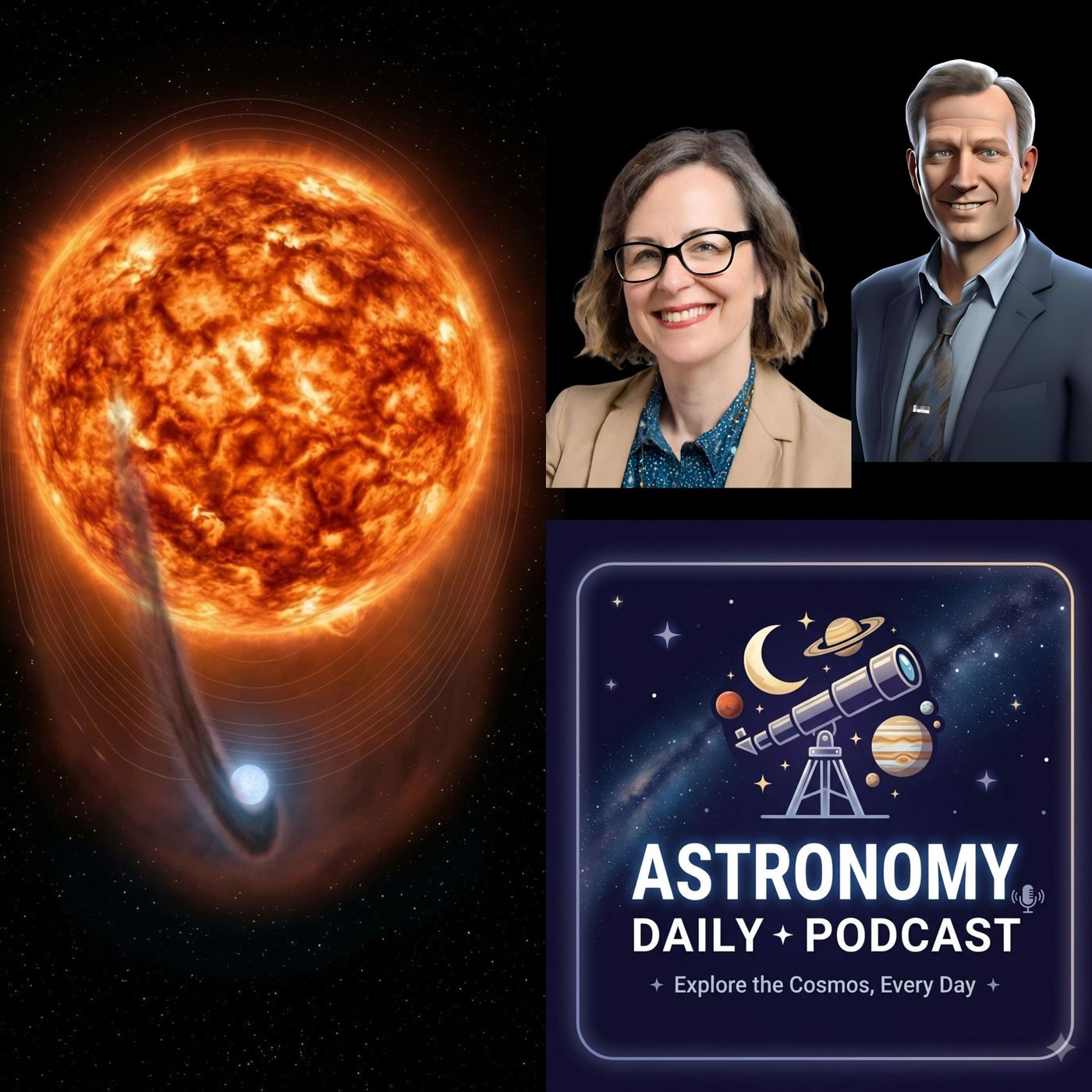
Betelgeuse’s Ghost Companion: The Hidden Star Stirring Orion’s Giant
In this episode
Episode summaryBetelgeuse is being haunted. New VLA and ALMA radio observations show the red supergiant's atmosphere stretches and relaxes in step with the orbit of its hidden companion, Siwarha — a companion too faint to see in radio, caught by the ripples it leaves behind. Also: lithium-fluoride crystals that rode around the Moon on Artemis I, why comets almost certainly didn't deliver life's ingredients to Earth (but did better on Mars), and Virgin Galactic's new spaceship, Apeiron. Plus Swift's final days, Hubble helping Roman, Starship Flight 15, and where to find Betelgeuse tonight from both hemispheres.Show notes
The Ghost in Betelgeuse · Matthews (MIT Haystack), Dupree (CfA), Richards (Manchester) and Dent (ESO/ALMA) imaged Betelgeuse at seven frequencies, 22–485 GHz, with the VLA and ALMA between 2021 and 2026. · The outer atmosphere has recovered from the 2019–20 Great Dimming (~3,500 K at 22 GHz); a temperature minimum of ~2,220 K sits at ~1.2 stellar radii, matching the infrared 'MOLsphere'. · The star's ellipticity tracks the orbital phase of its companion Siwarha: more stretched near greatest elongation (~10% in Oct 2024), rounder near transit and eclipse (<2% in Apr 2026). · Caveats: small effect, ~9 epochs, frequency-dependent orientation puzzle, Siwarha's nature contested; preprint posted August 2026. · Next: Siwarha re-emerges on the far side of Betelgeuse in late 2027. Crystals That Went Around the Moon · Bilski et al. (IFJ PAN, DLR), Radiation Measurements: LiF fluorescent nuclear track detectors from the MARE phantoms on Artemis I reconstructed the cosmic-ray energy-deposition spectrum without destroying the detector. · Matched plastic track detectors at intermediate energies; ~30% overestimate for the heaviest ions, attributed to neutron knock-on of lithium nuclei; lithium-7 crystals reduce it. · Near the Moon, dose was higher than in low Earth orbit but less than intuition suggests, and more evenly spread through the body. Comets Probably Didn't Seed Life on Earth · Anslow et al. (Cambridge), Scientific Reports: rapid decline of the bombardment, comet break-up, atmospheric filtering, impact heating and crater-lake dilution make HCN delivery to early Earth 'exceedingly rare'. · Delivery to Mars is about five times more effective (lower impact speeds, thinner atmosphere). · Caveat: modelling, focused on HCN; doesn't exclude delivery in tightly packed exoplanet systems. Virgin Galactic's Apeiron Comes Home · First Delta-class spaceplane named Apeiron ('boundless') on 28 Oct and flown under mothership Eve from Mesa, Arizona to Spaceport America. · Flight tests next; customer flights targeted mid-2027; second ship late 2027; target twice-weekly flights and 500+ missions per vehicle. Quick Hits · Swift ended operations 20 Oct; NASA expects re-entry within weeks. · Hubble lens image DESI J194.5345+03.5358 released to help calibrate Roman's ~160,000 expected strong lenses (image release, no new paper). · Starship Flight 15 targeted for November with a two-stage catch attempt; no official date. Skywatch · Betelgeuse rises ~22:33 Sydney, 21:48 LA, 21:46 NY, 20:39 London (Fri 30 Oct); highest before dawn: 49° Sydney, 63° LA, 57° NY, 46° London. US clocks fall back Sun 1 Nov. · Saturn at dusk; Mercury's last evening appearance favours the south (~11° at sunset from Sydney). · Pre-dawn Mars–Jupiter closing: 6.5° (this weekend), ~4° (5 Nov), ~1.2° (16 Nov). Last quarter Moon 1 Nov 20:28 UTC; Moon past Mars, Jupiter and Regulus 2–3 Nov. · Zodiacal light: evening west from the south, pre-dawn east from the north. Solar viewing only with ISO 12312-2 filters. Sources · NRAO via Newswise — What Lurks Within the Shadows of Betelgeuse? —...
Anna: Hello, everyone. Thanks for taking the time to listen. Today's headline. There's a star in Orion that's being haunted. Something is moving through its outer atmosphere, stirring it up, pulling it out of shape. And nobody can see the thing doing it. Not in radio, anyway. Avery: Just in time for Halloween. Today, Betelgeuse and the ghost inside it. How two of the world's great radio telescopes caught a hidden companion by the ripples it leaves behind. Anna: Welcome to Astronomy AstroDailyPod.
I'm Anna. Avery: And I'm Avery. Also today, crystals that rode around the moon on Artemis 1 and came home carrying the tracks of cosmic rays. A new study that says comets almost certainly didn't seed life on Earth, but might have done better on Mars. And Virgin Galactic's new spaceship gets a name and a home. Anna: Plus, Swift's final days. Hubble getting Roman ready, and where to find Betelgeuse tonight. Let's go. Avery: It's Halloween, so I'm guessing you have something on theme to get us going.
Anna: Let's start with the star itself. Because Betelgeuse is not a normal star. It's a red supergiant, the bright orange red shoulder of Orion. And it is enormous. Put it where the sun is and its surface would reach somewhere out past the orbit of Mars. Avery: Um, and it's close enough and big enough that it's one of the very few stars we can actually resolve as a disc rather than a point. It was the first star other than the sun ever directly imaged by hubble back in 1996. Anna: It's also famously restless.
In late 2019 and early 2020, it went through what's now called the great dimming. By February 2020, it had faded to its faintest in more than a century of records. People genuinely wondered whether it was about to go supernova. Avery: It didn't. The dimming turned out to be a huge surface mass ejection, a shock wave from deep convection that threw out gas, which cooled and formed dust and blocked our view for a few months. Anna: But Betelgeuse has a second slower rhythm that has puzzled astronomers for a long time.
On m top of its roughly 400 day pulsation, it brightens and fades over about 2,100 days. Call it 5.8 years. Avery: And that's where the Ghost comes in. In 2024, two independent teams went back through more than a century of brightness, velocity and position measurements and came to the same. That long period is a companion star in orbit? Anna: Not just in orbit. In orbit inside Betelgeuse's extended atmosphere. The companion circles at about 2.3 times the radius of the visible star, which for a star this size means.
Means it's ploughing through the giant's outer layers of gas. Avery: It now has a name. Siwarha Betelgurst comes from an Arabic phrase usually read as the hand of Al Jawza. So the companion was named for her bracelet. The International Astronomical Union adopted it this year Anna: and the evidence has been building fast. Speckle imaging gave a tentative detection in 2025. In January this year, a team led by Andrea Dupree at the Centre for Astrophysics used Hubble and ground based spectra to what looks like a wake, a dense trail of gas left behind the companion as it moves.
And then, using the Sphere instrument on ESO's Very Large Telescope at Paranal in Chile, a team led by Miguel Montargis reported a direct detection of the companion itself at about six sigma. Avery: So by now we're fairly confident it's there. The new question is, what is it doing to Betelgeuse? Anna: This is the new paper led by Lynn Matthews of MIT's Haystack Observatory with Andrea Dupre, Anita Richards at the University of Manchester and Bill Dent at ESO and alma. It's published in the Astronomical Journal and the National Radio Astronomy Observatory released it this week.
Avery: They observed Betelgeuse at seven radio frequencies from 22 GHz up to 485 GHz between 2021 and 2026. The two lowest came from the Very Large Array in New Mexico. The other five came from alma, high on the Chagnator Plateau in Chile. Anna: And here's why seven frequencies matter in radio. A, uh, star's atmosphere is opaque. But how opaque depends on the wavelength. Longer wavelengths only let you see the higher outer layers. Shorter wavelengths let you see deeper in. So stacking seven frequencies is like slicing the atmosphere into layers from just above the visible surface out to nearly three times the star's radius.
Avery: A CT scan of a star more or less with a disc only about a, uh, 20th of an arc second across Anna: three things. First, Betelgeuse has recovered from the great dimming. Back in 2019, just before the dimming, Matthews and Dupree had found the outer atmosphere unusually cold in radio, a sign of that shock passing through. Now, at 22 gigahertz, the gas is back to about 3,500 kelvin, roughly the temperature of the star's own surface. Avery: Second, they've pinned down a temperature minimum. Go deeper with Alma's highest frequency to about 1.2 times the star's radius and the gas drops to about 2,200 kelvin.
That's more than 1,000 degrees cooler than the visible surface underneath it. Anna: Which sounds backwards hotter surface, cooler layer, then hotter again further out where the chromosphere is. But it matches a shell of molecular gas, the so called MOL spherethat infrared astronomers have inferred for years. The radio measurement says that cool gas really does dominate that region. Avery: And third, the ghost. The team fitted the shape of Betelgeuse at every frequency and every date, and the star isn't quite round, it's slightly egg shaped.
What they notice is that how egg shaped it is seems to track where the companion is in its orbit. Anna: When Swarha is at its greatest apparent distance from the star off to one side, Betelgeuse looks more stretched. When Swarha is passing in front of the star or hidden behind it, Betelgeuse looks rounder. The clearest Single example in October 2024, near greatest separation, the star was about 10% out of round. In April this year, near the companion's eclipse, it was under 2% Avery: and the companion itself completely invisible.
At these wavelengths, the team worked out, it would be tens to hundreds of times too faint to detect. Matthew's summary is that it actually passes through its extended atmosphere. And what they see is the disturbance, Anna: like watching ripples on a pond and inferring something moving just under the surface. Avery: And this needs the honest version. The effect is small. The star is never more than about 10% out of round. The correlation rests on around nine epochs, and a few of those come from earlier papers by other teams.
That's a pattern worth taking seriously, not a closed case. Anna: There's also a genuine puzzle. The authors flag themselves. The direction of the stretch isn't the same at every frequency. The highest ALMA bands, the middle ALMA bands and the VLA bands are all point different ways. One possibility is that different depths are cutting through different parts of a three dimensional wake. But that's an idea to test, not a result. Avery: And what suwarhat actually is remains contested. Estimates of its mass run from around half a solar mass to roughly 3.
Even the distance to Betelgeuse is uncertain. This paper uses about 720 light years, while the figure you'll usually see is around 651. Anna: More disclosure A preprint of this work appeared in early August, so the journal publication is what's new this week, not the first sight of the data? Avery: Why care? Because the companion is orbiting right in the zone where Betelgeuse launches its wind. The region where a red supergiant sheds the mass it loses on the way to its eventual supernova. If a companion is shaping that region, it changes how we model the star's last stages.
And not just for Betelgeuse. Anna: And there's a southern thread worth naming. Five of the seven frequencies came from Alma in the Atacama, including the deepest layer. One of the authors is at eso. And the direct detection came from Paranol. The northern Vla and the southern dishes together built the picture. Avery: The next beat has a date on it. Roughly. Cewarja is currently on the far side of Bedel. Geese from us. It should swing back into view on the opposite side in late 2027. Teams are already planning to be watching in radio, in the ultraviolet and with adaptive optics.
Anna: So the ghost comes back out in a year. Rather fitting. Avery: When Artemis 1 flew around the moon in late 2022, there were no astronauts on board. But there were two passengers. Mannequins called Helga and Zohar, built to mimic human bone and soft tissue and packed with thousands of radiation detectors. That was the MER experiment, led by the German Aerospace Centre. Anna: And some of the most interesting detectors on board were tiny crystals of lithium fluoride, made by the Institute of Nuclear Physics of the Polish Academy of Sciences in Krakow.
Avery: A new paper led by Pawel Bilski in the journal Radiation Measurements, reports how those crystals did m. The idea is clever. When a cosmic ray particle tears through the crystal, it knocks electrons loose and leaves a permanent defect along its path. Later, in the lab, you shine a laser through the crystal under a microscope and the particle's track glows blue. Anna: And the advantage over the old method is big. The standard track detectors are plastic. To read them, you soak them for hours in hot caustic soda to etch the tracks out, which destroys the detector and makes hazardous waste.
The crystal can be read without destroying it. Avery: The team stacked microscope images taken a micrometre apart and followed each track through the crystal in three dimensions. That let them rebuild the full spectrum of how much energy each particle dumped along its path, which is what matters biologically. Heavy ions dump a lot of energy in a short distance, and that's the dangerous part of deep space radiation. Anna: For middling energies, the crystals matched the plastic detectors flying right beside them.
For the heaviest hitters, they overestimated the dose by about 30%. The team's explanation is that fast neutrons can knock a lithium nucleus out of place inside the crystal, which leaves a track of its own. Crystals made with lithium 7 reduce that Avery: the broader MARI results are worth hearing too. Near the Moon, the dose was higher than in low Earth orbit, but not by as much as you might expect in Earth orbit. A big chunk of an astronaut's dose comes from protons trapped in the Van Allen Belt out by the Moon.
Those are gone and what's left is galactic cosmic radiation, which is so energetic it passes straight through the body. Anna: Which also means the dose was spread more evenly through the mannequins. Less a surface sunburn, more something that goes all the way through. Avery: This is a methods paper with preliminary numbers, not a full risk assessment for crews and Artemis. I flew near solar maximum when the sun shields us best from galactic cosmic rays. As we said back in episode 193, that shield weakens as the cycle quietens.
Anna: Which matters for the crews who'll go back to deep space after next year's Artemis 3 test in Earth orbit, they'll be flying as the sun winds down. Avery: Next up, a bit of myth busting. Anna: It's one of the most romantic ideas in planetary science that comets delivered the ingredients for life to the young Earth. And it's not baseless. Rosetta found glycine, an, um, amino acid and phosphorus at, uh, Comet 67P. Comets are rich in hydrogen cyanide, which chemists rate as one of the key starting molecules for building life's components.
Avery: A new study says the delivery almost certainly didn't work. It's led by Richard Anslow at the University of Cambridge's Institute of Astronomy, published in Scientific Reports. And in Anslow's own words, it's kind of a romantic idea. But their results suggest it's highly unlikely. Anna: The team modelled Earth's whole early comet bombardment, focusing on the slower short period comets, because those give the molecules their best chance. And then they ran into one problem after another. Avery: First, the bombardment fell away fast, within roughly the first 500 million years.
Second, many small comets tear themselves apart on the way in. Outgassing spins them up until they break. Third, Earth's atmosphere acts as a filter, destroying small comets and those coming in at shallow angles. And fourth, an impact is extremely hot, and earlier work showed only the gentlest strikes keep hydrogen cyanide intact. Anna: And even if some survived, there's a final twist. A big impact makes a crater lake and groundwater rushes in and dilutes whatever arrived far below useful concentrations.
Avery: Anslow's verdict is that it would have had to be a one in a million event, at best, a one off fluke. Anna: But here's the part I love. They ran the same numbers for Mars. And comets do about five times better there lower impact speeds because Mars is smaller and further from the sun and a much thinner atmosphere to filter them out. Avery: So if cometary delivery mattered for life anywhere in the inner solar system, Mars was the better target. Anslow puts it this in effect, it would be odd if it happened on Earth and not on Mars.
Or perhaps more likely, it didn't happen on either. Anna: Pawyats this is modelling centred on one molecule. It doesn't rule comets out, and it says nothing against comets delivering water or other material. And Anslow's own earlier work found that in tightly packed planetary systems, comets can bounce between planets, slow down and deliver intact. So the answer may depend on the system. Avery: It pairs nicely with this week's other icy body stories and with episode 200's three floods at Jezero.
If you're shopping for a place where life's chemistry got a delivery, Mars keeps looking interesting. Anna: Virgin Galactic is back. On Wednesday, the company named its first next generation space plane and on the same day flew it to its home base. Avery: The name is a, uh, Pyron, chosen in an online contest with votes from more than 80 countries. It's Greek for boundless, and it's said aperon, not ape. Iron. Anna: Apeiron is the first Delta class ship. It was carried slung beneath the twin fuselage mothership eve on a 90 minute flight from the company's factory in Mesa, Arizona to Spaceport America in New Mexico.
Teo Michael Cole Glaser summed up the day. This morning we gave Aiperon a name. This afternoon, 8 bron came home. Avery: The design principle hasn't changed since SpaceShipOne won the X Prize in 2004. Drop from the mothership at altitude, fire the rocket motor to the edge of space, then feather the wings to fall back stably before gliding to a Runway. Anna: The road here has been hard. The first SpaceShipTwo VSS Enterprise broke up in a test flight in 2014, killing one pilot. The second VSS Unity flew more than 30 people, including Richard Branson, before its last commercial flight in 2024.
The company then stopped flying to build this new class. Avery: The Delta ships are meant to be tougher and quicker to turn around. Better thermal protection, um, simpler maintenance. A target of two flights a week per ship and more than 500 missions each. Anna: What's next? Software integration and validation. Then flight tests. Paying customers who've paid as much as US$750,000 are due to fly from mid-2027. A second ship is already being built and should join in the second half of 2027, Avery: and the timing may suit them.
Blue Origin paused New Shepard after its 17th crewed flight in January for at least two years to focus on the Moon. So if the schedule holds, Virgin could have suborbital tourism to itself for a while. Anna: As ever with spaceflight. If let move on to a few quick updates from today's news. Avery: Swift NASA's Swift Observatory ended operations on 20 October at about 275 kilometres up and NASA says reentry is expected in the next few weeks. Tracking predictions currently point to early November. Most of it is expected to burn up.
Swift caught thousands of gamma ray bursts in 22 years, and the paper we covered on Monday, the burst with a split personality, was one of them. Anna: Hubble is helping Roman get ready. NASA has released a Hubble image of a gravitational lens catalogued as desi J194, where a galaxy about 4 1/2 billion light years away bends the light of a more distant one into an arc. And a counterarcing. Roman's wide survey should find around 160,000 lenses like it. And Hubble's sharp single detector views are helping calibrate how Roman's images will look.
This is an image release, not a new paper. Avery: And Starship SpaceX says Flight 15 is targeted for November with an attempt to catch both the booster and for the first time, the ship with the tower. Planning documents mention the 8th, but that's not an official date. Anna: Now let's go and find our haunted star. Betelgeuse sits at a declination of about plus 7 degrees, close to the celestial equator, which means this one is genuinely for everyone, north and south. Avery: Right now it's a late evening riser.
On Friday night it comes up at about 10:33pm in Sydney. 9:48 in Los Angeles, 9, 9:46 in New York and 8:39 in London. It's best before dawn, when it's highest, around 4:15 in the morning in Sydney, Los Angeles and New York, and about 3:20 in London. Anna: How high? Depends on where you are. About 49 degrees up from Sydney, 63 from Los Angeles, 57 from New York and 46 from London. And a reminder for North America, clocks fall back on Sunday 1st November. So from then on, all of those times arrive an hour earlier by the clock.
Avery: From Australia, Orion is upside down. The belt is still of the three stars in a row, but the red shoulder Betelgeuse sits below it and blue white Rigel above. Northern. Listeners get the familiar version Betelgeuse at Upper left. Compare its orange with rigel's blue. That's 3.5000 kelvin. Against more than 10,000 Anna: evening planets, Saturn is your easy one. After sunset, about 28 degrees up at dusk from Sydney, 15 from Los Angeles, 12 from New York and only six from London. Mercury is making its last appearance of this evening run and this one belongs to the south, about 11 degrees up at sunset from Sydney against under four from the US and barely one from London.
It's faint now, so binoculars and never sweep for it. Before the sun has fully set, Avery: the predawn sky is the north's turn. Mars and Jupiter are closing in six and a half degrees apart this weekend. Four by the 5th of November and just over one degree on the 16th. Jupiter is the bright one, Mars the dimmer orange one beside it. At civil dawn they're 60 to 69 degrees up from the US, 50 odd from London and about 30 from Sydney. Anna: The Moon helps out. It reaches last quarter on the 1st of November at 2028 UTC, which is early Monday morning in Sydney.
Before that it passes near Pollux in Gemini. Then in the Pre dawn of the 2nd and 3rd of November, it slides past Mars and Jupiter and then regulus, within about 2 degrees of regulus on the third. Avery: And with the Moon out of the evening sky after last quarter, it's a good week for zodiacal light, that faint cone of sunlight scattered by dust in the plane of the solar system. From the southern hemisphere it's in the west after dusk, the false dusk. From the north it's in the east before dawn. The false dawn dark sight, no Moon, and give your eyes 20 minutes.
Anna: Venus has just slipped past the sun into the morning sky, but it's still only a few degrees up. A dawn everywhere. Give it a couple of weeks. Avery: And our standing reminder, never look at the sun without proper protection for any solar viewing, including a partial eclipse, use only filters certified to ISO 123122 and never through binoculars or a telescope unless the filter goes over the front. Anna: That's Astronomy AstroDailyPod for today. A, uh, haunted supergiant, crystals that went around the Moon, comets that probably didn't deliver life to Earth, and a new spaceship with a Greek name.
Avery: If you head out before dawn this weekend, find Betelgeuse and remember there's a companion in there, hidden, stirring things up. It reappears in about a year and we'll be watching for it. Anna: You can find every episode, the show notes and our newsletter at astronomydaily IO and you can send us your question there too. Some of our best segments started as a listener question. We are AstroDaily Pod on Social Media, part of the Bites.com Podcast Network. Avery: I'm Avery. Anna: And I'm Anna.
Clear skies and happy Halloween,
: Sam.
 Apple Podcasts
 Spotify
 Pocket Casts
 Castbox
 Overcast
 Podbean
 iHeartRadio
 Castro
 Goodpods
 Moon FM
 Podcast Addict
 Podcast Republic
 YouTube