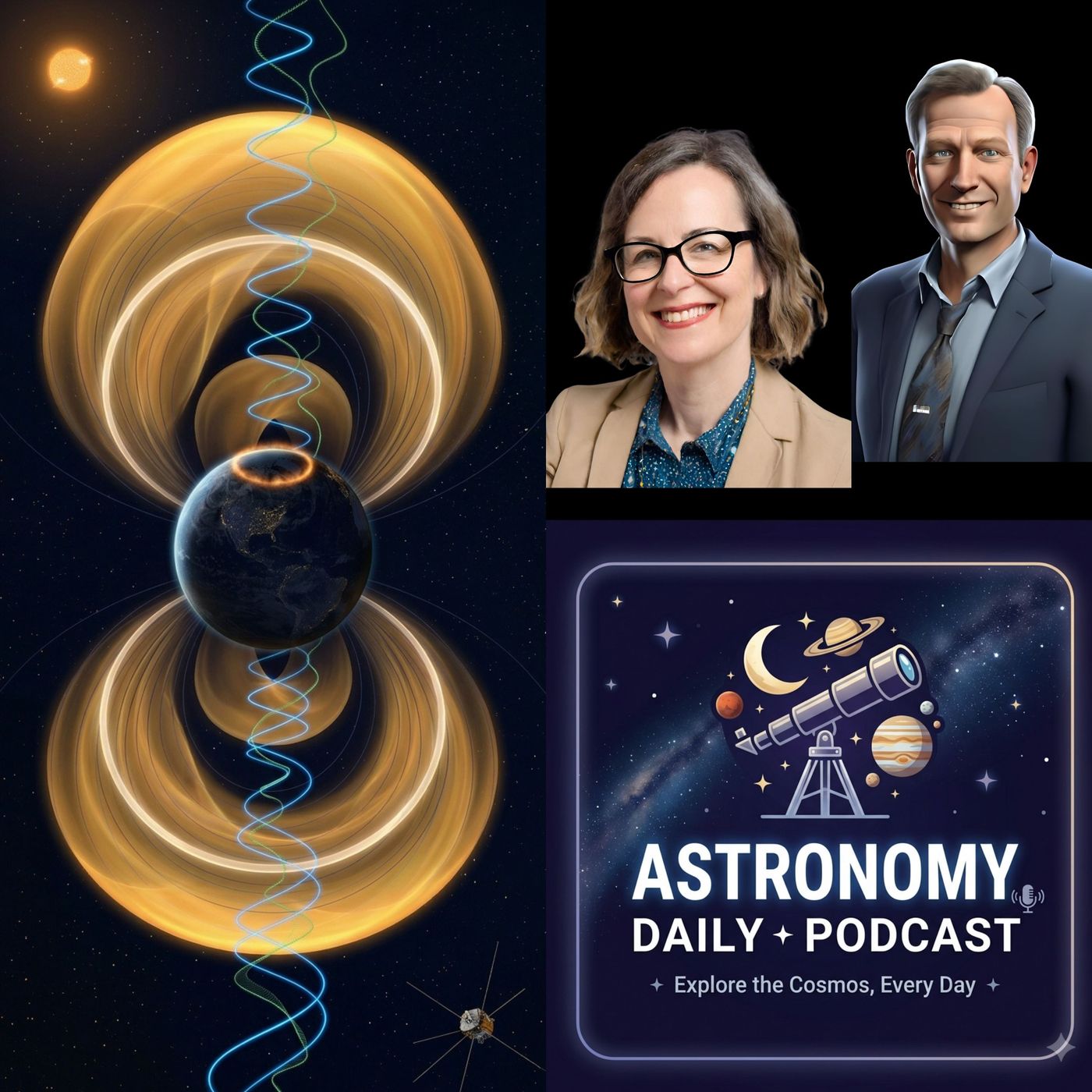
The Impenetrable Wall That Failed: Killer Electrons Made Inside Earth’s Radiation Belt
In this episode
Show notesElectrons made on the wrong side of Earth's 'impenetrable barrier', a gamma-ray burst that only looked weak, the week that was, and a Halloween that is astronomically a week early. The Wall That Broke In 2014 NASA's Van Allen Probes revealed a sharp inner edge to Earth's outer radiation belt: electrons at the very highest energies never got closer than about 2.8 Earth radii. During the May 2024 superstorm — the biggest since the 2003 Halloween storms — Japan's Arase satellite saw electrons of about 3 MeV rise deep inside that 'impenetrable barrier'. A new paper led by Yoshizumi Miyoshi (Nagoya University ISEE) shows a peak in electron phase space density growing in place at L* ≈ 3, about 12,000 km up — evidence the electrons were accelerated there rather than carried in. Intense chorus waves, operating in a region emptied by a crushed plasmasphere and a negative ionospheric storm, are the likely engine. Caveats: one storm; 'consistent with' chorus acceleration; the breach itself had been reported before — the new part is the mechanism. Not Faint, Just Side-On GRB 260310A, caught by Fermi on 10 March 2026, had a feeble gamma-ray flash but one of the brightest afterglows ever seen. Yu-Han Yang (Tor Vergata) and colleagues argue we viewed a two-component jet from the side. Preprint from May; published in ApJL this month; competing models exist. The Week That Was E214 GRB 160425A, one burst with two births · E215 θ¹ Ori C, the star born twice · E216 Rubin's first dwarf-planet candidate 2026 ED138 · E217 Betelgeuse pulled out of round by Siwarha · E218 Teghaza 001, one of the oldest pieces of Mars. Plus Swift's re-entry watch, Voyager 1 at one light-day on 18 Nov, and Starship Flight 15 targeted for November. Skywatch Halloween is astronomically a week early (true cross-quarter 7 Nov). Mars, Jupiter and Regulus line up before dawn, Mars–Jupiter just over 1° apart on 16 Nov. Moon near Mars and Jupiter on the mornings of 2–3 Nov. Saturn rules the evening, best from the south. US clocks fall back 1 Nov. Solar viewing only with ISO 12312-2 certified filters. Sources · Miyoshi et al., GRL 53, e2026GL125879 (2026) — https://doi.org/10.1029/2026GL125879 · ISAS/JAXA release, 27 Oct 2026 (Japanese) — https://www.isas.jaxa.jp/topics/004417.html · Nagoya University release via phys.org — https://phys.org/news/2026-10-solar-storm-triggered-ultrarelativistic-electrons.html · Yang et al., ApJL 1011 L22 (GRB 260310A) — https://iopscience.iop.org/article/10.3847/2041-8213/aea990 · arXiv 2605.23818 (Yang et al. preprint) — https://arxiv.org/abs/2605.23818 · Gill et al., arXiv 2605.26091 (competing model) — https://arxiv.org/abs/2605.26091 · NASA: Swift mission ends ahead of re-entry — https://science.nasa.gov/blogs/swift/2026/10/23/nasas-swift-mission-ends-ahead-of-re-entry/
Become a supporter of this podcast: https://www.spreaker.com/podcast/astronomy-daily-latest-space-news--5648921/support.
Sponsor Details:
Ensure your online privacy by using NordVPN. To get our special listener deal and save a lot of money, visit www.astronomydaily.io/nordvpn. You'll be glad you did!
Get the best secure and private email on the planet. Stop your Government, google and who knows who else spying on every email you write. Do what we did and use ProtonMail. They beleive in privacy and there are no ads in their business model...yet they still provide a free forever service. Check them out and get out special deal at
Anna: Happy Halloween. And if you want something properly spooky for the occasion, try this. Wrapped around the Earth is a boundary that, uh, space physicists have spent more than a decade calling the impenetrable barrier. A line that the most dangerous electrons in near Earth space were simply never seen to cross. Avery: Then in May 2024, the biggest geomagnetic storm since the famous Halloween Storms of 2003 hit the planet and a Japanese satellite watched electrons moving at nearly the speed of light turn up on the wrong side of the wall.
Anna: The paper explaining how they got there came out this week. Short version, they didn't break in. They were made in there. Welcome to Astronomy AstroDailyPod and to the weekend wrap for Saturday 31st October. I'm Anna. Avery: And I'm Avery. Today, the wall that broke, a gamma ray burst that only looked feeble because it was pointing the wrong way. Then the week that was. And a Halloween that turns out to be a week early. Let's go. Anna: Let's start with the neighbourhood. In 1958, America's first satellite, Explorer 1, carried a, uh, Geiger counter built by James Van Allen's team.
And it found that Earth is wrapped in radiation charged particles from the sun and from cosmic rays trapped by our magnetic field into two doughnut shaped zones. The Van Allen belts. Avery: Roughly speaking, the inner belt is dominated by energetic protons and the outer belt by electrons. And the outer belt is the restless one. A solar storm can empty it, uh, in hours or thousand, fill it with electrons travelling at a very large fraction of the speed of light. Anna: Those are the ones satellite engineers worry about.
Electrons above a few million electron volts can punch through shielding, build up charge inside electronics and discharge operators have a blunt nickname for killer electrons. Avery: In 2014, Dan Baker's team using NASA's twin Van Allen probes reported something odd about those killer electrons. The outer belt had a, uh, remarkably sharp inner edge. However hard a storm pushed, electrons at the very highest energies stopped at about 2.8 Earth radii measured out at the magnetic equator. The paper described it as a nearly impenetrable barrier and the name stuck.
Anna: Quick note on the units because they'll space physicists map the belts with a number called l. It's the distance in Earth radii from Earth centre at which a magnetic field line crosses the magnetic equator. L of 3 is about 12,000 kilometres above the surface. Avery: And the explanation for the barrier was roughly this. Inside it sits the plasma sphere, a dense cloud of cool, low energy plasma that leaks up from the ionosphere. In that environment the waves that scatter electrons away win out over the slow processes that carry them inward.
Electrons creep in, get knocked out and never build up Anna: a wall. In other words, that's really a balance. And balances can tip. Avery: On the 10th and 11th of May 2024, a run of eruptions from one huge sunspot group hit Earth. It was the strongest geomagnetic storm in more than 20 years, the largest since the Halloween storms of 2003. Aurora was seen at, uh, latitudes that almost never get it in both hemispheres. Here in Australia, the Aurora Australis was photographed much further north than usual.
And Japan, which rarely sees aurora at all, saw it too. Anna: And one spacecraft was in exactly the right place. Arase, launched by Jaxa in December 2016, flies an elongated orbit close to the magnetic equator, straight through the belts. Crucially, it measures everything at the electrons across a huge range of energies the magnetic field, the plasma waves and the density of the cold plasma. Its science centre is run jointly by JAXA's Institute of Space and Astronautical Science and Nagoya University.
Avery: Here's what Arase saw. After the main phase of the storm, electrons at around 3 million electron volts climbed sharply inside the barrier. The team went back through the whole record to 2017. In ordinary storms, nothing gets in at those energies. May 2024 stands alone. It was the largest increase of high energy electrons Arasi has recorded, and the enhanced levels persisted for weeks. Anna: Which leaves the real question. And it's the subject of the new paper led by Yoshizumi Miyoshi of, uh, Nagoya University's Institute for Space Earth Environmental Research, published this week in Geophysical Research Letters.
Were those electrons carried in from outside or were they accelerated right where they were found? Avery: The test is a quantity called phase space density. Think of a footpath crowded with people. If everyone arrived through a gate at one end. The crowd is thickest by the gate and thins out along the path. If a bus pulls up in the middle and let everyone off, the crowd peaks in the middle and spreads both ways. Anna: And to compare like with like, you track electrons with the same underlying orbital properties, not just the same energy, because an electron moving inward naturally gains energy as the field strengths.
Getting that right needs measurements near the magnetic equator over a wide energy range. That's exactly a rasae specialty. Avery: The result? During the storm's recovery, a clear peak in phase space density formed at about L3, roughly 12,000 kilometres up inside the barrier. And it grew in place. Then the electrons spread out from it, both inward towards Earth and outward. That's the bus in the middle of the footpath. They were made there. Anna: So what's the engine? The team points to chorus waves.
These are natural radio waves in the magnetosphere at audio frequencies. Feed them into a speaker and they sound remarkably like birds at dawn. But which is where the name comes from. Avery: Porous waves are generated during storms by lower energy electrons injected from the magnetotail and they can resonate with other electrons and push them to very high energies. Normally they can't operate where this happened because the dense plasma sphere fills that region. Anna: But in May 2024, two things lined up.
The storm crushed the plasma sphere far closer to Earth than usual. And at the same time, a, uh, negative ionospheric storm drained electrons from the ionosphere 90 to 500 kilometres up. That's the reservoir that normally refills the plasma sphere after a storm. With the reservoir low, the plasma sphere stayed shrunken for longer than usual. Avery: So for days, a region that's normally full of cold plasma was close to empty. Arase saw intense chorus waves there. At the same time the electrons were growing chorus waves where they shouldn't be, accelerating electrons where they shouldn't be.
Anna: It's a chain. The sun compresses the magnetosphere, the plasmasphere gets crushed, the ionosphere can't refill it, the waves move in and the wall gets bypassed from the inside. Avery: Three honest caveats. First, this is one storm, a once in two decades event, and the paper is careful about that. Second, the authors say the observations are consistent with chorus driven acceleration. Waves and acceleration seen together in the same place is a strong case, but it isn't a direct proof of cause.
Anna: And third, the breach itself isn't the new part. Low altitude satellites reported high energy electrons rising inside the barrier during the 2003 Halloween storms. And earlier this year, a Chinese led team, Sun, Liu Zhong and colleagues combining the MSS1 satellite with Arase, reported that the barrier had been violated in May 2024. What this paper adds is the mechanism, the peak that grew in place. Avery: For spacecraft designers, the region inside the barrier has been treated as comparatively calm for these ultra relativistic electrons, anything that lives in or passes through it.
Satellites in medium orbits. Spacecraft climbing out towards geostationary orbit or the moon may need margin for the rare storm that switches it on. Anna: It also completes a run we've been building on this show. In episode 192, the Super Flare, the Sun could produce in 193 the radiation dose on a long haul flight. And a Fortnight ago in 211 weather balloons sent up into a radiation storm. Same dial each time. This one adds a twist. A big storm doesn't just bring radiation in, it can rearrange the house, so the radiation is made inside.
Avery: And timing matters here, too. Solar Cycle 25 is past its peak. Um, and we've been tracking the spotless days. But the 2003 Halloween storms came well after solar cycle 23 had peaked. The declining years still throw big punches, Anna: which is a fitting thought for tonight. Happy Halloween from the inside of the impenetrable barrier. Avery: One more fresh story before the recap, and it's a nice companion to Monday's lead on, um, the 10th of March this year, NASA's Fermi telescope caught a gamma ray burst, now called GRB260310A.
Its gamma ray flash lasted about a minute, which made it a long burst, the kind made by a collapsing massive star. But the flash was feeble for its class. Anna: And then the afterglow refused to behave. Instead of fading from the start, the visible light rose slowly over several hours. The X rays faded, then, after about three weeks, brightened again for around a week. Avery: And the afterglow was spectacular. A team led by Johan Yang at the University of Rome Torvegata publishing in the Astrophysical Journal Letters, ranks its X ray and optical afterglows in the top 1% of all bursts, and its radio in the top five.
The burst sits at a redshift of about 0.15, roughly 2 billion light years away. And a supernova of the kind that accompanies collapsing stars was confirmed underneath it. Anna: So a weak flash and a brilliant afterglow. How do you get both? Avery: Their answer is geometry. A burst's jet is like a torch beam. Look straight down it and the flash is blinding. Stand off to the side and you miss the flash. But as, uh, the jet slows, its light spreads to wider angles and the afterglow rises into view.
That's the slow rise they saw. And they argue for a jet with two parts. A narrow, bright core inside a wider sheath. With the late X ray rebrightening, possibly the core swinging into view, Anna: they used Chandra time to rule out a neighbouring source contaminating the X rays. And their headline estimate is that someone looking straight down the core would have seen roughly a billion years of the sun's output packed into that beam. Avery: Caveats. The paper first appeared as a preprint in May, so it's five months old in that form, published in the Journal this month.
And this burst has attracted at least four papers. One competing team weighs a slower debris laden jet seen nearly head on as an alternative. The geometry is argued, not settled, Anna: but there's a lovely lesson in it. On Monday we had a burst that looked like two different explosions today, one that looked faint and wasn't. Both are telling us the same thing. Our neat categories partly reflect where we happen to be standing. Avery: Okay, moving on. What's next? Anna: Now the week that was in the order it happened Avery: Monday led with GRB 160425A in April 2016, Swift caught a sharp flash under two seconds long, then more than four minutes of silence, then a second Messier episode lasting nearly a minute from the same patch of sky.
Short bursts mean mergers, long ones mean collapsing stars, and this one looked like both. The paper in Nature Astronomy keeps the mechanism open and um, that's how we left it. Anna: Monday also brought a black hole disc in Maxi J0637 that puffs up and shades itself at at only about a fifth of its maximum feeding rate, a record deuterium rich methane measurement from Interstellar Comet 3I Atlas and NASA's Psyche thrusting almost continuously toward its 2029 arrival. Avery: Tuesday's lead solved a puzzle in Orion.
The discs around the young stars in the Orion Nebula are being eroded so fast they shouldn't still exist, and the nebulous shell looks too young as well. Wilhelm Trani and Portahese Zwart showed that both make sense if the massive star at the centre Theta one or Rionis the C, recently formed in a stellar merger, so its fierce ultraviolet switched on later than the region's age implies. There's a clean an inner companion on a 61 and a half day orbit. Anna: Tuesday also had a white dwarf with a double gas disc hinting at two hidden bodies, and a Yale study finding that giant impacts can let rocky planets keep their primordial atmospheres.
Avery: Wednesday was Rubin's first dwarf planet candidate 2026 ED138. It's about 46 astronomical units away, somewhere between 600 and 1,500 kilometres across, and it hit for years against the crowded Milky Way at a declination of -43, a properly southern object. Once it was found, it turned up in older dark energy camera images going back to 2016. Anna: Also Wednesday, TOI561B, a lava world reflecting most of the light that hits it, with University of Sydney co authors and HERA seeing Didymos and Dimorphos as two separate points for the first time.
Avery: Thursday led with Betelgeuse radio and millimetre images from the VLA and ALMA gathered over Five years show the star's shape stretching in step with the orbit of its small companion Sahuara. Betelgeuse is being pulled out of round by something we can barely see. Saguara comes back out from behind the star in late 2027. Anna: Thursday also covered radiation detectors flown on Artemis 1. A Cambridge study finding comets were a poor delivery route for hydrogen cyanide to early Earth, but about five times better for Mars and Virgin Galactic's new space plane Aperon.
Avery: And Friday LED with Tegaza 001, a uh, Martian meteorite from the Zaharov. At least 4.1 billion years old. One of the oldest pieces of Mars we have published in Science. We noted the age was first shown at a conference in July. Friday also brought Voyager 1's two days of silence in mid October and um, the Beta Pictoris cat's tail, which looks like the wreckage of a collision between bodies the size of charon or makemake. Anna: Three threads to close Swift. NASA ended operations on 20 October at about 275 kilometres and re entry is expected within weeks as we record it hasn't come down.
Will tell you when it does. Avery: Voyager 1 reaches one light day from Earth on 18 November, the first object ever to get that far. And Starship Flight 15 is targeted for November with SpaceX saying it uh, will try to catch both stages with the tower targeted. Not scheduled. Anna: Next up, Skywatch, Avery: let's look up first a uh, Halloween bonus. Halloween descends from Samhain, a festival that falls on a cross quarter day halfway between an equinox and a solstice. But the true astronomical midpoint, when the sun is exactly halfway along the sky from the September equinox to the December solstice, doesn't arrive until the 7th of November at a quarter to seven in the evening UTC.
So astronomically, Halloween is a week early. Anna: And in the southern hemisphere that same moment is the midpoint between spring and summer, not autumn and winter. One instant, two seasons depending where you stand. Avery: The best show this week is before dawn and it strongly favours the north. Mars and Jupiter are closing in Leo with the star Regulus just beside them. They're under 6 degrees apart on Sunday, about 3 degrees by the 8th and just over 1 degree on the 16th of November Anna: from Los Angeles at nautical dawn on Sunday, Jupiter stands 60 degrees up and Mars 65 from New York 56 and 61 from London, about 50 from Sydney.
Both are only about 25 degrees up low in the northeast, still worth it. But the north gets the better view Avery: and the Moon joins them. Last quarter is Monday the 2nd at 7:28 in the morning Sydney time, which is late Sunday evening utc. Over the next two mornings, the Moon passes about a degree from Mars, about half a degree from Jupiter, then close to Regulus. Exact distances depend on where you are, so look on the mornings of the second and third. Anna: A reminder for North American listeners Clocks fall back on Sunday morning, the 1st of November.
That makes dawn earlier on the clock. Nautical dawn on Sunday is about 5:17 in Los Angeles and 5:25 in New York Standard Time. Avery: The evening belongs to the South. Saturn is the only bright planet after sunset. Half an hour after sunset tonight, it's 35 degrees up from Sydney against 21 from Los Angeles, 18 from New York and 11 from London. Mercury has dropped back into the twilight, and it's gone for now. Venus has passed between us and the sun and will climb into the dawn sky over the coming weeks.
But it isn't clear of the glare yet, Anna: and given today's lead, the sun is still active and space weather forecasters have flagged the chance of minor geomagnetic storming this weekend. If you're at high latitude north or south, check your local aurora alerts before you write off the night. Avery: And our standing reminder never look at the sun directly or through any optics without proper protection. For solar viewing, use only eclipse glasses or filters certified to the international safety standard ISO 123122 from a reputable supplier and check them for damage before every use.
Anna: That's the weekend wrap electrons made on the wrong side of Earth's impenetrable barrier, a gamma ray burst that only looked weak, and a week that ran from Orion to Betelgeuse to the oldest piece of Mars. Avery: Show notes, sources and links to every paper are at astronomydaily.IO Questions or story ideas use the contact form there. Some of our best segments have started with a listener's question and you'll find us on social media. Astrodaily Podcast Anna: Happy Halloween and Clear asgive.
I'm Anna. Avery: And I'm Avery. Anna: See you Monday.
 Apple Podcasts
 Spotify
 Pocket Casts
 Castbox
 Overcast
 Podbean
 iHeartRadio
 Castro
 Goodpods
 Moon FM
 Podcast Addict
 Podcast Republic
 YouTube