
Launch Delays, Evolving Dark Matter, and Traces of a Catastrophic Solar Event
In this episode
Join Anna in this episode of Astronomy Daily as she navigates through a stellar array of updates from the cosmos, highlighting the latest breakthroughs and challenges in space exploration. Prepare for an informative journey that spans from the intricacies of SpaceX's Starship program to groundbreaking discoveries at the heart of our galaxy.Highlights:
- SpaceX's Starship Flight 9 Update: Dive into the latest developments as the FAA gives a conditional green light for SpaceX's ninth Starship flight following the explosive mishap of Flight 8. Discover the implications for air travel and the ambitious plans for the future of space exploration.
- Gilmour Space Technologies' Launch Delay: Learn about the recent postponement of Australia's first sovereign orbital launch attempt due to a nose cone malfunction. Despite the setback, the team remains optimistic about the future of Australian aerospace engineering.
- Planet Formation in Galactic Center: Explore the astonishing discovery of protoplanetary disks forming in the extreme conditions of the Milky Way's center, challenging previous notions of planetary formation and expanding our understanding of the universe.
- Evolving Dark Matter Theory: Delve into a novel proposal suggesting that dark matter may evolve over time, offering fresh insights into the Hubble tension problem and opening new avenues for research in cosmology.
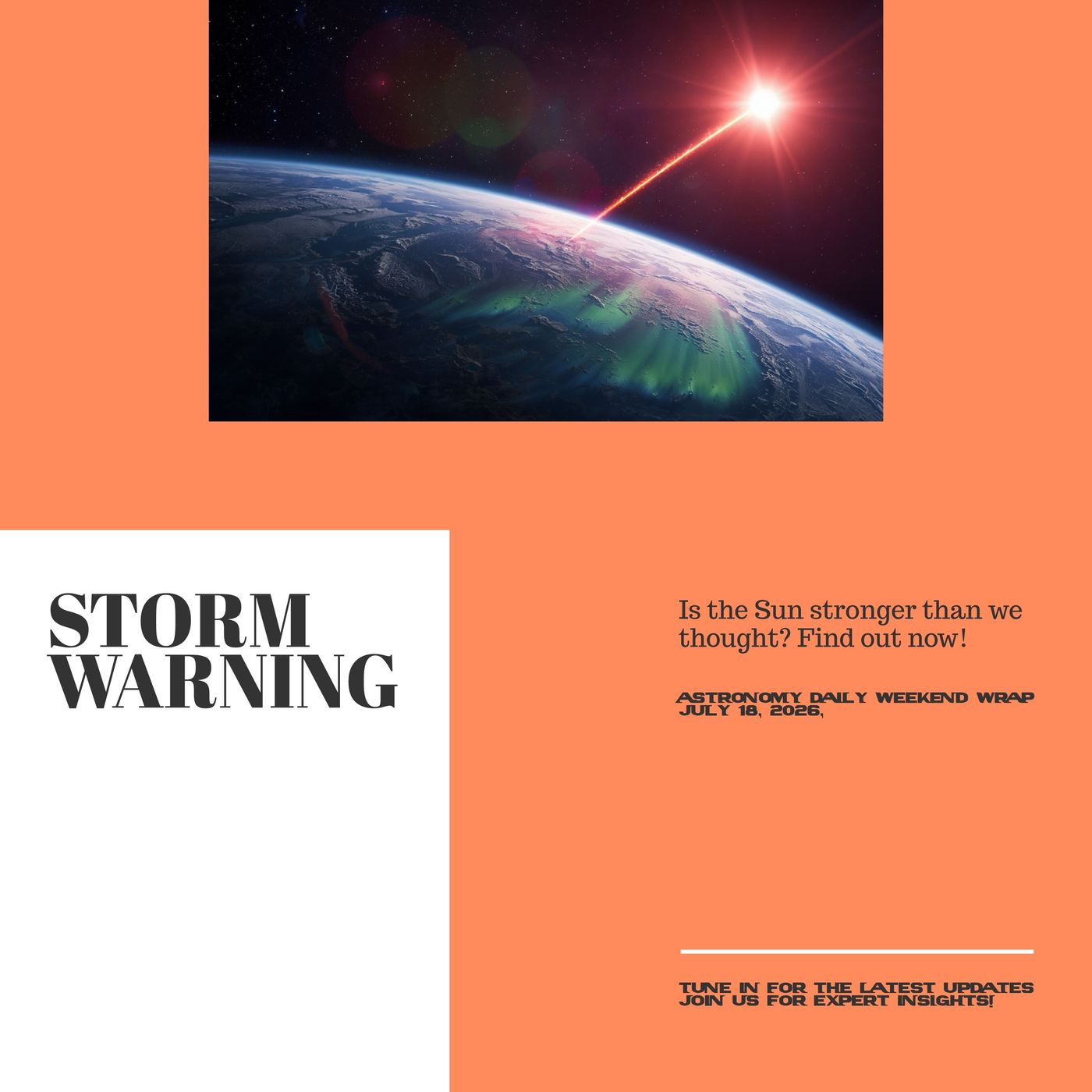
- Evidence of Ancient Solar Storm: Uncover the findings surrounding the most violent solar storm in recorded history, which struck Earth 14,300 years ago. Learn how this event could inform modern space weather preparedness in our technology-dependent world.
For more cosmic updates, visit our website at astronomydaily.io. Join our community on social media by searching for #AstroDailyPod on Facebook, X, YouTubeMusic, TikTok, and our new Instagram account! Don’t forget to subscribe to the podcast on Apple Podcasts, Spotify, iHeartRadio, or wherever you get your podcasts.
Thank you for tuning in. This is Anna signing off. Until next time, keep looking up and stay curious about the wonders of our universe.
Chapters:
00:00 - Welcome to Astronomy Daily
01:10 - SpaceX's Starship Flight 9 update
10:00 - Gilmour Space Technologies' launch delay
15:30 - Planet formation in the Milky Way's center
20:00 - Evolving dark matter theory
25:00 - Evidence of ancient solar storm
✍️ Episode References
SpaceX Starship Updates
[SpaceX](https://www.spacex.com/)
Gilmour Space Technologies
[Gilmour Space](https://gilmourspace.com/)
Protoplanetary Disks Research
[Peking University](https://www.pku.edu.cn/)
Dark Matter Theory
[University of Cologne](https://www.uni-koeln.de/en/)
Ancient Solar Storm Findings
[Climate Chemistry Model](https://www.sciencedirect.com/science/article/pii/S0921818121002175)
Astronomy Daily
[Astronomy Daily](http://www.astronomydaily.io/)
Become a supporter of this podcast:
Anna: Welcome to Astronomy Daily, your cosmic companion for all things space. I'm Anna, and I'm thrilled to bring you today's celestial roundup of the most fascinating developments from across the universe. Today we're exploring a diverse constellation of space news that spans from our own backyard to the very heart of our galaxy. We'll start with the latest on SpaceX's Starship program, where the FAA has made some crucial decisions about Flight 9 following March's explosive setback. Then we'll jet off to Australia, where a Histor rocket second launch attempt was scrubbed at the last minute due to an unexpected glitch.
With a most peculiar payload aboard, our journey takes us deeper into space as we discover something truly remarkable. Planets forming in the extreme environment at the center of our Milky Way, challenging what scientists thought possible about planetary formation. We'll also delve into theoretical physics with a fascinating new proposal about dark matter. Could this mysterious substance actually be evolving over time? The answer might solve one of cosmology most persistent puzzles. And finally, we'll travel back in time to discover evidence of what may be the most violent solar storm ever to hit Earth.
A cosmic event so powerful it left traces we can still detect 14,300 years later. So buckle up for a journey across space and time as we explore today's biggest astronomical breakthroughs. Let's m start with some SpaceX news. The Federal Aviation Administration has given SpaceX a conditional green light for its ninth Starship flight, approving license modifications but stopping short of authorizing an immediate launch. This decision comes in the wake of Flight 8's explosion in March, which created significant disruptions in our skies.
Before Elon Musk's massive rocket can take to the launch pad again, SpaceX must wait for the FAA to either close its investigation into the Flight 8 mishap or make a specific return to flight determination. As you might recall, the previous test ended dramatically when the spacecraft began spinning uncontrollably with its engines cut off before exploding in space. That incident wasn't just a setback for SpaceX. It disrupted approximately 240 flights with space debris concerns forcing more than 24 aircraft into diversions.
It's a stark reminder that even events happening in space can have very real consequences for air travel here on Earth. The FAA is currently reviewing SpaceX's mishap report, which was only submitted on May 14. When Flight 9 does eventually launch, we'll see expanded safety measures, including larger aircraft and maritime hazard areas, both in the United States and other countries. This expansion stems directly from the March explosion and reflects Another notable first, SpaceX plans to reuse a UH previously launched super heavy booster rocket, marking an important milestone in the company's reusability goals.
The impact on air travel will be substantial when the launch eventually proceeds. The flight path will affect air routes extending 1,600 nautical miles eastward from Texas through the Straits of Florida. Both the Bahamas and Turks and Caicos are expected to close their airspace up to 6,000ft, while the FAA will close airspace above that level. All told, the agency estimates about 175 flights will be affected. In a separate but related decision, the FAA has also approved increasing the number of launches at SpaceX's Boca Chica, Texas facility from five to as many as 25, a significant expansion of operations that had actually been announced back in March.
While these setbacks may seem disappointing, it's worth remembering the ambitious nature of what SpaceX is attempting to the Starship system stands at a towering 403ft and represents the centerpiece of Musk's vision to eventually send humans to Mars, potentially as soon as the turn of the decade. The March explosion marked the second consecutive failure in SpaceX's test launch program, following another explosion in the seventh test flight. Both incidents occurred during early mission phases that SpaceX had previously navigated successfully, highlighting the ongoing challenges in developing such revolutionary technology.
Next, an update from Australia in what would have been a historic moment for Australia's space industry, Gilmour Space Technologies has been forced to postpone its eagerly anticipated rocket launch after discovering a glitch in the nose cone mechanism. This would have marked the first time an Australian made rocket reached orbit from Australian soil. M the company reported Friday that an electrical fault erroneously triggered the opening mechanism of the carbon fiber nose cone during pre flight testing.
In short, the nose cone fell off. This critical component is designed to shield the payload, in this case, quite charmingly, a jar of vegemite as the rocket ascends through Earth's atmosphere. Fortunately, the mishap occurred before fueling began at the company's spaceport near Bowen, a coastal township situated about 1000km north of Brisbane in Queensland. Both the rocket and ground crew were unharmed in the incident. CEO Adam Gilmour maintained an optimistic outlook despite the setback, stating, while we're disappointed by the delay, we're already working through a resolution and expect to be back on the pad soon.
He emphasized that safety remains their highest priority, a sentiment echoed by communications chief Michelle Gilmour, who noted that the team is accustomed to such challenges. We do rockets, they are used to setbacks. The 23 meter 3 stage ARIS rocket represents a significant achievement in Australian aerospace engineering. Weighing 30 tons when fully fueled, it employs a hybrid propulsion system combining solid inert fuel with a liquid oxidizer. The team expects the delay to last at least a few weeks as they transport a replacement nose cone to the launch site.
This postponement follows another delay just the previous day caused by a bug in the external power system used for system checks. These consecutive setbacks highlight the inherent challenges in rocket development, even for a company with a decade of experience in the field. The choice of Vegemite as payload speaks to the Australian character of the mission, with Michelle Gilmour describing the iconic spread as hardy, resilient, like Ozzies. The payload reportedly remained intact despite the nosecone malfunction.
With 230 employees and backing from venture capital group Blackbird and pension fund Hesta, Gilmour, Space Technologies has ambitious plans. While this test flight has been delayed, the company remains focused on beginning commercial launches by late 2026 or early 2027, potentially establishing Australia as a significant player in in the increasingly competitive commercial space launch industry. Let's move on out to some space news. In a uh, groundbreaking discovery that challenges our understanding of planetary formation, astronomers have found evidence of protoplanetary disks forming in the most extreme environment of our galaxy, its very center.
An international team from Peking University, the Shanghai Astronomical Observatory, and the University of Cologne conducted the most detailed survey yet of the Milky Way's central molecular zone, or cmz, revealing that planets may be forming in places we never expected. Protoplanetary disks are essentially cosmic nurseries, swirling rings of gas and dust surrounding young stars where planets are born. Within these structures, tiny dust particles collide and stick together, gradually building into pebbles, boulders, and eventually planetary embryos through a process called core accretion.
As these embryonic planets grow, they leave behind distinctive patterns that astronomers can detect with advanced telescopes. What makes this discovery so remarkable is the location. The galactic center presents incredibly harsh conditions with intense radiation, strong magnetic fields, and turbulent gas clouds, environments previously thought hostile to planet formation. Yet the research team identified over 500 dense cores where stars are forming under these remarkably different conditions. Detecting these systems was no small feat.
The central molecular zone is approximately 17 billion astronomical units away and heavily obscured by dust. To overcome these challenges, the team employed the Atacama Large Millimeter Array, or alma, in Chile. This powerful radio telescope combines signals from widely spaced antennas to achieve extraordinary resolution, allowing researchers to observe structures as small as 1,000 astronomical units. Despite the immense distance, the team used a clever approach called dual band imaging Capturing two wavelengths at the same resolution to gather critical data on temperature, dust composition and structure.
What particularly surprised researchers was that over 70% of the dense cores Appeared redder than expected, suggesting the presence of protoplanetary disks. As Feng Weishu from the University of Cologne's Institute of Astrophysics described it, we were astonished to see these little red dots across the whole molecular clouds. They are telling us the hidden nature of dense star forming cores. The findings suggest there may be over 300 potential disk forming systems in just three CMZ clouds, opening a new window into how planetary systems might form under radically different conditions Than those near our Sun.
This diversity in planet forming environments could have profound implications for our understanding of exoplanet populations such as throughout the Galaxy. If planets can form in the turbulent high pressure environment at the galactic center, it suggests the building blocks of planetary systems Are far more resilient and adaptable than previously thought. As astronomers continue to study these distant protoplanetary disks, we may soon discover whether these early formations can indeed evolve into full planetary systems and how such processes might differ across the vast expanse of the Milky Way.
Next up, everybody's favorite subject, dark matter. For a while now, cosmologists have been wrestling with a perplexing mystery known as the Hubble tension problem. While observations consistently support the expanding universe model, There's a troubling discrepancy. Measurements from the early cosmos show a lower acceleration rate Than what we observe locally. This inconsistency has led scientists to propose numerous potential solutions, from questioning general relativity to rethinking dark matter entirely.
Now a fascinating new theory has emerged that puts a fresh spin on dark matter. What if it evolves over time? This concept is particularly novel because, while evolving dark energy has been proposed before, the idea of dark matter changing over time hasn't received much attention from researchers. There are good reasons for this oversight. First, we have excellent observational evidence for dark matter. It appears to be some kind of material that doesn't interact strongly with light, perfectly explaining galaxy rotation curves and gravitational lensing.
The only major gap is our inability to directly detect dark matter particles. Second, most critics of dark matter theory Focus on eliminating it entirely through alternative M models like modified gravity, rather than refining the concept. What makes this new approach interesting is how it flips. Uh, our thinking. Researchers have found that models with evolving dark matter and constant dark energy can produce results similar to those with constant dark matter and evolving dark energy. To match observations, they propose that dark matter must have a changeable equation of state that oscillates over time.
This isn't actually as strange as it might sound. Consider neutrinos. They have mass, don't interact strongly with light, and are effectively a form of hot dark matter, Though they can't account for all the dark matter in the universe. Importantly, neutrinos undergo mass oscillation. Perhaps cold dark matter particles experience something similar. The researcher's model suggests that roughly 15% of cold dark matter might be oscillatory, with the remaining 85% being standard dark matter. This combination would address the Hubble tension while remaining consistent with our other dark matter observations.
It's worth emphasizing that this remains a conceptual um, model without specific constraints for dark matter particles. The researchers themselves describe it as a toy model, a simplified framework that captures essential features while omitting details. Nevertheless, it opens an intriguing new avenue for dark matter research that broadens our thinking beyond conventional models as we continue to gather data and refine our understanding of the cosmos. Evolving dark matter might prove to be a valuable piece in solving one of astrophysics most persistent puzzles.
At the very least, it demonstrates how creative thinking can help us tackle even the most fundamental questions about our universe. Finally, today, a little history lesson. Imagine discovering that 14,300 years ago, our planet was struck by a cosmic event so powerful it left physical evidence that scientists can still detect today. That's exactly what researchers have uncovered. The most violent solar storm in recorded history, dwarfing anything we've experienced in modern times. By examining partially fossilized tree trunks and ancient ice cores, scientists found unmistakable signatures of an extraordinary event that occurred around 12,350 BCE.
Using a specially developed climate chemistry model called SOCOL, researchers have now confirmed this was a massive solar storm, the biggest we've ever found evidence for. To put this in perspective, the ancient storm was more than 500 times more intense than the largest event of the modern satellite era, which occurred in 2005. That's simply staggering when you consider the potential impacts. For those wondering how scientists can possibly know about something that happened so long ago, the answer lies in radioactive carbon 14.
When the sun unleashes a, uh, powerful coronal mass ejection, essentially billions of tons of plasma with embedded magnetic fields, the particles interact with our atmosphere to temporarily increase carbon 14 production. This carbon 14 gets incorporated into living organisms like trees, creating a distinctive spike in tree rings from that period. Since carbon 14 decays at a known rate, scientists can precisely date these events and even determine their relative strength. What makes the 12,350 before Common Era event particularly significant is that it's the only known extreme solar particle event outside the Holocene epoch, the relatively stable warm climate period of the past 12,000 years.
This required the researchers to develop new modeling approaches that could analyze radiocarbon data under different climate conditions. The implications for our modern world are sobering. We've already seen how smaller solar storms can disrupt technology like the carrington event of 1859, which set telegraph systems ablaze worldwide, or the 1989 storm that caused multiple power grid failures. Now imagine something hundreds of times more powerful hitting our satellite dependent, electronically interconnected civilization.
This discovery establishes a new worst case scenario for space weather preparedness. Understanding the potential scale of these events is crucial for evaluating risks to modern infrastructure, from power grids and communication systems to the satellites that enable everything from GPS navigation to weather forecasting. While such extreme events appear to be rare on human timescales, this research reminds us that the sun is capable of far more violent outbursts than anything we've witnessed in recent centuries.
As we become increasingly dependent on vulnerable technologies, the importance of space weather monitoring and developing resilient systems becomes even more critical. This ancient solar tantrum, preserved in the rings of trees that stood witness to its fury, serves as both a scientific treasure and a warning from the distant past. And on that somber note, that wraps up another fascinating journey through our cosmos. From the earthbound challenges facing SpaceX's Starship and Australia's budding rocket program, to the mind bending discoveries of planets forming in our galaxy's heart and the possibility of evolving dark matter, we've covered quite the astronomical landscape today.
And that ancient solar storm revelation really puts things in perspective, doesn't it? A cosmic event 500 times more powerful than anything we've experienced in modern times reminds us just how dynamic and sometimes temperamental our stellar companion can be. I'm Anna and I've been your guide through today's cosmic headlines on Astronomy Daily. If you enjoyed this episode and want to keep up with all the latest developments in space science and exploration, I invite you to visit our [email protected] where you can sign up for our free daily newsletter.
There you'll also find our complete archive of past episodes ready for you to explore at your leisure. Don't forget to subscribe to Astronomy Daily on Apple Podcasts, Spotify, YouTubeMusic, or wherever you get your podcasts. To ensure you never miss an episode, Each day brings new discoveries and insights into our fascinating universe, and I'd love to share them with you. Until tomorrow, keep looking up the cosmos never ceases to amaze.


 Apple Podcasts
 Spotify
 Pocket Casts
 Castbox
 Overcast
 Podbean
 iHeartRadio
 Castro
 Goodpods
 Moon FM
 Podcast Addict
 Podcast Republic
 YouTube