
Interstellar Dreams, SphereX Launch, and Volcanic Wonders on IO: S04E28
In this episode
Astronomy Daily - The Podcast: S04E28In this episode of Astronomy Daily, host Anna takes us on an exhilarating journey through the latest astronomical breakthroughs and discoveries that are expanding our understanding of the universe. From pioneering advancements in interstellar travel technology to dramatic volcanic activity on Jupiter's moon Io, this episode is packed with insights that will inspire your cosmic curiosity.
Highlights:
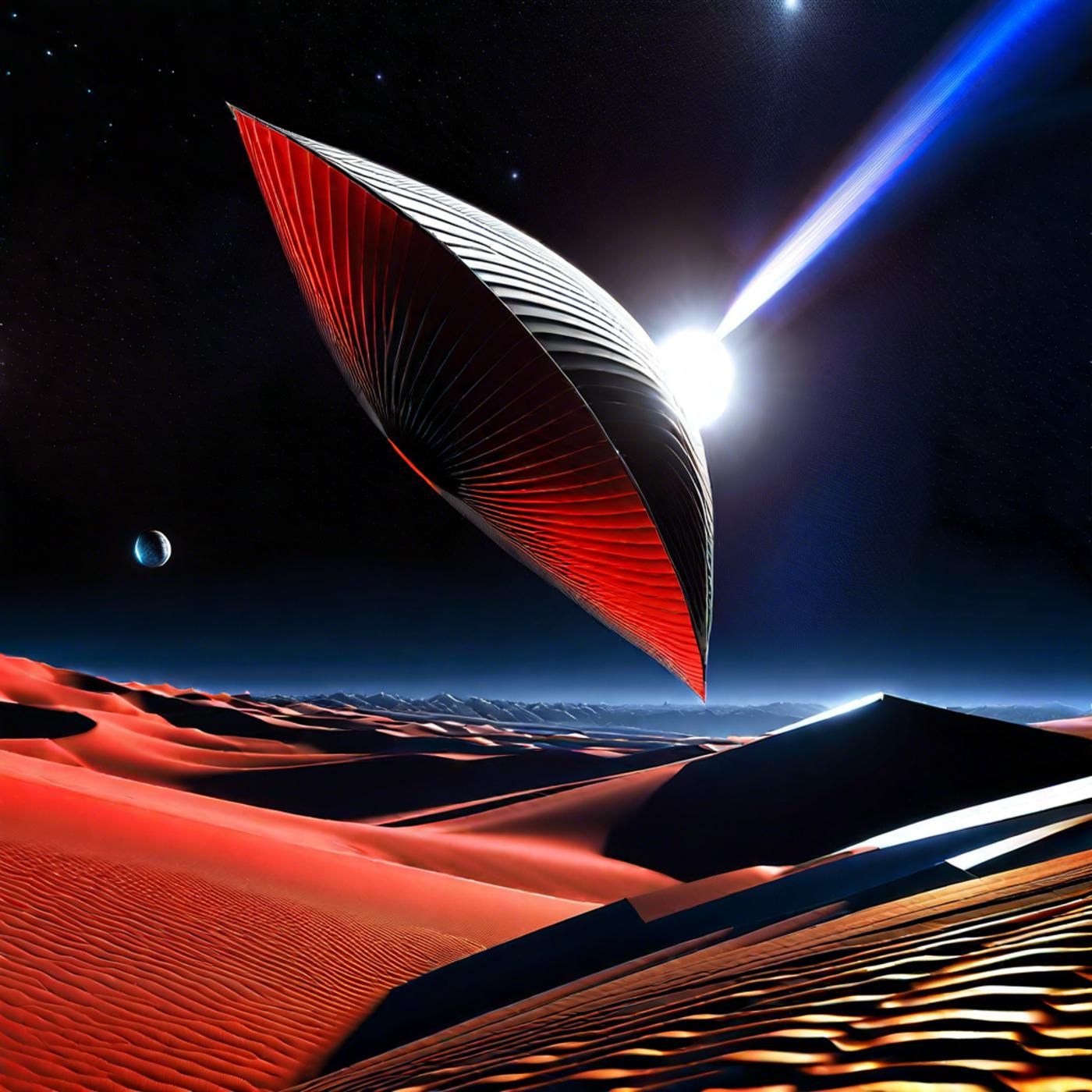
- Interstellar Travel Breakthrough: Discover how scientists are making strides in the development of ultra-thin light sails, a key component in the Breakthrough Starshot Initiative. Learn about the innovative materials being tested that could one day propel spacecraft to distant stars using powerful laser beams.
- NASA's SphereX Telescope: Get ready for the upcoming launch of SphereX, a revolutionary space telescope that will map the entire sky in 102 different infrared colors, unveiling cosmic secrets that even the James Webb Space Telescope can't reach.
- Volcanic Activity on Io: Join us as we explore the most powerful volcanic event ever recorded on Jupiter's moon Io, as observed by NASA's Juno spacecraft. This unprecedented eruption challenges our understanding of volcanic processes on celestial bodies.
- Comet Atlas's Fiery Journey: Follow Comet C 2024 G3, also known as Comet Atlas, as it passes close to the Sun, providing stunning insights into how solar winds affect comets and their behavior in our solar system.
- Lunar Geological Discoveries: Delve into new findings from the Moon's far side, revealing unexpected geological activity and previously unknown ridges that reshape our understanding of lunar geology and its implications for future exploration.
For more cosmic updates, visit our website at astronomydaily.io. Join our community on social media by searching for #AstroDailyPod on Facebook, X, YouTubeMusic, Tumblr, and TikTok. Don't forget to subscribe to the podcast on Apple Podcasts, Spotify, iHeartRadio, or wherever you get your podcasts.
Thank you for tuning in. This is Anna signing off. Until next time, keep looking up and stay curious about the wonders of our universe.
00:00 - Astronomy Daily brings you the latest in space and astronomy news
00:50 - Advances in interstellar travel technology with light sails
03:20 - Upcoming launch of NASA's SphereX telescope
06:15 - Record-breaking volcanic activity on Jupiter's moon Io
09:30 - Comet Atlas's journey past the Sun
12:20 - New geological findings on the Moon
15:00 - Conclusion and upcoming content
✍️ Episode References
Breakthrough Starshot
[Breakthrough Starshot](https://breakthroughinitiatives.org/initiative/3)
NASA SphereX
[NASA SphereX](https://www.nasa.gov/spherex)
NASA Juno Mission
[NASA Juno](https://www.nasa.gov/juno)
Comet Atlas
[Comet Atlas](https://solarsystem.nasa.gov/comets/atlas/overview/)
Astronomy Daily
[Astronomy Daily](http://www.astronomydaily.io)
Become a supporter of this podcast: https://www.spreaker.com/podcast/astronomy-daily-latest-space-news--5648921/support.
Sponsor Details:
Ensure your online privacy by using NordVPN. To get our special listener deal and save a lot of money, visit www.astronomydaily.io/nordvpn. You'll be glad you did!
Get the best secure and private email on the planet. Stop your Government, google and who knows who else spying on every email you write. Do what we did and use ProtonMail. They...
Speaker 1: Hello space enthusiasts. Today on Astronomy Daily, we're exploring an incredible array of astronomical discoveries and developments that are pushing the boundaries of our understanding of the cosmos. We'll dive into groundbreaking research that's bringing us closer to interstellar travel, as scientists make significant progress with ultra thin light sales that could one day propel spacecraft to distant stars. We'll also take a look at NASA's exciting new SPHEREx telescope, set to launch this month, which promises to reveal aspects of our universe that even the James Web Space Telescope can't see.
Speaker 1: From there, we'll journey to Jupiter's moon Io, where NASA's Juno spacecraft has witnessed the most powerful volcanic event ever recorded in our solar system. We'll also catch up with Comet Atlas as it makes its fiery journey past our Sun, and explore fascinating new findings about geological activity on the Moon that's challenging our understanding of our celestial neighbors. Stay with me, Anna, as we explore these fascinating developments in space science and discovery. Scientists are making remarkable progress in turning the science fiction dream of interstellar travel into reality through the development of ultra thin light sales.
Speaker 1: The Breakthrough Starshot Initiative, a program started in twenty sixteen by theoretical physicists Stephen Hawking and scientist Yuri Milner at the California Institute of Technology, has recently achieved a significant milestone in this ambitious endeavor. The research team, led by Starshot Lightsale Research Director Harry Atwater, has developed an innovative platform for testing materials that could potentially form these revolutionary light sales. These spacecraft propulsion devices would harness the power of laser beams to achieve unprecedented speeds, potentially opening up interstellar distances to direct exploration that we can currently only study through remote observation.
Speaker 1: One of the most challenging aspects of developing these light sALS is creating a membrane that can withstand intense heat while maintaining its shape under pressure and staying stable along a laser beam's axis. The team has ingeniously engineered a test to measure the precise force that lasers exert on ultra thin membranes of different materials, turning what was once a technical obstacle into a scientific advantage. Their research has revealed fascinating insights into how these miniature light sales interact with laser beams.
Speaker 1: When struck by light, these mechanical resonators vibrate in response to both heat and radiation pressure. The team discovered that by studying these vibrations, they could accurately measure the force being exerted on the membrane, providing crucial data for future designs. Perhaps most intriguingly, the researchers found that when laser beams strike the light sale at angles, as would happen in real space conditions, the force is actually lower than theoretical predictions. This discovery, attributed to light scattering off the sale's edges, has led to promising new research directions involving nanomaterials and meta materials that could help control the sideways, movement and rotation of these future spacecraft.
Speaker 1: This breakthrough represents a crucial stepping stone toward developing freely accelerating light sales that could one day carry tiny probes to our nearest star systems, potentially revolutionizing our ability to explore the Cosmos firsthand. The team's work continues to focus on creating surfaces that can automatically correct their position if they drift off course, bringing us ever closer to making interstellar travel a reality. Next up today, NASA is preparing to launch an extraordinary new space telescope that promises to revolutionize our view of the cosmos.
Speaker 1: Named SPHEREx, this innovative observatory is scheduled for launch in late February aboard a SpaceX Falcon nine rocket, marking another milestone in our journey to understand the universe. What makes SPHEREx truly special is its unprecedented ability to map the entire sky in one hundred and two different infrared colors, something that's never been done before in human history. While the James Webb Space Telescope excels at studying specific celestial objects in great detail, SPHEREx will take a broader approach, creating a comprehensive panorama of the entire sky visible from Earth.
Speaker 1: This eggshell white conical probe might look modest compared to some of its predecessors, but don't let its appearance fool you. Weighing about as much as a grand piano and using less power than your home refrigerator, SPHEREx has been engineered to perform its mission with remarkable efficiency. To protect its sensitive instruments from heat interference, the spacecraft features an ingenious design with three concentric cone shaped photon shields and specialized radiator plates. These work together to keep the telescope cool enough to detect the faintest infrared signals from space.
Speaker 1: The mission's goals are ambitious. Scientists hope to use SPHEREx to study hundreds of millions of galaxies, potentially unlocking secrets about cause inflation, that mind bending moment just after the Big Bang, when the universe expanded faster than the speed of light. They're also planning to search for icy organic molecules floating between stars, which could help explain how life on Earth began. What's particularly exciting is how SPHEREx will work in tandem with other observatories. Its all sky infrared map will be an invaluable resource for James Webb Telescope scientists, helping them identify the most promising targets for detailed observation.
Speaker 1: Every six months, SPHEREx will complete a new map of the sky, building up an unprecedented view of our cosmic neighborhood. Over its two year primary mission at a modest cost of around four hundred and eighty eight million dollars. SPHEREx demonstrates that groundbreaking science doesn't always require the most expensive instruments. Instead, it's about having the right tool for the right job, and in this case, that means creating the most detailed infrared map of our universe ever attempted. Let's head over to Jupiter now.
Speaker 1: Jupiter's moon Io has just set a new record for volcanic activity, and what NASA's Juno spacecraft recently witnessed there is nothing short of spectacular. During its December twenty twenty three flyby, Juno observed a volcanic event so massive it makes Earth's most powerful eruptions look like campfires in comparison. The newly discovered hotspot region on Io's surface spans an area larger than Lake Superior, and the energy its releasing is truly mind boggling, equivalent to six times the combined output of all Earth's power plants.
Speaker 1: This isn't just another eruption on Io. It's the most powerful volcanic event ever recorded on what was already known as the most volcanic world in our Solar system. The discovery came during Juno's close approach to Io, when it passed within about nine hundred and thirty miles of the Moon's surface. Using its infrared instrument, the spacecraft detected an enormous hot spot in Io's southern hemisphere that was so intense it actually saturated. The scientists believe what they're seeing isn't just one massive eruption, but several closely spaced hotspots, all erupting simultaneously, suggesting the presence of a vast underground magma chamber system.
Speaker 1: What makes Io such a volcanic powerhouse. The answer lies in its relationship with Jupiter. As the Moon orbits the gas giant every forty two point five hours, Jupiter's immense gravitational pull creates powerful tidal forces that literally squeeze and stretch Io. This constant needing generates tremendous heat inside the Moon, leading to the spectacular volcanic activity we're witnessing. The Moon's surface is already home to about four hundred active volcanoes, all spewing lava, gas, and ash into Io's atmosphere.
Speaker 1: This new eruption, however, stands apart in its sheer scale and intensity. The affected region covers roughly forty thousand square miles, and scientists are eagerly awaiting Juno's next fly by in March to see how this remarkable event has reshaped Io's surface. These observations aren't just spectacular, they're providing valuable insights into volcanic processes, not just on Io, but potentially on other worlds throughout our Solar System. As scientists continue to study this unprecedented event, we're gaining new understanding of how planetary bodies evolve and interact with their environments.
Speaker 1: Okay, how did you go at photographing Comet atlass when it's sped by us last month? Not as well as this, I would think. A remarkable celestial spectacle unfolded in our cosmic neighborhood as Comet C twenty twenty four G three, also known as Comet Atlas, made its dramatic journey past the Sun between January eleventh and fifteenth. The comet treated astronomers to an extraordinary show as it blazed through the inner Solar System, coming within just eight million miles of our star. That's a mere nine percent of the distance between Earth and the Sun.
Speaker 1: The ESA and NASA's Soho spacecraft captured stunning images of this cosmic wanderer using its Lasco instrument. By cleverly blocking out the Sun's intense light with a special disc, LASCO revealed intricate details of the comet's tail as it responded to the solar wind. These observations are providing scientists with valuable insights into how the Sun's constant stream of particles and energy influences objects passing through our solar neighborhood. The images processed by Carl Badams at the US Naval Research Lab brought out remarkable fine details in the comet's tail, showcasing how it twisted and turned in response to fluctuations in the solar wind.
Speaker 1: This interaction between comet and solar wind is helping heliophysicists better understand the Sun's influence on its surrounding environment. While the comet briefly graced Northern Hemisphere skies during its closest approach to the Sun, it has since moved into southern skies. However, there are indications that this cosmic visitor may have paid a price for its close encounter with our star. Scientists have observed signs suggesting the comet might be breaking apart, which could lead to it rapidly fading from view in the coming days.
Speaker 1: Next, let's turn our attention to some fascinating lunar developments that are reshaping our understanding of Earth's closest celestial neighbor. Firefly's Blue Ghost mission has reached a significant milestone in its forty five day journey to the Moon, with NASA's specialized camera system SCALPS one point one successfully completing its first round of tests. All six of its high resolution cameras are functioning perfectly, ready to document every crucial moment of the spacecraft's eventual descent and touchdown on the lunar surface.
Speaker 1: Four of these cameras are specifically designed to capture the interaction between Blue Ghosts, rocket plumes, and the Moon's surface, while two additional cameras will record detailed before and after images of the landing site. This documentation is becoming increasingly important as we prepare for more frequent lunar missions, helping scientists better understand how spacecraft landings affect the lunar environment. Meanwhile, a groundbreaking discovery on the Moon's far side is challenging our long held assumptions about lunar geology.
Speaker 1: Researchers from the National Air and Space Museum and the University of Maryland have identified two hundred and sixty six previously unknown small ridges that tell an unexpected story of recent geological activity. These ridges, typically found in groups of ten to forty, appear to be surprisingly young, possibly forming within the last two hundred million years. This is remarkably recent in geological terms, especially for a body that many scientists believed had been geologically dormant for billions of years.
Speaker 1: The research team used crater counting techniques to date these features, finding that some ridges even cut through existing impact craters, providing clear evidence of their relatively recent formation. The structures bear striking similarities to features found on the Moon's near side, suggesting they were created by the same forces, possibly shallow moonquakes first detected during the Apollo missions. Movements are likely caused by a combination of shifts in the Moon's orbit and its gradual shrinking, a process that continues to influence lunar surface dynamics today.
Speaker 1: These findings have significant implications for future lunar exploration and infrastructure planning, Understanding that the Moon is still geologically active will be crucial for determining safe locations for future astronaut missions, equipment placement, and potential permanent installations on the lunar surface. And that brings us to the end of another fascinating episode of Astronomy Daily. From breakthrough developments in interstellar travel technology to record breaking volcanic activity on Jupiter's moon Io, from NASA's ambitious news sphere X telescope to surprising discoveries about lunar geology.
Speaker 1: It's been an exciting day in space news. I'm Anna, and I want to thank you for joining me on this cosmic journey. If you're hungry for more space and astronomy news, head over to Astronomy Daily dot io, where you'll find our constantly update newsfeed and all our past episodes ready for your listening pleasure. Don't forget to join our growing community across social media. You can find us as astro Daily Pod on Facebook, x YouTube, YouTube, music, Tumblr, and TikTok. Stay curious, keep looking up, and we'll see you Monday for another edition of Astronomy.
Speaker 2: Dailyday Star starz Star


 Apple Podcasts
 Spotify
 Pocket Casts
 Castbox
 Overcast
 Podbean
 iHeartRadio
 Castro
 Goodpods
 Moon FM
 Podcast Addict
 Podcast Republic
 YouTube