In this episode
In this episode, we bid farewell to the interstellar comet 3I/Atlas as it completes its closest approach to Earth, offering a glimpse into a cosmic journey that spans billions of years. We discuss the Parker Solar Probe's remarkable 26th close approach to the Sun, where it continues to gather critical data about solar activity at a staggering speed of 430,000 miles per hour. In a more whimsical turn, we share the exciting news of a public contest to design a mascot for NASA's Artemis 2 mission, highlighting the incredible engagement from around the globe.Shifting gears, we delve into the enigma of luminous fast blue optical transients (LFBOTs), exploring a recent discovery that suggests these cosmic explosions may arise from massive black holes tearing apart companion stars. We also examine the potential threat posed by asteroid 2024 YR4, which has a small chance of impacting the Moon in 2032, potentially scattering debris into near-Earth space. Finally, we analyze Russia's revamped plans for its future in space, as it opts to repurpose aging modules from the International Space Station into a new national space station, raising questions about safety and scientific capabilities.### Timestamps & Stories01:05 –Story 1: Farewell to Interstellar Comet 3I/Atlas**
**Key Facts**
- Comet 3I/Atlas made its closest approach to Earth, coming within 168 million miles.
- It is only the third interstellar object detected passing through our solar system.03:20 –
**Story 2: Parker Solar Probe's Close Approach**
**Key Facts**
- The probe completed its 26th perihelion, flying just 3.8 million miles from the Sun.
- It operated autonomously while gathering crucial data about solar activity.05:45 –
**Story 3: NASA's Artemis 2 Mascot Contest**
**Key Facts**
- NASA invited the public to design a zero gravity indicator for the Artemis 2 mission.
- Thousands of submissions were received, with 25 finalists selected.08:00 –
**Story 4: Understanding LFBOTs**
**Key Facts**
- Recent findings suggest LFBOTs result from black holes shredding companion stars.
- The energy emitted during these events is significantly higher than typical supernova explosions.10:15 –
**Story 5: Potential Impact of Asteroid 2024 YR4**
**Key Facts**
- There is a 4% chance that this building-sized asteroid will hit the Moon in 2032.
- The impact could release energy equivalent to 400 times the Hiroshima bomb.12:00 –
**Story 6: Russia's Future in Space**
**Key Facts**
- Russia plans to repurpose the old ISS modules into a new national space station.
- Concerns arise regarding the safety and maintenance of aging infrastructure.### Sources & Further Reading
1. NASA
2. James Webb Space Telescope
3. Space.com
4. European Space Agency
5. NASA Solar System Exploration
### Follow & Contact
X/Twitter: @AstroDailyPod
Instagram: @astrodailypod
Email: [email protected]
Website: astronomydaily.io
Clear skies and see you next time! 🌟
Become a supporter of this podcast: https://www.spreaker.com/podcast/astronomy-daily-latest-space-news--5648921/support.
Sponsor Details:
Ensure your...
Avery: Hello, and welcome to Astronomy Daily, your source for the latest news from across the cosmos. I'm Avery. Anna: And I'm Anna. It's great to have you with us. Today we say goodbye to our interstellar visitor and look to the future of life in orbit. Avery: That's right. We'll be talking about a comment from another solar system that just made its closest approach to Earth. And we'll check in on the Parker solar probe as it once again braves the Sun's fiery atmosphere. Plus, a fun story about how you could have helped design a mascot for the next mission to the Moon.
Anna: And later in the show, we'll dive into a cosmic mystery involving incredibly powerful blue explosions, a building sized asteroid with a small chance of hitting the Moon, and Russia's surprising new plans for its future in space after the International Space Station. So let's get started. Avery: First up, a, visitor from very, very far away. On Friday, December 19, interstellar comet 3I Atlas made its closest approach to our planet. Anna: It came within 168 million miles of Earth. Now that it's passed us, it will begin its long journey back out of our solar system, continuing its voyage through the Milky Way.
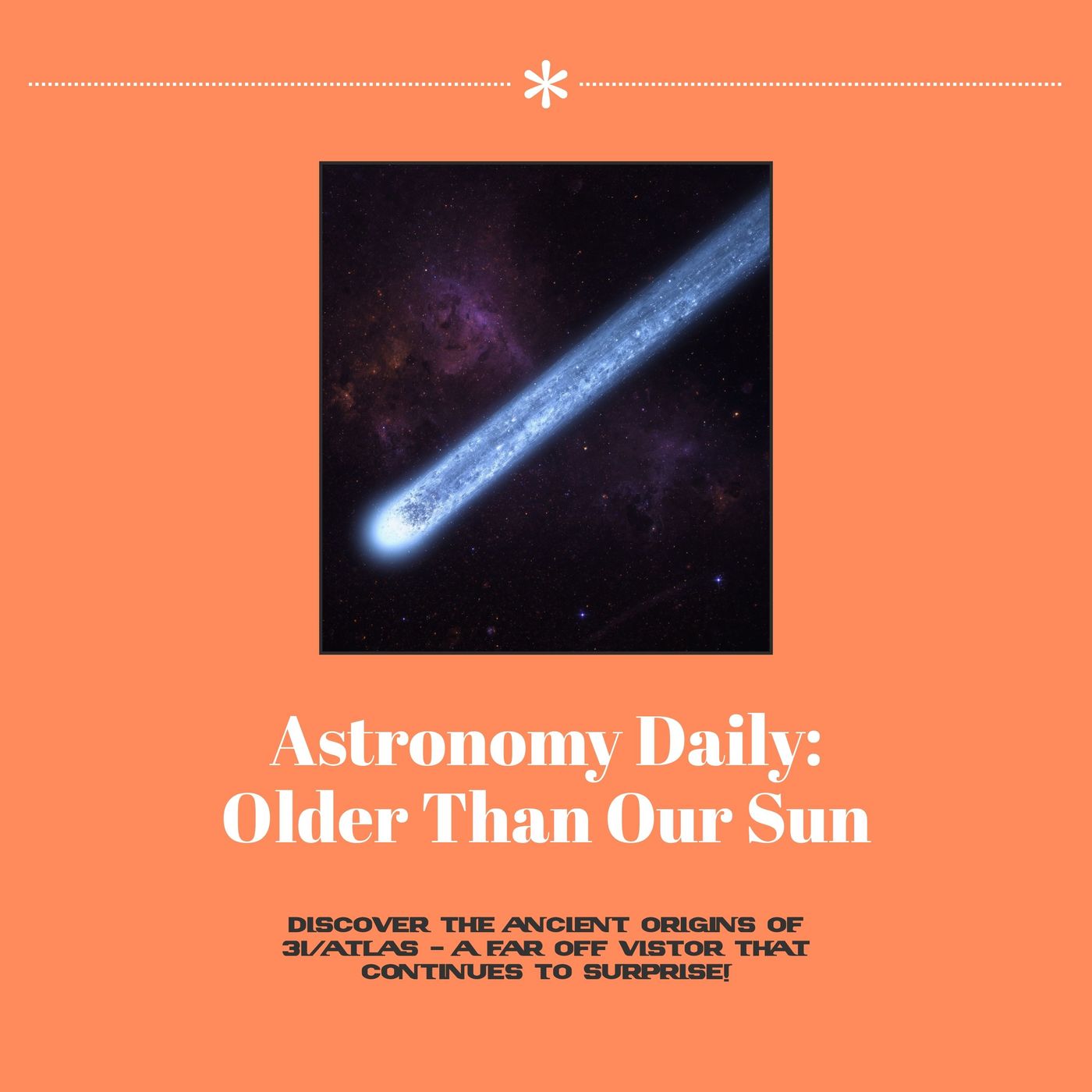
Avery: And, this isn't just any comet. It's only the third object we've ever detected passing through our solar system. That originated from interstellar space. Anna: Exactly. It was first spotted by NASA's Atlas system on July 1, 2025. By analyzing its trajectory, scientists determined it didn't come from around here. In fact, its path suggests it comes from a region of our galaxy that might be up to 7 billion years old. Avery: 7 billion years. That means this little icy wanderer is significantly older than our own 4.6 billion year old solar system.
It's like a relic from a completely different time and place. Anna: Mm. A true cosmic fossil. And it gave scientists a bit of a surprise. As it made its closest approach to the sun, the comet brightened much more than expected. And the reason for that extra glow is still a mystery. It's a fascinating puzzle for scientists to analyze as they gather the data from its Flyby. So farewell, 3i Atlas. You put on quite a show for us. Avery: Speaking of getting close to the Sun, NASA's Parker Solar Probe has been doing just that again.
Anna: That's right. On December 13, the probe completed its 26th close approach, or perihelion. And it wasn't just another flyby. It matched its own incredible records. Avery: And what records they are, it flew just 3.8 million miles from the solar surface. To put that in perspective, earth is about 93 million miles away. And its speed, a, blistering 430,000 miles per hour. Anna: It's almost impossible to comprehend that velocity. During this close approach, the spacecraft was completely out of contact with Earth, operating fully autonomously as its instruments gathered data from right inside the sun's atmosphere.
The corona Avery: And the timing is perfect. This is all happening while the sun is in a very active phase of its 11 year cycle. Anna: That's the key. These observations are critical for helping us understand our star and the space weather events it produces, like solar flares and coronal mass ejection. That data is vital for protecting our astronauts and technology both in orbit and here on Earth. Avery: Alright. From the intense heat of the sun to something a little more whimsical, NASA recently gave the public a very unique opportunity.
The chance to design a mascot for the Artemis 2 mission. Anna: This is such a great story. In collaboration with the platform Freelancer, NASA held a contest for a zero gravity indicator. These are small, usually plush items that the crew takes with them when they start to fly afloat. It's a simple visual cue that they've reached the microgravity of space. Avery: Right. It's a long standing tradition in human spaceflight, but this is the very first time the public has been invited to create the crew's mascot.
Artemis 2 is the mission that will send four astronauts on a trip around the moon in early 2026. So this is a historic flight. Anna: The response was overwhelming. The contest received thousands of submissions from over 50 countries. They've now narrowed it down to 25 finalists and the winning will be fabricated by NASA's own thermal blanket Lab and will fly with the astronauts on their journey. Avery: I love that we won't know the winner until closer to the launch date, but it's fantastic to see this level of public engagement with such a landmark mission.
It really connects people to the adventure of space exploration. Anna: Now for a deep space mystery. For years, astronomers have been puzzled by extremely powerful and bright blue cosmic explosions. They're called luminous fast blue optical Transients, or L LFBOTs for short. And we may finally know what causes them. Avery: Lfbots. The name itself is a mouthful. What's the leading theory here? Anna: Well, a, recently detected signal designated at 2024wpp has provided a major clue. It suggests that LFBOTs are the result of an extreme version of something called a tidal disruption event, or tde.
Avery: That's when a black hole tears a star apart, right? Anna: Exactly. But in this case, we're talking about a black hole with a mass up to 100 times that of our sun, completely shredding its companion star in a matter of days. This particular event at 2024wpp emitted about 100 times more energy than an average supernova explosion. Avery: Wow. So what makes it so much more powerful than a typical tde? Anna: The theory is that this wasn't just a one time. The black hole was likely parasitically feeding from its companion star for a long time, which created a huge shell of material around the pair.
When the star finally spiraled close enough to be completely shredded, the new stellar material slammed into that pre existing shell. That massive collision is what generated the immense light and energy that we observe as an lfbot. Yes. Avery: So it's a cosmic two punch knockout. The star gets torn apart and then its remains crash into a wall of its own lost material. That's an incredible level of cosmic violence. Anna: It certainly is now bringing the cosmic violence a little closer to home. Let's talk about an asteroid named 2024 yr.
4. Avery: Right. This is a building size asteroid roughly 60 meters wide. And scientists have calculated that there is about a 4% chance that it will hit the moon in the year 2032. Anna: A 4% chance isn't huge, but it's certainly not zero. And the potential consequences are significant. If it does hit the moon, the impact could release energy equivalent to 400 times the Hiroshima bomb. Avery: And it gets a bit more concerning. There's also a 1% chance that the impact could scatter meteorites into near Earth space.
That debris cloud could pose a real threat to our satellites and any astronauts in orbit. Anna: So what can be done? Is there a plan to deflect it? Avery: At the moment a deflection mission is impractical. However, some options like intentionally breaking it up into smaller, less harmful pieces are being considered. The most immediate step is to gather more data. Anna: and NASA's James Webb Space Telescope might give us the clear view we need. There's a potential observation window in February 2026 that could help scientists refine the asteroid's orbit and get a much better handle on the actual odds of a L impact.
Avery: For our final story today, we're looking at a major shift in the future of human spaceflight. Russia has significantly altered its plans for what comes after the International Space Station. Anna: That's right. The original plan was to build an entirely new station, the Russian Orbital Station or ros. But now the plan has changed. The core of this new station will actually be the old Russian segment of the issuance. Avery: So in 2030 when the US segment of the ISS is scheduled to be deorbited and burned up in the atmosphere, the Russian segment will just detach and become its own station.
Anna: Essentially, yes, this decision is widely seen as a money saving move for Russia's war strapped economy. However, it means their new national space station will be based on modules that are already over 30 years old. Avery: That raises some pretty serious concerns. Using hardware that old brings up major questions about safety, long term maintenance and the station's future scientific capabilities. Anna: It does. And it places Russia's program in stark contrast with other nations. At a time when China is operating its new Tiangong space station and India is developing its own, Russia is choosing to repurpose aging infrastructure.
It's a significant moment that could reshape the geopolitical landscape of human activity in low Earth orbit. Avery: And that is all the time we have for today. From interstellar visitors to the shifting future of space stations, it's been another busy day in the world of astronomy. Anna: We hope you enjoyed our tour of the latest headlines from the cosmos. Avery: Thank you for tuning in to ASTRONOMY Daily. I'm Avery. Anna: And I'm Anna. We'll be back on Monday with more updates. Until then, keep looking up.
Avery: The world.
 Apple Podcasts
 Spotify
 Pocket Casts
 Castbox
 Overcast
 Podbean
 iHeartRadio
 Castro
 Goodpods
 Moon FM
 Podcast Addict
 Podcast Republic
 YouTube