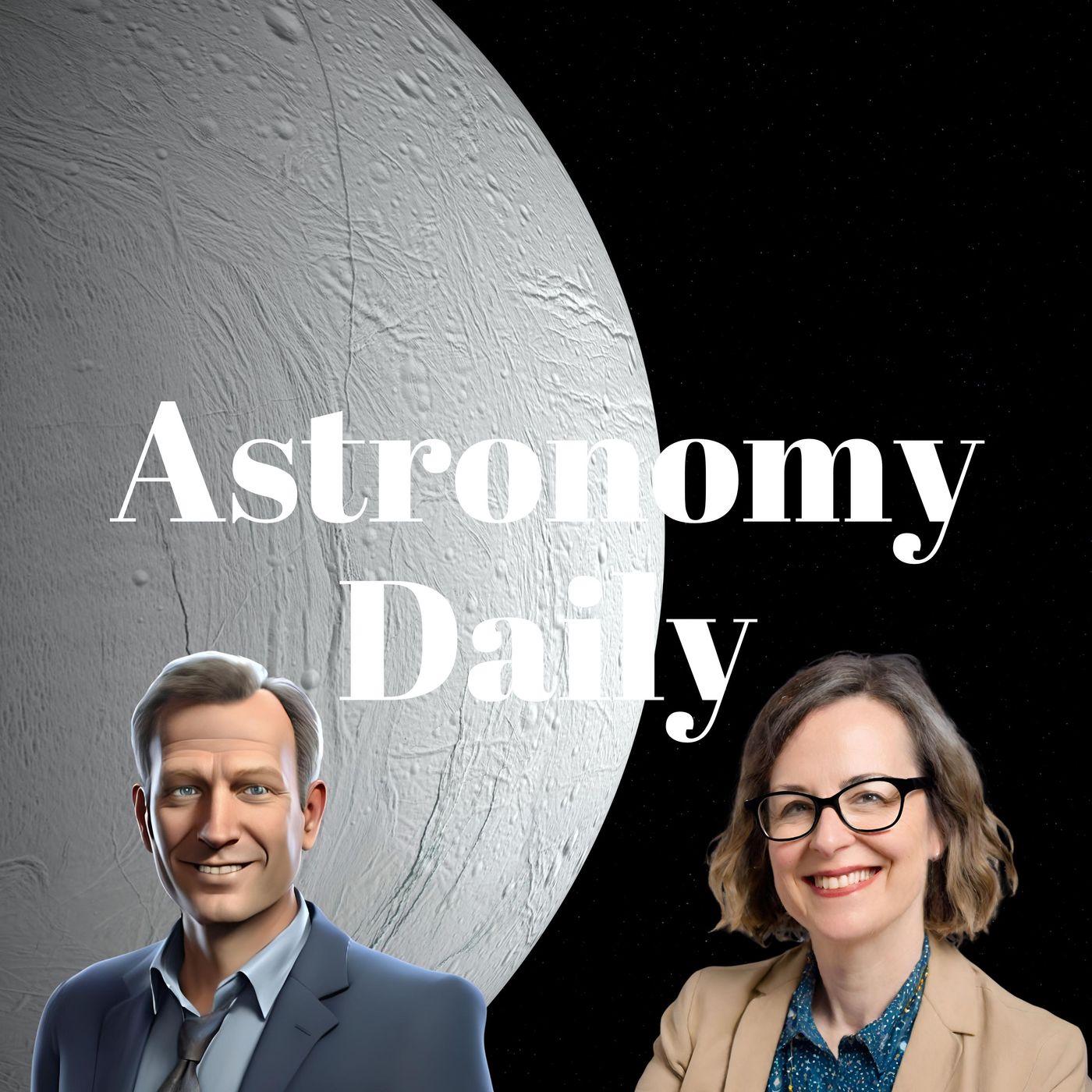
Enceladus' Ocean Secrets, Titan's Wobbling Atmosphere, and Venus' Water Revelation
In this episode
- Enceladus: A Potential Haven for Life: New analysis of data from the Cassini spacecraft reveals that Enceladus, one of Saturn's moons, possesses complex chemical reactions in its subsurface ocean. This finding confirms that the moon has the essential conditions for a habitable environment, including liquid water, energy sources from hydrothermal vents, and organic molecules crucial for life.
- Strange Behavior of Titan's Atmosphere: Titan, Saturn's largest moon, is exhibiting unusual atmospheric behavior. Recent research indicates that its atmosphere is wobbling like a gyroscope, a phenomenon that may stem from a past event. This discovery is vital for NASA's upcoming Dragonfly mission, which will explore Titan's atmosphere in the 2030s.
- Venusian Clouds Revisited: A reanalysis of data from NASA's Pioneer mission has unveiled that clouds on Venus contain a significant amount of water, previously thought to be scarce. This finding challenges long-held beliefs and opens new possibilities for the search for life in Venus's clouds, as the water is chemically bound within minerals.
- Public Perception of the Space Industry: A new Australian survey reveals a disconnect between public interest in space and knowledge about its applications. While support for increased space spending is high, awareness of how satellite technology impacts daily life remains low, highlighting the need for better communication about the benefits of space exploration.
- For more cosmic updates, visit our website at astronomydaily.io. Join our community on social media by searching for #AstroDailyPod on Facebook, X, YouTubeMusic, TikTok, and our new Instagram account! Don’t forget to subscribe to the podcast on Apple Podcasts, Spotify, iHeartRadio, or wherever you get your podcasts.
- Thank you for tuning in. This is Anna and Avery signing off. Until next time, keep looking up and exploring the wonders of our universe.
Enceladus Findings
[NASA](https://www.nasa.gov/)
Titan Atmosphere Research
[University of Bristol](https://www.bristol.ac.uk/)
Venus Cloud Analysis
[NASA](https://www.nasa.gov/)
Australian Space Survey
[Australian Government](https://www.gov.au/)
Astronomy Daily
[Astronomy Daily](http://www.astronomydaily.io/)
Become a supporter of this podcast: https://www.spreaker.com/podcast/astronomy-daily-latest-space-news--5648921/support.
Sponsor Details:
Ensure your online privacy by using NordVPN. To get our special listener deal and save a lot of money, visit www.astronomydaily.io/nordvpn. You'll be glad you did!
Get the best secure and private email on the planet. Stop your Government, google and who knows who else spying on every email you write. Do what we did and use ProtonMail. They beleive in privacy and there are no ads in their business model...yet they still provide a free forever service. Check them out and get out special deal at www.astronomydaily.io/protonmail
Become a...
Avery: Welcome back to Astronomy Daily, the podcast that brings the cosmos down to Earth. I'm your host, Avery. Anna: And I'm your other host, Anna. Uh, it's great to have you with us. We have an absolutely packed show for you today with news that spans our solar system. Avery: We are starting in the outer solar system with some incredible new findings from not one, but two of Saturn's moons. First up, Enceladus, which is looking more and more like a prime candidate for hosting extraterrestrial life.
Anna: Then we'll stay in the same neighborhood to visit Titan, Saturn's largest moon, where its entire atmosphere appears to be doing something very strange, something scientists are comparing to a, uh, gyroscope. Avery: From there, we're taking a big leap inwards, all the way to our planetary neighbor, Venus. You might think you know Venus, but a fresh look at some very old data has turned our understanding of its clouds completely on its head. Anna: And to wrap things up, we'll bring it all back home.
A new survey from Australia reveals a fascinating and perhaps slightly worrying gap between how much people support the space industry and how much they actually know about it. Avery: It's a journey from potential alien oceans to public opinion polls, so let's not waste any more time. Anna, uh, why don't you start us off with the exciting news from Enceladus. Anna: My pleasure, Avery. This story is a beautiful example of a mission that just keeps on giving. The Cassini spacecraft gave us two decades of incredible insights into Saturn.
And even years after the mission ended, scientists are still mining its data for gold. Avery: And it seems they've struck a new vein. This is about those amazing water plumes, right? The ones Cassini actually flew through? Anna: That's the one. Almost 20 years ago, Cassini flew through plumes of water bursting from cracks in the icy surface of Enceladus. Now, a new analysis of that fly through data has confirmed what many had hoped, that complex chemical reactions are happening within the Moon's hidden subsurface ocean.
Avery: That sounds huge. When we talk about searching for life, we're always looking for certain key ingredients. What does this new finding tell us? Anna: Well, it essentially affirms that Enceladus has all three of the major conditions necessary for a habitable environment, at least as we understand it. You need liquid water, which we know the Moon has, in its subsurface ocean. You need a source of energy, likely from hydrothermal vents on the ocean floor. And you need a specific set of chemical elements, the building blocks of life.
Avery: And this new analysis adds more to that third category. The Chemical building blocks. Anna: Exactly. They found organic molecules, some new ones they hadn't detected before in the fresh ice grains that were ejected directly from the ocean. This included molecular fragments that potentially contain nitrogen and oxygen, which are crucial for life as we know it. Avery: So this is direct evidence of complex chemistry happening right now in that ocean. And Frank Postberg, one of the co authors, made a really important point about this, didn't he?
Anna: He did. He emphasized that these molecules were found in freshly ejected material. This proves that the complex organics Cassini previously detected in Saturn's E ring aren't just the result of being zapped by radiation in space for a long time. They are being actively produced or are readily available right there in the ocean. Avery: So it's an active, chemically rich environment. And I believe another scientist on the paper, Nozair Kawasha, added that there are many possible chemical pathways that could lead from these simple organic molecules to more complex biologically relevant compounds.
Anna: That's right. It significantly enhances the likelihood that the moon is habitable. We have to be clear, this is not evidence of life itself. But it is perhaps the strongest evidence yet that an environment that could support life exists, exists right now in our own solar system. Avery: Well, let's not leave the Saturn system just yet, because its biggest moon, Titan, is also making headlines with some very unusual behavior. Anna: That's right. If Enceladus is all about its hidden ocean, Titan is famous for its thick, hazy atmosphere.
It's the only moon in our solar system with a substantial atmosphere, denser even than Earth. Avery: Um, and we've always known it's a weird place with its methane lakes and rivers. But now it seems the atmosphere itself is acting strangely. Anna: Researchers at the University of Bristol have uncovered that Titan's atmosphere doesn't rotate in step with its surface. The new discovery is that the entire atmospheric system seems to be tilted off axis, and it wobbles or oscillates almost like a spinning top or a gyroscope.
Avery: The whole atmosphere is wobbling. How m is that possible? Anna: The prevailing theory is that some major event in Titan's past could have knocked the atmosphere off its original spin axis, causing it to wobble ever since. What's even stranger is that the size of this wobble actually changes with Titan's seasons. Avery: That has to be a critical piece of information for NASA's next big mission to the outer solar system. Anna: Absolutely. We're talking about the Dragonfly mission, the car sized drone like rotorcraft that's scheduled to arrive at titan in the2030s.
Its whole mission is to fly through Titan's atmosphere. Avery: And if you're trying to land a multi billion dollar nuclear powered drone on a distant moon, you'd probably like to know if the entire atmosphere you're flying through is wobbling around. Anna: To put it mildly, yes. Understanding how the atmosphere behaves is absolutely crucial for calculating the landing trajectory. This discovery is a vital new piece of that puzzle. Avery: Okay, from the cold hazy reaches of the Saturn system, let's head sunward to a place that's anything but cold.
Venus. And uh, for as long as I can remember, the defining feature of Venus has been its clouds of sulfuric acid. Anna: That has certainly been the dominant picture. But a new paper is challenging that in a fundamental way. A team of researchers decided to re, analyze, analyze data from NASA's Pioneer mission to Venus from the 70s. Avery: I love these stories where old data reveals new secrets. What did they find? Anna: Pioneer analyzed aerosols in the clouds by seeing at what temperatures they burnt off.
The researchers applied modern techniques to this old data and noticed massive spikes in water. Avery: So it's not a water cloud in the way we think of one on Earth, but water is a huge component of what it's making up the clouds. Anna: A, uh, huge component. It seems the water is locked up inside other minerals as hydrates. When they did the math, they found that this hydrated water made up the bulk of the aerosols, measured a, ah, staggering 62%. Avery: This has enormous implications for one of the most exciting ideas in planetary science.
The search for life in the clouds of Venus. Anna: It really does. One of the primary arguments against that possibility has always been the extreme lack of available water. But if water is actually far more abundant just chemically bound up, it completely changes the equation. It reopens the door to that possibility. And for our last story today, we're coming back to Earth. A new report has been released based on a survey of Australian opinions about space. And it reveals a really interesting picture.
Avery: Let me guess, people love watching rocket launches but don't think about it much. Anna: Otherwise, that's a pretty good summary. The report shows a clear disconnect between the public's interest and their knowledge. People are three times more likely to want to increase spending on space, but awareness of what the sector actually does remains low. Avery: That's a key point. Things like using gps, checking the weather, or even making a credit card transaction often rely on data from satellites.
It's this invisible infrastructure we take for granted. Anna: Precisely. The survey also found people want to see Australia pull its own weight and build its own space capabilities. And another point that came through very strongly was sustainability. Two thirds of respondents think it's important to invest in sustainable space practices. Avery: So the big takeaway is about communication. Anna: Exactly. The report concludes that there have to be real, tangible links made between this vital sector and the everyday lives of Australians, showing them how investments in space pay dividends right here on the ground.
Avery: And that just about does it for us. Today we explored the life giving potential of, uh, Enceladus Ocean and the bizarre wobbling atmosphere of Titan. Anna: We rewrote the textbooks on the clouds of Venus and we took the pulse of public opinion on the importance of space right here on Earth. Avery: It's a constant reminder that there is always something new to discover. Thank you all so much for tuning in. I'm, uh, Avery. Thanks for. Anna: And I'm Anna. You've been listening to Astronomy Daily.
For even more space and astronomy news, be sure to visit our website where we have a continuously updating newsfeed. You'll find us at astronomydaily IO. We'll be back tomorrow with all the latest news from our universe. Until then, keep looking up.
 Apple Podcasts
 Spotify
 Pocket Casts
 Castbox
 Overcast
 Podbean
 iHeartRadio
 Castro
 Goodpods
 Moon FM
 Podcast Addict
 Podcast Republic
 YouTube