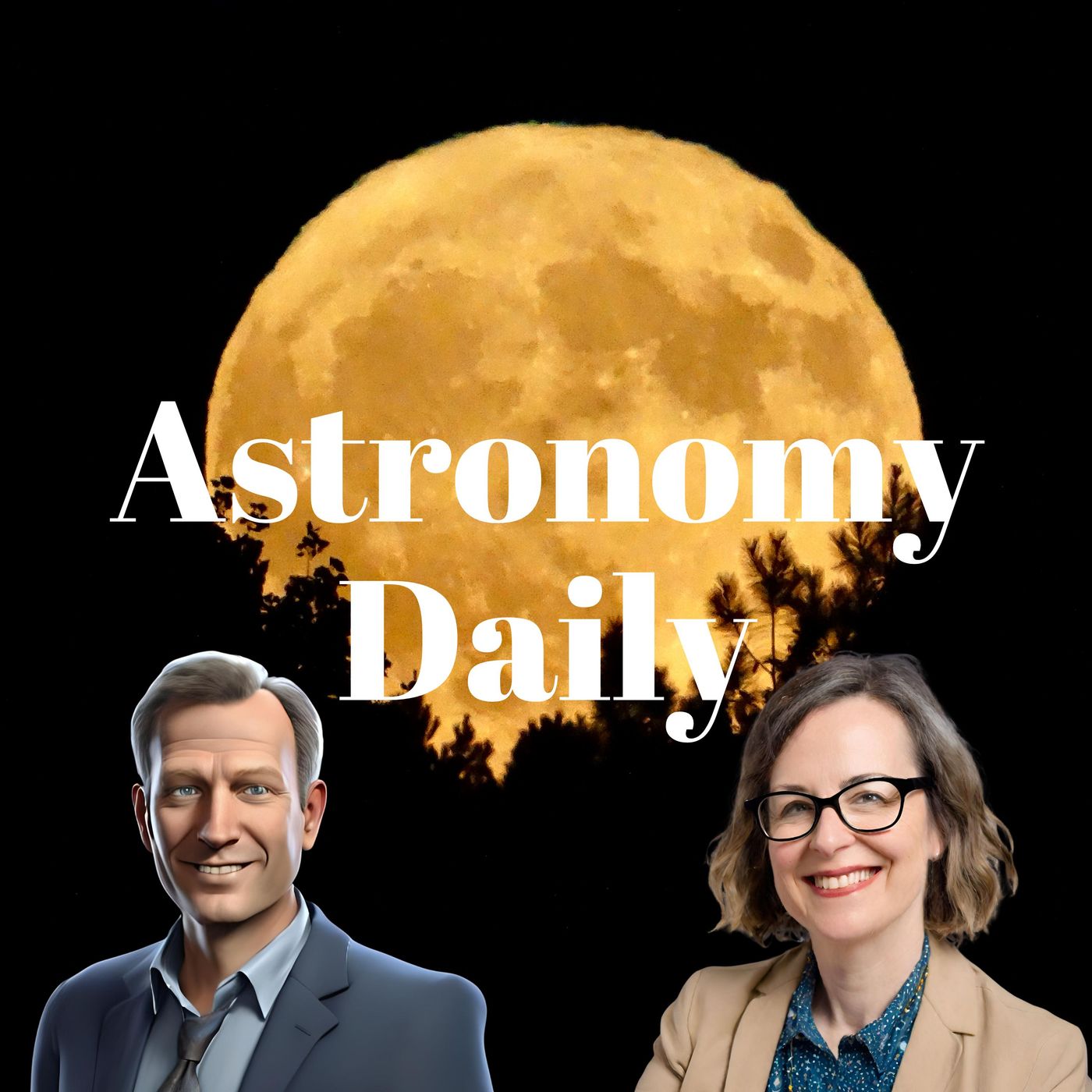
Supermoon Spectacle, Interstellar Comet Insights, and Mars' Ozone Mystery Uncovered
In this episode
- Biggest Supermoon of 2025: Mark your calendars for October 6th at 11:48 PM Eastern Time, as we prepare for the largest supermoon of 2025. This full moon, known as the Harvest Moon, will appear up to 14% larger and 30% brighter than a typical micro moon, offering a stunning celestial display just after sunset.
- Interstellar Comet 3i Atlas: Excitement is building around the interstellar comet 3i Atlas, the third such object detected in our solar system. The European Space Agency is mobilizing three spacecraft to study its unique trajectory as it approaches the sun, providing a rare opportunity to analyze its composition and understand the building blocks of distant star systems.
- Mysterious Ozone Surge on Mars: Scientists are investigating a puzzling increase in ozone levels over Mars' north pole during winter months. The ExoMars Trace Gas Orbiter has revealed that extreme cold conditions lead to the freezing of water vapor, halting ozone-depleting reactions and allowing ozone concentrations to rise, offering insights into Mars' atmospheric dynamics and water history.
- Challenging Dark Matter: A new theory proposed by physicist Rajendra Gupta from the University of Ottawa questions the existence of dark matter and dark energy. By suggesting that fundamental constants of nature may change over time, this model could explain cosmic phenomena traditionally attributed to dark matter, prompting a reevaluation of our understanding of the universe.
- For more cosmic updates, visit our website at astronomydaily.io. Join our community on social media by searching for #AstroDailyPod on Facebook, X, YouTubeMusic, TikTok, and our new Instagram account! Don’t forget to subscribe to the podcast on Apple Podcasts, Spotify, iHeartRadio, or wherever you get your podcasts.
- Thank you for tuning in. This is Anna and Avery signing off. Until next time, keep looking up and exploring the wonders of our universe.
Supermoon Details
[NASA](https://www.nasa.gov/)
Comet 3i Atlas Updates
[ESA](https://www.esa.int/)
Mars Ozone Research
[ExoMars](https://exploration.esa.int/)
Dark Matter Theory
[University of Ottawa](https://www.uottawa.ca/)
Astronomy Daily
[Astronomy Daily](http://www.astronomydaily.io/)
Become a supporter of this podcast: https://www.spreaker.com/podcast/astronomy-daily-latest-space-news--5648921/support.
Sponsor Details:
Ensure your online privacy by using NordVPN. To get our special listener deal and save a lot of money, visit www.astronomydaily.io/nordvpn. You'll be glad you did!
Get the best secure and private email on the planet. Stop your Government, google and who knows who else spying on every email you write. Do what we did and use ProtonMail. They beleive in privacy and there are no ads in their business model...yet they still provide a free forever service. Check them out and get out special deal at www.astronomydaily.io/protonmail
Become a supporter of...
Avery: Welcome, listeners, to Astronomy Daily, the podcast that brings the cosmos down to Earth. I'm Avery. Anna: And I'm Anna. We have a fantastic show for you today, packed with news from our celestial neighborhood and the farthest reaches of the universe. Avery: That's right, we'll be looking up at the biggest supermoon of 2025, tracking an interstellar visitor as it zips past the sun and uncovering a strange atmospheric mystery on Mars. Anna: And to cap it all off, we'll be exploring a mind bending new the that asks, what if dark matter doesn't exist at all?
Avery: It's going to be a, um, big one. Let's get started with a sight we can all look forward to in our own night sky. Anna: Indeed, after a year of seeing the Moon looking a bit smaller than usual, we're in for a treat next week. 11:48pm Eastern Time on October 6, to be precise, which, if I've done my math correctly, corresponds to 3:48 UTC on October 7th will see the biggest and brightest supermoon of 2025. Avery: I'm already marking my calendar. So for our listeners who might be new to this, what exactly makes a full moon a, uh, supermoon?
Anna: It's all about the moon's orbit. It's not a perfect circle, it's an ellipse. So sometimes the Moon is at its farthest point from Earth, which we call apogee. And sometimes it's at its closest point, or perigee. A supermoon happens when a full moon coincides with its perigee. Avery: And that makes it look bigger and brighter in the sky. Right. I read it can appear up to 14% larger and 30% brighter than a micro moon, which is when the full moon happens at apogee. Anna: Exactly. And we've just come through a period of micro moons, so the difference will be quite noticeable.
This particular supermoon is also the Harvest Moon, which is the full moon closest to the autumnal equinox. Avery: The harvest Moon. That's the one that historically helped farmers bring in their crops. Because it rises so close to sunset, giving them extra light to work by, it often looks huge and orange on the horizon. Anna: That's the one. The orange color is due to the same effect that makes sunsets red. The light is passing through more of Earth's atmosphere. So next week we get a combination of things.
The closest full moon of the year and the beautiful effect of the harvest moon, all making for a spectacular celestial event. Avery: From something we can see with our own eyes to something that requires a fleet of interplanetary spacecraft. Let's get an update on the interstellar comet 3i Atlas. Anna: This is incredibly exciting. 3i Atlas is only the third interstellar object we've ever detected passing through our solar system. The first was Oumuamua and The second was 2i Borisov. These objects are cosmic messengers from other star systems.
Avery: And the European Space Agency is pulling out all the stops to study this one. From now until early November, they're planning to use a trio of their spacecraft, the Mars Express and ExoMars Trace Gas Orbiter, which are both orbiting Mars, and the JUICE spacecraft, which is on its way to Jupiter. Anna: The reason this is such a unique opportunity is because of the comet's trajectory. As it makes its closest approach to the sun, it's going to heat up dramatically. This heating causes ices on its surface to sublimate, turn directly into gas, releasing dust and revealing the chemical composition of the comet's nucleus.
Avery: So it's like unwrapping a gift from another star. And using three different spacecraft gives them a huge advantage, doesn't it? Anna: It certainly does. Each spacecraft has different instruments and will see the comet from a different vantage point. This triangulation allows scientists to build a much more complete 3D picture of the comet's activity and the mater its shedding. By studying the composition of this gas and dust, we can learn about the building blocks of planets in whatever distant star system this comet came from.
Avery: It's a reminder of how interconnected the galaxy is. A piece of another solar system just passing through for a quick visit. Incredible. Anna: Absolutely. Now let's bring our focus a little closer to home, to our planetary neighborhood, Mars. Scientists have been puzzled by a mysterious surge in ozone that appears over its north pole during the winter. Avery: M ozone on Mars. I, uh, usually associate ozone with Earth's protective layer. Is it the same thing? Anna: It's the same molecule. Three oxygen atoms bonded together.
But on Mars, its behavior is very different. Using the ExoMars Trace Gas Orbiter. The same one. Watching the comet, scientists noticed that ozone concentrations in the middle atmosphere spike during the winter inside the polar vortex. Avery: A, uh, polar vortex. We have those on Earth too. Basically a giant spinning cyclone of frigid air, right? Anna: Precisely. And on Mars, it gets incredibly cold inside this vortex, dropping below minus 1, 130 degrees Celsius. This cold is the key to the mystery.
Normally, water vapor in the atmosphere reacts with other chemicals to destroy ozone. Avery: But when it gets that cold, the water vapor freezes out, forming ice clouds. So with the water vapor gone, the. Anna: Ozone destroying chemical reactions Stop. And the ozone is allowed to build up to much higher concentrations than seen anywhere else on the planet. Avery: That's a clever piece of atmospheric detective work. What does this tell us about Mars? Anna: It gives us a new way to trace the circulation of gases in the Martian atmosphere.
And more importantly, it helps us understand the history of water on Mars. By tracking where and when water vapor is present, we can build better models of Mars past climate and figure out where all its ancient water went. Avery: From a mystery on Mars to the biggest mystery in the entire cosmos. Ana, uh, we have to talk about this new theory that challenges the very existence of dark matter and dark energy. Anna: This is one of those ideas that could either be a dead end or completely revolutionized cosmology.
The standard model of the universe called Lambda CDM tells us that about 95% of the universe is made of two invisible components, dark matter and dark energy. Avery: Right. Dark matter provides the extra gravity needed to hold galaxies together. And dark energy is, ah, a force that's causing the universe's expansion to accelerate. We can't see them, but we infer their existence from their effects. Anna: Exactly. But physicist Rajendra Gupta, uh, from the University of Ottawa, has proposed a new model that gets rid of both.
His idea is based on a combination of other theories, including one about tired light and another covariing coupling constants. Avery: Whoa, those are some heavy terms. Let's break that down. Covariing coupling constants. What does that mean? Anna: In simple terms? It means that the fundamental constants of nature, things like the strength of gravity or the electromagnetic force, might not actually be constant. They could be changing very, very slowly as the universe ages and expands. Avery: So if the strength of these forces changed over billions of years, how would that replace dark matter?
Anna: Gupta's model suggests that these changing constants could create effects that we currently misinterpret as dark matter. For example, the way galaxies rotate much faster than they should, which is, uh, a key piece of evidence for Dark matter could be explained by these evolving physical laws instead of an unseen particle. The model also accounts for the accelerated expansion of the universe without needing dark energy. Avery: So we might not be living in a universe filled with mysterious dark stuff, but in a universe where the fundamental rules are slowly changing.
That's a profound thought. Anna: It is. It's important to stress that this is still a very new and untested hypothesis. The vast majority of evidence still points towards the standard lambda CDM model. But it's a fascinating alternative that reminds us to keep questioning our assumptions. It shows that there are still huge fundamental questions about our universe left to answer. Avery: And that is a perfect place to wrap up for today. From a supermoon in our backyard to an interstellar comet, a Martian weather mystery, and a whole new way to think about the universe itself, it's been a.
Anna: Whirlwind tour of the cosmos. Thank you so much for joining us on Astronomy Daily. If you'd like to see more details on these stories and more, please visit our [email protected] and check out our continually updated newsfeed. And while there, you may like to sign up for our free daily newsletter as well. Avery: Join us again tomorrow as we continue to explore the wonders of the universe. Clear skies, everyone. And remember to keep looking up, especially this week.
 Apple Podcasts
 Spotify
 Pocket Casts
 Castbox
 Overcast
 Podbean
 iHeartRadio
 Castro
 Goodpods
 Moon FM
 Podcast Addict
 Podcast Republic
 YouTube