
Cosmic Discoveries: Mini Moons, Laser Stars, and the Coldest Exoplanet Ever
In this episode
In this episode of Astronomy Daily, join host Anna as she unveils a captivating array of astronomical discoveries and cosmic events that highlight the wonders of our universe. Prepare to be amazed by this week's fascinating stories that showcase the dynamic nature of space exploration.Highlights:
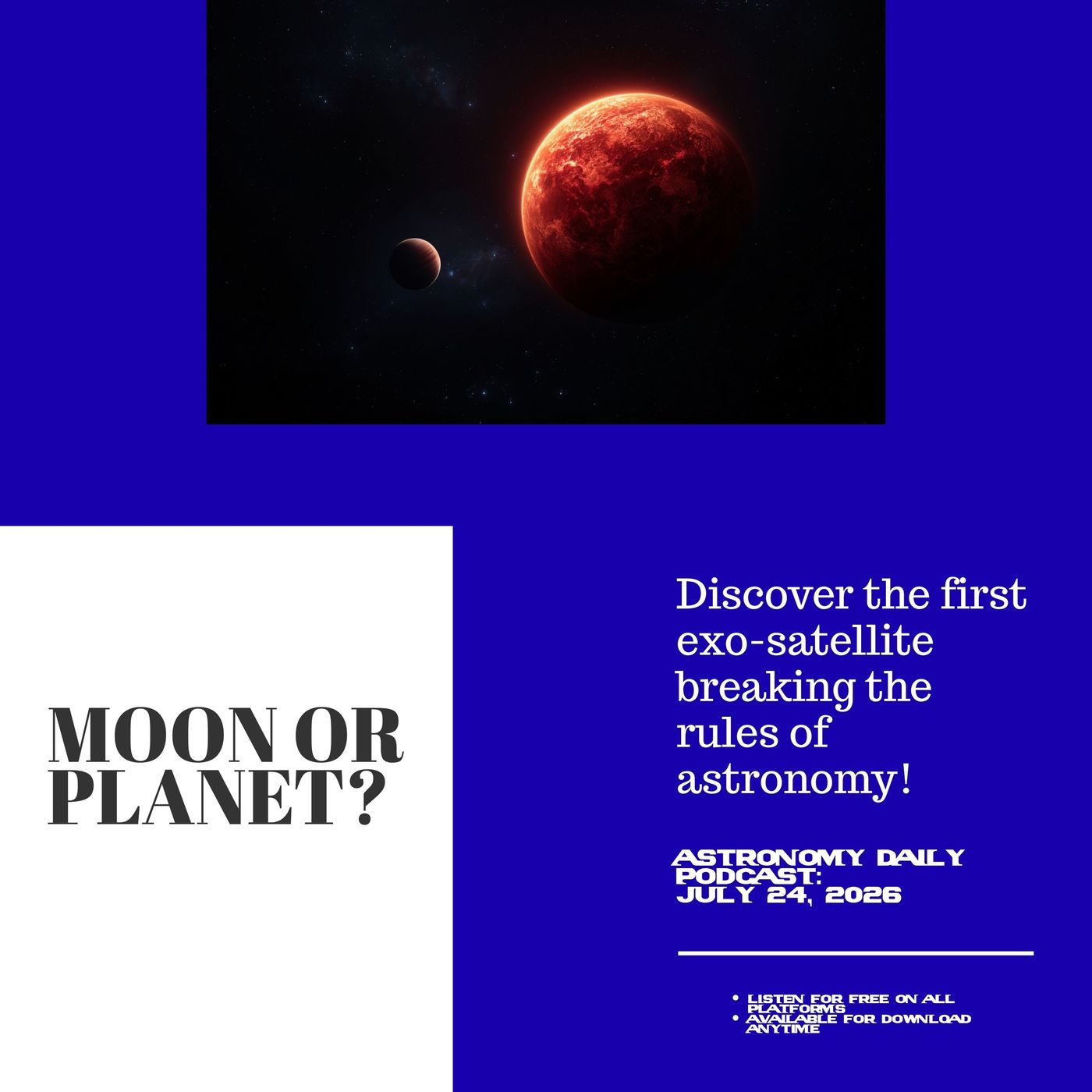
- Discovery of Mini Moons: Explore the surprising revelation of mini moons near Earth, including the newly identified 2024 PT5. This small rocky body hints at a hidden population of lunar fragments that may have been ejected from our own moon during ancient impacts, offering unique insights into the Moon's geological history.
- Laser Guide Stars: Discover the innovative technology at the Paranal Observatory in Chile, where astronomers are using powerful lasers to create artificial stars. This cutting-edge method helps counteract atmospheric turbulence, allowing ground-based telescopes to capture images nearly as sharp as those from space.
- Coldest Exoplanet Found: Delve into the groundbreaking discovery made by the James Webb Space Telescope of WD 1856 534b, the coldest exoplanet ever observed, orbiting a white dwarf. This discovery challenges our understanding of planetary survival and evolution in the aftermath of stellar death.
- Eta Aquarid Meteor Shower: Get ready for the upcoming Eta Aquarid meteor shower, peaking on May 5th and 6th. Learn how to best observe this celestial event as Earth passes through the debris trail of Halley's Comet, with the potential to witness up to 50 meteors per hour.
- Return of Cosmos 482: Finally, hear about the anticipated return of the Soviet Union's Cosmos 482, a Venus lander that has been orbiting Earth for over five decades. This rare opportunity to examine early planetary exploration technology offers a glimpse into the ambitions of the first space age.
For more cosmic updates, visit our website at astronomydaily.io. Join our community on social media by searching for #AstroDailyPod on Facebook, X, YouTubeMusic, TikTok, and our new Instagram account! Don’t forget to subscribe to the podcast on Apple Podcasts, Spotify, iHeartRadio, or wherever you get your podcasts.
Thank you for tuning in. This is Anna signing off. Until next time, keep looking up and stay curious about the wonders of our universe.
00:00 - Today's featured stories showcase just how dynamic our universe truly is
01:03 - Scientists have discovered what appears to be a second mini moon near Earth's orbit
04:00 - Scientists at Paranal Observatory in Chile use lasers to create artificial stars
06:58 - The James Webb Space Telescope has found the first confirmed planet orbiting a dead star
10:51 - The Eta Aquarid meteor shower peaks on May 6th
13:45 - The Soviet Union's Cosmos 482 spacecraft is expected to reenter Earth's atmosphere
16:40 - This week's Astronomy Daily podcast features some of today's most interesting discoveries✍️ Episode References
Mini Moons Discovery
[NASA](https://www.nasa.gov/)
Laser Guide Stars
[European Southern Observatory](https://www.eso.org/)
James Webb Space Telescope
[NASA JWST](https://www.nasa.gov/mission_pages/webb/main/index.html)
Eta Aquarid Meteor Shower
[American Meteor Society](https://www.amsmeteors.org/)
Cosmos 482 Update
[Russian Space Agency](https://www.roscosmos.ru/)
Astronomy Daily<br...
Speaker 1: Welcome to Astronomy Daily. I'm anna bringing you the latest astronomical wonders and space news from across the universe. Today, we have a stellar lineup of fascinating stories that showcase just how dynamic our universe truly is. We'll explore the surprising discovery of many moons lurking near Earth that might hint at a hidden population of lunar fragments in our neighborhood. Then we'll look at a remarkable telescope that's literally shooting lasers into space to create artificial stars. I'll also share details about the James Webb Space Telescopes groundbreaking discovery of the coldest exoplanet ever found and it's orbiting a dead star.
Speaker 1: Plus, get ready for the upcoming Eta Aquarid meteor Shower, your chance to witness the cosmic debris from Halle's comment lighting up our night skies. And finally, we'll update you on that Soviet Venus lander that's been stranded in Earth orbit for over five decades and is now making its way back home. So let's journey together through these cosmic tales that remind us just how wondrous our universe truly is. First up, today, Earth's Moon might be getting a bit of company in our cosmic neighborhood.
Speaker 1: Scientists have discovered what appears to be a second mini moon, a small rocky body that travels near Earth's orbit. This new mini moon, designated twenty twenty four PT five, was first spotted last year by astronomers in South Africa, and the evidence suggests it may have been blown off our own Moon during an ancient impact event. What makes twenty twenty four PT five particularly interesting is that it represents the second known lunar fragment traveling near Earth. The first, called camo Oalewa, was traced to the Moon in twenty twenty one.
Speaker 1: As planetary scientists Teddy Caretta from Lowell Observatory in Arizona puts it, if there were only one object, that would be interesting but an outlier. If there's two, were pretty confident that's a population. This discovery hints at a potentially hidden collection of lunar fragments orbiting in Earth like paths around the Sun. Think of it as Earth traveling in its highway lane around the Sun, while these mini moons cruise along in adjacent lanes, occasionally merging into Earth's path. Before moving on again.
Speaker 1: What's fascinating about twenty twenty four PT five is how researchers identified its lunar origin. After its discovery, scientists quickly turned the Lowell Discovery telescope toward this space rock and studied it using both visible and near infrared data. The composition matched rocks brought back by Apollo missions and the Soviet Union's Luna twenty four mission, confirming its lunar heritage. Size Wise, twenty twenty four PT five is relatively small, estimated at just twenty six to thirty nine feet in diameter.
Speaker 1: Scientists believe it was likely excavated when an asteroid or other object crashed into the Moon, ejecting material that eventually found its way into an earth like orbit. Kreta aptly compared this discovery to finding a new kind of evidence at a crime scene. These lunar fragments offer scientists a unique opportunity to study the effects of massive impacts on the Moon. By matching the debris to specific lunar craters, researchers may gain new insights into how cratering events shape planetary bodies throughout the Solar System.
Speaker 1: The two confirmed mini moons appear quite different from each other. Kama Oaloa is larger and shows signs of longer exposure to cosmic rays and solar radiation, suggesting it's been in space longer than twenty twenty four pt five. Their orbits also differ slightly. While twenty twenty four pt five occasionally crosses Earth's orbital path, Kamo Waloa maintains a more consistent quasi satellite orbit that keeps it in Earth's vicinity for several consecutive orbits. Researchers are now actively searching for more of these lunar refugees, with Kreta suggesting that some asteroids previously classified as unusual might actually be disguised lunar rocks.
Speaker 1: As new large scale survey telescopes like the Vera Reuben Observatory come online, we may soon discover that Earth's mini moon population is much larger than previously thought. Next up a rather intriguing experiment at the Paranol Observatory in Chile, astronomers have developed what might be the most dramatic solution to a persistent problem. They're shooting powerful lasers into space. But this isn't science fiction. It's cutting edge astronomy at work. The UT four telescope, one of four to eight meter behemoths that make up the very large telescope array, is equipped with a remarkable system called the four Laser Guide Star facility.
Speaker 1: This system allows the telescope to do something extraordinary, create artificial stars high in Earth's atmosphere. When we look up at the night sky, we see stars twinkling. While this might be beautiful, it's actually a serious problem for astronomers trying to capture clear images. That twinkling is caused by atmospheric turbulence. Essentially, we're looking at space through a constantly shifting layer of air that distorts the light. The UT four solution. It fires four brilliant laser beams about ninety kilometers up into the atmosphere, where they excite sodium atoms, causing them to glow brightly.
Speaker 1: These glowing points effectively create guide stars that the telescope can use as reference points. By observing how these artificial stars are distorted by the Earth's atmosphere in real time, the telescope's adaptive optics system can precisely adjust the shape of its secondary mirror to counteract the blurring effects. It's like wearing glasses that constantly update their prescription to match changing conditions. The results are spectacular. This technology allows ut for to capture images from the ground that are almost as sharp as those taken from space based telescopes, but at a fraction of the cost, and with the ability to upgrade and maintain the equipment regularly.
Speaker 1: The success of this system has been so impressive that plans are underway to equip the other three telescopes in the VLT array with similar laser technology. This is part of a series of upgrades to the VLT Interferometer and its Gravity Plus instrument, which can combine light from multiple telescopes to create what is essentially a huge virtual telescope. Not far from Paranol, another ambitious project is taking shape. The extremely large telescope currently under construction, will be equipped with at least six lasers to ensure it delivers the sharpest possible images for a ground based observatory.
Speaker 1: What makes this technology truly revolutionary is how it transforms the capabilities of Earth based astronomy. Space telescopes like Hubble and James Webb provide incredible clarity, but are extraordinarily expensive to build, launch and operate. With laser adaptive optics, ground based telescopes can now approach that level of precision while remaining accessible for regular upgrades and maintenance. This brilliant solution, literally creating stars with lasers to see the real ones better, represents one of the most innovative approaches in modern astronomy.
Speaker 1: It's allowing us to peer deeper into the cosmos than ever before, all while keeping our feet firmly on the ground. And while on the subject of telescope, let's get an update from the JWST. The James Webb Space Telescope has made another groundbreaking discovery, this time finding the first confirmed planet orbiting a dead star. This isn't just any exoplanet, it's also the coldest one ever directly observed, offering astronomer's unprecedented insights into planetary evolution. The planet, named WD eighteen fifty six plus five thirty four B, was actually first spotted back in twenty twenty, but scientists weren't entirely sure whether it was truly a planet or possibly a brown dwarf, one of those failed stars that never quite gathered enough mass to ignite fusion in their cores.
Speaker 1: It took the incredible sensitivity of the James Webb Space Telescope to settle the debate. Located about eighty light years from Earth, this Jupiter sized world orbits a white dwarf, the dense Earth sized remnant core left behind after a sunlike star has exhausted its nuclear fuel, expanded into a red giant, and then collapsed. What makes this discovery particularly fascinating is that the planet completes an orbit around its dead star every one point four days, placing it remarkably close to the stellar remnant.
Speaker 1: This proximity creates what astronomers call a paradox. WD eighteen fifty six plus five thirty four B exists in what should be a forbidden zone, a region so close to the white dwarf that any planet there should have been completely destroyed when the star expanded during its red giant phase. Yet somehow this massive world survived, or more likely migrated inward after the star's violent death throws had subsided. As Mary Anne Limbach, the astronomer who led the study at the University of Michigan, put it, this is compelling evidence that planets cannot only survive the violent death of their star, but also move into orbits where we didn't previously necessarily expect them to exist.
Speaker 1: The planet is extraordinarily cold, with a temperature of about negative one hundred twenty five degrees fahrenheit negative eighty seven degrees celsia. This makes it significantly colder than the previous record holder Epsilon INDAB, which is a relatively balmy thirty five degrees fahrenheit. The extreme cold, combined with its orbit around a white dwarf, offers astronomers a unique laboratory for studying planetary atmospheres and evolution. This discovery has wide ranging implications for our understanding of cosmic evolution.
Speaker 1: It suggests that the migration of planets after stellar death might be a key mechanism for positioning worlds in the potentially habitable zones around white dwarfs, regions where liquid water and potentially life could exist while this particular gas giant wouldn't be habitable. The principle applies to smaller rocky worlds as well. The James Webb Space Telescope hasn't yet reached its theoretical limits for detecting cold objects. Future observation programs aim to push those boundaries, potentially allowing astronomers to detect planets as cold as negative three hundred twenty four degrees fahrenheit.
Speaker 1: Such capabilities would accelerate our understanding of exoplanets similar to our own Jupiter and Saturn, placing our Solar System in a broader galactic context. The research team isn't finished with this fascinating system either. They plan to conduct a second JWST observation this July, hoping to spot any additional planets that might be gravitationally bound to the star. Finding another planet could help explain how WD eighteen fifty six plus five thirty four B managed to migrate to its current close orbit around the White Dwarf without being destroyed in the process.
Speaker 1: Whether or not they find additional planets, these observations represent a crucial step forward in understanding how planetary systems evolve through the dramatic final stages of a star's life cycle, knowledge that may one day help us predict the ultimate fate of our own Solar system. Okay, it's time to get outside and look up. Get ready for a spectacular celestial light show, as the Eta Aquarid media shower is set to peak on the morning of Tuesday, May six, that's this coming Tuesday. This dazzling display occurs when Earth passes through the debris trail left behind by perhaps the most famous cosmic wanderer of all, Halley's Comet.
Speaker 1: During the peak nights of May five and six, well positioned observers could witness up to fifty meteors per hour streaking across the night sky. These shooting stars are actually tiny particles of primordial comet dust, some no bigger than grains of sand, that slam into Earth's atmosphere at the astonishing speed of forty miles per second. That's about one hundred forty four thousand miles per hour. The shower takes its name from its radiant point, which appears to be near the star Eta Aquarii in the constellation Aquarius.
Speaker 1: This makes the Southern Hemisphere the prime viewing location for this particular meteor shower, as Aquarius rises much higher in their night sky this time of year, allowing observers there to catch the greatest number of meteors. For those of us in the Northern Hemisphere, don't despair. We can still enjoy the show, though with somewhat reduced numbers. The best viewing time will be during the pre dawn hours when Aquarius rises in the eastern sky, Observers in places like New York might expect to see around ten meteors per hour.
Speaker 1: While fewer than our southern neighbors, it's still a respectable showing for a meteor shower. What makes the Eta Aquarids particularly special is the nature of the meteors themselves. They're known for leaving glowing debris trails that can persist in the night sky for several seconds after the meteor itself has disappeared. These luminous trails are sometimes called persistent trains and add an ethereal quality to the shower. For the best viewing experience, experts recommend finding a spot forty degrees away from the radiant in the direction of your zenith that's the point directly overhead.
Speaker 1: Allow at least thirty minutes for your eyes to fully adapt to the darkness, and remember, binoculars or telescopes aren't necessary or even recommended for meteor watching. Your naked eyes, with their wide field of view, are the perfect instruments for taking in these fleeting celestial visitors. While the shower peaks on May five six, the Eta Aquorids have actually been active since April twenty, so keep watching the skies in the coming days. As activity ramps up. There's always the chance of catching an especially dramatic fireball, a meteor that burns exceptionally bright as a larger chunk of cometary debris meets its fiery end in our atmosphere.
Speaker 1: This celestial light show is just one of two annual meteor showers produced by Halle's comet. We'll cross its debris field again in October, creating the Orionid meteor Shower. So even though Halle itself won't return to the inner Solar System until twenty sixty one, we get to enjoy its cosmic calling cards twice each year. Finally, today, an update to a story we covered yesterday, there's new information. After more than half a century silently orbiting Earth, a relic of the space race is finally coming home.
Speaker 1: The Soviet Union's Cosmos four hundred and eighty two, a failed VSNUS probe launched back in nineteen seventy two, is expected to re enter Earth's atmosphere around May tenth, give or take about two days. According to satellite tracker Marco Langbruck. This isn't your typical space debris. Cosmos four hundred eighty two was meant to be a sister mission to the successful Venera eight, which successfully landed on Venus and transmitted data for fifty minutes before succumbing to the planet's crushing atmosphere and scorching temperatures.
Speaker 1: Unfortunately, Cosmos four hundred eighty two's upper stage rocket malfunctioned after reaching Earth orbit, stranding the Venus bound spacecraft in our planet's gravitational embrace. What makes this re entry particularly fascinating is that the surviving component appears to be the actual lander module, a reinforced capsule specifically designed to withstand the extreme conditions of Venus. This robust engineering means it might actually survive the plunge through Earth's atmosphere intact and reach the surface without disintegrating.
Speaker 1: Recent images captured by satellite tracker Ralph Vanderberg in the Netherlands reveal intriguing details about the wayward spacecraft. His high resolution photography shows what appears to be a clear compact ball, presumably the lander itself. Even more interesting, several frames seem to show a weak, elongated structure extending from one side of the spherical object. This has led to speculation that the lander's parachute may have prematurely deployed during its decades in orbit. Vanderberg notes that the object might be tumbling, which would explain why this potential parachute is only visible in certain frames.
Speaker 1: If confirmed, this would be an extraordinary development a spacecraft that not only survived fifty three years in space, but actually initiated part of its landing sequence while still in orbit. The re entry is expected to be a long, shallow trajectory through the atmosphere due to the spacecraft's current orbit. This, combined with the age and condition of the object, introduced numerous uncertainties about exactly when and where it might return to Earth. However, the fact that this capsule was engineered to withstand Venus's atmosphere, which is far denser and hotter than Earth's, gives it a fighting chance to reach the surface relatively intact.
Speaker 1: This unexpected return of Cosmos four eighty two offers a rare opportunity to examine early Soviet planetary exploration technology that has endured more than five decades in the harsh environment of space. For scientists and space enthusiasts, alike. This visitor from the early days of interplanetary exploration provides a tangible connection to the ambitious dreams of the first space age. Well that brings us to the end of today's cosmic journey, and what an extraordinary collection of discoveries we've explored together.
Speaker 1: From the hidden population of mini moons that may be scattered throughout our orbital neighborhood to giant telescopes shooting lasers into space, the universe continues to surprise and captivate us. The James Webb Space temeelescope's discovery of a planet orbiting a dead star challenges our understanding of planetary survival, while the upcoming Eta Aquarid meteor Shower promises to paint our skies with celestial fireworks, and the imminent return of a Soviet Venus lander after fifty three years in orbit reminds us of humanity's long history of reaching toward other worlds.
Speaker 1: If you've enjoyed today's episode, I'd love for you to visit our website at Astronomy Daily dot io, where you can sign up for our free daily newsletter and catch up on all the latest space in astronomy news with our constantly updating newsfeed. You can subscribe to Astronomy Daily on all podcast apps including Apple Podcasts, Spotify, YouTube, and iHeartRadio, or wherever you get your podcasts from him. Anna and I'll be back soon with more fascinating stories from the cosmos. Until then, keep looking up.
Speaker 1: There's a lot going on if only.
Speaker 2: You Lookday stars, the stars, the soul Stars, the soul
Speaker 2: m


 Apple Podcasts
 Spotify
 Pocket Casts
 Castbox
 Overcast
 Podbean
 iHeartRadio
 Castro
 Goodpods
 Moon FM
 Podcast Addict
 Podcast Republic
 YouTube