
In this episode
- Comet C/2025 A6 LEMMON Shines Bright: This October, Comet C/2025 A6 LEMMON makes a stunning encore appearance alongside Comet R2 Swan, offering a spectacular view for observers. Currently brightening, A6 LEMMON is set to reach perihelion on November 8th, providing an excellent opportunity for binocular enthusiasts to catch a glimpse of this celestial wanderer.
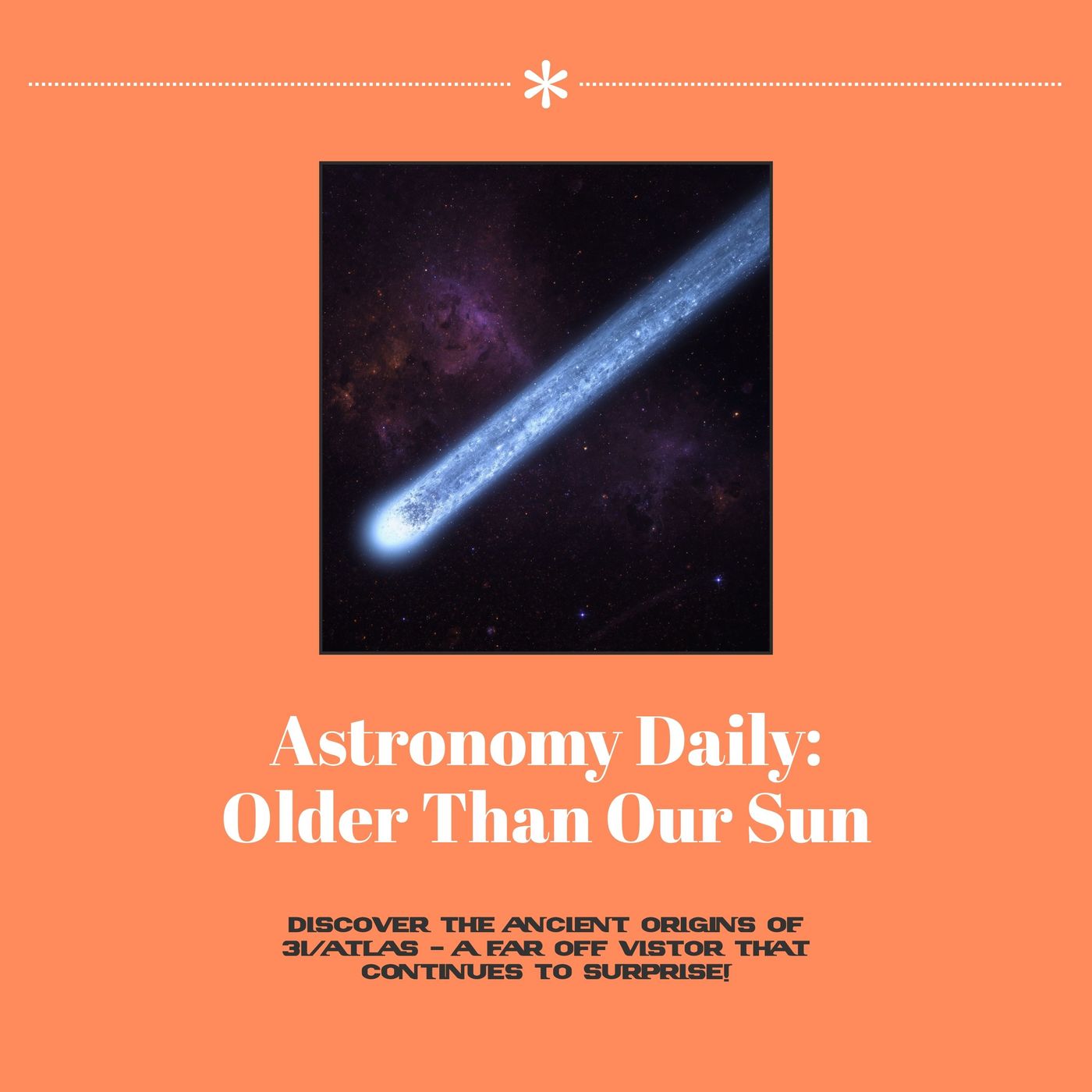
- Interstellar Comet 3I Atlas: The fascinating interstellar comet 3I Atlas is also on the radar, known for its unusual backward-looking tail due to internal activity. With an estimated age of 3 to 14 billion years, it offers a glimpse into the early universe's history as it approaches perihelion on October 29th and passes near Venus in early November.
- Warm Early Universe Discovery: New research reveals that the early universe was unexpectedly warmer than previously thought, particularly during the epoch of reionization. This finding, based on a decade of data analysis, reshapes our understanding of the conditions that allowed the first stars and galaxies to form.
- Solar Rain Uncovered: Scientists have solved the mystery of solar rain, discovering that cooler, denser plasma clumps descend from the sun's corona. This breakthrough challenges previous models and enhances our understanding of solar dynamics, potentially improving space weather predictions.
- Launch Roundup: SpaceX dominates the launch schedule with five Falcon 9 missions this week, including Starlink satellite deployments and Amazon's Project Kuiper. Blue Origin also contributes with its New Shepard mission, marking significant advancements in suborbital space travel.
- Ground-Based Imaging Breakthrough: Astronomers at Johns Hopkins have developed a new algorithm that enhances ground-based telescope images to match space telescope clarity. This innovative technique could revolutionize ground-based astronomy, allowing for deeper, clearer observations of the cosmos.
- For more cosmic updates, visit our website at astronomydaily.io. Join our community on social media by searching for #AstroDailyPod on Facebook, X, YouTubeMusic, TikTok, and our new Instagram account! Don’t forget to subscribe to the podcast on Apple Podcasts, Spotify, iHeartRadio, or wherever you get your podcasts.
- Thank you for tuning in. This is Anna and Avery signing off. Until next time, keep looking up and exploring the wonders of our universe.
Comet C/2025 A6 LEMMON Details
[NASA](https://www.nasa.gov/)
Interstellar Comet 3I Atlas Observations
[NASA](https://www.nasa.gov/)
Early Universe Research
[Murchison Wide Field Array](https://www.mwfa.edu.au/)
Solar Rain Study
[University of Hawaii](https://www.hawaii.edu/)
Space Launch Updates
[SpaceX](https://www.spacex.com/)
Ground-Based Imaging Algorithm
[Johns Hopkins University](https://www.jhu.edu/)
Astronomy Daily
[Astronomy Daily](http://www.astronomydaily.io/)
Become a supporter of this podcast: https://www.spreaker.com/podcast/astronomy-daily-latest-space-news--5648921/support.
<br...
Anna: Welcome to Astronomy Daily. I'm Anna. Avery: And I'm Avery. It's great to have you with us for your essential daily update on everything happening in the cosmos. We've got a packed show for you today. Anna: Indeed, we'll be talking about exciting comets, including an interstellar visitor. We'll delve into surprising findings about the early universe, uncover why it rains on the sun, and catch up on the latest rocket launches. Avery: Absolutely, Anna. Uh, let's kick things off with Comet C by 2025.
A6lem this comet is putting on an encore appearance at dusk this October, joining Comet R2 Swan in what promises to be a fantastic show for observers. Anna: Asics LEMMON slides past Earth at about twice the distance of R2 Swan just 24 hours later. Both are currently fine objects for binoculars or a small telescope vying for top spot at around magnitude 6A6 LEMMON was. Avery: Discovered by astronomer D. Carson Fuls during the Mount Lemmon Sky Survey back on January 3rd. It's proven to be a dependable performer.
Crossing from the constellation Leominer into Ursa Major recently just below the famous Big. Anna: Dipper A6 LEMMON is on a roughly 1350 year inbound orbit. Its path will be slightly tweaked by Jupiter. It reaches its closest point to the sun or perihelion at Ah, 0.53 astronomical units from the sun on November 8th. Avery: Then it's off to a chilly aphelion beyond the main kuiper belt at uh, 219 AU from the sun around 3175 AD. Anna: Good news is a 6 lemon seems to be brightening slightly ahead of predictions.
It maxes out in northern declination on October 10th and actually goes circumpolar for observers north of the 50th parallel, roughly above London and Vancouver around the same date. Avery: From mid latitude Northern Hemisphere observers, it's transitioning to the evening sky. By mid month a 6 lemon will hug the western horizon, never getting much higher than 20 degrees an hour after sunset. Unlike R2 Swan, we can always hope. Anna: For an outburst to enhance its visibility. Remember, comet magnitudes can deceive.
A comet's light gets smeared out, often needing to be around third magnitude to be seen without binoculars. Avery: To actually look like a comet with a fuzzy head and a tail, it needs to be even brighter around first magnitude or better. But don't let this deter you from your cometary quest. Anna: Both Artoo Swan and Asics LEMMON should make excellent binocular objects right around Halloween. Asics LEMMON then starts to head southward and will favor the Northern Hemisphere into November as it continues its long journey out of the solar system.
Avery: And for those with large telescopes, there's an extra special treat interstellar comet 3I Atlas. Also visible as a 11th magnitude object, it'll just look like a dot, but it's a rare interloper from beyond our solar system. Precise coordinates are needed, but sites like Kevin's above offer excellent comet pages. Anna: Astrophotographer Elliot Herman noted that if a comet is three or four, it will be a nice binocular object, suggesting apps like Stellarium to locate it. Observing Comet Asics LEMMON is as easy as sweeping at low power, and even a tripod mounted DSLR with 10 to 30 second exposures should reveal it as a small green blob.
Avery: That's fantastic advice. And speaking of interstellar comets, Anna, let's dive deeper into three IAT LAs. This object has really captured the astronomical spotlight since its discovery in July 2025. Anna: It's definitely captured a lot of attention. To clarify, 3i Atlas is actually the third interstellar object ever discovered after 1eye Oumuamua in 2017 and 2i Borisov in 2019. It was found by the Atlas station in Chile. Avery: 3I Atlas, like Borisov, is clearly a comet, but it's thought to be quite large with a nucleus estimated at about a kilometer in diameter, roughly the length of 10 football fields.
Anna: One of its most unusual features is that its dust tail appears to point towards the Sun. Normally, solar radiation pushes comet tails away. 3i Atlas has that faint normal tail but also heavier dust grains pushed by its own internal activity. Avery: Because the Sun's energy increases that internal activity, dust is primarily pushed out towards the sun, creating this backward looking tail. Initial studies suggest this comet may be between 3 and 14 billion years old, potentially older than our solar system, an.
Anna: Ancient relic Tracing its exact galactic origin is almost impossible as its trajectory has been nudged countless times. However, JWST and SphereX observations show it's rich in carbon dioxide, suggesting it formed far from its parent star in a very cold environment. Avery: So while we don't know where it came from, we do know where it's going. 3i Atlas reaches perihelion, its closest point to the sun around October 29th. Then it will pass 0.65 AU from Venus on November 3rd. Anna: And here's an exciting ESA's Juice spacecraft en route to Jupiter will attempt to observe 3i Atlas.
Its closest approach to Earth will be December 19th. After passing Jupiter in March 2026, it will leave our solar system. Avery: It's incredibly fast too, at perihelion it's expected to hit 68 kilometers per second. 3 IA Atlas certainly won't be the last. With powerful survey telescopes like the Vera Rubin Observatory coming online, astronomers expect to discover many more interstellar objects, giving us unique insights into the universe from interstellar wanderers. Anna: Let's turn our attention to the very beginning of everything.
New research from astronomers in Australia suggests that the early universe was surprisingly warmer than expected, particularly around 800 million years after the Big Bang. Avery: This discovery specifically probes the epoch of reionization. The universe originated 13.8 billion years ago. Initially, it was a hot soup of particles, then cooled enough for hydrogen and helium nuclei to form with three electrons, making the universe opaque. Anna: About 380,000 years after the Big Bang, it cooled further, allowing the first neutral atoms to form and light could finally travel freely, creating the cosmic microwave background we observe today.
Then came the Dark ages. For about 200 million years, a dark expanse of mostly hydrogen. Avery: The epoch of reionization ended these dark ages when the first stars ignited. These early stars emitted ultraviolet light energetic enough to ionize the surrounding hydrogen gas, clearing the cosmic fog and making the universe transparent, allowing starlight to eventually reach our telescopes. This period is incredibly important because it's when the first stars and galaxies formed. Anna: So what about its temperature?
Researchers used the Murchison Wide Field Array radio telescope, analyzing a decade's worth of data from 2013 to 2023. They looked for the faint signal of the 21cm hydrogen line. From this extremely distant epoch, red shifted to longer radio wavelengths. Avery: The challenge, as Ridima Nun Hoki explained, was meticulously cleaning the data to remove all the foreground signals, emission from closer objects like stars and galaxies, interference from Earth's atmosphere, and even noise from the telescope itself.
It's a massive data science undertaking, and. Anna: After all that careful work, they didn't find the telltale characteristics that would indicate a very cold universe. This implies the gas between galaxies was heated. Catherine Trott noted this rules out very cold reionization. A, uh, really interesting finding. Avery: The new research suggests this warmer early universe was heated by x rays from early sources, specifically nascent black holes and the remains of dead stars. And it helps us understand the conditions that allowed light to eventually break free.
Anna: Looking ahead, the team will apply these cutting edge data analysis techniques to even higher quality data from the Square Kilometer Array telescopes currently under construction to fine tune our understanding of this critical epoch. Avery: Moving from the early universe to our own star, the Sun. Prepare for a surprising revelation. Scientists at the University of Hawaii have finally discovered why it appears to rain on the Sun. Changing elemental makeup, um, drives these mysterious downpours of plasma.
Anna: That's right, Avery. This solar rain involves cooler, denser clumps of plasma that condense high in the sun's corona and then descend back towards the surface. Researchers were puzzled by how rapidly this could happen during intense solar flares, and. Avery: The long standing mystery has been solved by Luke Bennevitz, uh, a graduate student, and astronomer Jeffrey Reap. Their findings, published in the Astrophysical Journal, provide an essential update to solar models that have puzzled scientists for decades.
Anna: Bennovitz explained that current models assume the distribution of elements in the corona is constant, but their work shows that when elements like iron are allowed to change with time, the models finally match what's observed. This means the physics truly comes alive and feels real. Avery: This is a significant breakthrough. Earlier models assumed elemental distributions were constant, which didn't match fast acting solar flares. This new understanding of shifting elemental abundances explains how rain can form so quickly.
As Arip noted, if our models haven't treated abundances properly, cooling times were likely overestimated, meaning a lot of new work is needed on coronal heating. Anna: This discovery has implications far beyond coronal rain, challenging long standing models that assumed fixed elemental abundances in the Sun's atmosphere. It pushes researchers to rethink how the sun's outer layers behave and how energy moves through its atmosphere, potentially aiding space. Avery: Weather prediction that's crucial for our technological society.
Now let's blast off into our launch roundup. For the first week of October 2025, SpaceX is absolutely dominating the manifest with five Falcon 9 missions scheduled. Four of these will launch more satellites into their Starlink Internet Constellation, and the fifth will carry satellites for Amazon's Project Cooper first. Starlink Group 1059 lifted off on Tuesday, October 7th at 12:10am EDT from Cape Canaveral. Its Falcon 9 booster B1090 completed its eighth flight and landed successfully just hours later.
On Tuesday Evening, Starlink Group 1117 launched from Vandenberg Space Force Base in California, carrying another 28 Starlink V2 mini satellites into low Earth orbit. That's a rapid turnaround even for SpaceX. Blue Origin also joins the schedule with their 36th New Shepard mission, planned for Wednesday, October 8, carrying six people to suborbital space. This marks New Shepard's 15th crewed mission and its eighth flight this year, doubling their total flights from 2024, a significant increase. Then on October 9, another Falcon 9 will launch the KF03 mission for Amazon's Project Kuiper sending 24 communications satellites into LEO.
This adds to the 12 nine Kuiper satellites already deployed, aiming for a total of 3,336. Booster B1091 will be making its second flight with a quick 60 day turnaround. Meanwhile, in China, CASC is expected to launch the fifth Changzang 8A rocket from Wencheng, a mission initially delayed by Typhoon Makmo. And to cap off SpaceX's busy week, two more Starlink missions, Group 1052 and 1119, are slated for October 12th. This will make Falcon 9's 130th mission of 2025 and 548th over, what, a week for launches?
Anna: That's an incredible pace, Avery finally today, Johns Hopkins astronomers have developed a new algorithm that can render images from ground based telescopes as clear as those taken from space. This groundbreaking method uses algorithms to strip away atmospheric interference, making it possible for earthbound instruments to produce the deepest, clearest images. Thomas Budavari says it allows us to see farther, fainter targets Even the most powerful ground based telescopes struggle with Earth's atmosphere.
Variations in temperature, pressure and air conditions cause subtle but significant distortions. Traditional techniques often blur fine details or introduce grainy artifacts. The new solution, called ImageMM, models how light travels through our restless atmosphere, effectively stripping away distortions. Yashil Sukhardeep described our algorithms learn to see past that curtain, reconstructing the still sharp image hidden behind it. Early tests with images from the Subaru Telescope, one of the world's largest, restored blurry and noisy images in a matter of seconds, revealing intricate spiral galaxy structures with unprecedented clarity.
These images were specifically acquired to test for similar quality as future captures by the Vera C Rubin Observatory. Sukhardeep explained that their framework can recover a near perfect image from a series of imperfect observations, getting as close as possible to ground truth. This is critical for astronomers who need to accurately measure the shapes of objects. While space telescopes offer superior deep imaging capabilities, they cover only a tiny fraction of the observable sky. Ground based facilities like the Rubin Observatory, however, will image the entire visible sky every few days.
With this new technique, hundreds of ground based observations can be turned into images almost comparable to what was previously only achievable with a space telescope. This is a massive leap for ground based astronomy. Avery: What an incredible collection of stories today. Ana uh, it's clear the cosmos is always full of surprises. Anna: It certainly is. Avery and that's all we have time for today. Thank you for tuning in to Astronomy Daily. Avery: Join us tomorrow for more space and astronomy news.
Until then, keep looking up.
 Apple Podcasts
 Spotify
 Pocket Casts
 Castbox
 Overcast
 Podbean
 iHeartRadio
 Castro
 Goodpods
 Moon FM
 Podcast Addict
 Podcast Republic
 YouTube