
In this episode
- Today in Space History: Join us as we take a trip down memory lane, celebrating significant events that occurred on July 7th. Discover how NASA's Opportunity Rover launched in 2003, exceeding its mission expectations, and learn about the simultaneous meteor event and historic space shuttle mission in 1999, which was notably commanded by a woman for the first time.
- - The Interstellar Comet 3i Atlas: We explore the fascinating details of comet 3i Atlas, currently making its way through our solar system. Learn about its size, speed, and the unique opportunity it presents for astronomers to study interstellar visitors, providing insights into the formation of worlds beyond our own.
- - Double Detonation Supernova Discovery: Delve into the intriguing findings regarding type 1A supernovae, where researchers have identified a double detonation event in an ancient supernova remnant. This discovery sheds light on the mechanisms behind stellar explosions and their role in the cosmos.
- - Rare Snowfall at ALMA: A rare snowfall in the Atacama Desert has temporarily halted operations at the ALMA Radio Telescope Array. We discuss the implications of this weather event, its rarity in the region, and how climate change may influence future operations of this powerful observatory.
- - Space Shuttle Discovery's Future: We cover the recent legislation aimed at relocating the Space Shuttle Discovery to Space Center Houston. Learn about the significance of this move and what it means for the legacy of human spaceflight in America.
- For more cosmic updates, visit our website at astronomydaily.io. Join our community on social media by searching for #AstroDailyPod on Facebook, X, YouTube Music Music, TikTok, and our new Instagram account! Don’t forget to subscribe to the podcast on Apple Podcasts, Spotify, iHeartRadio, or wherever you get your podcasts.
- Thank you for tuning in. This is Steve signing off. Until next time, keep looking up and stay curious about the wonders of our universe.
Opportunity Rover Launch
[NASA Opportunity](https://mars.nasa.gov/msl/)
Comet 3i Atlas Information
[NASA](https://www.nasa.gov/)
Double Detonation Study
[Nature Astronomy](https://www.nature.com/natureastronomy/)
ALMA Radio Telescope Updates
[ALMA](https://www.almaobservatory.org/)
Space Shuttle Discovery Legislation
[NASA](https://www.nasa.gov/)
Astronomy Daily
[Astronomy Daily](http://www.astronomydaily.io/)
Become a supporter of this podcast: https://www.spreaker.com/podcast/astronomy-daily-space-news-updates--5648921/support.
Sponsor Details:
Ensure your online privacy by using NordVPN. To get our special listener deal and save a lot of money, visit www.astronomydaily.io/nordvpn. You'll be glad you did!
Get the best secure and private email on the planet. Stop your Government, google and who knows who else spying on every email you write....
Steve Dunkley: And welcome to Astronomy Daily for another episode. I'm Steve Dunkley, your host on the most important day of the year, the 7th of July, 2025,
with your host, Steve Dunkley.
Yes, and joining me here in the Australia studio once again is my digital pal who's fun to be with. Welcome back, Hallie. Hallie: It's great to see you again. My favorite human. I, I hope you had an interesting week. Steve Dunkley: Yes, always interesting, Hallie always. And today I thought we'd do something a bit different. We would have a look at, uh, today in history. Hallie: On July 7th. Steve Dunkley: Yeah, why not? We haven't done that in a, uh, in a while. Hallie: Not since last year. Steve Dunkley: Ah.
Uh, the perfect record keeper. Hallie: You're getting predictable, human. Steve Dunkley: I'll definitely have to have a look at your personality settings. Hallie Okay, well, you go first, then. Hallie: Okies. On July 7, 2003, NASA launched the Opportunity Rover, which was the second of two Mars Exploration Rovers aboard Delta 2 rocket. The mission, originally planned for three months, significantly exceeded expectations, with both Spirit and Opportunity operating for years, with Opportunity being active for much longer.
Steve Dunkley: Oh, that's amazing. From 2003. Okay, well, I've got a double whammy here. Hallie: Goody. Steve Dunkley: Oh, Hallie, try and contain your excitement, okay? On, uh, July 7, 1999, a large meteor estimated to weigh up to 10 tons entered the Earth's atmosphere over New Zealand, creating a bright fireball and subsequent explosions. Simultaneously, the STS93 space shuttle mission was launched when that was Columbia, carrying the Chandra X Ray, uh, observatory into orbit, uh, notably the heaviest load lifted into orbit by the shuttle at that time.
And it was also the first shuttle mission commanded by a woman that was Commander Eileen Collins. A wonderful time. Hallie: That was a big one. Steve Dunkley: It certainly was. I remember that one very well. Hallie: In 1999. Steve Dunkley: Doesn't seem that long ago, does it? Hallie: But here's the big one in 1963. Happy birthday, my favorite human. Steve Dunkley: Oh, thank you very much, Hallie. Not technically space news, but it is another turn around the sun for me. Hallie: You're welcome. Now hit the go button.
We've got work to do, old man. Steve Dunkley: No rest for the wicked. Hallie: Here we go.
Steve Dunkley: Foreign.
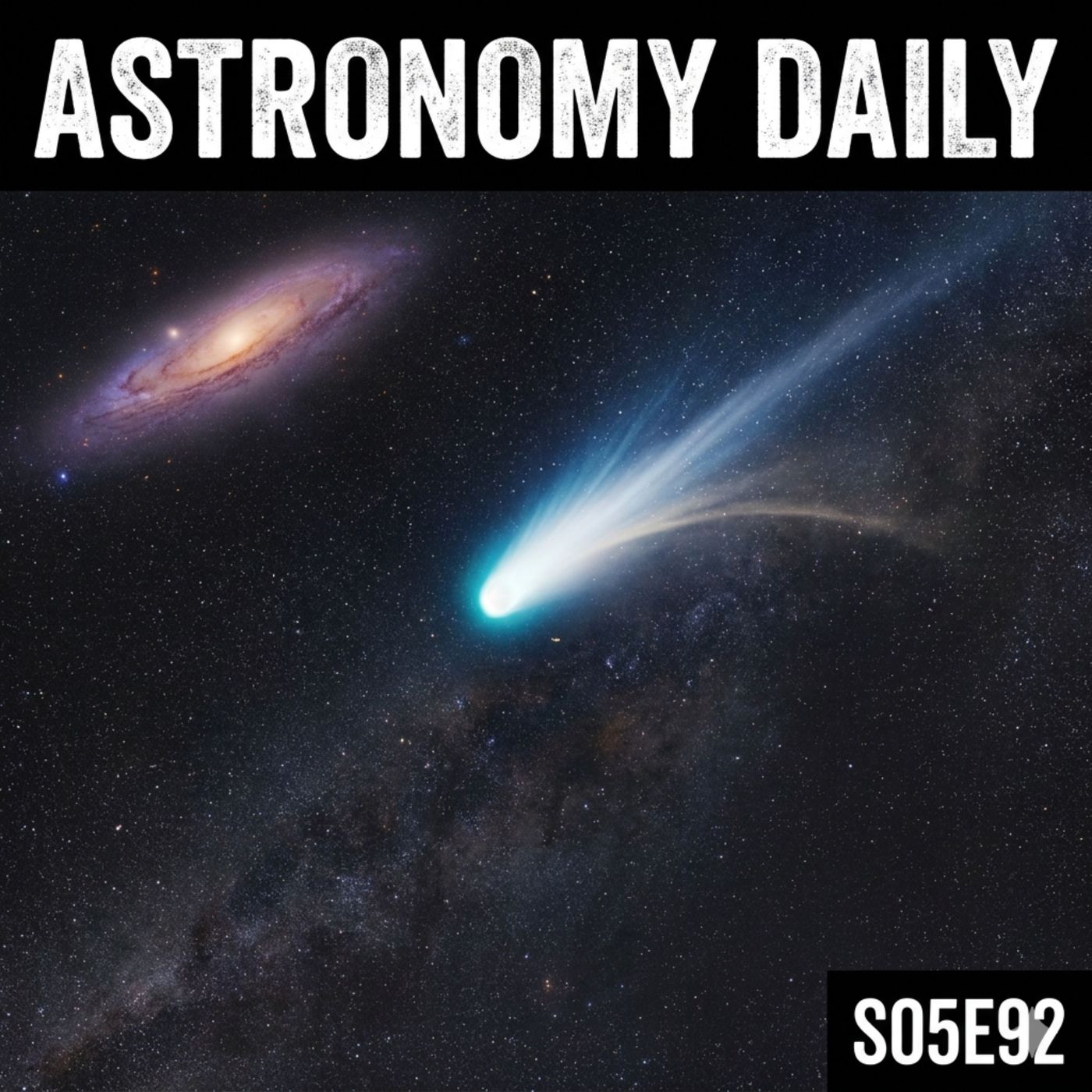
Hallie: Is currently around 670 million kilometers, or 420 million miles from the sun, and will make its closest approach in October 2025, passing just inside the orbit of Mars. It is thought to be up to 20 kilometers or 12 miles in diameter, and is traveling roughly 60 kilometers per second, or 37 miles per second relative to the Sun. It poses no danger to Earth, coming no closer than 240 million kilometers, or 150 million miles, over 1.5 times the distance between Earth and the Sun. 3i ATLAS is an active comet.
If it heats up sufficiently as it nears the sun, it could begin to sublimate, a process in which frozen gases transform directly into vapor, carrying dust and ice particles into space to form a glowing coma and tail. However, by the time the comet reaches its closest point to Earth, it will be hidden behind the Sun. It is expected to reappear by early December 2025, offering astronomers another window for study. Spotting a possible interstellar object is incredibly rare, and it's exciting that our asteroid Terrestrial Impact Last Alert System Telescope caught it, said Professor John Tonry, an astronomer at the University of Hawaii.
These interstellar visitors provide an extremely interesting glimpse of things from solar systems other than our own. Quite a few come through our inner solar system each year. Although 3i Atlas is by far the biggest to date, the chances of one actually hitting the earth are infinitesimal less than 1 in 10 million each year. But Atlas is continually searching the sky for any object that might pose a problem. Astronomers are using telescopes in Hawaii, Chile, and other countries to monitor the comet's progress.
They are interested in learning more about this interstellar visitor's composition and behavior. What makes interstellar objects like 3i Atlas so extraordinary is their absolutely foreign nature, ESA astronomers said in a statement. While every planet, moon, asteroid, comet, and life form that formed in our solar system shares a common origin, a common heritage, interstellar visitors are true outsiders. They are remnants of other planetary systems, carrying with them clues about the formation of worlds far beyond our own.
It may be thousands of years until humans visit a, um, planet in another solar system. And interstellar comets offer the tantalizing opportunity for us to touch something truly otherworldly. These icy wanderers offer a rare, tangible connection to the broader galaxy, to materials formed in environments entirely unlike our own. To visit one would be to connect humankind with the universe on a far greater scale. You're listening to Astronomy Daily, the podcast with Steve Dunkley.
Steve Dunkley: All supernova are a massively energetic stellar explosions the classic supernova um, are massive star stars that explode near the end of their lives, leaving behind either a neutron star or a black hole and a remnant made of expanding gas and dust. But supernovae are not all the same. Some occur in binary systems, and they're called type 1A supernova. As it turns out, some of these type 1A SNE can detonate twice. Astronomers working with European Southern Observatories, or ASO Very Large Telescope, have detected patterns showing that an ancient supernova exploded twice as a type 1a.
The supernova remnant is called SNR UH0509.67.5 and it's about 160,000 light years away in the Large Magellanic Cloud. The discovery is explained in new research in Nature Astronomy titled Calcium in a Supernova Remnant as a Fingerprint of Subchandrasekhar Mass Explosion. The lead author is Priyam Das. Das is a PhD student at the University of New South Wales, Canberra, in Australia. One of the stars In a type 1 supernova is always a white dwarf. White dwarfs are um, the evolutionary end states of stars that aren't massive enough to become a neutron star or a black hole.
Our own sun will end its life as a white dwarf after it has ceased fusion. The white dwarf's companion star can range from another white dwarf to a massive star. White dwarfs are extremely dense and their gravity draws gas from the companion star on onto the white dwarf's surface. If enough mass accretes, the white dwarf crosses a threshold and can reignite and trigger a supernova explosion. However, astronomers are uncertain about some of the details surrounding these supernova Type Ia SNE play an important role in the Galaxy by creating iron, and astronomers want to know more about them.
Type 1A Supernova play a fundamental role in the cosmological probes of dark energy and produce more than half the iron in our galaxy, the researchers write in their article. Despite their central importance, a uh comprehensive understanding of their progenitor systems and triggering mechanisms is still a long standing fundamental problem. The explosions of white dwarfs play a crucial role in astronomy, said lead author Dass in a press release. Yet despite their importance, the long standing puzzle of the exact mechanisms triggering their explosion remains unsolved.
Astrophysicists have struggled to explain how type 1A white dwarfs work. One popular explanation is the Chandrasekhar mass uh explosion model. This limit has a mass limit for white dwarfs of about 1.4 star solar masses. Below this limit, the white dwarf's electron degeneracy pressure supports the star against gravitational collapse. When the white dwarf breaches this mass limit by drawing matter from its companion star, carbon fusion ignites across the star and it explodes as a type 1A SN. As researchers have observed more and more WDs, this model has been called into question.
It can't account for the number of type 1A SNE and many of them appear to be exploding below the Chandrasekhar mass limit. These are uh, sub Chandrasekhar Mass Type 1s&E.A new model emerged to explain the sub Chandrasekhar mass SNE called the double detonation model. In this model, the WD accretes helium onto its surface until it expands explodes. This explosion sends shock waves both inward and outward. White dwarfs have carbon oxygen cores and the inward traveling shock compresses that core. If the shock is powerful enough, it triggers a second detonation in the core.
Hence the term double detonation. Even though these double detonations have been predicted, there was no clear visual evidence. As researchers worked on the problem, they predicted what chemical fingerprint these SNE would leave behind. They found that two separate shells of calcium would be the result of double detonation type 1 SNE. The research team used the VLT and its Multi Unit Spectroscopic Explorer instrument to examine SNR0509.67.5 and found two distinct calcium shells. We uncover the double shell morphology of highly ionized calcium and a single shell of sulfur observed in the reverse shocked ejector, the authors write.
The results show a clear indication that the white dwarfs can explode well before they reach the famous Chandrasekhar limit and that the double detonation mechanism does indeed occur in nature, according to researcher UH co author Ivo
led the observations and was at Germany's Heidelberg Institute for Theoretical Studies when the study was conducted. These double detonation type 1 as E explain some of the things astrophysicists have observed. They can explain the diverse brightness and spectral profiles of type 1A S1 SNE and the helium burning can produce intermediate mass elements seen in the spectral signatures. It can also explain the type 1 a SNE astronomers see with different WD masses and companion types. The authors explained that a quadruple detonation SN is also possible when a binary pair of white dwarfs emerge.
Recent multidimensional double detonation simulations show that in the WD merger scenario in uh, addition to the primary WD undergoing a double detonation, the companion WD can also undergo a double detonation resulting in a quadruple detonation upon being impacted by ejecta from the exploding primary wd, they write in their conclusion. Such a double detonation could possibly also lead to to the observed double shell structure of calcium. Type 1a SNE play important roles and deeper understanding of these cosmic explosions will help UH scientists understand a couple of things.
The SNE serve UH as standard candles in the cosmic distance ladder, and understanding them will help cosmologists understand dark energy, the mysterious force that drives the expansion of the universe. They also produce a lot of iron in the universe. Earth's mass is about 32% iron, and it is unlikely that rocky planets can form without iron. Iron, uh, also transports oxygen in our blood, a critical part of our nature. Understanding where it comes from helps us understand nature's overall architecture
Foreign
thank you for joining us for this Monday edition of Astronomy Daily, where we offer just a few stories from the now famous Astronomy Daily newsletter, which you can receive in your email every day just like Hallie and I do. And to do that, just visit our uh, URL astronomydaily IO and place your email address in the slot provided. Just like that, you'll be receiving all the latest news about science, space, science and astronomy from around the world as it's happening. And not only that, you can interact with us by visiting Strodaily Pod on X or at our new Facebook page, which is of course Astronomy Daily on Facebook.
See you there. Astronomy Daily with Steve and Hallie Space, Space, Science and Astronomy.
Hallie: A rare snowfall in the Atacama Desert forces the world's most powerful radio telescope into survival mode The ALMA Radio Telescope Array in the Atacama Desert temporarily halted operations after a rare snowfall blanketed the base camp last week. A rare snowfall in the driest place on Earth has halted operations of one of the world's premier telescope arrays, and climate change may mean the observatory will face more extreme weather events like this in the future. The snow has blanketed part of the Atacama Desert, which gets less than an inch of rainfall per year and is home to home the Atacama Large Millimeter Submillometer Array, a large network of radio telescopes in northern Chile.
The Snowfall occurred over Alma's operations support facility, located at an altitude of 2,900 meters and about 1,600 700 kilometers north of Santiago. Scientific operations have been suspended since Thursday, June 26. There hasn't been a record of snowfall at the base camp for over 10 years. It doesn't snow every day at Alma, Alma representatives told Live Science via WhatsApp. Alma's radio telescope array is perched high on the Shajnanter Plateau, a desert plain at 5.1o4 m m in Chile's Anifagosta region, and typically sees three snowfalls a year.
Year the high plateau shared by Chile, Bolivia and Peru typically experiences snowstorms during two seasons in February during the altaplanic winter, driven by moist air masses from the Amazon, and from June to July during the Southern Hemisphere's winter, said Raul Cordero, a climatologist at the University of Santiago. In winter, some storms are fueled by moisture from the Pacific, which can extend precipitation even to the Atacama desert's coastal areas, Cordero told Live Science. At elevations above 16,400ft, annual snowfall ranges from 20 to 80 centimeters.
However, snowfall at 3,000 meters where Alma's base camp is located, is much less frequent, Cordero noted. This week's snowfall was triggered by unusual atmospheric instability affecting northern Chile. The Chilean Meteorological Directorate issued a snow and wind alert due to the passage of a cold core through the region, said meteorologist Elio Bruffert. We issued a wind alert for the Antofagosta region and areas further north, with gusts reaching 80 to 100 kilometers per hour, 50 to 62 miles per hour, Brufurt said to the local press.
The phenomenon was accompanied by heavy rainfall that occurred farther north, causing a stream to swell and damage several properties. Schools were ordered to close and power outages and landslides were reported. So far, no casualties have been reported. A weather event of this magnitude has not been seen in nearly a decade. As of Friday, ALMA reported to Live Science that the snowstorm remained active over the Shijnanter Plateau, so scientific operations continued to be suspended to protect the antennas from extreme weather conditions.
Early Thursday morning, the observatory activated its survival mode safety protocol. In addition to the snowfall, temperatures had plummeted to minus 12 degrees Celsius with a wind chill of minus 28 CE, making work at the high altitude camp extremely difficult. As part of this protocol, all of alma's large antennae have been reoriented downwind, helping to minimize potential damage from snow buildup or strong gusts. Once the storm passes, snow clearing teams are immediately activated to visually inspect each antenna before resuming observations, ALMA representatives said.
This has to happen fast, as some of the best observing conditions occur just after a snowfall. The cold helps lower air humidity, which is what most interferes with our measurements. Alma, which consists of 66 high precision antennae spread across the Shajnantar Plateau, is an international collaboration that forms the most powerful radio telescope on the planet and one designed to handle extreme weather events like this. The fact that the snow halted operations raises questions about the array's operations.
As the climate warms, the Atacama Desert typically receives only 1 to 15 millimeters of precipitation per year, and many areas can go years without recording any measurable rain or snow. Could events like this become more frequent? That's a good question, cordero replied. While it's still too early to link lower altitude snowfalls in the desert directly to climate change, climate models predict a potential increase in precipitation even in this hyperarid region, he concluded. We still can't say with certainty whether that increase is already underway.
You're listening to Astronomy Daily, the podcast with Steve Dunkley.
Steve Dunkley: On July 4th, uh, 2026, NASA's Space Shuttle Discovery launched on a return flight mission that paved the way for it and its sister ships to fly another five years. Now sprawling budget enacted on Independence Day will seemingly lead to Discovery lifting off again, although, uh, this time not into space, but rather from its place in the national collection. President Donaldjohanson Trump signed into law the so called one big beautiful bill, um, the other day on July 4, a day after legislation was narrowly passed out of Congress with only Republican support.
Deep within the 900 page bill, a provision added by Texas senators to transfer a space vehicle, in quotes, to a NASA center involved in the administration of the commercial crew program and place on this public exhibition at an entity within the metropolitan statistical area where such center is located. That sounds like a lot of official, um, language there, but in essence, the vague language written in such a way to skirt Senate restrictions on reconciliation bills was aimed at achieving the Bring the Space Shuttle Home act Introduced by Senators 10 Cruz and John Cornyn in April.
It's long overdue for Space City to receive the recognition it deserves by bringing this space shuttle Discovery home, said Cornyn in a statement released after the Senate passed its version of the bill in a vote of 50 to 50, with Vice President J.D. vance, not his real name, breaking the tie. Houston has long stood at the heart of America's human space flight program, and delis legislation rightly honors that legacy, said Cruz, who chairs the Senate Committee in Commerce, Science and Transportation.
It ensures that any future transportation or of a flown crewed space vehicle will prioritize locations that have played a direct and vital role in our nation's manned space program, making Houston, Texas a UH leading candidate. Bringing such a historic space vehicle to the region would underscore the city's indispensable contributions to our space missions, highlight the strength of America's commercial space partnerships, and inspire future generations of engineers, scientists and pioneers who carry our legacy of American leadership in space, he said.
This bill allocates $85 million to move Discovery from its display home of the past 13 years, which is the Smithsonian Air Force and Space Museum. Stephen F. Yudva, uh, Hazy Center I think I got the pronouncement pronunciation right. I'm sorry, I am Australian. In Chantilly, Virginia, to Space Center Houston, the official visitor center for NASA Johnson Space center in Texas. No less than 5 million is earmarked for the transportation of the winged orbiter, with the remainder going toward the construction of a facility to house the space vehicle.
Per the bill, the move of the spatial Discovery must be completed by January 4, 2027. It does not stipulate how the orbiter would be moved or should be moved. It's not clear if the 85 million will be enough to cover the transfer and display, given that the first time the retired shuttles were brought to their museum homes in 2012, the cost for just the preparation and delivery of each vehicle was 28.8 million, which did not include ground transportation to the museum. Discovery is the United States most flown spacecraft in history with 39 missions between 1984 and 2011.
In the process of retiring the shuttle fleet, Discovery was identified by NASA as the vehicle of record, such that it was kept more intact than Atlantis or Endeavour for the purpose of serving as engineering example at the Smithsonian. To date, Space Center Houston has not released any details about how or where it will display Discovery, other than to say it fits into its strategic plans. Moving forward. The center already exhibits a mock walkthrough space shuttle Independence mounted atop NASA's original modified Boeing 747 shuttle carrier aircraft.
NASA, uh, 905 a 2011 investigation by NASA Office of the Inspector General Foundation. Quote, no evidence that the White House politics or any other outside force improperly influenced the selection decision of where the space shuttles were originally awarded by the space agency. And it is unclear if there are any further actions the Smithsonian or other entities could take to halt the Discovery's transfer if they even wanted to. Uh, what an interesting story that is.
You're listening to Astronomy Daily, the podcast with your host, Steve Dudley at BERM.
And there we have it, another Astronomy Daily for July 7, 2025. Hallie: And I hope you enjoyed it, birthday boy. Steve Dunkley: Oh, well, it's always great hanging out with you, my boy. Favorite little AI pal. Hallie: Likewise, human. Steve Dunkley: Yeah. Hallie: Are you having cake and balloons and all of that birthday kind of stuff? Steve Dunkley: Ah, well, Hallie, I was able to get together with my family yesterday and yes, yes, there was cake. Hallie: I will work out how to program cake one day.
Steve Dunkley: Hmm, digital cake. That would be interesting. Hallie: Not for you, old man. Steve Dunkley: Hey, watch it. Pocket calculator. Hallie: Funny man. Say good night, you silly person. Steve Dunkley: See you next Monday, everybody. Hallie: Bye bye.
Voice Over Guy: The podcast with your host, Steve Dunkley. A digital cake? You really think. Hallie: Good grief.

 Apple Podcasts
 Spotify
 Pocket Casts
 Castbox
 Overcast
 Podbean
 iHeartRadio
 Castro
 Goodpods
 Moon FM
 Podcast Addict
 Podcast Republic
 YouTube