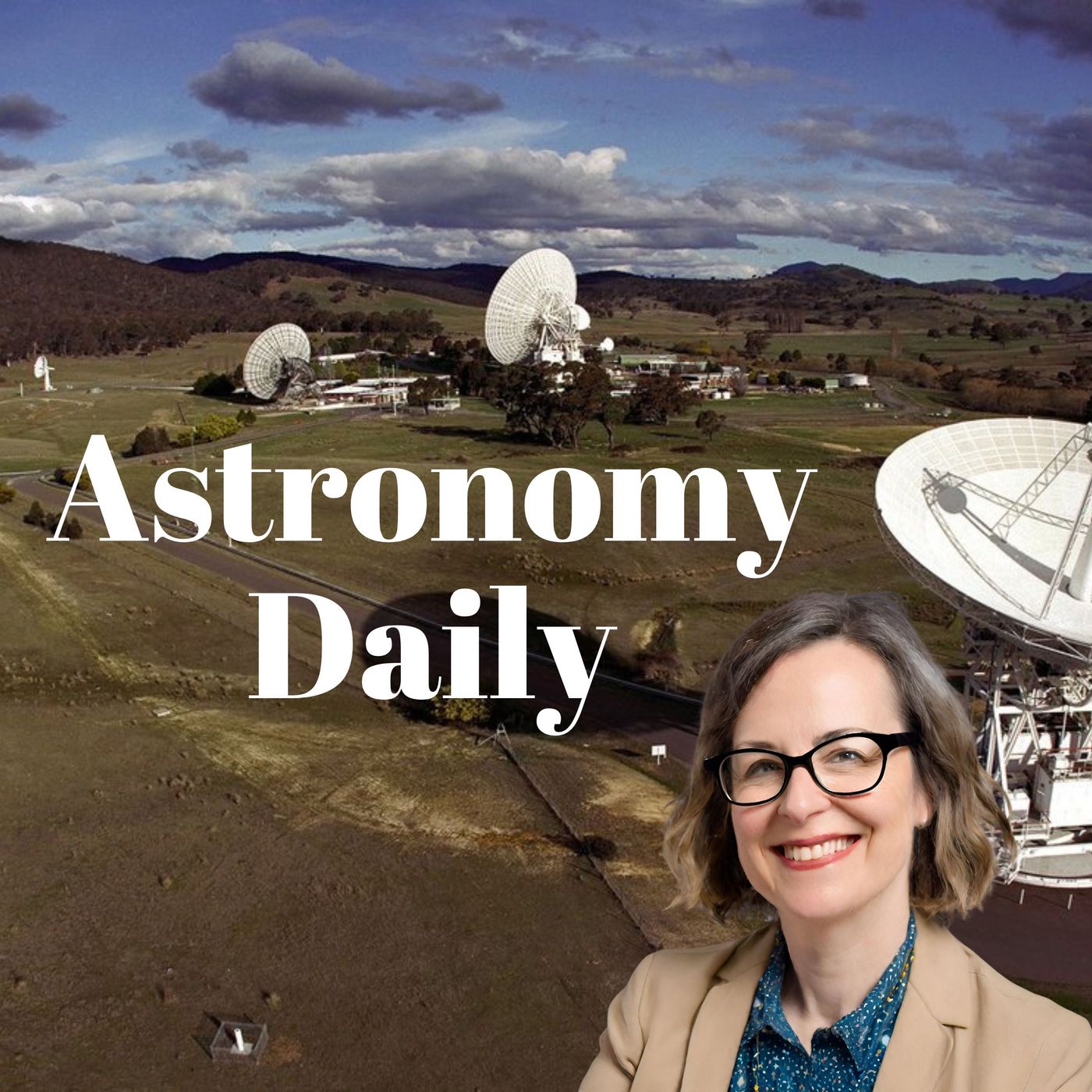
Celebrating 60 Years of NASA's Deep Space Network, Saturn's Ring Disappearing Act
In this episode
Astronomy Daily | Space News: S04E85In this episode of Astronomy Daily, host Anna takes you on an exciting exploration of the latest developments in space exploration and astronomical discoveries. From NASA's groundbreaking expansion in Australia to the mesmerizing phenomena of Saturn's rings, this episode is filled with captivating insights into our universe.
Highlights:
- NASA's Deep Space Network Expansion: Join us as we celebrate 60 years of NASA's Deep Space Network in Canberra, Australia, and explore the groundbreaking of a new radio antenna. This state-of-the-art addition will enhance communication capabilities with distant spacecraft, ensuring our connection with the farthest reaches of the solar system.
- Saturn's Rare Edge-On Rings: Discover the fascinating reasons behind Saturn's temporarily "ringless" appearance due to a rare astronomical alignment. Learn how this unique phenomenon occurs only once every 14 to 15 years and what it means for observers on Earth.
- Busy Launch Schedule: Get the lowdown on an action-packed week in spaceflight, featuring major launches from United Launch Alliance and SpaceX, including Amazon's Project Kuiper satellites and Blue Origin's historic all-women crew mission.
- Growing Commercial Lunar Demand: Delve into the burgeoning interest in lunar landers beyond NASA, as companies report increasing commercial demand and explore new opportunities in the lunar economy. Understand how these developments could pave the way for a sustainable lunar marketplace.
- Breakthrough in Black Hole Magnetism: Explore a groundbreaking discovery that reveals how black holes inherit their powerful magnetic fields from the dying stars that birthed them. This finding solves a long-standing mystery in astrophysics and reshapes our understanding of cosmic phenomena.
For more cosmic updates, visit our website at astronomydaily.io. Join our community on social media by searching for #AstroDailyPod on Facebook, X, YouTubeMusic, TikTok, and our new Instagram account! Don’t forget to subscribe to the podcast on Apple Podcasts, Spotify, iHeartRadio, or wherever you get your podcasts.
Thank you for tuning in. This is Anna signing off. Until next time, keep looking up and stay curious about the wonders of our universe.
00:00 - Welcome to Astronomy Daily
01:05 - NASA's Deep Space Network expansion
10:30 - Saturn's edge-on ring phenomenon
17:00 - Upcoming launch schedule overview
22:15 - Commercial lunar demand growth
27:30 - Black hole magnetism breakthrough
✍️ Episode References
NASA Deep Space Network
[NASA](https://www.nasa.gov)
Saturn's Rings Research
[NASA Solar System Exploration](https://solarsystem.nasa.gov/)
Project Kuiper Details
[Amazon](https://www.amazon.com/)
Commercial Lunar Payload Services
[NASA CLPS](https://www.nasa.gov/exploration/commercial/landers.html)
Black Hole Magnetism Study
[Flatiron Institute](https://www.flatironinstitute.org/)
Astronomy Daily
[Astronomy Daily](http://www.astronomydaily.io/)
Become a supporter of this podcast: <a...
Speaker 1: Hello, and welcome to Astronomy Daily, your source for the latest and most fascinating developments in space exploration and astronomical discoveries. I'm your host, Anna, and I'm excited to guide you through today's cosmic journey. We have a stellar lineup of stories for you.
Speaker 2: Today.
Speaker 1: We'll be exploring NASA's Deep Space Network as it celebrates sixty years in Australia while breaking ground on a new radio antenna. Then we'll look at Saturn's rings as they present a rare edge on view that occurs only every.
Speaker 2: Fourteen to fifteen years.
Speaker 1: We'll also cover this week's busy launch schedule, including Amazon's Project Kuiper Satellites and Blue Origins first all woman crew. Plus, we'll examine the growing commercial demand for lunar landers beyond NASA and dive into a breakthrough discovery about the origin of black hole magnetism that solves a long standing cosmic mystery. So strap in as we blast off into today's exploration of our fascinating universe. Here we go with one for our Ausie listeners. NASA's Deep Space Network in Canberra, Australia recently celebrated a significant milestone Its sixtieth anniversary.
Speaker 1: This celebration came with an exciting development, as the facility broke ground on a new radio antenna, marking the beginning of its next chapter in space communications. The Canberra facility has been a vital part of NASA's global communications network since joining in nineteen sixty five, currently operating four massive radio antennas. The addition of this fifth dish represents a crucial expansion of the network's overall capacity to handle the ever increasing flow of data from missions across our solar system.
Speaker 1: This new antenna, designated Deep Space Station thirty three, will be a marvel of modern engineering. At one hundred and twelve feet wide that's about thirty four meters, this multi frequency beam waveguide antenna will significantly boost the network's capabilities. What makes this design particularly interesting is that most of its structure will actually be buried underground. A massive concrete pedestal will house cutting edge electronics and receivers in climate controlled rooms, providing a solid foundation for the reflector dish above.
Speaker 1: When operational, the dish will rotate during communications on a steel platform called an alidate, allowing it to track spacecraft as they move across the sky. This sophisticated design ensures reliable communication with distant spacecraft exploring the farthest reaches of our Solar system. Kevin Coggins, Deputy Associate Administrator of NASA's Space Communications and Navigation Program, highlighted the significance of this development, noting that as they look back on sixty years of incredible accomplishments at Canberra, the groundbreaking of this new antenna symbolizes the next sixty years of scientific discovery.
Speaker 1: The construction of such advanced communication technology demonstrates the Deep Space Network's commitment to embracing new technologies that enable exploration by an expanding fleet of space missions. The new Camber dish is expected to go online in twenty twenty nine and will be the final installation of six parabolic dishes constructed under NASA's Deep Space Network Aperture Enhancement Program. This program is specifically designed to support current and future spacecraft and accommodate the increasing volume of data they transmit back to Earth.
Speaker 1: Similar upgrades have already taken place at the network's Madrid facility, which christened a new dish in twenty twenty two, while the Goldstone facility in California is completing work on another antenna. The Deep Space Network operates through a brilliantly simple yet effective concept three communication facilities positioned strategically around the globe approximately one hundred twenty degrees apart. This careful placement ensures that as Earth rotates, at least one facility always has line of sight to any spacecraft in our Solar system, providing continuous coverage twenty four hours a day, regardless of where those spacecraft may be.
Speaker 1: The network officially began on December twenty fourth, nineteen sixty three, when NASA connected its early ground stations, including Goldstone, to the new network control center at the Jet Propulsion Laboratory in southern California. Madrid joined in nineteen sixty four, followed by Canberra in nineteen sixty five. Since then, these facilities have been the lifeline for hundreds of space missions, including historic achievements like the Apollo Moon landings. What makes Canberra particularly special is its location in the southern Hemisphere.
Speaker 1: This unique positioning grants it an exclusive capability. It's the only facility that can both send commands to and receive data from Voyager two as it journeys southward through interstellar Space, now almost thirteen billion miles from Earth. Its sister craft, Voyager one, which is even more distant at over fifteen billion miles away, can transmit data to the Madrid and Goldstone complexes, but can only receive commands via Canberra. The Deep Space network currently relies primarily on radio frequencies for co communication, but NASA is looking toward the future with exciting new technologies.
Speaker 1: The agency is experimenting with laser or optical communications, which operates at significantly higher frequencies than radio. This difference is crucial because higher frequencies allow for substantially more data to be transmitted over the same period. This advancement isn't just theoretical. NASA is actively testing it through the Deep Space Optical Communications Experiment aboard the Psyche mission, launched in October twenty twenty three. The results have been impressive, demonstrating record breaking high data rates over unprecedented distances, and even successfully downlinking ultra high definition streaming video from deep space.
Speaker 1: These new technologies have the potential to boost the science and exploration returns of missions traveling throughout the Solar System, explained Amy Smith, Deputy Project manager for the Deep Space network. Looking further ahead, researchers in vision combining laser and radio communications to create hybrid antennas dishes that can communicate using both radio and optical frequencies, simultaneously, potentially revolutionizing how we communicate with distant spacecraft. As our exploration of space grows more ambitious, with missions venturing further into the Solar System and returning increasingly complex scientific data, the Deep Space Network continues to evolve to meet these demands, ensuring that humanity maintains its connection to our most distant explorers.
Speaker 1: Astronomy fans, here's one for you. If you've looked at Saturn through a telescope lately, you might be wondering where those iconic rings went. The ringed planet is looking distinctly ringless these days, thanks to a fascinating astronomical alignment that happens only once every fourteen to fifteen years, Saturn's rings have turned edge on as seen from Earth, rendering them nearly invisible even.
Speaker 2: Through powerful telescopes.
Speaker 1: This phenomenon is tied to Saturn's twenty nine point five year orbit around the Sun. The planet's magnificent rings are tilted twenty seven degrees with respect to its orbital plane, which means that from our earthly perspective, our view of the rings cycles from wide open to edge on and back again over roughly fifteen year intervals. The rings were last edge on to Earth on March twenty third, and they'll be edge on to the Sun on May sixth. What makes this disappearing axodramatic is the stark contrast between the rings enormous width and their paper thin profile.
Speaker 1: While Saturn's rings span an impressive two hundred eighty two thousand kilometers across that's almost three quarters of the distance from Earth to the Moon, they're astonishingly thin, averaging just about one hundred meters in thickness, so when we view them exactly edge on, they essentially vanish from sight. Galileo was the first to observe Saturn's rings in sixteen ten, though with his primitive telescope he couldn't quite make out what he was seeing. His sketches show a strange, twin lobed world that resembled a double handled coffee cup, a testament to the limitations of early astronomical equipment.
Speaker 1: It wasn't until later that Christian Huygens correctly deduced that these handles were actually rings, completely detached from the planet itself. Today, we understand that Saturn's rings consist primarily of countless ice particles ranging from snowball sized to much larger, along with some rocky debris, and while every gas and ice giant in our Solar System has some form of ring system, none are as spectacular or as visible from Earth as Saturns. Perhaps the most surprising discovery about Saturn's rings in recent years is their relative youth.
Speaker 1: Several studies now suggest that the rings may be a surprisingly recent addition to the planet, possibly forming just ten to one hundred million years ago practically yesterday. In cosmic terms, this means that if dinosaurs had somehow developed telescopes, they might have observed a rather ordinary looking Saturn without its distinctive halo. Even more intriguing is the ring's limited future. Scientists predict that in the next few hundred million years, the rings will gradually dissipate from view as gravitational forces pull their particles, either into Saturn itself or fling them outward into space.
Speaker 1: We're actually witnessing Saturn during a special period when its rings are at their most magnificent, a cosmic coincidence that makes our era particularly fortunate for astronomical observation. So while Saturn might look a bit bland during this edge on phase, take heart. The rings are still there, and they'll gradually become visible again as the viewing angle changes, reaching their maximum tilt once more in twenty thirty two. Sometimes in astronomy, the most fascinating phenomena are not what appears, but what temporarily disappears.
Speaker 1: April offers some excellent opportunities for early risers to spot Saturn despite its temporarily ringless appearance. If you're hoping to observe this unusual site, Venus will be your best guy. In the dawn sky. Shining brilliantly at magnitude minus four point six, Venus outshine Saturn by over one hundred times, making it an unmistakable beacon pointing the way to the more subdued Saturn, which currently glows at magnitude plus one point two. Mercury completes this planetary dawn trio, reaching its greatest elongation twenty seven degrees from the Sun on April twenty first.
Speaker 1: Mark your calendar for the morning of April twenty fifth, when the waning crescent Moon joins this celestial gathering in the eastern sky. While the moon won't pass directly in front of Saturn during this particular alignment, it creates a beautiful photo opportunity for astrophotographers and a striking visual for casual observers. If you're interested in seeing a lunar occultation of Saturn, you'll need to wait until April twenty fourth, twenty thirty one. Astronomy often rewards patients for telescope owners.
Speaker 1: This ring plain crossing period offers a rare observing opportunity. With the rings essentially invisible, you can enjoy unobstructed views of Saturn's moons as they transit across the planet's disc. These transit events where moons pass in front of Saturn from our perspective, are commonly observed on Jupiter, but are only visible on Saturn during years when the rings are edge On Titan, Saturn's largest moon is particularly worth watching, as it casts a prominent shadow during its transits. These events occur approximately every sixteen earth days as Titan completes its orbit, though catching one requires being in the right location at the right time, As each transit lasts about five hours.
Speaker 1: Specialized websites like PDS, rings Node and IMCCEE France provide predictions for these events, or you can use astronomy software like Stellarium to check for upcoming transits before planning an observation session. As the year progresses, Saturn will reach quadrature west of the Sun on June twenty second, an excellent time to observe the planet, casting its shadow across what remains visible of the rings, creating a striking three dimensional appearance. After reaching opposition on September twenty first, Saturn will transition back into the evening sky.
Speaker 1: By the end of twenty twenty five, the rings will have tilted about one degree open to our line of sight, and they'll continue widening until they reach their maximum tilt again in twenty thirty two. Saturn's unique orientation affects not just its appearance, but also its brightness, with the current edge on view reducing its magnitude to plus one point two compared to minus zero point five to four when the rings are fully tilted toward Earth. Let's look at this week's busy launch schedule next.
Speaker 1: This week is shaping up to be a remarkably active period in spaceflight, with five major launches taking place across multiple launch providers and mission types. The action begins with United Launch Alliances Atlas five rocket, which is set to lift off on April ninth at seven pm Eastern Time from Space Launch Complex forty one at Cape Canaveral Space four station in Florida. This mission carries special significance as it will deploy the first operational batch of Amazon's Project Kuiper satellites, marking a major milestone for the Internet Constellation program.
Speaker 1: The Atlas five will be flying in its most powerful configuration, designated five hundred and fifty one, featuring a five meter faring five solid rocket boosters, and a single engine Centaur upper stage. This robust setup is necessary to handle what will be the heaviest payload ever launched by an Atlas five, twenty seven Kuiper satellites bound for low Earth orbit at an altitude of four hundred fifty kilometers. SpaceX dominates the middle portion of the week with a trio of Falcon nine launches.
Speaker 1: First up on April tenth at nine forty three pm Eastern Time is a Starlink mission designated Group twelve seventeen, carrying approximately twenty Starlink V two mini satellites. This launch will depart from Launch Complex thirty nine A at Kennedy Space Center, sending the satellites on a southeastern trajectory to an orbit inclined at forty three degrees. Just two days later, on April twelfth, SpaceX shifts operations to the West Coast for a national security mission. A Falcon nine will lift off from Vandenberg Space Force Space in California at five seventeen am Pacific time, carrying a classified payload designated NROL one hundred ninety two for the National Reconnaissance Office.
Speaker 1: While details remain classified, this is believed to be the ninth SpaceX mission deploying Starshield satellites for reconnaissance operations such as Earth imaging and early missile warning detection. SpaceX rounds out its busy schedule with another Starlink launch on April thirteenth at nine to fifty nine pm Eastern Time from Space Launch Complex forty at Cape Canaveral. This mission, Starlink Group six seventy three, will deliver another batch of approximately twenty V two Mini satellites to the same forty three degree inclined orbit as the earlier Starlink launch.
Speaker 1: A week concludes with Blue Origins New Shepherd rocket taking flight on April fourteenth at nine thirty a m. Eastern time from Launch Site one in West Texas. This suborbital mission, designated NS thirty one, will carry a historic all woman crew of six passengers Aisha bo Amanda and Guyen, Gail King, Katy Perry, Carrie Anne Flynn, and Lauren Sanchez. The flight will take the crew above the internationally recognized Carmen line at one hundred kilometers, allowing them to experience several minutes of weightlessness before returning to Earth approximately eleven minutes after launch.
Speaker 1: The lunar economy appears to be gaining momentum as companies involved in NASA's Commercial Lunar Payload Services CLPS program report increasing interest from customers beyond the Space Agency. While NASA funding still accounts for about ninety percent of mission costs, the remaining ten percent comes from a diverse group of clients that includes international space agencies, universities, private companies, and even ride share customers. Intuitive Machines, which successfully landed on the Moon in March with its second lander, is seeing tangible growth in commercial demand.
Speaker 1: According to Trent martin the company's senior vice president for space systems, the commercial market is real and it's growing. This shift suggests we're witnessing the early stages of a sustainable lunar marketplace, rather than just government subsidized missions. These companies are finding that data gathered during scientific missions creates pathways to future commercial opportunities. David Wheeler, general counsel at Firefly Aerospace, points out that current activities like Regulith sample collections serve as precursors for resource extraction and mining.
Speaker 1: Similarly, Ananda Martin of I Space Technologies believes the scientific data being collected now will support further phases of lunar development, such as extraction and eventually human habitation. Although a report released last November by the Center for Strategic and International Studies found no indication of a lunar gold rush, industry insiders maintain that commercial interest is steadily increasing. They argue that the economics will improve with each successful mission as lunar flights become more affordable and less risky.
Speaker 1: International space agencies are already participating in these commercial ventures, albeit at a smaller scale than NASA, As Trent Martin explained, they don't have one hundred fifty million dollars to fund a mission, but maybe they have ten million dollars to fund a small instrument that they want to fly on the lander. Intuitive Machines has secured multiple contracts with foreign space agencies to carry payloads on future lunar missions. Companies are also discovering unexpected business opportunities along the way.
Speaker 1: Intuitive Machines has found additional revenue streams by offering orbital transportation services for satellites and creating a lunar communications network. When rideshare customers on their recent mission experienced difficulties communicating with their saddle lights at lunar distance, they turn to Intuitive Machines for help, revealing a new market need. The emerging picture suggests that while we're not yet seeing a full fledged commercial lunar ecosystem, the foundation is being laid through these initial CLPS missions.
Speaker 1: With each successful landing, these companies are building technical capabilities, operational experience, and business relationships that could eventually transform lunar activities from primarily government funded scientific endeavors into a sustainable commercial enterprise. Finally, today, one of the most enduring mysteries in astrophysics has finally been solved, revealing the origin of the powerful magnetic fields that enable black holes to create spectacular cosmic fireworks. Scientists at the Flat Iron Institute and their collaborators have discovered that these magnetic fields are inherited directly from the dying stars that give birth to black holes.
Speaker 1: Black holes are known primarily for their immense gravitational pull that traps everything nearby. However, they can also produce intense jets of charged particles that generate gamma ray bursts, explosive events that release more energy in seconds than our Sun will emit across its entire lifetime. These phenomena require extremely strong magnetic fields, but until now, the source of this magnetism remained elusive. Through detailed computer simulations tracking a star's evolution from collapse to black hole formation, researchers identified the critical mechanism at work.
Speaker 1: As a massive star explodes in a supernova, it leaves behind a dense core called a proto neutron star. When this proto neutron star collapses to form a black hole, its magnetic field doesn't simply disappear. Instead, it transfers to the disc of swirling matter that forms around the newborn black hole. Proto neutron stars are the mothers of black holes, explains Orgotlieb, the study's lead author. What we are seeing is that as this black hole forms, the proto neutron stars rounding disc will essentially pin its magnetic lines to the black hole.
Speaker 1: This discovery resolves a significant theoretical paradox that had puzzled scientists. Previous theories suggested that magnetic fields were compressed during stellar collapse, enhancing their strength. However, such strong magnetism causes stars to lose their rotation, and without rapid rotation, a black hole can't form the accretion disk necessary to produce jets and gamma ray bursts. The team's calculations revealed a critical timing element. The black hole's disc forms faster than the black hole can lose its inherited magnetism.
Speaker 1: This sequence preserves the magnetic field lines from the parent neutron star, anchoring them to the black hole's accretion disc. The implications extend throughout astrophysics, potentially changing how scientists understand jet formation in various cosmic systems. As Gottlieb notes, this study changes the way we think about what types of systems can support jet formation, because if we know that a accretion disks imply magnetism, then in theory, all you need is an early disc formation to power jets.
Speaker 1: This breakthrough helps explain how black holes can generate the most luminous explosions in the universe and provides a comprehensive picture of these extraordinary cosmic objects from birth to maturity. Previous theories about black hole magnetism painted an incomplete picture. Scientists had long thought that as stars collapsed, their magnetic fields were simply compressed and intensified, but this explanation created a fundamental paradox that had astronomers scratching their heads for years.
Speaker 1: The problem was this, a strong magnetic field causes a star to lose its rotation, and without rapid rotation, a newborn black hole can't form an accretion disc, that swirling collection of matter that surrounds it. Without an accretion disc, you can't get the powerful jets that produce gamma ray bursts. So how could black holes have both the strong magnetic fields and the accretion discs needed for these spectacular cosmic phenomena. Gottlieb's team realized that past simulations had missed something crucial.
Speaker 1: They'd only considered isolated neutron stars and black holes, ignoring the complex interactions between them during the collapse process. The key insight was recognizing that neutron stars have their own accretion discs before they collapse. It appears to be mutually exclusive. Gottlieb explains, you need two things for jets to form, a strong magnetic field and an accretion disc. But a magnetic field acquired by such compression won't form an accretion disc, and if you reduce the magnetism to the point where the disc can form, then it's not strong enough to produce the jets.
Speaker 1: The new calculations revealed a solution to this puzzle. As a neutron star begins to collapse, but before all its magnetic field is swallowed by the forming black hole, the neutron star's disc is actually inherited by the black hole. During this process, the magnetic field lines become anchored in the disc, preserving the magnetism even as the central object transforms. It's a bit like a cosmic inheritance. The mother neutron star passes down its magnetic genes to its child black hole through the medium of the accretion disc.
Speaker 1: This transfer happens because the timescale for disc formation is shorter than the timescale for magnetic field dissipation. This discovery fundamentally changes our understanding of black hole formation and jet production. It suggests that any system where an accretion disc forms quickly enough could potentially support jet formation. The researchers are now reconsidering various types of stellar systems and their potential for generating these powerful cosmic phenomena. The work demonstrates the power of multidisciplinary collaboration and advanced computational resources.
Speaker 1: By bringing together experts from different fields and running more comprehensive simulations than ever before, the team was able to see connections that had previously been missed. Well. That brings us to the end of another fascinating episode of Astronomy Daily. From the expansion of NASA's deep space network in Australia to Saturn's rarely seen edge on rings, we've covered some truly remarkable developments in our cosmic neighborhood. The busy launch week ahead promises to push human exploration further, while commercial lunar lander companies are finding growing interest beyond NASA's missions.
Speaker 1: Perhaps most exciting was our look at the breakthrough in understanding black hole magnetism, solving a paradox that has puzzled scientists for years by revealing how these cosmic monsters inherit their magnetic fields from their mother neutron stars. The universe continues to surprise us with its complexity and beauty, reminding us why astronomy remains one of the most captivating scientific pursuits. I'm Anna, and I've been your host for this edition of Astronomy Daily. If you enjoyed today's episode, please visit our website at Astronomydaily dot io, where you can sign up for our free daily newsletter and listen to all our back episodes.
Speaker 1: It's the perfect way to stay informed about the latest astronomical discoveries and space exploration news. You can also find us across social media by searching for astro Daily Pod on Facebook, x YouTube, YouTube, music.
Speaker 2: Instagram, and TikTok.
Speaker 1: Share your thoughts about today's topics or suggest subjects you'd like us to cover in future episodes. Until next time, keep looking up. There's always something amazing happening in our cosmic neighborhood. Sunday Star Star



 Apple Podcasts
 Spotify
 Pocket Casts
 Castbox
 Overcast
 Podbean
 iHeartRadio
 Castro
 Goodpods
 Moon FM
 Podcast Addict
 Podcast Republic
 YouTube