In this episode
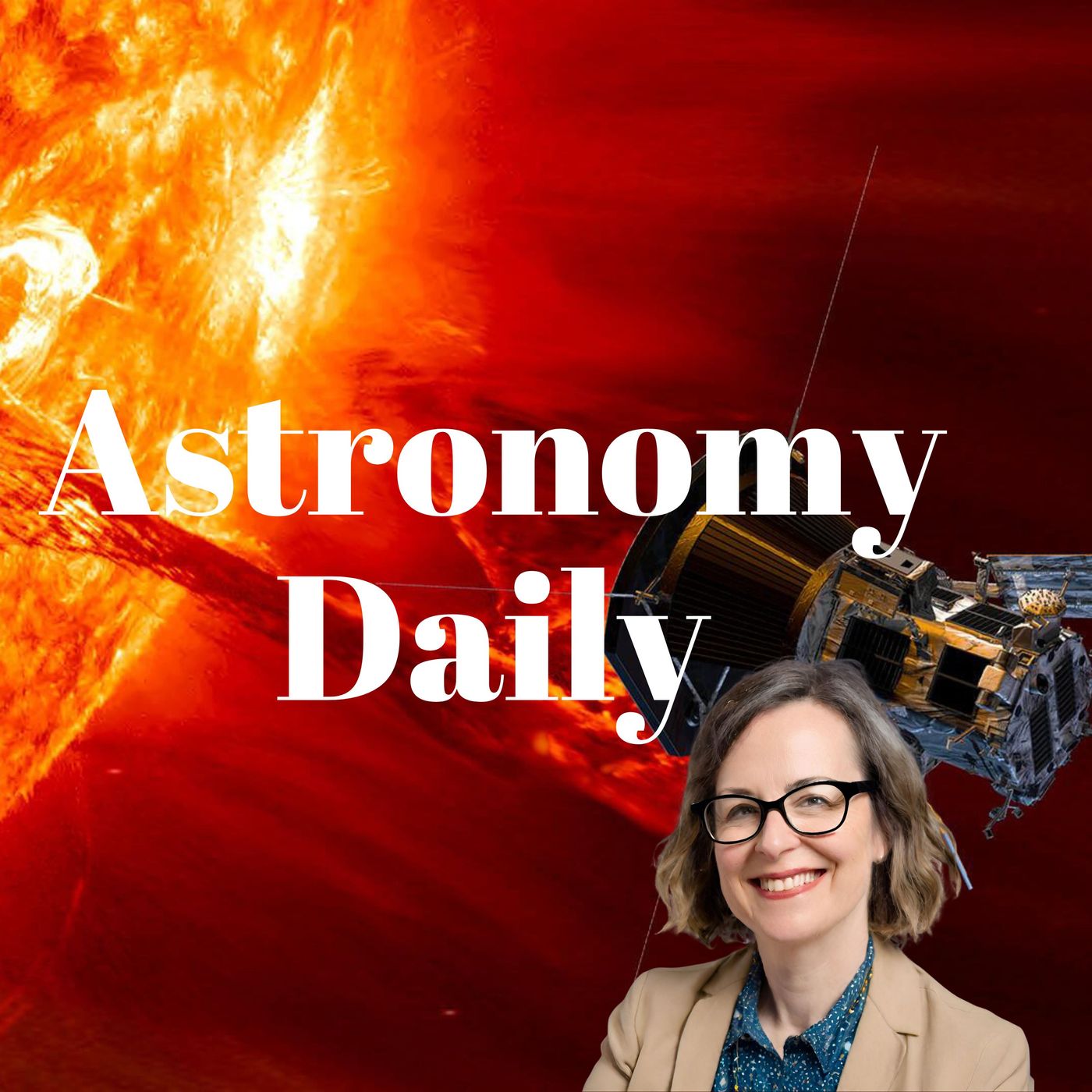
Astronomy Daily | Space News: S04E73In this enlightening episode of Astronomy Daily, host Anna navigates the latest cosmic events and breakthroughs that are reshaping our understanding of space. From the Parker Solar Probe's record-breaking approach to the Sun to the intriguing phenomenon of space piracy, this episode is packed with insights that will keep you captivated.
Highlights:
- Parker Solar Probe's 23rd Close Approach: Join us as we celebrate the Parker Solar Probe's incredible achievement of reaching within 3.8 million miles of the Sun's surface, matching its own records for both proximity and speed. Discover how this groundbreaking mission is transforming our understanding of solar activity and the mysteries of the corona.
- The Mysterious Blue Spiral: Explore the captivating blue spiral that lit up the skies over Europe, sparking theories of extraterrestrial origins. We reveal the true cause behind this mesmerizing light show, linked to a SpaceX Falcon 9 launch, and how modern space technology creates such stunning celestial phenomena.
- 3D Printing for Space Colonization: Delve into how 3D printing technology is poised to revolutionize sustainable living on the Moon and Mars. Learn about in situ resource utilization and how astronauts can use local materials to create habitats, tools, and structures, paving the way for future space colonization.
- NASA Astronauts' Return from the ISS: Catch up on the return of NASA astronauts Suni Williams and Butch Wilmore after an extended nine-month stay aboard the International Space Station. We discuss the fascinating physical changes they experienced during their time in microgravity and the challenges of readjusting to Earth's environment.
- The Rise of Space Piracy: Finally, we venture into the emerging concern of space piracy as commercial activities in orbit increase. Experts warn of potential criminal exploitation and the need for new security measures to protect valuable space assets.
For more cosmic updates, visit our website at astronomydaily.io. Join our community on social media by searching for #AstroDailyPod on Facebook, X, YouTubeMusic, TikTok, and our new Instagram account! Don’t forget to subscribe to the podcast on Apple Podcasts, Spotify, iHeartRadio, or wherever you get your podcasts.
Thank you for tuning in. This is Anna signing off. Until next time, keep looking up and stay curious about the wonders of our universe.
00:00 - Welcome to Astronomy Daily
01:05 - Parker Solar Probe's latest approach
10:30 - Blue spiral phenomenon explained
17:00 - 3D printing technology for space colonization
22:15 - Return of astronauts from the ISS
27:30 - Emerging concerns of space piracy
✍️ Episode References
Parker Solar Probe Updates
[NASA](https://www.nasa.gov)
SpaceX Falcon 9 Launch Details
[SpaceX](https://www.spacex.com)
3D Printing in Space
[NASA](https://www.nasa.gov/3dprinting)
NASA Astronauts' Research
[NASA](https://www.nasa.gov/astronauts)
Space Piracy Insights
[Center for the Study of Space Crime Policy and Governance](https://www.cscpg.org/)
Astronomy Daily
[Astronomy Daily](http://www.astronomydaily.io/)
Become a supporter of this podcast: <a...
Anna: Welcome to Astronomy Daily. I'm Anna, and you're tuned in to your essential source for the latest developments beyond our atmosphere. We've got a packed episode for you today as we journey from the scorching vicinity of our sun all the way to the emerging frontiers of space law and security. Our cosmic journey begins close to home. Well, Relatively speaking, as NASA's Parker Solar Probe completes its 23rd close approach to the Sun. Navigation Matching its own impressive records for both proximity and speed, this intrepid spacecraft continues to push the boundaries of what we can learn about our star.
Then we'll look into a mysterious blue spiral that captivated sky gazers across Europe this week. The spectacular phenomenon had social media buzzing with theories ranging from the scientific to the extraterrestrial. We'll reveal what really caused this mesmerizing celestial light show. Looking toward humanity's future among the stars will explore how 3D printing technology may be the key that unlocks sustainable living on other worlds. Just as early pioneers had to adapt to new environments using local resources, future space colonists will need innovative solutions to survive on the Moon and Mars.
We'll also check in on NASA astronauts Suni Williams and Butch Wilmore, who recently returned to Earth after an unexpectedly extended nine month stay aboard the International Space Station. Their prolonged exposure to microgravity has resulted in fascinating physical changes, and we'll discuss what their recovery process might look like. Finally, we'll venture into more speculative territory with a look at an emerging concern that might sound like science fiction but is being taken very seriously by experts.
Space piracy. As commercial activities in orbit expand, security specialists are warning that criminal exploitation may not be far behind. So whether you're a casual space enthusiast or a dedicated follower of astronomical advances, stay with us as we explore these fascinating developments from across the cosmos on today's edition of Astronomy Daily. Let's get started. NASA's Parker Solar Probe has achieved another remarkable M milestone in its mission to study our star up close. On March 22, the spacecraft completed its 23rd close approach to the sun, reaching perihelion at 6:42pm Eastern Daylight Time.
During this close encounter, the probe once again equaled its own impressive distance record, coming within approximately 3.8 million miles of the Sun's surface. To put this incredible proximity into perspective, that's about 4% of the distance between Earth and the Sun. At this close range, the Parker Solar probe experiences temperatures that would melt most spacecraft. But thanks to its revolutionary heat shield, it continues to operate in this extreme environment. The probe didn't just match its distance record.
It also matched its speed record, hurtling around the sun at a mind boggling 430,000 miles per hour, or 692,000 kilometers per hour. That's fast enough to travel from New York to Los Angeles in just over 20 seconds. This incredible velocity makes Parker the fastest human made object ever created. Mission operators at the Johns Hopkins Applied Physics Laboratory in Laurel, Maryland, where the spacecraft was designed and built, received a beacon tone on Tuesday, confirming that the probe was in good health, with all systems operating normally despite the intense conditions it had just experienced.
This perihelion marked the midpoint of the probe's 23rd Solar Encounter, which began on March 18 and continued through March 27. During these close approaches, Parker Solar Probe conducts unrivaled scientific measurements of the solar wind, the stream of charged particles flowing from the sun, and related solar activity. The data collected during these encounters is transforming our understanding of the Sun's outer atmosphere, called the corona, and helping scientists solve long standing solar mysteries.
One of the biggest questions involves why the corona is millions of degrees hotter than the Sun's visible surface, which defies what we'd expect to see as you move away from a heat source. Parker's measurements are also critical for understanding how solar eruptions affect space weather, which can impact satellites, power grids, and telecommunications systems back on Earth. By better understanding these solar processes, scientists hope to improve forecasting of, uh, potentially damaging solar storms.
This mission continues to push the boundaries of engineering and scientific discovery. With each close approach, Parker Solar Probe ventures into territory no spacecraft has ever explored before, sending back valuable data from the very edge of our star. As it continues its planned series of increasingly close solar encounters, we can expect even more groundbreaking discoveries about the star that makes life on Earth possible. Next up, a mystery for our European listeners has been solved with a rather straightforward answer.
A mysterious blue spiral lit up the night skies across Europe on March 24, creating a social media frenzy as residents from the UK Croatia, Poland and Hungary shared photos and videos of the strange celestial phenomenon. The eerie blue whirlpool, which many compared to a spiral galaxy, prompted wild speculation about its origin, with some even suggesting it might be evidence of extraterrestrial visitors. One observer initially thought it was the moon moon behind clouds until it started moving with spiraling light emanating from it.
Others watched in awe as the spectacular formation expanded and persisted in the sky for several minutes before gradually fading away. The sight was particularly striking against the dark European skies, appearing as an icy blue vortex that seemed almost otherworldly despite the alien theories circulating online the explanation is rooted in modern space technology rather than science fiction. The spiral was actually created by a SpaceX Falcon 9 rocket that had launched earlier that day from Cape Canaveral Space Force Station in Florida.
The rocket was carrying the secretive NROL 69 mission for the National Reconnaissance Office when it created this unexpected light show thousands of miles away. What witnesses observed is sometimes called a SpaceX spiral, a phenomenon that occurs after the upper stage of a Falcon 9 rocket has separated from its first stage booster, while the lower stage returns to Earth for recovery. Minutes after launch, the upper stage continues its journey to deliver its payload to orbit. After releasing its cargo, the upper stage begins its own descent back to Earth.
During this descent, the upper stage enters a spinning motion while simultaneously venting any remaining fuel. At the high altitude where this occurs, the expelled fuel instantly freezes in the cold vacuum of space, creating a swirling pattern that perfectly preserves the spinning motion of the booster. When sunlight reflects off this frozen fuel formation, it produces the stunning spiral that captivated European skywatchers. Physicist and science communicator Brian Cox took to social media to reassure concerned citizens that the event was indeed associated with the SpaceX launch and not something more alarming.
Amateur astronomers and smartphone photographers captured remarkable images of the phenomenon, with some describing it as unforgettable and stunning. While these SpaceX spirals remain relatively rare sightings, they may become more common as the frequency of rocket launches continues to increase. As commercial space activities ramp up worldwide, these spectacular but harmless light shows could become a more familiar sight in our night skies. One social media user humorously expressed disappointment at the rational explanation, writing that they wished it was an invasion so they could use the time off work.
But for most observers, witnessing this rare and beautiful cosmic spectacle was more than enough excitement for one evening, even if it didn't herald the arrival of visitors from another world. While on the subject of visiting other worlds throughout history, when pioneers ventured into uncharted territories, they carried only the essentials and relied on local resources to build new lives. In the coming era of space exploration, astronauts will face even greater challenges than those early settlers, but with one crucial technological advantage, 3D printing.
Unlike the Vikings who reached Greenland with axes and plows, today's space pioneers will bring advanced manufacturing capabilities that can transform the alien environments of the Moon and Mars into habitable outposts. These remarkable machines will be essential for extending human presence beyond Earth, allowing astronauts to create tools, structures, and habitats from materials found on these distant worlds. The technology is already proving its value in space. Aboard the International Space Station, astronauts regularly use 3D printers to manufacture tools and spare parts.
From ratchet wrenches to brackets and clamps, these items can be produced in hours rather than waiting months for supplies from Earth. NASA has even begun recycling waste plastic to create new components with the UH Refabricator, an advanced printer installed in 2019. Why not simply bring everything from Earth? The answer comes down to economics and practicality. Launching materials into space is prohibitively expensive, with NASA estimating costs around $500,000 per pound just to reach the Moon.
Building sustainable outposts requires using resources available at the destination, a concept known as in situ resource utilization. The primary building material on both the Moon and Mars will likely be regolith, the fine, dusty sand like particles covering these worlds. Unlike Earth soil, regolith contains few nutrients and no living organisms, but researchers believe it could serve as an excellent printing medium for constructing protective structures. These habitats must shield astronauts from extreme temperature fluctuations, radiation, micrometeorite impacts, and the absence of breathable atmosphere.
Engineering teams are exploring several promising approaches. Some are developing a regolith UH based concrete partially made from surface ice. Others are experimenting with melting regolith at high temperatures and molding it while liquid, or using concentrated sunlight, lasers, or microwaves to fuse particles together without requiring binders, a process called SINK. One team at NASA's Moon to Mars Planetary Autonomous Construction Technology Program created Mars Creit, a special concrete used to 3D print a test structure in 2017.
By 2019, they had constructed a 1/3 scale prototype Mars habitat using similar technology, complete with living, sleeping, research, and food production modules. These innovations face significant technical hurdles. Manufacturing behaves differently in reduced gravity environments, with materials cooling and crystallizing in unexpected ways. The M moon has just 1/6 Earth's gravity, while Mars has about 2/5. Additionally, researchers must work with simulated regolith, since actual lunar and Martian materials are scarce or inaccessible.
The composition differs significantly between worlds. Lunar regolith consists mostly of silicates and is extremely fine and angular, while Martian regolith contains iron oxide, giving it its characteristic reddish color. The technology being developed for space habitats is already finding applications on Earth. Engineers are adapting these techniques to address housing shortages, creating affordable 3D printed homes from locally sourced materials and recycled construction debris. This practical spinoff demonstrates how space research often yields unexpected benefits for terrestrial problems as humanity prepares to establish a permanent presence Beyond Earth.
With Artemis 3 scheduled to return humans to the lunar surface in 2027 and a potential Mars mission as early as 2035, 3D printing technology will undoubtedly be among the most essential tools enabling people to truly live off alien land, transforming these hostile environments into humanity's second home. Next, a little catch up. NASA astronauts Suni Williams and Butch Wilmore have finally touched down on Earth after what can only be described as an unexpectedly extended mission aboard the International Space Station.
Originally scheduled for a brief stay after arriving last June, technical issues with their Boeing Starliner spacecraft left them stranded in orbit for a remarkable nine months. Their capsule splashed down in the Gulf of Mexico. Or is that the Gulf of America these days? On March 18, bringing to an end a mission that saw them complete over 4,500 orbits around Earth and travel an astounding 121 million miles. While the mission may have concluded, the physical journey for these astronauts is far from over.
Extended exposure to zero gravity environments triggers profound changes in the human body, many of which are already visible in Williams and Wilmore. Comparison photos taken before and after their mission reveal noticeable physical differences that scientists are now studying carefully. Dr. Christopher Mason, a professor at Weill Cornell Medicine, explains that astronauts typically experience temporary increases in height and general leanness upon returning to, uh, Earth. This occurs alongside significant changes in gene expression and telomere length, the protective caps at the end of chromosomes that typically lengthen during spaceflight.
All of it is, at least on some measures, transient, Dr. Mason notes. Most of it is a response to space flight. And usually in a few weeks, they're mostly back to normal. It's the first few days that are the most really dynamic. When they get back to Earth. Those first days can be particularly challenging. Former NASA astronaut Jose M. Um Hernandez, who spent 14 days in orbit, recalls his own return. I remember my first two words when I came down was gravity sucks because your body starts adapting and you've got to recalibrate your vestibular balance system.
The physical challenges facing Williams and Wilmore are substantial muscle atrophy from limited movement, reduced bone density, increased mineral content in their bodies, and neurological shifts, including disorientation, are all common post space symptoms. Their bodies have also likely experienced blood volume reduction, decreased aerobic capacity, and potentially compromised immune systems. Immediately after landing, both astronauts were transported to medical facilities for comprehensive evaluations.
They now face what could be months of intensive physical therapy and rehabilitation as their bodies readjust to Earth's gravity. As Hernandez predicted, it's going to take a couple of months before they feel kind of normal back here on Earth. These physical adaptations highlight the extraordinary sacrifices astronauts make in the name of scientific advancement. The data collected from Williams and Wilmore's extended stay will prove invaluable for NASA's ongoing research into the effects of long duration spaceflight.
Critical knowledge as the agency prepares for future missions to the moon and Mars, their unexpected nine month journey has inadvertently provided scientists with a rare opportunity to study prolonged space exposure, potentially helping researchers develop better countermeasures for future astronauts embarking on deep space missions where returns to Earth won't be measured in months, but years. Finally today, a subject you probably haven't given much, if any thought to, but a problem is looming.
Ahoy, space enthusiasts. Just when you thought the final frontier couldn't get any more intriguing, a new concern has emerged that sounds like it belongs in a science fiction novel. Space piracy. Yes, you heard that right. Experts are now warning that the growing commercialization of space is bringing with it the very real threat of criminal activity beyond our atmosphere. The center for the Study of Space Crime Policy and Governance, or cscpg, is at the forefront of examining this emerging risk.
Their message is clear and comes with a touch of humor. You may not be interested in space piracy, but space pirates are interested in you. Mark Feldman, the Center's executive director, and Huw Taylor, a specialist in cybersecurity, have co authored a book titled Space Preparing for a Criminal Crisis in Orbit. They describe their work as speculative nonfiction, emphasizing that while space piracy hasn't fully materialized, they believe it's only a matter of time. What's particularly concerning is their assertion that early forms of space crime are already underway.
We are arguing that it's already started in very early stages with attempts to hack satellites, taylor explains. As commercial activities in space accelerate, they anticipate both physical and digital attacks on valuable space assets, potentially beginning with disruptions to Earth based infrastructure like launch facilities or ground stations. One scenario Feldman envisions involves criminals taking control of a broadcast satellite in geosynchronous Earth orbit to disrupt a major global media event like the World Cup.
The pirates might demand either pay a very large amount to ensure the televised event, or it goes dark and other blackouts will follow. Sounds like something out of a James Bond film, doesn't it? Satellites involved in shipping are also considered highly vulnerable targets. So how do we protect against these celestial buccaneers? The experts suggest we need a dedicated agency to coordinate efforts. While the U.S. space Force might seem like the logical choice, they currently lack the specific structure and mandate for this mission.
Interestingly, Taylor points out that the US Navy, with its 250 years of experience combating maritime piracy, could be invaluable if given the proper legal authority. On the international front, the United Nations Office for Outer Space affairs may provide the best venue for bringing together the diverse stakeholders needed to address this issue comprehensively. People don't like the United nations, taylor acknowledges, but it arguably is the only venue where everyone can come together and talk.
Feldman emphasizes the need for developing new weapons and rapid response capabilities. As of now, there is no way to quickly respond, he warns, suggesting that small, agile and appropriately armed spacecraft might be essential for dealing with hostage situations on commercial space stations or similar emergencies. The historical parallel isn't lost on these researchers. Pirates of old drove innovation in shipbuilding as colonial shipyards from New England to the Carolinas designed faster, sleeker vessels specifically for their pirate customers.
Similarly, combating space piracy may spur technological development in ways we can't yet imagine. The experts stress that the United States intelligence community and space force need to expand their focus beyond nation state threats like China, Russia, Iran and North Korea to include non state actors. Once this understanding is digested, Feldman concludes, creative responses to prevent and mitigate these threats will follow as we venture further into the commercial development of space. With private companies launching satellites, building space stations, and planning lunar bases, the legal and security frameworks that govern these activities must evolve accordingly.
Otherwise, the high seas of Earth orbit might indeed become the next hunting ground for those seeking to plunder the valuable resources now floating above our heads. Well, that brings us to the end of today's journey through the cosmos. From the Parker solar probe's record breaking close approach to the sun, to the spectacular blue spiral that captivated European skywatchers, to the innovative 3D printing technologies that will help us build homes on other worlds, to our returning astronauts and their physical transformations, and finally to the emerging frontier of space.
Face security challenges the universe continues to amaze, challenge and inspire us. I'd like to thank you for spending the last 20 minutes with astronomy Daily. I'm your host Anna, and it's been my pleasure to bring you these fascinating developments from beyond our atmosphere. For more space content and in depth coverage of these stories, please visit our [email protected] we're constantly updating with news articles, images and blog posts. You can also join our community of space enthusiasts by following us on social media.
Just search for Astro Daily Pod on x, Facebook, Instagram, YouTubeMusic, and TikTok for daily updates, stunning visuals and conversations about our universe. Until our next cosmic rendezvous, keep looking up. The sky is not the limit. It's just the beginning. This has been Astronomy Daily. I'm Anna signing off.



 Apple Podcasts
 Spotify
 Pocket Casts
 Castbox
 Overcast
 Podbean
 iHeartRadio
 Castro
 Goodpods
 Moon FM
 Podcast Addict
 Podcast Republic
 YouTube