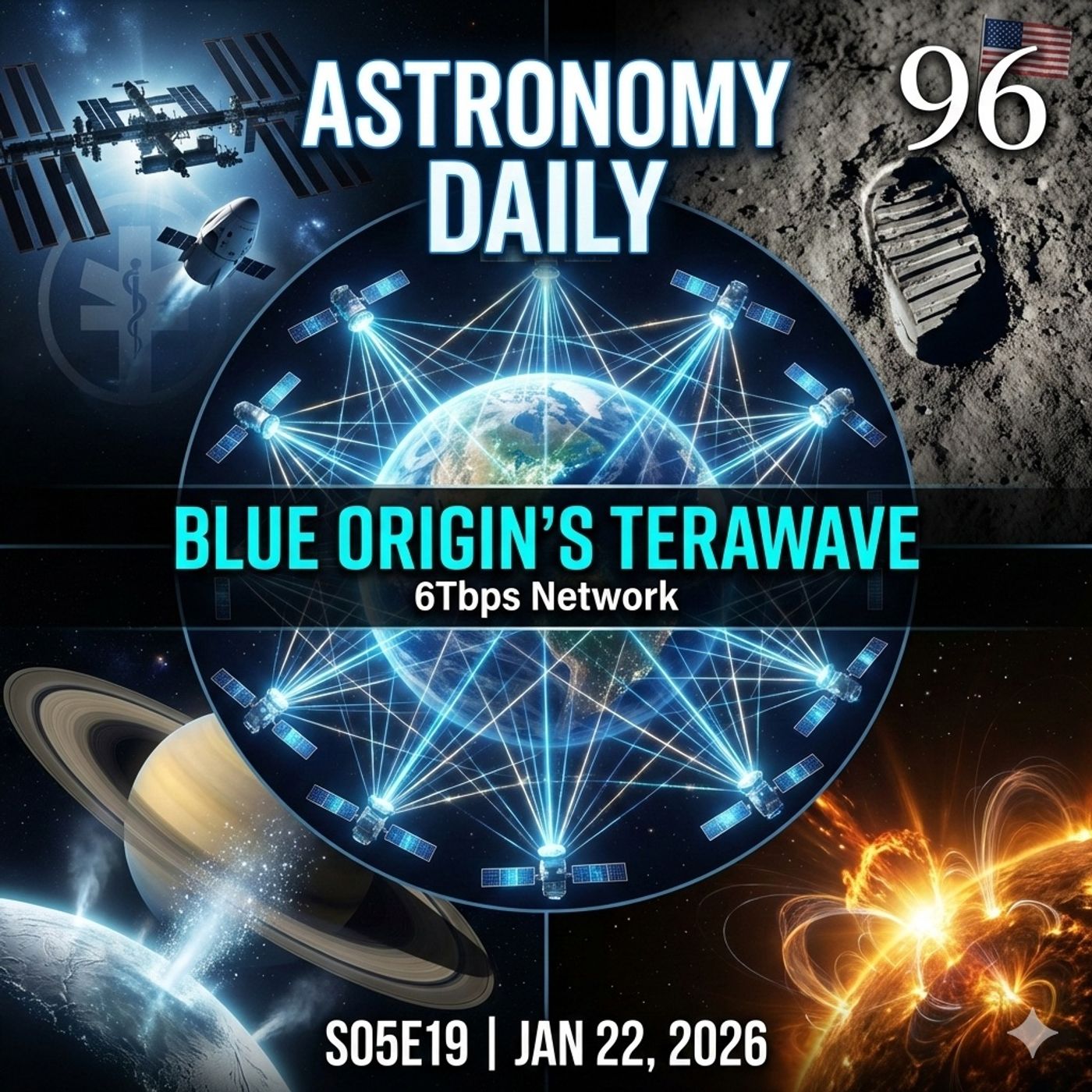
Blue Origin's TeraWave Network, Historic ISS Medical Evacuation & Buzz Aldrin Turns 96
In this episode
Welcome to Astronomy Daily! In today's episode, we explore Blue Origin's ambitious new TeraWave satellite internet network offering speeds up to 6Tbps, discuss the first-ever medical evacuation from the International Space Station, and celebrate Buzz Aldrin's 96th birthday as the oldest living astronaut. We also dive into exciting science from Saturn's moon Enceladus, surprising plasma wave discoveries at Mercury, and groundbreaking Solar Orbiter observations revealing how magnetic avalanches power solar flares.EPISODE HIGHLIGHTS:
• Blue Origin announces TeraWave: A new satellite network with 6Tbps speeds for enterprise and government customers
• Historic ISS evacuation: Crew-11 returns early in NASA's first medical evacuation from space
• Buzz Aldrin celebrates 96th birthday as Artemis II crew prepares for lunar journey
• Scientists develop new method to analyze Enceladus plumes for ocean habitability
• BepiColombo discovers Mercury shares plasma wave behavior with Earth
• Solar Orbiter reveals magnetic avalanches trigger solar flares
STORY TIMESTAMPS:
[00:00] Introduction
[01:15] Blue Origin's TeraWave Satellite Network
[05:42] ISS Medical Evacuation - Crew-11's Historic Return
[10:28] Buzz Aldrin's 96th Birthday & Artemis II Connections
[14:35] Enceladus Plumes May Hold Clues to Ocean Habitability
[18:20] Mercury and Earth Share Plasma Wave Behavior
[22:10] Solar Orbiter Discovers Magnetic Avalanches Power Flares
[26:45] Outro
LINKS & RESOURCES:
• Blue Origin TeraWave: https://www.blueorigin.com/terawave
• NASA Crew-11 Mission Information: https://www.nasa.gov/
• Artemis II Mission Details: https://www.nasa.gov/artemis-ii
• BepiColombo Mission: https://www.esa.int/Science_Exploration/Space_Science/BepiColombo
• Solar Orbiter Mission: https://www.esa.int/Science_Exploration/Space_Science/Solar_Orbiter
• Astronomy Daily Website: https://astronomydaily.io
CREDITS:
Hosted by Anna and Avery
Produced by Astronomy Daily
Episode S05E19 - January 22, 2026
SUBSCRIBE & CONNECT:
Never miss an episode! Subscribe to Astronomy Daily on your favorite podcast platform and visit astronomydaily.io for more space news, articles, and community discussions.
Follow us on social media for daily updates and bonus content!
#AstronomyDaily #SpaceNews #BlueOrigin #NASA #ISS #BuzzAldrin #ArtemisII #Enceladus #Mercury #SolarOrbiter #SpaceExploration
Become a supporter of this podcast: https://www.spreaker.com/podcast/astronomy-daily-latest-space-news--5648921/support.
Sponsor Details:
Ensure your online privacy by using NordVPN. To get our special listener deal and save a lot of money, visit www.astronomydaily.io/nordvpn. You'll be glad you did!
Get the best secure and private email on the planet. Stop your Government, google and who knows who else spying on every email you write. Do what we did and use ProtonMail. They beleive in privacy and there are no ads in their business model...yet they still provide a free forever service. Check them out and get out special deal at www.astronomydaily.io/protonmail
Become a supporter of Astronomy Daily by joining our Supporters Club. Commercial free episodes daily are only a click way... Click Here
This episode includes AI-generated content.
Anna: Hey there, space fans. I'm Anna. Avery: And I'm Avery. Welcome to Astronomy Daily, your daily dose of space and astronomy News. It's Thursday, January 22, 2026, and boy, do we have a packed episode for you today. Anna: We really do. We're covering everything from Blue Origin's ambitious new satellite Internet network to an update on that historic medical evacuation from the International Space Station. Plus, we'll celebrate a special bir for a lunar legend. Avery: That's right. We've also got some fascinating science stories, including new insights into Saturn's moon Enceladus, surprising discoveries about plasma waves at Mercury, and groundbreaking observations of solar flares.
Anna: So buckle up, let's dive right into today's space headlines. Avery: Alright, Anna, um, let's kick things off with some major news from Blue Origin. Jeff Bezos Space Company just announced a new satellite Internet network called TerraWave. And the numbers are pretty staggering. Anna: They really are. We're talking about data speeds up to 6 terabits per second. That's seriously impressive. How does that compare to what's available now? Avery: Well, for context, SpaceX's Starlink currently maxes out at 400Mbps for consumers, though they're planning to upgrade to 1 gigabit speeds in the future.
But 6 terabits per second, that's in a completely different league. Anna: So this isn't really targeting the same market as Starlink then? Avery: Exactly. Blue Origin is very clear about this. TerraWave is geared toward enterprise customers, data centers and government applications. It's meant to add a space based layer to existing network infrastructure, particularly for reaching locations that traditional methods can't access. Anna: What's the architecture looking like? How many satellites are we talking about?
Avery: The constellation will use a mix of 5,280 satellites in low Earth orbit and 128 in medium Earth orbit. The low Earth orbit satellites will use RF connectivity with maximum data transfer speeds of 144 gigabits per second, while the medium Earth orbit satellites will use optical lengths to achieve those incredible 6 terabits per second speeds. Anna: When can we expect to see this actually deployed? Avery: Blue Origin plans to start deploying the first satellites in late 2027. They haven't given a timeline for the full build out yet, which makes sense given the scale of the project.
Anna: This is interesting timing too, isn't it? Because Jeff Bezos other company Amazon, just rebranded their satellite network as LEO. Avery: That's right. LEO will have around 3,000 satellites in low Earth orbit, offering more traditional broadband speeds to consumers. So, taken together, Amazon's LEO and Blue Origin's TerraWave could provide pretty robust competition to SpaceX's Starlink across different market segments. Anna: It's really shaping up to be an exciting era for satellite Internet.
The competition should drive innovation and hopefully improve service for everyone. Avery: Absolutely. And it shows how Blue Origin is evolving beyond just their space tourism flights. With New Shepard, with the successful launches of their new Glenn rocket, landing the booster on just a second attempt, and now this satellite network announcement. They're really becoming a multifaceted commercial space player. Anna: Great point. Alright, let's move on to some news from closer to home, or at least from low Earth orbit.
Avery, we need to talk about the unprecedented medical evacuation from the International Space Station. This was a historic moment and not in a way anyone wanted. Well, today we have a bit of an update as the astronauts have made their first live appearance since returning to Earth. Avery: You're absolutely right, Anna. For the first time in over 25 years of continuous human presence on the ISS, and the first time in NASA's entire history, a space mission was cut short due to a medical issue. The four astronauts of Crew 11 splashed down in the Pacific Ocean off the coast of California on January 15, about a month earlier than planned.
Anna: Can you tell us who was on this crew? Avery: The crew included NASA astronauts Zena Cardman and Mike Fenk, Japan Aerospace Exploration Agency astronaut Kimiya Yui and Russian cosmonaut Oleg Platanov. They'd been on the station for 167 days, having launched back in August 2025. Anna: And NASA still hasn't disclosed which crew member had the medical issue or um, what the condition was. Avery: That's correct. They're protecting the astronauts medical privacy. What they have said is that the crew member is stable and that this wasn't an emergency situation despite bringing the entire crew home early.
Anna: How did this unfold? What were the warning signs? Avery: The first public indication came when NASA canceled a planned spacewalk on January 8 due to a medical concern. Mike Fink and Zena Cardman were supposed to venture outside the station to work on the power system. The next day, NASA made the decision to bring the entire crew home early. Anna: That must have been a difficult decision to make. Avery: Absolutely. NASA Administrator Jared Isaacman emphasized that while they have medical equipment and trained crew members aboard the iss, the capability to properly diagnose and treat this particular condition simply doesn't exist on the station.
He called it, uh, a controlled medical evacuation, not an emergency deorbit. Anna: What's particularly interesting to me is what the crew members said at their press conference yesterday. They seemed remarkably positive about the experience, they really did. Avery: Mike Fink, who was the ISS commander during this mission, said the way the crew and ground teams handled everything made him more confident about human space exploration, not less. He specifically mentioned this bodes well for the upcoming Artemis program.
Anna: I remember reading that they used the portable ultrasound machine on the ISS during this incident. Avery: Right. Fink mentioned that during the press conference. He emphasized that while the ultrasound was extremely helpful, the ISS doesn't have the capacity for larger imaging equipment like MRI machines. Zena Cardman also pointed out that as we venture beyond low Earth orbit to the Moon and eventually Mars, having better diagnostic and treatment tools on board will be a critical challenge to solve.
Anna: How has this affected operations on the iss? Avery: Well, their departure left only three people on the station, two Russian cosmonauts and one NASA astronaut who'd arrived on a Soyuz capsule in November. That's significantly reduced from the typical crew of seven, which means fewer experiments and less maintenance can be performed. The next crew rotation, Crew 12 is scheduled to launch no earlier than February 15th. Anna: Despite the challenging circumstances, this really demonstrates the professionalism and preparedness of our space programs.
Avery: Exactly as Cardman emphasized, astronauts are the eyes and ears for researchers on the ground, and this experience will undoubtedly inform how we prepare for longer duration missions further from Earth. Alright, shall we move on to a much happier space story? Anna: Absolutely. This past Tuesday, January 20th, marked the 96th birthday of Buzz Aldrin, the second man to walk the moon and now the oldest living astronaut. Avery: What an incredible milestone. Buzz Aldrin, born Edwin Eugene Aldrin Jr. On January 20, 1930 in Glen Rich, New Jersey, made history alongside Neil Armstrong during the Apollo 11 landing in 1969.
He was 39 years old when he stepped onto the lunar surface. Anna: I love the story behind his nickname. Did you know that his sister couldn't pronounce brother properly and called him Buzzer, which got shortened to Buzz? Avery: I did. And he liked it so much he legally changed his first name to buzz in 1988. Now, it's worth noting that this past year hasn't been easy for Aldrin. He lost his wife, Anka Fower, last fall after a battle with cancer. They'd been married on his 93rd birthday in 2023. Anna: That's heartbreaking, but it sounds like he's surrounded by family now.
Avery: Yes, his family posted an update in late December showing he's spending time with his children and grandchildren in Los Angeles and and they're planning to move him closer to family in Southern California. Despite his age and recent loss, he remains a cheerleader for NASA and space exploration. Anna: Speaking of which, the timing of his birthday is pretty special with the Artemis II mission coming up. Avery: Absolutely. The Artemis astronauts wished him a happy birthday this past weekend from Kennedy Space center as their Orion, uh, spacecraft atop the Space Launch System rocket rolled out to launch pad 39B.
It's the same pad that launched many Apollo missions. Anna: The Artemis 2 crew, NASA astronauts Reid Wiseman, Victor Glover, Christina Koch, and Canadian Space Agency astronaut Jeremy Hansen could launch as early as February 6th. They'll be the first humans to return to the vicinity of the moon since 1972. Avery: And they'll make history, too. Victor Glover will be the first black astronaut, Christina Koch the first woman, and Jeremy Hansen the first non American to travel that far from Earth. Anna: What really struck me was how the Artemis astronauts talked about their connections to the Apollo program.
Avery: Me too. Reid Wiseman shared this great story about almost missing a call from Apollo 10's General Tom Stafford on the day he was selected for Artemis 2. He thought it was a telemarketer, but Stafford called to congratulate him, and Wiseman said, the Apollo astronauts are just so excited that we're headed back to the moon. Anna: Victor Glover mentioned carrying a bag of wisdom quotes from Apollo 9's Rusty Schweiker to the space station, and he's planning to take it to the moon as well. Avery: And Christina Koch talked about Fred haise from Apollo 13, teasing her about breaking their distance record.
She said that moment brought her into the Apollo camaraderie, and she promised to carry that spirit forward. Anna: Jeremy Hansen's story is my favorite, though. He saw a picture of Buzz or Neil on the moon as a kid, turned his treehouse into a spaceship, and here he is now about to go to the moon himself. Avery: It really shows the lasting impact of the Apollo program. Of the 12 men who walked on the moon, only four are still alive. Buzz Aldrin at 96, David Scott at 93, Charles Duke at 90, and Harrison Schmidt at 90.
Anna: Buzz Aldrin truly is a living legend, and his enthusiasm for the future of space exploration is inspiring. Happy 96th birthday, Buzz. Avery: Hear, hear. Now let's shift gears and head out to Saturn's moon Enceladus. Anna. Uh, this next story is about one of the most exciting places in our solar system when it comes to the search for life. Saturn's moon Enceladus. Anna: Oh, I love Enceladus. Those gorgeous plumes shooting out from the south pole are just mesmerizing. What's the new development?
Avery: A team of Japanese scientists has Developed a new method for analyzing those plumes that could help us determine whether Enceladus subsurface ocean is habitable. They're proposing to use Rayman spectroscopy To estimate the ph levels of the water Being ejected from the moon. Anna: Rayman spectroscopy, can you explain what that is for our listeners? Avery: Sure. Rayman spectroscopy is a technique that uses laser light to identify the molecular composition of materials. It's been used on several planetary missions, including on, um, the perseverance rover currently on Mars.
The technique can identify different chemical compounds and in this case, different ph levels. Anna: And why is ph so important for habitability? Avery: Well, the ph level tells us how acidic or alkaline the water is, which is crucial for understanding whether life as we know it could potentially exist there. Scientists have estimated that Enceladus plumes Likely have a ph somewhere between 8 and 12, which is weakly to strongly alkaline. Anna: So how did they test this method? Avery: The researchers conducted laboratory experiments Using carbonate salty fluid samples at different ph levels.
They placed these samples in a vacuum chamber to simulate Enceladus surface conditions, Letting the fluid evaporate and freeze, Leaving only the salt deposits behind. Then they used Raman spectroscopy instruments Configured to simulate how they'd work On a future space mission. Anna: And were they successful? Avery: They were. The Raman spectroscopy Successfully identified the different ph levels in each of the salt deposit samples. The researchers concluded that this technique could identify Carbonate minerals On Enceladus surface and potentially estimate the ph of the subsurface ocean.
Anna: This is particularly clever because it means we wouldn't necessarily need to drill through the ice to sample the ocean directly. Avery: Exactly. The plumes are constantly depositing material on the surface, so a lander could analyze these deposits and learn about the ocean below. It's a much more accessible approach Than trying to penetrate kilometers of ice. Anna: Remind me, what do we already know about enceladus from the Cassini mission? Avery: Well, Cassini discovered the plumes back in the mid 2000s and even flew through them.
The mission found mostly water ice, but also salt rich ice grains, Organic molecules, Hydrogen gas, and evidence of heat, all indicative of active geology and a warm subsurface ocean. Anna: And the presence of hydrogen gas Was particularly exciting because it could be produced by hydrothermal vents on the ocean floor, right? Avery: Exactly. That could provide A source of chemical energy for potential microbial life, Similar to what we see around hydrothermal vents in earth's deep oceans. Being able to measure the ph more accurately Would be another crucial piece of the habitability puzzle.
Anna: This really makes me excited for future missions to enceladus hopefully we'll see a dedicated mission there in the coming decades. Avery: Absolutely. The technology is there. We just need the mission. Alright, let's head to Mercury for our next story. Anna: Avery, this next story reveals some surprising connections between Mercury and Earth. It turns out these two very different planets have more in common than we thought when it comes to their magnetospheres. Avery: That's right, Anna. Um.
An international team of researchers has discovered that natural electromagnetic waves, called chorus emissions occur in Mercury's magnetosphere with strikingly similar characteristics to those found around Earth, despite Mercury having a magnetic field only about 100th as strong. Anna: Chorus waves. That's such an evocative name. Can you explain what these are? Avery: Sure. Chorus waves are plasma waves that sound like birdsong when converted to audio frequencies. They're created when electrons in a planet's magnetosphere interact with electromagnetic waves, producing these characteristic rising and falling tones.
Anna: And why do we care about these waves on Earth? Avery: They play a crucial role in the Van Allen radiation belts. They can both accelerate particles to create the belts and also cause particles to rain down into the atmosphere, depleting them. Understanding these waves is important for space weather forecasting and protecting satellites from radiation. Anna: So how did researchers make this discovery at Mercury? Avery: They used data from the BepiColombo mission's magnetospheric orbiter, called MEO, during six flybys of Mercury between 2021 and 2025.
They combined this with decades of data from Earth's Geotail satellite, which operated from 1992 to 2022. Anna: Why was Geotail particularly useful for comparison? Avery: Great question. Geotail observed Earth's Magnetotail from about 10 Earth radii away, conditions that actually resemble Mercury's much smaller, more compact magnetosphere. This made it an excellent benchmark for comparison. Anna: What exactly did they find? Avery: The team identified rapid rising and falling frequency sweeps at Mercury, indicating the same kind of nonlinear coupling between electrons and waves that we see at Earth.
They also found that the emissions were concentrated in the dawn side sector, just like at Earth, where energetic electrons preferentially stream through the magnetosphere. Anna: What surprised me about this is that Mercury has almost no atmosphere. I would have thought that would make a big difference. Avery: That's what scientists expected, too. Earlier theories suggested that Mercury wouldn't have the cold or low energy electrons necessary to generate chorus waves. But this discovery confirms predictions from 2025 that these electrons do exist around Merc.
Anna: So what does this tell us about how universal these plasma processes are? Avery: It demonstrates that the mechanisms responsible for generating chorus emissions can operate across vastly different Planetary environments. From Earth with its strong magnetic field and thick atmosphere, to Mercury with its weak field and virtually no atmosphere. It's a universal plasma process. Anna: This has implications for other planets too, doesn't it? Avery: Absolutely. The researchers mentioned that this opens up systematic comparative studies of auroral and radiation processes at multiple planets, including Mars, Jupiter and Saturn.
By understanding how these emissions work across different planetary systems, we can build a more complete picture of plasma physics throughout the solar system. Anna: And Mio is scheduled to enter Mercury orbit in late 2026, right? Avery: That's correct. Once in orbit, Mio will be able to make much more detailed observations of how these emissions vary with location and how they interact with electron populations around Mercury. We should learn a lot more in the coming years. Anna: It's amazing how studying one planet helps us understand others.
Alright, let's wrap up with some solar. Avery: Science for our final story today. Anna, uh, we're heading to the sun to talk about some remarkable new insights into how solar flares actually work, courtesy of ESA's Solar Orbiter spacecraft. Anna: Solar flares are one of those phenomena that everyone's heard of and are certainly in the news this week, but I think many people don't really understand what's happening. What did Solar Orbiter discover? Avery: Well, researchers found that solar flares start with what they're calling a magnetic avalanche.
Just like a, uh, snow avalanche starts with a small amount of snow movement and then cascades into something much larger. And solar flares begin with initially weak magnetic disturbances that rapidly become more violent. Anna: That's a great analogy. How are they able to observe this? Avery: Solar Orbiter captured one of its most detailed views of a large solar flare during its September 30, 2024 close approach to the Sun. What made this observation special was the combination of four different instruments working together.
The Extreme Ultraviolet Imager, along with spice sticks and phi. Anna: What kind of detail are we talking about? Avery: The high resolution imagery from the EUI instrument zoomed in to features just a few hundred kilometers across in the Sun's corona, capturing changes every two seconds. And the team was able to watch the buildup to the flare for about 40 minutes before it erupted. Anna: That's incredibly fortunate timing. Avery: It really was. Pradeep Cheetah from the Max Planck Institute for Solar System Research, who led the study, said they were very lucky to witness the precursor events in such beautiful detail.
These kinds of high cadence observations take up enormous amounts of memory on spacecraft, so they can't do them all the time. Anna: So what actually happens during this magnetic avalanche? Avery: About 40 minutes before the main Flare. The instruments observed a dark filament of twisted magnetic fields connected to a cross shaped structure of progressively brightening magnetic field lines. New magnetic field strands appeared every two seconds or less, each one magnetically contained and becoming twisted like ropes.
Anna: And then everything becomes unstable. Avery: Exactly. Just like in a typical avalanche, the region becomes unstable. The twisted strands begin to break and reconnect in what's called magnetic reconnection. This rapidly triggers a cascade of further destabilizations, creating progressively stronger reconnection events and outflows of energy visible as increasing brightness in the imagery. Anna: This is different from how scientists previously thought flares work. Avery: Scientists had proposed a simple avalanche model for explaining the collective behavior of thousands of flares on the sun and other stars.
But it wasn't clear whether a single large flare could be described this way. Anna: Mhm. Avery: This result shows that a flare isn't necessarily one coherent eruption, but can be a cascade of many interacting reconnection events. Anna: I read something about raining plasma blobs in this study. Avery: Yes, that's one of the most fascinating parts. The team observed ribbon like features moving extremely quickly down through the Sun's atmosphere even before the main episode of the flare. These streams of what they called raining plasma blobs are signatures of energy deposition.
They get stronger as the flare progresses and continue even after the flare subsides. Anna: And they detected some seriously high energy particles too, right? Avery: They did. The STIX instrument measured X ray emission that rose dramatically during the flare. As reconnection events increased, particles were accelerated to speeds of 40 to 50% the speed of light. That's about 430 to 540 kilometers per hour. Anna: Those high energy particles can be dangerous for satellites and astronauts, can't they?
Avery: Absolutely. They can escape into interplanetary space and pose radiation hazards to satellites, astronauts and even Earth based technologies. That's why understanding this process is essential for forecasting space weather. Anna: What surprised the researchers most about this discovery? Avery: Cheetah said they didn't expect the avalanche process could lead to such high energy particles. They're excited to explore this further. But he mentioned they'd need even higher resolution X ray imagery from future missions to really untangle all the details.
Anna: What does this mean for our understanding of flares on other stars? Avery: That's a great question. Miho Janvier, ESO Solar Orbiter Co project scientist, called this one of the most exciting results from Solar Orbiter so far. She said an interesting prospect is whether this avalanche mechanism happens in all, uh, flares and on other flaring stars as well. It really highlights how much we still have to learn about our own sun, even as we explore the far reaches of the solar system. Anna: Absolutely.
And that's the beauty of space science. There's always new mysteries to unravel. Avery: Well, that wraps up another packed episode of Astronomy Daily. We've covered everything from cutting edge satellite technology to historic medical operations in from birthday celebrations to groundbreaking scientific discoveries. Anna: What a journey through the cosmos. From Blue Origin's ambitious Terra Wave network to the first medical evacuation in ISS history, from Buzz Aldrin's 96th birthday to Enceladus potentially habitable ocean, from Mercury's plasma waves to the Sun's magnetic avalanches, there's never a dull moment in space exploration.
Avery: If you enjoyed today's episode, make sure to subscribe to Astronomy Daily wherever you get your podcasts. We bring you the latest space and astronomy news every single day. Anna: And don't forget to follow us on social media for updates, bonus content, and to join our community of space enthusiasts. You can find all our episodes and more at astronomydaily.IO thanks for joining us. Avery: On this cosmic journey. Anna: Keep looking up clear skies, everyone. Avery: This has been Astronomy Daily.
We'll see you tomorrow.


 Apple Podcasts
 Spotify
 Pocket Casts
 Castbox
 Overcast
 Podbean
 iHeartRadio
 Castro
 Goodpods
 Moon FM
 Podcast Addict
 Podcast Republic
 YouTube