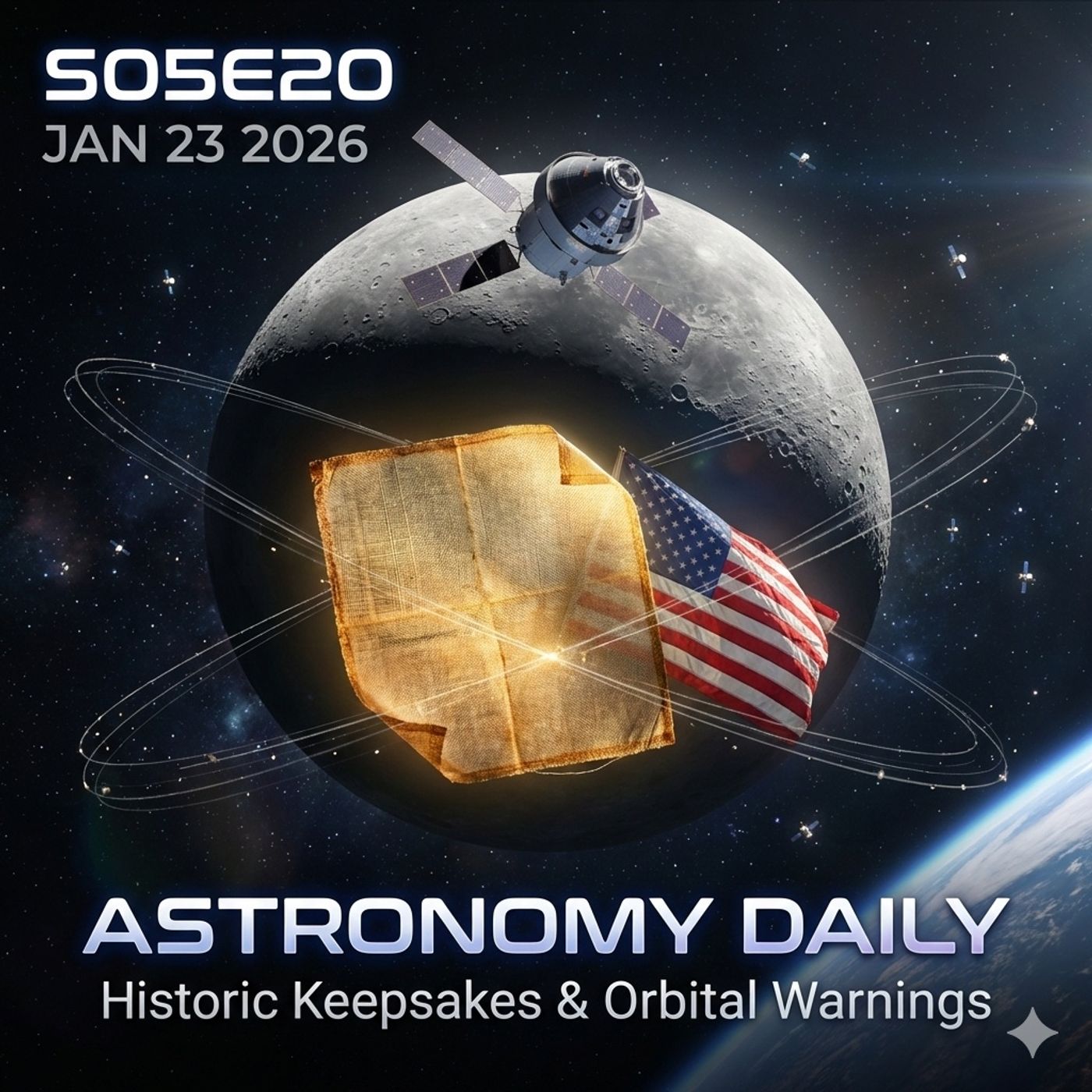
Artemis II's Historic Cargo, Orbital Debris Crisis, and AI Finds 7,000 New Worlds
In this episode
Welcome to Astronomy Daily! Today we explore NASA's inspiring collection of historic keepsakes heading to the Moon on Artemis II, including fabric from the 1903 Wright Flyer. We examine an urgent warning about orbital debris—the CRASH Clock shows catastrophic collision could occur in just 5.5 days if satellites lose maneuvering capability. New analysis of Apollo lunar samples challenges our understanding of where Earth's water came from. Irish researchers solve the mystery of how supermassive black holes grew so quickly in the early universe. Plus, Blue Origin schedules its third New Glenn launch with a reused booster, and NASA's AI tool ExoMiner++ identifies 7,000 new exoplanet candidates in TESS data.Hosts: Anna & Avery
Episode: S05E20
Become a supporter of this podcast: https://www.spreaker.com/podcast/astronomy-daily-latest-space-news--5648921/support.
Sponsor Details:
Ensure your online privacy by using NordVPN. To get our special listener deal and save a lot of money, visit www.astronomydaily.io/nordvpn. You'll be glad you did!
Get the best secure and private email on the planet. Stop your Government, google and who knows who else spying on every email you write. Do what we did and use ProtonMail. They beleive in privacy and there are no ads in their business model...yet they still provide a free forever service. Check them out and get out special deal at www.astronomydaily.io/protonmail
Become a supporter of Astronomy Daily by joining our Supporters Club. Commercial free episodes daily are only a click way... Click Here
This episode includes AI-generated content.
Anna: Welcome to Astronomy Daily. I'm Anna. Avery: And I'm, um, avery. It's Friday, January 23rd, and we've got an amazing lineup of space stories to close out your week. Anna: We certainly do. Today we're exploring NASA's plans to send some very special keepsakes around the moon on Artemis 2. Blue Origin's latest new Glenn launch plans, and some m fascinating new research about where Earth's water really came from. Avery: Plus, we'll dive into a rather urgent warning about the increasing dangers of space space debris, uncover new insights about how supermassive black holes grew so quickly, and learn how AI Is helping scientists discover thousands of new exoplanets.
Let's get started, avery. Anna: As Artemis 2 preparations continue at Kennedy Space Center, NASA has revealed something really special they'll be taking along for the ride. And it's not just the four astronauts. Avery: Oh, I love when missions carry meaningful items. What are they bringing? Anna: This is fascinating. The official flight kit includes a piece of fabric from the original 1903 Wright Flyer. It's a tiny swatch just one inch square from the very first aircraft that made the powered flight at Kitty Hawk.
What's even cooler is that this same piece already flew on the space shuttle discovery back in 1985. Avery: So it's making its second journey to space. That's a beautiful connection between the beginning of powered flight and humanity's return to the moon. What else is in the flight kit? Anna: There's an American flag with an incredible history. It flew on the very first shuttle mission, STS1, and the final shuttle mission, STS135. It also went up on SpaceX's first crewed Dragonflight. Talk about bookending an era of spaceflight.
Avery: That flag has seen some serious history. Is there anything connecting Artemis back to the Apollo program? Anna: Absolutely. They're flying a flag that was originally meant for Apollo 18, a mission that never happened. This will be its very first spaceflight, finally fulfilling its original destiny after all these years. There's also a photo negative from the Ranger 7 mission, which was the US first spacecraft to successfully reach the lunar surface back in the 1960s. Avery: It's like they're weaving together the entire story of American exploration.
And knowing NASA, I bet they're including the public somehow. Anna: Of course, an SD card carrying millions of names, including ours, from the send you'd name to space campaign will be aboard. NASA administrator Jared Isaacman put it beautifully when he said these artifacts reflect the long arc of American exploration and the generations of innovators who made this moment possible. With about 10 pounds of mementos in total, Artemis 2 will truly be carrying our, uh, collective history and dreams.
Dreams Forward into the next chapter beyond Earth. Avery: What a perfect way to mark America's 250th anniversary. Now, speaking of missions and launches, let's shift gears to Blue Origin and their New Glenn rocket. Anna: Blue Origin has announced their third New Glenn launch is scheduled for late February. And there's an interesting twist to this one. Avery: Let me guess. Everyone expected them to fly their Blue Moon lunar lander next, right? Anna: Exactly. But instead, they're launching a satellite for AST Space Mobile, making it the second commercial payload to fly on New Glenn.
The blue moon mark one lander is currently being shipped to NASA's Johnson Space center for vacuum chamber testing. And they haven't announced a launch date for that mission yet. Avery: So what makes this particular launch notable? Anna: This will be the third New Glenn launch in just over a year, which is impressive considering the rockets spent a decade in development. But here's the really exciting part. They're reusing the booster from November's second flight. They successfully landed it on a drone ship in the Ocean, just like SpaceX does with Falcon 9.
Avery: So this demonstrates their reusability program is working. That's crucial for reducing launch costs. What else is Blue Origin working on? Anna: They've got some ambitious plans. In November, they revealed a super heavy variant of New Glenn that will be taller than a Saturn V rocket on par with SpaceX's Starship. And just this week, they announced a satellite Internet constellation called Terrawave that they plan to start deploying in late 2027. Avery: February is shaping up to be a busy month for spaceflight.
NASA might launch Artemis 2 as early as February 6th. SpaceX is testing the third version of Starship, and Crew 12 to the International Space Station is also scheduled. Speaking of busy orbital environments, that brings us to our next story about space debris. Anna: Avery, this next story is both fascinating and a bit alarming. A new study has introduced something called the crash clock. And according to their calculations, if satellite operators suddenly lost the ability to maneuver their spacecraft, we could see a catastrophic collision in just 5.5 days.
Avery: Wait, 5.5 days? That's incredibly short. What's driving this? Anna: Megaconstellations. The researchers found that close approaches between satellites, defined as two satellites passing within 1km of each other, now happen every 22 seconds across all low Earth orbit megaconstellations. For Starlink alone, It's once every 11 minutes. Each Starlink satellite performs an average of 41 avoidance maneuvers per year. Avery: Those numbers are staggering, and you said 5.5 days. I thought I'd heard this was originally 2.8 days.
Anna: Good catch. The team updated their model based on community feedback. The original calculation was 2.8 days, but after incorporating expert input, they Revised it to 5.5 days for 2025 data. By comparison, back in 2018, before the mega Constellation era really took off, it would have taken 164 days before a collision. Avery: So we've gone from 164 days down to 5.5 days in just seven years. What could cause operators to lose control like that? Anna: Solar storms are the main threat. When a coronal mass ejection hits Earth, it heats up the upper atmosphere, creating more drag on satellites and making their trajectories harder to predict.
During the Gannon storm in May 2024, over half of all satellites in low Earth orbit had to for repositioning maneuvers. More seriously, solar storms can knock out satellites, navigational and communication systems, leaving them unable to maneuver at all. Avery: And, um, solar storms don't give us much warning, do they? Anna: Typically just a day or two at most. The study found that within 24 hours of losing maneuvering capability, there's a 30% chance of a collision between tracked objects and a 26% chance of a collision involving a, uh, Starlink satellite.
Specifically, such collisions would be catastrophic, creating major debris generating events with high likelihood of secondary and tertiary collisions. Avery: That sounds like Kessler Syndrome, the cascade effect, where collisions create debris that causes more collisions. Anna: Exactly. Though the researchers want to be clear about something important, lead author Sarah Thiel emphasized, they're not saying Kessler Syndrome is days away. The crash clock only measures time to the first collision, not a runaway cascade.
Bolkesler Syndrome would take decades or even centuries to develop. But the clock does show how reliant we are on errorless operations every single day. Avery: So it's more of a stress indicator for the orbital environment, Right. Anna: The team suggests the crash clock could serve as a key environmental indicator, similar to how we use carbon emissions metrics for climate change. They're calling for improved debris mitigation, coordinated traffic management, and stronger space weather resilience measures to protect the technology modern society depends on.
Now let's shift from orbital concerns to lunar mysteries. Avery: For decades, Anna, uh, scientists have assumed that Earth's water was delivered by asteroids and comets during the Late heavy bombardment about 4 billion years ago. But new research from lunar samples is challenging that assumption. Anna: The Apollo samples are still teaching us new things after all these years. What did they find? Avery: Dr. Tony Gargano the Lunar and Planetary Institute led a team that analyzed lunar rocks and regolith using high precision triple oxygen isotopes.
They found that meteorites could only have supplied a small fraction of Earth's water. Even by the most generous estimates, the lunar surface record sets a hard limit on volatile delivery. Anna: Why is the Moon such a good record keeper for this? Avery: On Earth, tectonic plates constantly renew the surface, erasing traces of ancient impacts. But the Moon is airless and hasn't had geological activity for billions of years. So its geological record since the Late Heavy Bombardment has been carefully preserved.
It's like a cosmic history book that hasn't been edited. Anna: How did they approach the analysis differently from previous studies? Avery: Instead of focusing on metal loving elements like previous researchers, Gargano's team analyzed oxygen isotopes, which make up the largest mass fraction of rocks. The oxygen triple isotope signature can separate two things that are often confused in lunar the addition of impactor material and the effects of impact induced vaporization on isotopic composition.
Anna: And what did the oxygen isotopes tell them? Avery: They found that at least 1% of the moon's mass consists of impact related material, likely from carbonaceous meteorites that partially vaporized on impact. From this, they calculated that only a tiny amount of water has been delivered to the Earth Moon system since the Late Heavy Bombardment compared to Earth's existing water. Anna: To put that in perspective, how much water does Earth have? Avery: Water covers over 71% of Earth's surface, but it only accounts for about 0.023% of Earth's total mass.
That still works out to roughly 1.46 sextillion kilograms. That's 1.46 followed by 21 zeros. So even a tiny fraction of that is significant. Anna: Co author Dr. Justin Simon from NASA summed it up. Well, the results don't say meteorites delivered no water, but they do make it very hard for late meteorite delivery delivery to be the dominant source of Earth's oceans. Avery: This has interesting implications for lunar exploration, doesn't it? Anna: Absolutely. While meteorites may have delivered only a tiny fraction of Earth's water, their contribution could be crucial for the Moon.
Water ice in permanently shadowed regions is essential for establishing a sustained human presence, providing drinking water, irrigation, radiation shielding and the means to make rocket propellant. As the researchers noted, that small amount of water delivered by impacts could be the single most important factor enabling humanity's expansion into space. Avery: From water on the Moon to mysteries in the early universe, let's talk about supermassive black holes. Anna: How did black holes get so big so fast?
That's been one of astronomy's great mysteries. Avery and researchers at Ireland's Maynooth University have found an answer. Avery: The James Webb Space Telescope has been finding these massive black holes in the early universe that shouldn't exist according to our previous models. Right? Anna: Exactly. These supermassive black holes existed just a few hundred million years after the Big Bang, and conventional theories said there wasn't enough time for them to grow so large. The Maynooth team, led by PhD candidate Daxel Mehta, used state of the art computer simulations to reveal what happened.
Avery: Um, and what did they discover? Anna: The chaotic conditions in the early universe triggered these smaller black holes to undergo what they call a feeding frenzy, devouring material all around them. The dense, gas rich environments in early galaxies enabled something called Super Eddington accretion. Avery: Super Eddington accretion. That sounds intense. What is it? Anna: It's when a black hole eats matter faster than what's considered normal or safe. Normally, when matter falls into a black hole that quickly, it should blow the food away with radiation pressure.
But somehow, in these early dense environments, the black holes kept eating anyway, growing incredibly fast into tens of thousands of times the mass of our Sun. Avery: So they found the missing link between the first stars and later supermassive black holes. Anna: Yes. Black holes come in two main seed. Light seeds, which start at only about 10 to a few hundred times the mass of our sun, and heavy seeds, which can start at, uh, up to 100,000 solar masses. Previously, astronomers thought you needed those rare heavy seeds to explain supermassive black holes.
But this research shows that common light seed black holes can grow at extreme rates under the right conditions. Avery: Dr. John Regan from the team put it perfectly when he said heavy seeds are somewhat exotic and may need rare conditions to form. But their simulations show that garden variety stellar mass black holes can grow at extreme rates in the early universe. Anna: This has implications beyond just understanding the past. The research team noted that future gravitational wave observations from the Lisa mission, scheduled to launch in 2035, may be able to detect the mergers of these tiny, early, rapidly growing baby black holes.
It's exciting to think we might actually observe these processes directly from black holes to exoplanets. Avery: Let's close with our final story about AI hunting for new worlds. Anna. Uh, we've found over 6,000 exoplanets so far, with more than half discovered using data from NASA's Kepler and Tess missions. But there's still a treasure trove of data waiting to be analyzed. And that's where artificial intelligence comes in. Anna: I remember hearing about exominer back in 2021. Is that what this is about?
Avery: Exactly. The team at NASA's Ames Research center created Exominer, which used AI to validate 370 new exoplanets from Kepler data. Now they've released Exominer, trained on both Kepler and TESS data, and the results are impressive. Anna: What can the new version do? Avery: On, um, its initial run of test data, Exominer identified 7,000 targets as exoplanet candidates. These are signals that are likely to be planets but require follow up observations to confirm. The software sifts through observations of possible transits, those tiny dips in starlight when a planet passes in front of its host star and predicts which ones are real planets versus other phenomena like eclipsing binary stars.
Anna: And this is all open source software? Avery: Yes. Anyone can download it from GitHub and use it to hunt for planets in TESS's growing public data archive. Kevin Murphy, NASA's chief science data Officer, emphasized that open source software like exominer accelerates scientific discovery. When researchers freely share their tools, it lets others replicate results and dig deeper into the data. Anna: What makes exominer particularly effective? Avery: Miguel Martinho, the co investigator, explains that when you have hundreds of thousands of signals like this, it's the ideal place to deploy deep learning technologies.
Despite Kepler and TESS operating differently, TESS surveys nearly the whole sky looking for planets around nearby stars, while Kepler looked at a small patch of sky more deeply. The two missions produce compatible datasets. This allows exominer to train on both and deliver strong results. Anna: Project lead Hamed Valizadigan said it perfectly with not many resources, they can make a lot of returns. What's next for the program? Avery: The team is working on giving the model the ability to identify transit signals themselves from raw data, rather than just evaluating pre identified candidates and looking ahead.
NASA's Nancy Grace Roman Space Telescope will capture tens of thousands of exoplanet transits starting in a few years and all that data will be freely available too. The advances made with exominer could help hunt for planets in Roman data as well. Anna: Exoplanet scientist John Jenkins summed it up beautifully. Open source science and open source software are, uh, why the exoplanet field is advancing as quickly as it is. It's a great reminder of how collaboration and shared resources drive discovery.
Avery: And that's all we have time for today. What a day of space news. Anna um, from legacy keepsakes heading to the moon to urgent warnings about orbital debris to AI discovering thousands of new. Anna: Worlds and everything in between. New insights about Earth's water, the rapid growth of supermassive black holes, and Blue Origin's expanding launch manifest. Space exploration continues to accelerate on multiple fronts. Avery: That's it for today's episode of Astronomy Daily. Thanks for joining us, and we'll see you tomorrow.
Keep looking up. Anna: Clear skies, everyone. Avery: Astronomy Day Stories we told. Anna: Love.
Avery: Story Soul.


 Apple Podcasts
 Spotify
 Pocket Casts
 Castbox
 Overcast
 Podbean
 iHeartRadio
 Castro
 Goodpods
 Moon FM
 Podcast Addict
 Podcast Republic
 YouTube