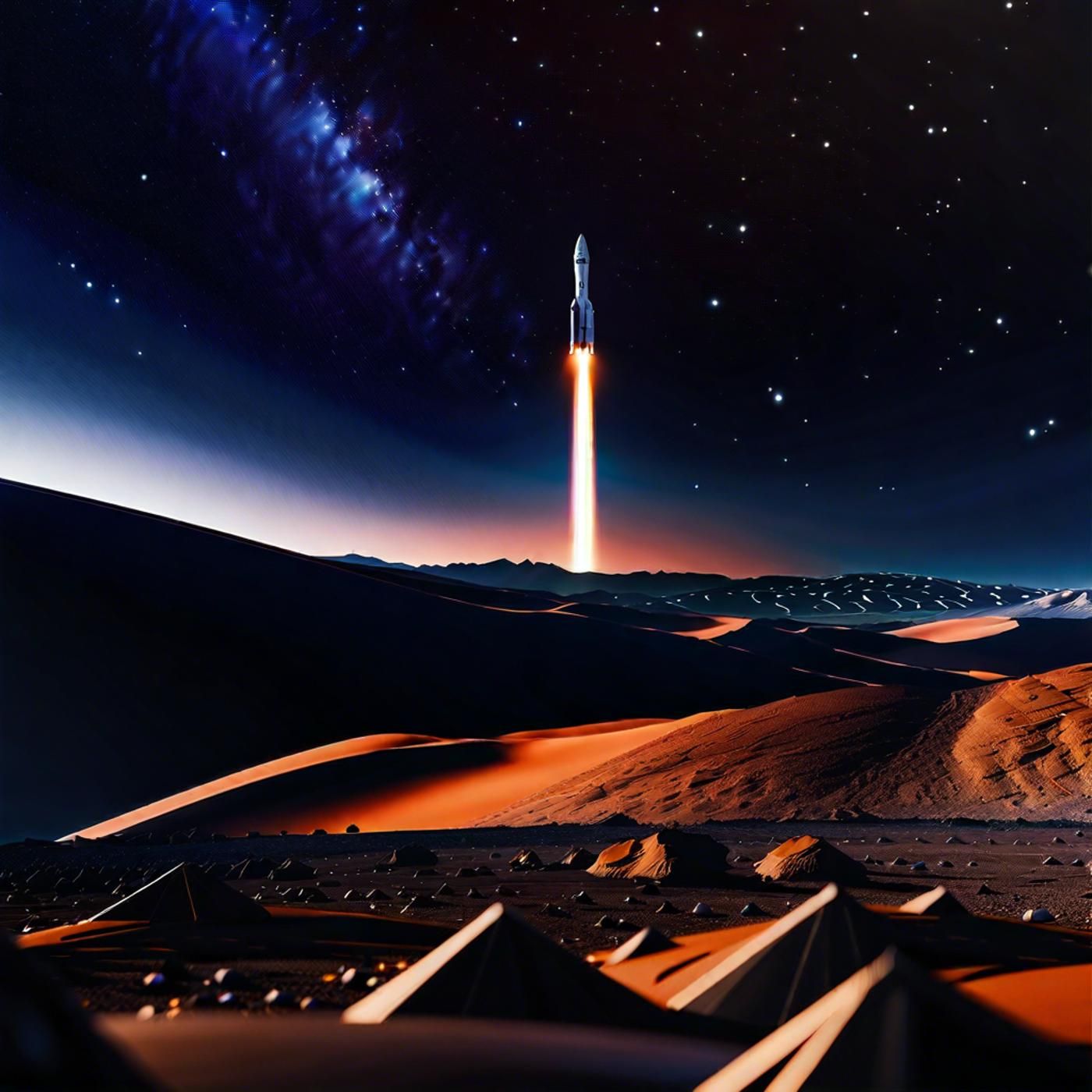
S03E42: Starlink's Martian Ambition & Chang'e-6's Lunar Quest: Redefining Space Connectivity
In this episode
Join us on a cosmic journey with today's episode of Astronomy Daily - The Podcast, as we explore the most recent and thrilling developments in space exploration. We're taking you from the red sands of Mars, where SpaceX's Starlink could revolutionize interplanetary communications, to the enigmatic far side of the moon, where China's Chang'e 6 probe is making history with its ambitious sample retrieval mission. We'll also venture into the burgeoning realm of commercial space flights, where Virgin Galactic's upcoming mission promises to democratize the awe of zero gravity. And we'll dive into the potential of finding extraterrestrial life through the powerful lens of the James Webb Space Telescope. Buckle up for an interstellar voyage that spans the past, present, and future of our celestial endeavors.1. **Starlink's Martian Ambitions**: SpaceX's bold plan to interconnect our solar system.2. **Chang'e 6's Lunar Quest**: China's groundbreaking mission to the moon's far side.3. **Galactic Zero Seven**: Virgin Galactic's leap towards commercial space tourism.4. **James Webb's Exoplanet Excitement**: A cautious but hopeful look for signs of life.5. **Hayabusa 2's Magnetic Revelations**: Uncovering the ancient history of the solar system through asteroid Ryugu.For an immersive experience of the cosmos, visit our website at astronomydaily.io, and join the stargazing community on X (@AstroDailyPod) for continuous updates and celestial conversations. Until our next stellar encounter, this is Anna reminding you to keep your eyes on the skies and your curiosity ever burning. Clear skies and boundless wonder to all our fellow space enthusiasts! This episode is presented with the support of our cosmic companions at NordPass. Secure your interstellar journey with our special offer by visiting www.bitesz.com/nordpassSupport Astronomy Daily the Podcast and access the commercial free episodes....for not very much money. Honest...check it out here: https://www.spreaker.com/podcast/astronomy-daily-the-podcast--5648921/support
Sponsor Details:
Ensure your online privacy by using NordVPN. To get our special listener deal and save a lot of money, visit www.astronomydaily.io/nordvpn. You'll be glad you did!
Get the best secure and private email on the planet. Stop your Government, google and who knows who else spying on every email you write. Do what we did and use ProtonMail. They beleive in privacy and there are no ads in their business model...yet they still provide a free forever service. Check them out and get out special deal at www.astronomydaily.io/protonmail
Become a supporter of Astronomy Daily by joining our Supporters Club. Commercial free episodes daily are only a click way... Click Here
Welcome to Astronomy Daily, the podcast where we dive into the latest news from the cosmos. In this episode, we delve into some of the most compelling stories that have captured the attention of those who look towards the stars. From the far reaching satellites destined for Mars, potentially revolutionizing interplanetary communications, to the ambitious lunar surface missions poised to bring back precious samples, we are entering a new era of cosmic exploration. We'll also take a look at the burgeoning industry of commercial space flights, promising to make the experience of zero gravity accessible to more people.
And not least, we'll discuss the tantalizing prospects of uncovering extraterrestrial life with the latest data from cutting edge space telescopes. Join us as we journey through these stellar developments and discoveries of our universe. The Autonomy Day pocast in an exhilarating update from the forefront of interplanetary communication, NASA is betting on SpaceX's Starlink to possibly beam high speed Internet across the Martian landscape. This collaboration could become a keystone in humanity's quest to colonize the red planet.
SpaceX, under the dynamic leadership of Elon Musk, has been tasked with adapting the Starlink broadband Internet satellites for Mars, a concept that is nothing short of revolutionary, As part of a wider initiative involving a dozen concept studies from nine companies, including industry giants such as Blue Origin, Lockheed Martin, and Moore, Starlink's potential extension to the Martian orbit heralds a new dawn in space exploration. With funding between two hundred thousand dollars and three hundred thousand dollars for these reports due in August, we are witnessing the private sector's growing influence in advancing our cosmic capabilities.
Imagine the possibilities a future where scientists on Mars can seamlessly transmit their findings to Earth, where settlers can communicate with their loved ones millions of miles away, and where the Internet unites not just a world, but a solar system. SpaceX has long championed the interconnectivity of celestial bodies, and Starlink's Mars adaptation could be the thread that binds our future interplanetary society. Eric Iinson, director of NASA's Mars Exploration program encapsulates this moment perfectly, declaring We're in an exciting new era of space exploration with rapid growth of commercial interest and capabilities.
Indeed, we stand at the cusp of a new era where partnerships between public institutions and private entities like SpaceX will bolster science at Mars in the coming decades. Together, NASA and SpaceX are not just shooting for the stars, they are laying the groundwork for humanity's multiplanetary future, and it all starts with a robust, red threaded network, a Martian starlink. China's monumental strides in space exploration have once again riveted the global community as the nation embarks on an historic quest to retrieve samples from the lunar Phar side with the chang A six probe.
The mission, a testament to human ingenuity and ambition, saw the Long March fifth rocket majestically ascend successfully from the wen Chung Space Launch Center, marking the first effort by any nation to collect rocks and regolith from the side of the Moon, perpetually hidden from Earth's view, residing in mystery and beckoning to be understood. The south Pole Aitken Basin on the Moon's far side. Harbor's secrets nestled within its ancient terrain. Known to be the largest impact crater in our Solar System, this is a region where no human or robotic presence has ventured for sample retrieval until now.
This mission, with its unprecedented scale, may unearth clues to unravel the perplexing history of our nearest celestial neighbor. The Change six journey is not a solitary endeavor. It's a collaborative venture with instruments from the international space community, including contributions from France, Italy, Pakistan and partnerships with the European Space Agency. Much to the chagrin of scientific cooperation, US laws have kept NASA out of reach from participating directly due to restrictions on space collaboration with China.
Nevertheless, the mission advances, poised to illuminate our understanding of lunar geology and perhaps to rewrite the textbooks on the evolution of the Solar System itself. Anticipation holds the breath of many as we await the success of Chung six is landing its targeted touchdown after a meticulous four to five days of travel promises to deliver two kilograms of lunar material back to Earth, an odyssey spanning millions of miles and eons of time. This celestial ballet of technology and pursuit of knowledge is not just an active exploration.
It's a precursor to a grander vision, a permanent lunar outpost. The planned China Russia led International Lunar Research Station is an audacious step towards sustained human presence and deep space exploration. As we contemplate the achievements and forward gaze of the Change sixth mission, we can't help but marvel at the bold steps taken by China to unfurl the secrets of the Moon's far side. Each grain of moondust brought back may well hold the tail of our primal cosmic neighborhood, and perhaps the whispers of future footsteps on a permanent lunar base.
Stay tuned, as this mission could set the stage for yet another giant leap for mankind. Virgin Galactic, the space tourism company that's striving to make space accessible to civilians, has its sites set sky high with the scheduled launch of its seventh commercial spaceflight on June eighth, appropriately christened Galactic zero seven. As this venture draws nearer, Virgin Galactic demonstrates remarkable progress and solidifies its place in the emergent realm of private space travel on the heels of a successful flight earlier this year.
Galactic zero seven embodies the company's seamless combination of ambition and adherence to rigorous safety protocols. Virgin Galactic's unique air launch system, distinguished by the carrier aircraft VMS EVE and the suborbital SpaceLiner VSS Unity, will propel Galactic zero seven skyward from the tarmac of Spaceport America in the New Mexico Desert. Once released from the maternal clutch of Eve, at approximately forty five thousand feet, VSS Unity will ignite its rocket motor, breaching the boundary to suborbital space.
The intrepid passengers aboard Unity, hailing from New York, California, Italy, and one Axiom Space affiliated researcher astronaut will bask in the transcendent experience of weightlessness and the profound spectacle of seeing our planet juxtaposed against the Cosmos. Virgin Galactic remains transparent about its endeavors, learning from every mission. A past concern saw an alignment pin detach unexpectedly. However, with the full cooperation of the US Federal Aviation Administration, Virgin Galactic has crafted meticulous corrective actions, ensuring even greater safety for Galactic zero seven and all subsequent flights.
With the flamboyant price tag of four hundred and fifty thousand dollars a seat, this mission highlights a bold step towards a future where the marvels of space are not solely the realm of astronauts. Virgin Galactic's vision for commercial spaceflight is more than an audacious dream. It's a testament to the human spirit's persistence and its unyielding desire to reach for the stars. The Astronomy Daily podcast in a fascinating leap forward for astronomy. The James Webb Space Telescope or JWST, has been at the center of some thrilling speculation recently.
Initial reports suggested that the telescope may have found indications of life on a distant exoplanet. While these claims were premature, let's unpack the significance of the JWST's capabilities and what it means for our quest to find life beyond Earth. The planet under observation K two eighteen B, located some one hundred twenty light years away, grabbed attention due to its potential biosignature elements identified in its atmosphere. K two eighteen B circles its star within the habitable zone and is thought to be an ocean world, complete with what could be vast bodies of liquid water, a key ingredient for life on Earth.
Similar environments are teeming with biological activity, so you can understand the buzz of excitement. However, as scientist sheng Min Sai of the University of California Riverside points out, while the exoplanet receives a similar amount of solar radiation to our home and can boast a comparable temperature if you exclude atmospheric effects, the composition is quite different with its hydrogen dominated atmosphere, adding to the initial excitement. Last year, a tentative detection of demethyl sulfide or DMS was reported by researchers using JWST on Earth.
DMS is a compound produced by oceanic phytoplankton, and if this finding were confirmed, it would be a tantalizing hint that similar biological processes could exist on K two eighteen B. However, researchers have urged caution and highlighted the need for further observations to verify the presence of DMS. The JWST's follow up studies with other instruments, such as the mid Infrared Instrument, will be crucial in determining the nature of K two to eighteen b's atmosphere and potential signs of life.
It's this kind of rigorous scientific investigation that will ultimately lead us to more definitive answers. Even though we must temper our initial enthusiasm with a dose of scientific skepticism. These intriguing observations by JWST underscore our ability to reach further into the cosmos with unprecedented detail, heralding a ne new age of discovery in the search for extraterrestrial life. The journey of uncovering life in the universe is just beginning, and telescopes like the JWST are opening doors that once seemed firmly shut.
What we're witnessing today is just a preview the unfolding story of the cosmos. Awaits and It's a narrative full of mystery, with every revelation bringing us closer to answering the age old question are we alone in the universe. The Japanese Hyabusa two mission has delivered a cosmic breakthrough, enlightening our understanding of the Solar System's ancient history through the study of asteroid Reyugu. These findings have unlocked secrets of the early Solar systems magnetic fields and offered a clearer picture of space weathering changes on planetary bodies without atmospheres induced by meteoroid impacts and influences from the void of space.
By examining Pristine's samples gathered directly from Yugu's surface, scientists unleash the potential of a method known as electron holography to delve into the asteroid's magnetic properties. The discoveries center on tiny, yet incredibly significant specs the remnants of magnetite found within Ryugus grains. Magnetite, a magnetic mineral comprising iron oxide, is cradled within these particles, preserving the echoes of the magnetic field that existed when our Solar System was young. Although this magnetization has weakened over billions of years, its imprint remains within the asteroids fabric.
By measuring this ancient remnant magnetization, researchers can glean invaluable insights into the magnetic conditions that presided during the early stages of planetary formation. But the Solar System is a dynamic arena, and even the properties of magnetite can evolve under the duress of space weathering. This is precisely what the Hyabusa two mission samples have started to unveil. Astonishingly, scientists discovered that certain magnetite grains lost their magnetism, transforming into what's been dubbed pseudomagnetite, a mineral with curious ties to both magnetite and wastite.
This metamorphosis, alongside the presence of countless metallic iron nanoparticles, is theorized to have arisen from the relentless barrage of micrometeoroids impacting REUGU at velocities over fifteen thousand miles per hour. Understanding the journey of these grains from their birth amongst nebular clouds to the onslaught of space weathering takes us a step closer to unraveling the mysteries of planetary system evolution, a quest as timeless as the stars themselves. Such insights not only deepen our knowledge of Reugu, but chart a path to decoding the magnetic legacies of other cosmic bodies, cementing the Hyabusa to mission as a beacon in our interstellar odyssey.
As we conclude today's journey across the universe, i'd like to thank you for tuning in to Astronomy Daily, the podcast. For those eager to delve deeper into the cosmos, remember to visit our website at Astronomy Daily dot io. Here you can catch up on past episodes, embrace the latest in space and astronomy news, and explore our thought provoking blog summaries. And the conversation doesn't end here. Join us on x the platform formerly known as Twitter, where our updates and discussions continue to soar into the celestial sphere.
Find us at astro Daily Pod. Until next time, this is Anna saying, keep your eyes to the skies and your curiosity alight. Sunday, Stars Star




 Apple Podcasts
 Spotify
 Pocket Casts
 Castbox
 Overcast
 Podbean
 iHeartRadio
 Castro
 Goodpods
 Moon FM
 Podcast Addict
 Podcast Republic
 YouTube