
In this episode
- NASA's New Interim Administrator: In a surprising turn of events, President Trump has appointed Sean Duffy as NASA’s interim administrator. With a background in transportation and a stint on reality television, Duffy's unconventional path raises questions about the future direction of the agency amidst significant budget cuts proposed by the administration.
- - Discovery of Comet 3i Atlas: Astronomers have traced the origin of the newly discovered interstellar comet 3i Atlas back to the Milky Way's thick disc, revealing it to be between 7.6 and 14 billion years old. This groundbreaking finding offers invaluable insights into the history of our galaxy and the processes of planetesimal formation.
- - Insights from NASA's DART Mission: We delve into the complexities revealed by NASA’s DART mission, which successfully altered the orbit of the asteroid Dimorphos. The aftermath of the impact has unveiled new physics regarding asteroid composition and debris movement, crucial for future planetary defence strategies.
- - Saturn's Return to the Night Sky: Stargazers rejoice! Saturn is making its return to the late night sky, providing an excellent opportunity for observation. With tips on timing and viewing conditions, we encourage listeners to grab their telescopes and enjoy the stunning sight of this magnificent gas giant.
- For more cosmic updates, visit our website at astronomydaily.io. Join our community on social media by searching for #AstroDailyPod on Facebook, X, YouTube Music, TikTok, and our new Instagram account! Don’t forget to subscribe to the podcast on Apple Podcasts, Spotify, iHeartRadio, or wherever you get your podcasts.
- Thank you for tuning in. This is Anna signing off. Until next time, keep looking up and stay curious about the wonders of our universe.
NASA Interim Administrator
[NASA](https://www.nasa.gov/)
Comet 3i Atlas Discovery
[University of Oxford](https://www.ox.ac.uk/)
DART Mission Insights
[NASA DART](https://www.nasa.gov/mission_pages/dart/main/index.html)
Saturn Viewing Tips
[In The Sky](https://www.inthesky.org/)
Astronomy Daily
[Astronomy Daily](http://www.astronomydaily.io/)
Become a supporter of this podcast: https://www.spreaker.com/podcast/astronomy-daily-space-news-updates--5648921/support.
Sponsor Details:
Ensure your online privacy by using NordVPN. To get our special listener deal and save a lot of money, visit www.astronomydaily.io/nordvpn. You'll be glad you did!
Get the best secure and private email on the planet. Stop your Government, google and who knows who else spying on every email you write. Do what we did and use ProtonMail. They beleive in privacy and there are no ads in their business model...yet they still provide a free forever service. Check them out and get out special deal at www.astronomydaily.io/protonmail
Become a supporter of...
Anna: Welcome to Astronomy Daily, your regular dose of the cosmos. I'm Anna, and today we've got an exciting lineup of stories for you. First up, we'll dive into the surprising news from Washington, D.C. where NASA has just received a new interim administrator with a rather unconventional background. Then we'll journey beyond our solar system to uncover a groundbreaking discovery about the origin of a recently spotted interstellar comet. It's a first of its kind. We'll also get the Latest insights from NASA's DART mission, learning how deflecting asteroids isn't quite as straightforward as once thought.
And finally, for all you stargazers out there, I'll share some tips on how to spot the magnificent ringed planet Saturn as it makes its grand return to the late night sky this week. Let's get started. Our first big story takes us to the political landscape of space, as President Trump has appointed a new interim administrator for NASA, Sean Duffy. This comes six weeks after the termination of Jared Isaacman's nomination. What makes this appointment particularly noteworthy is that Duffy currently serves as the Secretary of transportation, a massive role overseeing 55,000 employees and 13 agencies, including the FAA.
President Trump announced the news on his social media, praising Duffy's tremendous job in transportation and calling him a fantastic leader for the space agency, even if only for a short time. Duffy himself took to X, stating he was honoured to accept this mission. Time to take over space. Let's launch. This choice might seem unconventional considering Duffy's background, which includes starring on the Real world Boston in 1997, working as an ESPN commentator and serving as a Republican in the US House of Representatives.
He doesn't have a traditional space career, although he has recently shown interest in spaceflight as FAA administrator, even watching the Crew 9 missions splash down. This appointment apparently caught NASA officials off guard, as they had anticipated the current acting administrator, Janet Petro, would remain. However, sources suggest President Trump wanted someone he personally liked and trusted at NASA's helm. This could actually be a significant advantage for the agency, providing a direct line to the president.
Duffy could, for instance, text Trump directly if NASA needs something or faces unfairness during the budgeting process, offering a level of political sway Petro lacked. On the flip side, there are genuine concerns about NASA's future under Duffy's leadership. Given his political background, his primary mission might be to implement the president's budget request, which proposes significant cuts to NASA's science funding and changes to its deep space exploration plans. He's expected to align with Russ Vaught, who leads the White House Office of Management and Budget and holds strong views on presidential authority over federal spending.
This could mean a more aggressive push to enforce budget cuts, potentially impacting NASA's workforce and ongoing projects. While NASA now has a trusted and politically savvy leader for the next few months, the path forward is anything but clear. It remains to be seen whether Duffy will heed the concerns of NASA's Scientific and Engineering leadership, or if his mandate will be to streamline the agency according to the proposed budgetary directives. It's a development we'll be watching closely here at Astronomy Daily, Shifting gears from earthbound space politics to incredible cosmic journeys Astronomers have just made a groundbreaking discovery about the third known object to visit our solar system from M interstellar space.
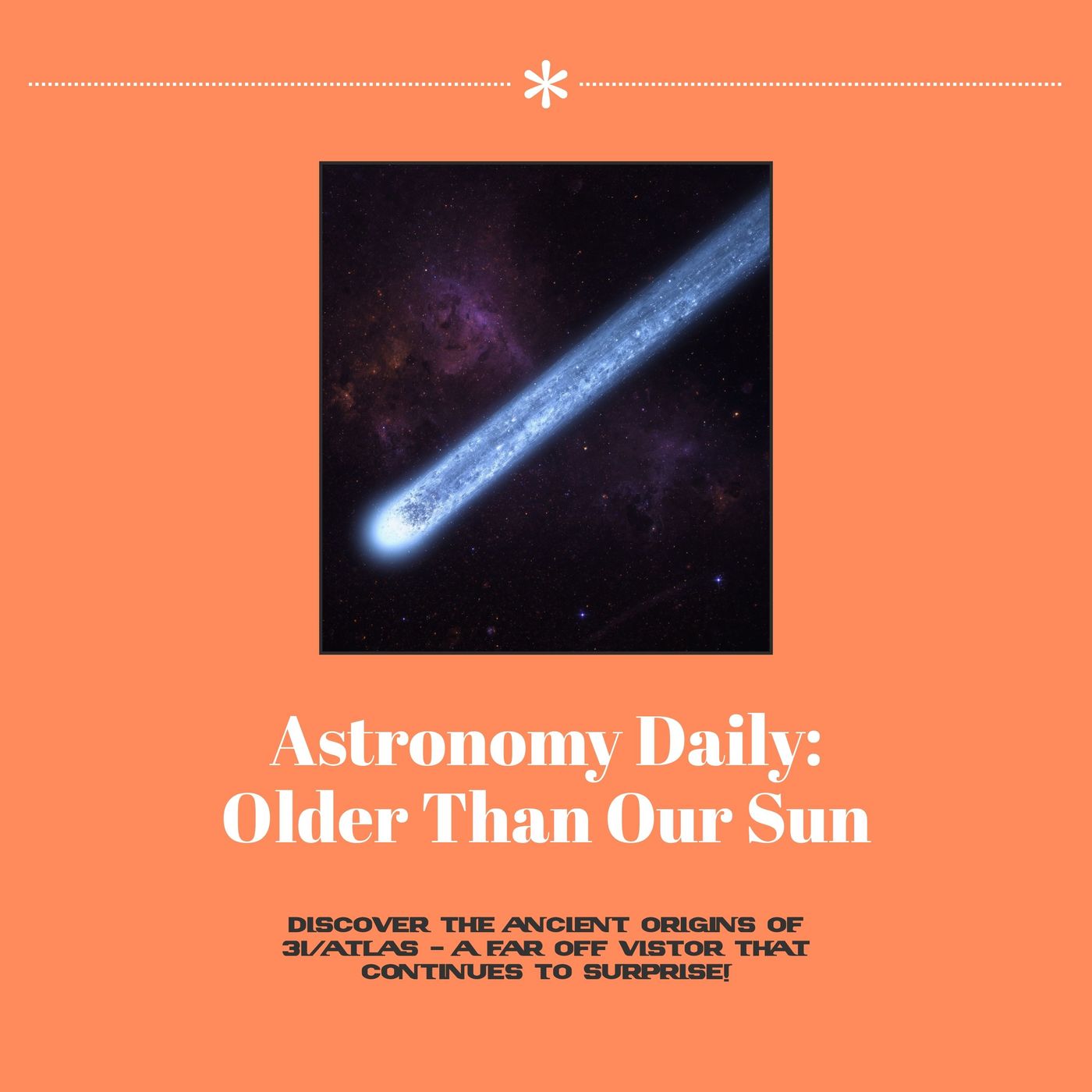
This new visitor, Comet 3i Atlas, has a truly unique origin that sets it apart from its predecessors Oumuamua and 2i Borisov. A team led by astrophysicist Matthew Hopkins of the University of Oxford has traced Comet 3I Atlas back to the thick disc of the Milky Way. This isn't just any region of our galaxy it's a vastly different and much older environment than the thin disc where our sun currently resides. This unprecedented finding suggests that Comet 3i Atlas is significantly older than our own solar system, with researchers estimating its age to be between 7.6 and 14 billion years old compared to our Sun's mere 4.6 billion years.
The comet, discovered on July 1, 2025, was found travelling at an astonishing velocity of 57 kilometres per second. To pinpoint its origin, Hopkins and his colleagues employed a sophisticated protocol known as the Otautahi Oxford Interstellar Object Population Model. This model, developed by astronomers from New Zealand and the uk, combines Gaia satellite data with models of galactic chemistry and object movement to map out populations of interstellar objects. Their analysis revealed that the comet's velocity is perfectly consistent with an origin in the Milky Way's thick disc.
This region contains about 10% of the galaxy's stars, most of which are over 10 billion years old. This discovery not only makes 3i Atlas the first known interstellar interloper from this ancient part of our galaxy, but also makes it highly unlikely that all three known interstellar visitors came from the same source. Comet 3I Atlas is estimated to be between 10 to 20 kilometres across, with a bluer surface hue and a redder coma than most comets native to our solar system. Its closest approach to the sun will occur in October 2025, bringing it just inside the orbit of Mars before it continues its journey back out of our solar system.
While it's currently impossible to Trace these interstellar objects back to a single specific star. The fact that 3i Atlas hails from the thick disc provides invaluable insights. These interstellar objects offer a rare opportunity to study the process of planetesimal formation and evolution from diverse galactic environments, expanding our understanding beyond just our own cosmic neighbourhood. It's a remarkable glimpse into the broader history of our galaxy. From ancient interstellar travellers, we now turn our attention to how we're preparing to defend our own cosmic neighbourhood from asteroids right here in the solar system.
NASA's DART mission, a real world test of asteroid deflection, made history by purposefully colliding with Dimorphos, a small asteroid moon, in late 2022. The mission successfully changed the moon's orbital period by a remarkable 33 minutes. However, what unfolded after the collision has opened a complex new chapter in asteroid science. As DART slammed into Dimorphos, it launched a significant swarm of boulders into space. These rocks, some as large as 3.6 metres, were propelled at high speeds, carrying over three times the momentum of the DART spacecraft itself.
This surprising revelation came from images captured by Lichicube, a tiny Italian spacecraft that flew alongside dart. A team led by Tony Farnham at the University of Maryland analysed these ejected boulders, finding they weren't randomly scattered. Instead, they formed two distinct clusters. Farnham noted something unknown is at work here, with one large cluster flung towards the south, possibly breaking off from two massive surface boulders. This analysis highlights, uh, a crucial difference from previous missions.
Jessica Sunshine, a, uh, co author, explained that unlike earlier impacts on uniform surfaces, DART hit a rocky asteroid. This created chaotic ejecta, proving that an asteroid's composition and surface structure significantly influence impact results, a critical lesson for future planetary defence. The ejecta's shape and direction are vital for understanding momentum transfer. The plume formed a tilted cone, meaning the force wasn't just straight back. It also moves sideways. This lateral force could potentially tilt the asteroid's orbit or change its spin.
Researchers estimate this recoil might have shifted Dimorphos orbital plane by up to one degree, which is significant in spaceflight. The DART mission aimed to measure momentum enhancement, the extra push from kicked up material. The momentum from these ejected boulders was directed almost perpendicular to Dart's path and adding a significant twist to the expected outcome. Farnham emphasised while the direct impact of the DART spacecraft caused this change, the boulders ejected gave an additional kick that was almost as big.
That additional factor changes the physics we need to consider when planning these types of missions. As Jessica Sunshine vividly put it, you can think of it as a cosmic pool game. We might miss the pocket if we don't consider all the variables. This underscores why tracking debris movement is so essential. Lichicube's detailed images analysed with parallax, made a, uh, 3D map possible, helping scientists understand velocities and ejecta evolution. Looking ahead, this analysis will be crucial for Europe's HERA mission, scheduled to arrive at the Didymos system in 2026.
HERA will closely examine the aftermath of the DART impact, using this study as a vital roadmap. Ultimately, dart's success wasn't just about moving an asteroid. It was about revealing the complex physics involved when an asteroid breaks apart and ejects material. It's a powerful reminder that when trying to protect Earth, we truly need to account for every single rock. And now, shifting our gaze from potential threats to a celestial beauty, we have some exciting news for stargazers. The magnificent ringed gas giant Saturn is making its long awaited return to the late night sky for observers in the Northern Hemisphere this coming week, offering a prime opportunity for some breathtaking views.
For the past few months, Saturn has been putting on a spectacular show for early risers. Appearing as a morning star just before or during dawn each day, it's been rising a little earlier, steadily moving away from the light of the sunrise. Now, for those in the Northern hemisphere, Saturn will be making its triumphant return to the late night sky. For instance, New Yorkers can expect to see Saturn rise alongside the stars of the Constellation Pisces at 11:57pm EDT on July 9th. Remember that the exact times a planet rises and sets will vary based on your specific location, so it's always a good idea to check a trusted website like inthesky.org for timings tailored to where you are.
Each successive night, Saturn will rise a few minutes earlier, becoming increasingly visible in the evening sky by the time it reaches opposition, which is when Earth is positioned directly between the ringed giant and the sun. On, uh, September 21st, it will rise just a few minutes after sunset and be observable throughout the entire night. Saturn will remain a consistent fixture in the evening sky until the middle of March 2026, when it will pass close to the sun from our perspective, temporarily disappearing from view before its cycle begins anew in the predawn sky.
While Saturn is absolutely spectacular to view with the naked eye alone, if you have a 6 inch telescope, you'll be able to resolve its iconic ring system and perhaps even some of its larger moons. For those with a larger 8 inch scope, you might even be able to make out the 2,980mile gap in the iconic ring system known as the Cassini Division. Especially under good seeing conditions and dark skies, it's a truly awe inspiring sight. So if you have the chance, definitely take a look. That's all the cosmic news we have for you today on Astronomy Daily.
Thank you for tuning in and joining me Anna, as we explore the universe together. If you want to catch up on all the latest space and astronomy news with our constantly updating news feed or listen to all our back episodes, be sure to visit our [email protected]. you can also subscribe to the podcast on Apple Podcasts, Spotify, YouTube, or wherever you get your podcasts to make sure you never miss an episode. Until next time, keep looking up.
 Apple Podcasts
 Spotify
 Pocket Casts
 Castbox
 Overcast
 Podbean
 iHeartRadio
 Castro
 Goodpods
 Moon FM
 Podcast Addict
 Podcast Republic
 YouTube