In this episode
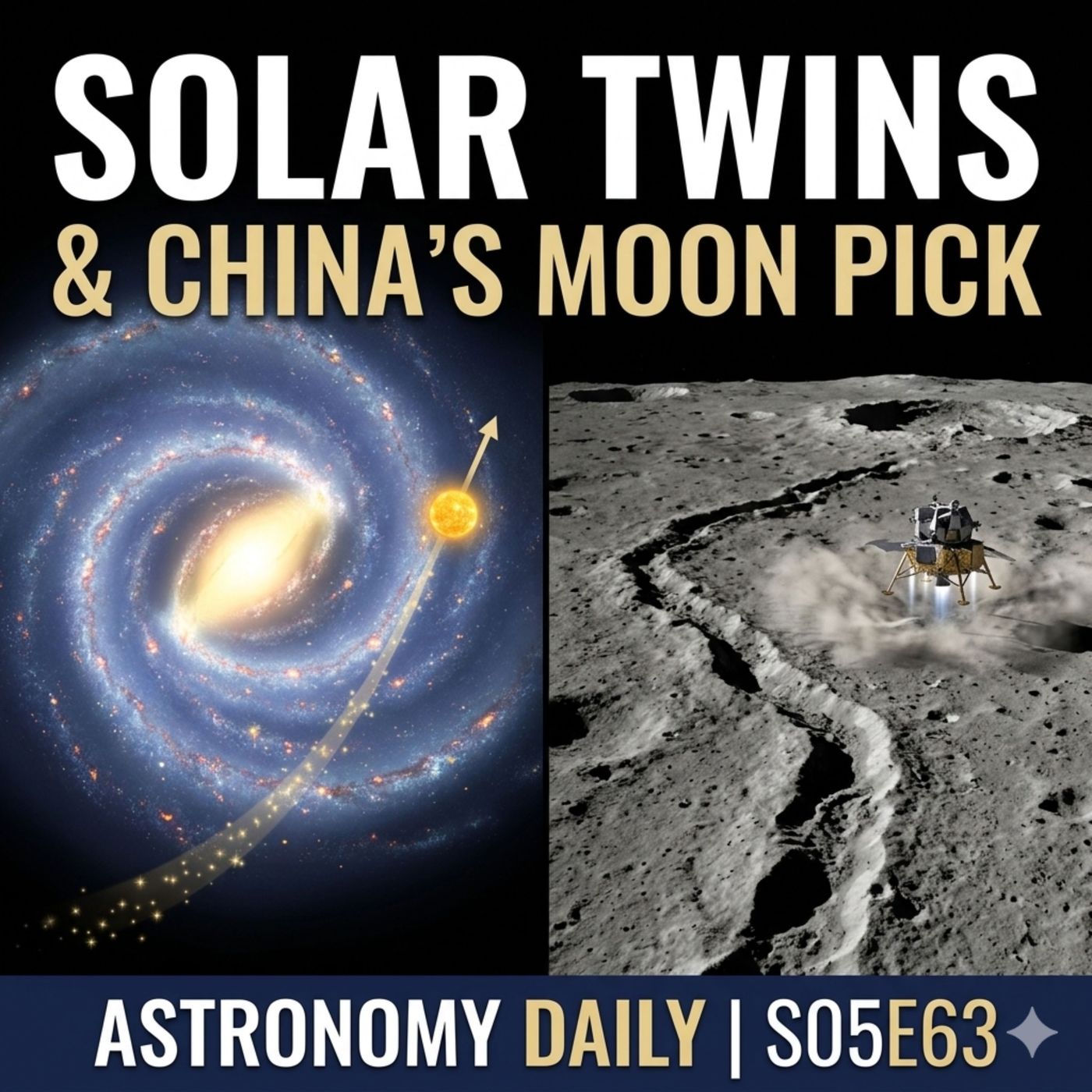
Episode: S05E63 | Date: Saturday, 14 March 2026 Hosted by Anna & Avery | Astronomy Daily Podcast Network — Bitesz.com From galactic migrations to Pi Day planets, Episode 63 covers six stories that span the breadth of the solar system and beyond. Our Sun turns out to have hitched a ride outward from the Milky Way's interior billions of years ago — and brought thousands of stellar companions with it. China has named a leading candidate for its first crewed Moon landing. Russia is dusting off the legacy of the legendary Soviet Venera programme with an ambitious 2036 return to Venus. NASA's nuclear-powered Titan drone is now being physically built. China's Mars sample return mission is constructing actual spacecraft. And in honour of Pi Day, we visit the exoplanet whose year lasts almost exactly 3.14 days. Story 1: The Sun Was Part of a Galactic Migration of Solar Twins A new study in Astronomy & Astrophysics by researchers at Tokyo Metropolitan University and the National Astronomical Observatory of Japan has built the largest-ever catalogue of solar twins — 6,594 Sun-like stars. Using ESA's Gaia satellite, they found a clustering of stars aged 4–6 billion years, suggesting the Sun migrated outward from the Milky Way's inner regions billions of years ago, possibly when the galactic bar was still forming and its 'corotation barrier' was weak enough to allow mass stellar movement. This migration may have placed Earth in a calmer, more life-friendly region of the Galaxy. • Journal: Astronomy & Astrophysics (March 2026) • Lead researchers: Daisuke Taniguchi (Tokyo Metropolitan University) & Takuji Tsujimoto (NAOJ) • Data source: ESA Gaia satellite — catalogue of ~2 billion stars • Key finding: Sun likely formed ~10,000 light-years closer to the Galactic Centre than its current position Story 2: China Eyes Rimae Bode for Its First Crewed Moon Landing A study published in Nature Astronomy (9 March 2026) proposes Rimae Bode — a volcanic region near Sinus Aestuum on the lunar near side — as a prime candidate for China's first crewed lunar landing, targeted for 2030. The site contains five distinct terrain types including pyroclastic deposits, mare basalts, rille systems and highland material. Researcher Jun Huang (China University of Geosciences, Wuhan) described it as a 'geological museum.' Four specific landing spots within the region have been proposed. • Journal: Nature Astronomy (March 2026) • Lead researcher: Jun Huang, China University of Geosciences, Wuhan • Site: Rimae Bode, near Sinus Aestuum, lunar near side • Oldest volcanic activity in region: ~3.2–3.7 billion years ago • China's crewed lunar landing target: 2030 Story 3: Russia Plans Venera-D Mission to Venus in 2036 Russia's First Deputy Prime Minister Denis Manturov confirmed on 10 March 2026 that Russia plans to launch the Venera-D mission — comprising a lander, atmospheric balloon, and orbiter — to Venus in 2036. The mission would extend the legacy of the Soviet Venera programme (1961–1983), which remains the only national programme to have successfully landed on Venus. Scientific goals include searching for microbial life in Venus's clouds and studying the planet's atmosphere. • Mission: Venera-D (lander + balloon + orbiter) • Planned launch: 2036 • Agency: Roscosmos • Heritage: Soviet Venera programme — 16 missions, 1961–1983 • Science goal: Search for biosignatures in Venusian cloud layers (48–60 km altitude) • Source: TASS, citing Razvedchik Journal interview with Denis Manturov Story 4: NASA Begins Building Dragonfly — Nuclear-Powered Drone for Titan NASA and Johns Hopkins Applied Physics Laboratory (APL) officially began integration and testing of the Dragonfly rotorcraft on 10 March 2026. The car-sized, nuclear-powered octocopter is designed to fly across the surface of Saturn's moon Titan, targeting a 2028 launch on a SpaceX Falcon Heavy and...Speaker 1: Happy Pie day space fans three point one four one, five nine and counting. Yes, it's March fourteenth. And if that sounds like an excuse to talk about an exoplanet with a three point one four day year, that's because it absolutely is.
Speaker 2: But before we get to our cosmic pie celebration, we have a packed episode, a story about where our own son came from, a big announcement about where China's astronauts might first set foot on the Moon, and Russia's bold plan to pick up where the Soviet Union left off at Venus.
Speaker 1: Plus a nuclear powered flying drone for Saturn's moon Titan is now actually being built, and China's race to beat everyone to a Martian soil sample is well and truly underway. I'm Avery and I'm Ana. This is Astronomy Daily, Season five, episode sixty three. Let's get into it.
Speaker 2: Here's a question that sounds simple but turns out to be surprisingly deep. How did our own own sun end up where it is in the Milky Way?
Speaker 1: Right? I mean, you might assume it just formed where it is, but the evidence has been pointing somewhere else for a while. And a new study published this week in Astronomy and astrophysics might finally have the answer, and it involves thousands of stars traveling together.
Speaker 2: Researchers at Tokyo Metropolitan University and the National Astronomical Observatory of Japan built the largest ever catalog of what are called solar twins, stars so similar to our Sun in temperature, mass, chemical composition, and surface gravity that they're essentially its cousins.
Speaker 1: They compiled six thousand, five hundred and ninety four solar twins, which is a staggering number when you think about how special we tend to think our Sun is, and they.
Speaker 2: Used ESA's Gaya satellite data to determine two things about each star, how old it is and where it has been moving. What they found was a striking pattern. A large number of these solar twins are between four and six billion years old, which is the same age bracket as her own Sun.
Speaker 1: That clustering is not random. It suggests that the Sun and many of these stars formed in the same general region of the galaxy, probably closer to the Milky Way's inner regions, and then gradually drifted outward together over billions of years.
Speaker 2: But here's the puzzle that the researchers had to solve. The Milky Way has what's called a galactic bar, a rotating bar shaped structure of stars and gas. Near the center. That bar creates something astronomers call a co rotation barrier, which basically traps stars in certain orbital zones and makes it very hard for them to move outward.
Speaker 1: So how did the Sun escape?
Speaker 2: The theory is that when the Sun and its companions formed, the galactic bar was still in the process of forming. It wasn't fully developed yet, and the weaker barrier may have allowed whole groups of stars to break out together, carried along by the dynamics of the early galaxy.
Speaker 1: And the implications of this go beyond just knowing our Sun's origin story. If the Sun formed much closer to the center researchers estimate about ten thousand light years closer than it is today, then this migration may actually be part of the reason Earth became habitable.
Speaker 2: The galactic center is a harsher place, higher star density, more frequent supernova explosions, more high energy radiation moving outward placed us in a calmer neighborhood, one more complex chemistry and life could hold and persist over billions of years.
Speaker 1: So our Sun didn't travel alone. It was part of a wave, a kind of ancient stellar migration, and that journey maybe one of the reasons we're here to talk about it.
Speaker 2: There is a lot to be grateful for in that story.
Speaker 1: If you've been following the global Moon race, you'll know that China has an ambitious target to land astronauts on the lunar surface by twenty thirty and this week we got the clearest picture yet of where that landing might happen.
Speaker 2: A new study published in Nature Astronomy has highlighted a region called Remi Bode, a volcanic area near the lunar equator on the Moon's near side, as the leading candidate for China's first crude lunar mission.
Speaker 1: And the description that researcher June Long from the China University of Geosciences used for it is just perfect. He called it a geological museum.
Speaker 2: Because within a relatively compact area, Remay Bode contains five distinct terrain types, ancient pyroclastic deposits from volcanic eruptions, smooth mare basalts, two different real systems, which are essentially long channels or cracks in the surface and nearby highland material five completely different chapters of lunar history, all accessible from one landing zone.
Speaker 1: That's the key point for mission planners. A scientifically rich site is only useful if it's also safe and practical. So what makes Remay Bode attractive is that astronauts could potentially traverse across several very different geological environments without having to travel enormous and risky distances.
Speaker 2: The researchers dated some of the earliest volcanic activity in the region to roughly three point two to three point seven billion years ago. That's deep lunar history, and those ancient pyroclastic materials could include ash and glass beads thrown up from the Moon's interior, which would be completely different from the rocks returned by the Apollo missions or China's own robotic Chang emissions.
Speaker 1: This site didn't come out of nowhere. Chinese researchers had originally screened one hundred and six potential landing areas and narrowed them to fourteen candidates based on practical requirements. Mere side location for communication with Earth, access to solar power, and terrain safe enough for landing and surface operations.
Speaker 2: From that shortlist. The new paper poses four specific landing spots within Remay Bode itself, each offering slightly different scientific priorities while still meeting those safety criteria. The plan also includes the use of an unpressurized rover to travel between geological units, which would dramatically extend the science possible in a single mission.
Speaker 1: China's crude lunar program is part of a larger sequence that includes Changa seven and Changa eight missions with long term goals around a south polar research station, but Remay Bode as a first landing site makes a lot of sense near side for communications, scientifically diverse and a manageable operating environment.
Speaker 2: It's still a candidate rather than a confirmed destination, but this is the most specific and scientifically detailed case we've seen yet for where China's first astronauts might set foot on another world.
Speaker 1: Another country making a big announcement this week, Russia has announced plans to launch emission called Venera D to Venus in twenty thirty six, and it's an ambitious one. We're talking about a lander, a balloon that would float through the Venutian atmosphere, and an orbiter all working together.
Speaker 2: And the historical context here is remarkable. The Soviet Union is the only nation in history to have successfully landed and operated spacecraft on the surface of Venus. Venera seven did it first back in nineteen seventy, and over the following thirteen years, the Soviets sent a whole series of Venera Landers and orbiters, sixteen missions in total across twenty two years.
Speaker 1: And when you understand what the surface of Venus is actually like, that achievement becomes even more extraordinary. Surface temperatures around nine hundred degrees fahrenheit, that's four hundred and eighty celsius, atmospheric pressure more than ninety times that of Earth at sea level. It is a genuinely hellish environment.
Speaker 2: The Soviet Venera Landers didn't just survive, they sent back images. Those photographs of Venus's volcanic rock surface, tinged yellow by the sulfuric acid clouds above, remained some of the most extraordinary images in the history of space exploration.
Speaker 1: Russia hasn't been to Venus since nineteen eighty three, and Venera D has actually been in planning since two thousand and three. It was at one point even under consideration as a joint mission with NASA before Russia's twenty twenty two invasion of Ukraine ended that kind of collaboration.
Speaker 2: Russia's first Deputy Prime Minister, Dennis Mantarov confirmed the mission this week, describing Venus, alongside the Moon, as central to russia space ambitions, and one of the naradi's key scientific goals will be searching for signs of microbial life in Venus's clouds.
Speaker 1: That's not as outlandish as it might sound. The cloud layers of Venus at altitudes of around forty eight to sixty kilometers have temperatures and pressures not unlike those at Earth's surface, and there have been disputed detections of phosphene and ammonia there, both of which could potentially be biological in origin.
Speaker 2: Russia isn't the only nation looking at Venus right now. Issa's Envision Mission, India's Shukrayon I, and NASA's Da Vinci and Veritas projects are all in various stages of developments. Venus is having a.
Speaker 1: Moment, and if Fenerade launches in twenty thirty six as planned, it would extend one of the most impressive and now largely forgotten legacies in space exploration history. The Soviets conquered Venus. Russia wants to go back.
Speaker 2: Now here's a milestone that deserves a moment of appreciation. This week, engineers at the Johns Hopkins Applied Physics Laboratory in Maryland officially began assembling NASA's Dragonfly rotorcraft, the nuclear power drone that will one day fly across the surface of Saturn's moon Titan.
Speaker 1: This is the point where a mission stopp ops being a plan and starts being a physical thing. Principal investigator Elizabeth Turtle put it perfectly when she said, this milestone essentially marks the birth of our flight system.
Speaker 2: So what is Dragonfly exactly? It's a car sized eight rotor drone. Think of a very large quad copter, but with eight rotors and four counter rotating pairs. It'll be powered not by solar energy, but by a radio isotope thermoelectric generator, a nuclear power source, because sunlight on Titan is too faint and too inconsistent to be.
Speaker 1: Useful, and Titan is just a spectacular target. It's Saturn's largest moon, and it's unlike anywhere else we've thought about sending a mission. It has a thick nitrogen atmosphere denser than Earth's, which is actually what makes flying there possible. It has rivers and lakes, but not of water, of liquid methan and ethan. It has complex organic chemistry raining down from in the atmosphere, like a slow chemical snow.
Speaker 2: Scientists think Titan's surface chemistry might resemble what Earth look like before life emerged, which is exactly why it's so exciting from an astrobiology perspective. Dragonfly will fly to dozens of locations across the surface, stopping to collect and analyze samples as it goes.
Speaker 1: The first power and functional tests have already been completed on Dragonfly's integrated electronics lodule, its brain, and its power switching units. The aeroshell and cruise stage are being assembled at Lockheed Martin and Colorado, and the wind tunnel testing at NASA Langley has already validated the rotor design.
Speaker 2: The timeline integration and testing continues at Johns Hopkins through this year and into early twenty twenty seven, then system level testing at Lockheed Martin, then final environmental testing back at Hopkins, before heading to Kennedy Space Center in spring of twenty twenty eight for launch. On a SpaceX Falcon Heavy that summer.
Speaker 1: Arrival at Titan twenty thirty four, and once there, Dragonfly aims to cover more than one hundred and eight miles of terrain, nearly double the total distance traveled by all Mars rovers combined. It is one of the most audacious planetary missions ever conceived, and this week it became a real spacecraft.
Speaker 2: More news from China. The race to return samples from Mars is very much on, and this week came confirmation that China's entry in that race is moving from engineering prototypes to real flight hardware.
Speaker 1: Chief designer Liu j Chung announced at China's annual Two Sessions political meetings on March twelfth that Tianwin three has achieved breakthroughs in all key technologies and now is entering the flight model development phase, meaning they're building the actual spacecraft that will go to Mars.
Speaker 2: Dion Went three is an enormously complex mission. It involves two separate launches from Earth in late twenty twenty using long March five rockets, the same type that launched China's previous Mars mission and its lunar sample return. One launch carries a lander and acent vehicle. The other carries an orbiter and Earth return spacecraft.
Speaker 1: The lander touches down on Mars, collects at least five hundred grams of Martian rock and soil using a combination of a scoop, a drill, and a small drone. Then the ascent vehicle launches those samples into Mars orbit. There it rendezvous with the orbiter, which then carries the samples all the way back to Earth. Targeted arrival in twenty thirty one.
Speaker 2: If successful, that would make Tianwin three the first ever mission to return samples from Mars, and that's important context. NASA's own Mars sample return program was effectively canceled earlier this year when it received no funding in the twenty twenty six appropriations bill.
Speaker 1: China has narrowed its landing site candidates from one hundred and six down to nineteen, with the final three to be selected by the end of this year. Candidate sites include ancient shorelines, clay mineral rich terrain that could preserve organic molecules, and areas associated with Mars's ancient water systems.
Speaker 2: The primary scientific goal is the search for biosignatures, potential signs that life once existed. On Mars. The mission is also open to international collaboration, with China inviting partner payloads and promising international sciences access to the return samples.
Speaker 1: This is a story worth watching very closely. By the time Tianwan's relaunches in twenty twenty eight, it may well be the only active Mars sample return mission on the books. The first Martian soil in a laboratory on Earth could be arriving on a Chinese spacecraft.
Speaker 2: We'll keep an eye on this one. The geopolitical ramifications, not to mention bragging rights could be quite important, all right.
Speaker 1: We saved the best for Pyday, and NASA's Astronomy Picture of the Day team clearlyreas with us because today's APOD is dedicated entirely to K two three one five B, the exoplanet with a year that lasts almost exactly three point one four days.
Speaker 2: K two three one five B was discovered using data from the Kepler Space Telescopes extended K two mission and announced back in twenty twenty. It's an Earth sized world orbiting a cool red dwarf star, an M type star about one hundred and eighty five light years away from US.
Speaker 1: Now an orbital period of three point one four days means it is very close to its star, very close, which means its surface temperature is absolutely scorching, the kind of baking hot that makes any thoughts of habitability evaporate immediately.
Speaker 2: But that's fine. K two three point fifteen B is not here to be habitable. It's here to be delightful. Because of all the exo planets we found, and we found thousands, now this one just happens to orbit it star in almost precisely pi days.
Speaker 1: The precise is genuinely striking. Astronomers measured the orbital period at three point one four one five nine days, which if you had your pie memorized since school, you'll recognize as pie to five decimal places.
Speaker 2: The universe didn't do that on purpose, obviously, but it's a beautiful coincidence and a wonderful reminder that the cosmos doesn't always have to be profound and weighty. Sometimes it just gives you a planet that celebrates mathematics.
Speaker 1: So from all of us here at Astronomy Daily, Happy Pie Day. May your circles be perfect and your exoplanets be numerically satisfying.
Speaker 2: And that wraps up episode sixty three of Astronomy Daily Season five. What a Show Today, Solar Twin Migrations, China's Lunar Museum, Soviet Era, Venus Nostalgia, Nuclear Drones for Titan, the Mars Sample Race, and the Pie Day Cosmic treat.
Speaker 1: If you enjoyed today's episode, please leave us a review. Wherever you listen, it genuinely makes a difference in helping new listeners find out and share the show with anyone who needs a little more space in their life.
Speaker 2: You can find us at Astronomy Daily dot io and we're at astro Daily Pod on x, Instagram, TikTok, YouTube, Facebook, and Tumblr. All your show notes, links and extras are on the website.
Speaker 1: We'll be back on Monday with more of the Universe's greatest hits. Until then, keep looking.
Speaker 2: Up Sunday Starstzo Starzo


 Apple Podcasts
 Spotify
 Pocket Casts
 Castbox
 Overcast
 Podbean
 iHeartRadio
 Castro
 Goodpods
 Moon FM
 Podcast Addict
 Podcast Republic
 YouTube