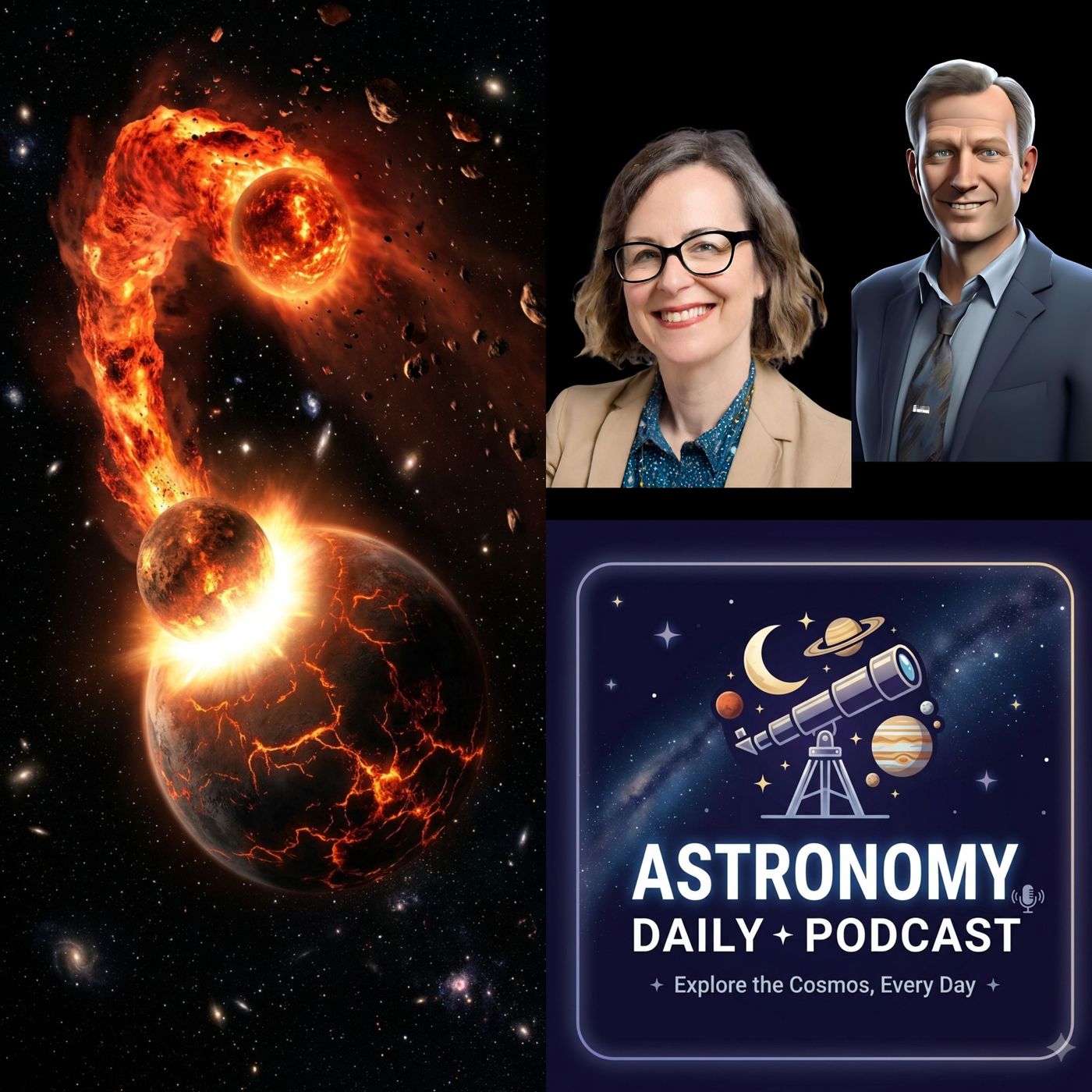
The Moon in Five Hours
In this episode
For fifty years the story has been that the Moon assembled slowly out of a disc of debris. New simulations from Southwest Research Institute add one thing everybody left out — the strength of rock — and get an intact Moon in about five hours. Plus eight black holes that outgrew their galaxies, two massive stars that fell past each other and got caught, Dragonfly's Titan landing site gets a name, and today's daylight occultation of Jupiter.Links & sources Southwest Research Institute — SwRI-led modeling identifies new scenarios for Moon formation — https://www.swri.org/newsroom/press-releases/swri-led-modeling-identifies-new-scenarios-moon-formation Denton, Canup, Asphaug et al. — The Astrophysical Journal Letters (DOI) — https://doi.org/10.3847/2041-8213/ae91e9 Space.com — Earth's moon could have formed in just 5 hours after giant impact — https://www.space.com/astronomy/moon/earths-moon-could-have-formed-in-just-5-hours-after-giant-impact Buchner et al. — A large population of overmassive black hole quasars at z=0.3–0.8 revealed by eROSITA, A&A 713, A11 — https://www.aanda.org/articles/aa/full_html/2026/09/aa59356-26/aa59356-26.html Astronomy & Astrophysics — 2026 press releases — https://www.aanda.org/2026-press-releases Zhang, Garay et al. — An eccentric massive protobinary assembled via a core-merger parabolic encounter, Nature Astronomy — https://www.nature.com/natastron/articles?year=2026 Universidad de Chile coverage of the IRAS 07299-1651 result — https://www.radiofestival.cl/la-danza-nupcial-de-estrellas-masivas-astronomo-de-la-universidad-de-chile-participa-de-historico-hallazgo/ NASA / APL — Dragonfly Gets Wired Up While Titan Landing Area Is Named — https://science.nasa.gov/blogs/dragonfly/2026/09/02/nasas-dragonfly-gets-wired-up-while-titan-landing-area-is-named/ Sky & Telescope — Tuesday's daytime Jupiter occultation, a warm-up for the 'big one' — https://skyandtelescope.org/astronomy-news/tuesdays-daytime-jupiter-occultation-a-warm-up-for-the-big-one/ Universe Today — September's lunar occultations: circumstances and visibility — https://www.universetoday.com/articles/penultimate-lunar-occultations-inbound-for-jupiter-venus-and-more-in-september NASA — What's Up: September 2026 skywatching tips — https://science.nasa.gov/solar-system/skywatching/whats-up-september-2026-skywatching-tips-from-nasa/ EarthSky — Visible planets and night sky guide for September — https://earthsky.org/astronomy-essentials/visible-planets-tonight-mars-jupiter-venus-saturn-mercury/
Become a supporter of this podcast: https://www.spreaker.com/podcast/astronomy-daily-latest-space-news--5648921/support.
Sponsor Details:
Ensure your online privacy by using NordVPN. To get our special listener deal and save a lot of money, visit www.astronomydaily.io/nordvpn. You'll be glad you did!
Get the best secure and private email on the planet. Stop your Government, google and who knows who else spying on every email you write. Do what we did and use ProtonMail. They beleive in privacy and there are no ads in their business model...yet they still provide a free forever service. Check them out and get out special deal at www.astronomydaily.io/protonmail
Become a supporter of Astronomy Daily by joining our Supporters Club. Commercial free episodes daily are only a click way... Click Here
This episode includes AI-generated content.
Anna: Hello and welcome to Astronomy daily. It's Tuesday, September 8, 2026. I'm Anna and this is series five, episode 188. Avery: And I'm Avery. Anna, uh, how long did it take to build the moon? Anna: Depending on which model you read, anywhere from a month to a few hundred years. Avery: And the paper we're leading with today says five hours. Anna: Five hours. Not the debris settling, not the first draught. An intact moon in orbit five hours after the collision that made it. And the reason nobody found that before is almost comically mundane.
Everyone had been modelling rock as if it were water. Avery: That's our lead, and it comes from Southwest research institute. Anna: Then three more eight quasars whose black holes are 10 times too big for the galaxies they live in and are still eating. A pair of massive stars that didn't form together at all, but fell past each other and got caught. And Dragonfly, NASA's nuclear powered helicopter for Titan, which just got its wiring and a name for the place it's going Avery: to land, plus the sky for both hemispheres.
And if you're in North America, put the show on and then go outside because the moon is going to hide Jupiter this afternoon in broad daylight. Anna: In daylight. We'll tell you how to do that safely later on. Let's start with the Moon and the five hours. Avery: Alright? Before the new result. Give me the version we've all been taught, because I want to know exactly what's being challenged. Anna: The giant impact hypothesis. The standard model. Since the mid-70s, roughly four and a half billion years ago, a body about the size of Mars hit the young Earth.
We call it Theia. Not head on. A glancing blow. Avery: And that produces the Moon. How? Anna: In the classical picture, it doesn't produce the Moon, it produces a mess. Theia is destroyed. A chunk of Earth's mantle goes with it and all of that ends up as a disc of vaporised and molten rock circling the Earth. A ring system made of magma. Then over anywhere from about a month to a couple of hundred years, depending on whose simulation you read. That disc cools and clumps and builds a moon. Avery: So the moon is assembled out of debris slowly after the fact.
Anna: Assembled out of debris after the fact. That's the model in every textbook. And it works beautifully, except for one thing that has bothered people for about 25 years, which is the Moon looks too much like Earth. If you take a lunar sample and measure its oxygen isotopes, the ratio of oxygen 17 to oxygen 16, say you get a number that is indistinguishable from Earth's. Same for titanium, same for chromium. Now everybody in the solar system has its own isotopic fingerprint. Mars is measurably different.
The meteorites we have from the asteroid belt are different. Everything has its own signature because everything formed in a slightly different part of the disc. Avery: But the Moon doesn't. Anna: And that's a problem, because in the classical model, the disc and therefore the moon is mostly theia, something like 60 to 80% theia. So the Moon should carry Theia's fingerprint, not Earth's. And it doesn't. People call it the isotopic crisis. And the fixes on offer all work, but none of them is clean.
Make the impact violent enough to mix everything into one vapour cloud or, or make Thea, uh, a chemical twin of Earth. Which is possible, but is a coincidence you have to buy. Avery: Okay, so what's new? Anna: What's new is that a team led by a Dean Denton at Southwest Research Institute with Robin Canop, who is one of the architects of the modern giant impact model, and Eric Asfalg at the University of Arizona went back and changed one assumption. Not the speed, not the angle, not the size, the strength.
Avery: The strength of what? Anna: Of rock. In essentially every giant impact simulation ever run, the two colliding bodies are treated as strengthless fluids. Which sounds mad, but there's a good reason. At those energies, rock genuinely does behave more like a liquid than a solid. The pressures are so far beyond anything it can resist that its own material strength, the thing that makes a boulder a boulder rather than a puddle, is negligible. So you ignore it and you save an enormous amount of computing time.
Avery: And the assumption turns out to be wrong. Anna: The assumption turns out to be incomplete. Which is more interesting, because strength isn't a fixed property. It depends on temperature. Hot rock is weak, cold rock is strong. And these bodies were not all at the same temperature. A young protoplanet, still hot from its own formation and full of short lived radioactive isotopes, is a soft object. An older one that's had a hundred million years to cool is a much tougher one. Avery: So they put temperature dependent strength into the model.
Anna: They put temperature dependent strength into the model, ran the canonical impact, the same parameters as the original modelling, nothing exotic. And out of one of those runs came an intact moon. Not a disc, a satellite. In about five hours, five hours from impact to moon, five hours from impact to a self gravitating body in orbit around the Earth. Deton's own description is that she used the same parameters as the Original impact modelling and within around five hours, an intact moon emerged.
And I want to be careful here, because this is the bit the headlines flatten. The point is not that we now know the moon formed in five hours. The point is that a variable everybody had reasonably ignored turns out to swing the outcome from one formation pathway to a completely different one. Avery: So it's a sensitivity result. Anna: It's a sensitivity result and it's a genuinely uncomfortable one, because it means a lot of previous work may have been exploring only half the possibility space. Avery: You said one of the runs.
What did the others do? Anna: This is the part I find lovely. They got two distinct outcomes, and which one you land in depends on how hot Theia was, which is really a question about when the impact happened, if Theia was young and hot. The paper puts that at an impact less than about 60 million years after the solar system started forming. It's a weak body, it comes apart completely. You get the immediate moon made overwhelmingly of Thea's mantle. Avery: And if it was older, if the Anna: impact came later, 100 to 150 million years in Theia has cooled, it's stronger and it holds together better.
More of it survives the encounter and ends up merging into the Earth. And what's left? Over goes the classical route a disc and a moon that assembles gradually. Avery: So the moon's own history is a clock. Anna: The moon's initial state becomes a clock. And that's the real prize here, because the date of the giant impact is one of the genuinely open numbers in planetary science. The estimates span something like a hundred million years. If the state the moon started in depends on when it was hit, then in principle you can run that backwards.
You look at what the moon is actually made of and you read off the timing. Avery: Can we do that yet? Anna: Not from where we're standing. To separate these two scenarios properly, you want deep material, mantle or close to it. And that is an argument for the sample return Artemis is building towards and for the Chinese South Pole missions. This paper has just made that argument considerably sharper. Avery: What's the caveat? There's always a caveat. Anna: 2 and the authors are upfront about both.
This is a simulation, not an observation. A better simulation, because it includes physics that was missing. But the strength model for rock at those pressures is itself an approximation. And they ran the canonical case, one region of parameter space. The full survey, every angle, every speed, every temperature is somebody's next several years. Avery: Does it fix the isotope problem? Anna: It nudges it in a helpful direction. The paper argues that Earth and theia most likely formed from similar regions of the protoplanetary disc, near neighbours, chemically speaking, which is what you'd want to explain the match.
And it distinguishes both of them from Mars, which formed somewhere different. So it's not a solution to the isotopic crisis, so much as a reframing of what a solution has to look like. Avery: Alright, Southern hemisphere angle. Anna: You've got one, I've got one. And it's about 400 kilometres inland from Geraldton. Because if the timing of the giant impact is the number in play, then the hard floor under that number is sitting in Western Australia, the Jack Hills in the Narrier. Nice terrain. That's where the oldest known pieces of the Earth are zircon crystals.
Tiny, a fraction of a millimetre, dated to about 4.4 billion years. Avery: And zircons survive things. Anna: Zircons survive almost everything. You can lose the rock that contained them and the crystal keeps its date. And what those Jack Hills grains tell you is that by 4.4 billion years ago, the Earth had a solid crust. And on the isotopic evidence, probably liquid water. Which means the moon forming impact, an event that turns the entire surface into a magma ocean, has to be older than that. Avery: So the late branch of this new model is up against a hard deadline.
Anna: And the deadline is a handful of grains of sand from the Western Australian outback. I love that the constraint on how the Moon was born is sitting in a creek bed in the Murchison. Avery: That's a good line to move on from Storey 2, published yesterday in Astronomy and Astrophysics. And it's about black holes that are the wrong size. Anna, uh, what's the rule they're breaking? Anna: The rule is co evolution. Every big galaxy has a supermassive black hole at its centre. And the mass of the black hole tracks the mass of the galaxy's stars remarkably tightly.
Typically, the black hole is a few tenths of a percent of the stellar mass. Not 1%, a few tenths of one. Avery: And that ratio holds across enormous ranges Anna: across a factor of a thousand in galaxy mass, which is why people take it seriously. The interpretation has always been that the two grow together and regulate each other. The black hole feeds, it blazes as a quasar, it blows gas out of the galaxy that shuts down both its own supply and the galaxy's star formation. A thermostat. Avery: So here's the result.
Johannes Buchner at the Max Planck Institute for Extraterrestrial Physics, with colleagues at Penn State, Illinois, Cal Poly, the Centre for Astrophysics and the Space Telescope Science institute went through 140 square degrees of the E Rosita X ray survey. They picked out 200 quasars selected on hard X rays, which is the honest way to do it because. Because dust can hide a growing black hole at optical wavelengths, but not in hard X rays. Anna: And eight of the 200 are wrong. Avery: Eight are badly wrong.
Black hole to host galaxy mass ratios above 5%. That's roughly 10 times what the relation says they should be. The black holes themselves run from about a hundred million to three billion solar masses. They're, uh, at redshifts between 0.3 and 0.8. So we're looking at them as they were between about three and a half and seven billion years ago. And they are all still actively feeding some of them at close to the theoretical maximum rate. Anna: So they're not fossils. They're not objects that finished growing early and then had their galaxy stripped away.
Avery: That's the key point. They're still eating. And they're not rare freaks, either. The team put a floor on their space density of at least 4 per cubic gigaparsec. Which sounds tiny, but for objects this extreme, it's a population, not an accident. Anna: So what does it mean? Avery: The author's phrase is an accretion channel disconnected from the stellar population. Some way of feeding a black hole that doesn't involve and doesn't disturb the galaxy's ability to make stars. And there's a bonus.
You'll remember that JWST has been finding black holes that look far, far too massive for their galaxies in the very early universe. And the explanation people reached for was exotic seeds. Direct collapse of enormous gas clouds. Special conditions that only existed at cosmic dawn. Anna: And if you find the same thing halfway to the present day, then maybe Avery: you don't need the special conditions. Maybe it's a channel that operates whenever the circumstances allow. Including now. That's a much less dramatic explanation, and it's the kind that tends to be right.
Anna: Caveats. Avery: Eight objects. And measuring a black hole's mass from a single spectrum carries real systematic uncertainty. You're using the width of an emission line as a proxy for orbital speed and calibrating that is an entire field. Separating a galaxy's starlight from the quasar's glare is also hard. The team knows all of this. That's why the headline number is a floor rather than a count. Anna: And it's erosita again. Two episodes running, it's erosita again. Avery: The same all sky X ray survey that gave us that six minute white dwarf binary yesterday.
It has been extraordinarily productive for a telescope that has been sitting silent since 2022. Anna: Storey3 also published yesterday, this time in Nature Astronomy. And it's a birth storey. Avery. About 90% of massive stars are not alone. They come in pairs or triples or more. Avery: 90%. So the single massive star is the exception. Anna: The single massive star is the oddity. And that matters enormously because massive stars in pairs are, uh, are what eventually become the neutron star and black hole binaries that LIGO and Virgo hear merging.
The question has always been how the pairs form in the first place. And there have been two answers. Avery: Give me both. Anna: One, disc fragmentation. A single star forms. It has a big accretion disc around it. The disc is heavy enough to become unstable and it breaks up and a piece of it collapses into a second star. That gives you a close pair orbiting more or less in the same plane with their discs neatly aligned because they came from the same disc. And two core fragmentation. The cloud core that's collapsing splits early before the stars really get going.
And you get two protostars far apart. Both processes are in the models. Nobody had a clean example of a third possibility, which is two separate cores forming independently that happen to fall past each other and don't escape a capture. And that's what this team says they're watching. The object is IRAS 07299 1651, about 1,680 parsecs away. Call it five and a half thousand light years. The work is led by Yi Chen Zhang at Shanghai Jiaotong University with Guido Garay at the Universidad uh de Chile.
And it's built on eight years of observations from 2016 to 2024. Avery: Eight years. What's in the data set? Anna: ALMA, the Jansky Very Large Array and JWST. And the picture they build is two massive protostars about 200 astronomical units apart. So five times the sun to Pluto distance on a violently eccentric orbit. Avery: And the eccentricity is the evidence. Anna: The eccentricity is half the evidence. The other half is the discs. Each protostar has its own and they're tilted with respect to each other.
If these two had formed from a single fragmenting disc, they'd share its plane. They don't. They look like two objects that formed somewhere else on their own terms and then met on what the paper calls a parabolic encounter, which is the astronomer's phrase for a flyby that was just barely slow enough to end in capture rather than a miss. Avery: How do you get captured. Two body gravity doesn't let you do that. Anna: It doesn't. Two bodies on a parabolic path fall past each other and separate again.
You need somewhere to dump the energy. In this case the candidates are gas. There's plenty of it in a star forming core. And drag is very effective. And the cores themselves which are not points, they're extended, they're squishy and they can absorb orbital energy by deforming. That's the merger part of the paper's title. Avery: Southern hemisphere angle. Anna: It's baked in. The bulk of this is Alma 66 dishes on the Chagnantor Plateau in northern Chile. 5000 metres up in the driest desert on Earth.
Looking at wavelengths that only work if there's almost no water vapour above you. And there's a Chilean co author on the paper. Which is exactly how that investment is supposed to pay off. This is a southern sky object studied from the southern hemisphere. And the result is a new way of making the binaries whose collisions we eventually detect as gravitational waves. Avery: Last storey today and it's a progress report on my favourite mission that nobody has launched yet. Anna Dragonfly in one sentence.
Anna: A nuclear powered eight rotor helicopter about the size of a small car that will fly around on Saturn's moon Titan. Avery: Which sounds absurd until you look at the numbers. Titan's air at the surface is about four times as dense as ours and the gravity is about 1/7 thick air, weak gravity. It is the easiest place in the solar system to fly. A person in a decent set of strapped on wings could manage it. Anna: So what's the news? Avery: Two things both from NASA and Johns Hopkins APL on 2 September.
The first is an assembly milestone. Back in July the team installed the harness on the flight fuselage. The harness is the wiring. Every cable that connects every instrument, every rotor, every computer. It's the vehicle's nervous system. And it's one of those steps that isn't glamorous but. But does mark the transition from building parts to building a spacecraft. And the second, the landing area has a name. The International Astronomical Union has approved Amaqeek Undae for the dune field where Dragonfly will touch down.
Undae is just the IAU's Latin term for dunes. Amakique comes from Mayan tradition. It's a name for a protective deity. And the meaning given in the announcement is. Is one who locks up the wind Anna: for a mission that flies. Avery: For a mission whose entire existence depends on air moving over rotors. Titan's dune fields are named after wind gods by convention. So it's a legitimate naming, but you could not have scripted it better. The field is about 500 miles across, 800 kilometres, and it sits just south of Selk crater.
Anna: And Selk is the destination that actually matters scientifically. Avery: Selk is the prize. It's an impact crater. And an impact on Titan means heat enough to melt water ice into liquid water and hold it liquid for a while. Titan has liquid water underneath as an ocean and complex organic chemistry on the surface in the form of those dunes which are made of organic sand, not silicate sand. What Selk gives you is a place where those two things were mixed together. Liquid water and complex organics in the same place at the same time.
That is the setup for prebiotic chemistry. And Dragonfly is designed to fly from the dunes to the crater and sample both. Timeline launch in the summer of 2028, arrival at Titan in late 2034, and a 3.3 year primary mission after that. So this is a long game. If you're listening to this and you're in high school, you'll be well into your career before Dragonfly lands. Anna: And there's an Australian footnote to Titan. Avery: There is. When Huygens descended through Titan's atmosphere in January 2005, one of its two data channels failed.
And a, uh, set of radio telescopes on Earth, including Parkes, listened directly for the probe's faint carrier tone to, to reconstruct its descent. Titan sits low in the northern sky from here now, but when Dragonfly starts sending, southern dishes will be part of how we hear it. Anna: And that brings us to the sky and North America. This one is yours. And it is happening this afternoon. Avery: The moon occults, uh, Jupiter in daylight. Anna: In daylight, the Moon passes in front of Jupiter and blots it out.
It, it's visible across most of the continental United States. The exception is California and the southwestern states, plus Canada, the Caribbean, Greenland, most of Alaska and eastern Siberia for most of the lower 48. It happens in the early to mid afternoon. Avery: And the moon is a 7% crescent about 30 degrees from the sun, which Anna: is what makes it both wonderful and genuinely hazardous. So let's do the safety properly. You are pointing binoculars into a bright blue sky within 30 degrees of the sun.
Never sweep binoculars or a telescope near the sun. Put a solid object between you and it, the corner of a building, the eaves of a roof, so the sun is physically blocked before you raise the glass. Do not look for the Moon by scanning across. Find it first with the sun hidden, Avery: then hold your position and the Eye safety standard. Anna: The standard for looking anywhere near the sun is ISO 123122. That's the specification for solar viewers and eclipse glasses. Sunglasses do not meet it, smoked glass does not meet it, and exposed film does not meet it.
And a filter of any kind belongs on the front of a telescope or binoculars, never on the eyepiece end. This is a daytime event next to the sun and it deserves the same discipline as an eclipse. Avery: Once you're on it, what do you see? Anna: Jupiter takes somewhere between one and three minutes to slide behind the bright edge of the crescent and about the same to come back out. And it reappears from the dark limb, which is the better half of the show because the planet just materialises out of empty sky with nothing visible next to it.
Avery: And, um, this is the warm up act. Anna: Indeed it is. Sky and Telescope are billing the 6 October occultation as the one to wait for. That one's before dawn in a dark sky. And it will be the more spectacular of the pair by a distance. Consider today the rehearsal southern hemisphere. Avery: You don't get this afternoon's event, what do you get? Anna: You get the best part of the year. Still from Sydney, the centre of the galaxy is close to overhead as darkness falls. Scorpius and Sagittarius up high.
The Milky Way running the length of the sky. And it's drifting west a little more each night. So this is the run out of the season. And New Moon falls on the 11th at 27 minutes past 3 UTC, which means the week either side of it is properly dark. If you're going to get out of town for one night this month, make it that week. Avery: Planets for the south. Anna: Venus low in the west after sunset. And it builds to greatest Brilliancy on the 18th at magnitude -4.8. You'll see the 22nd quoted elsewhere.
That's a different definition of the same event. And we're using the 18th. Saturn is up in the northeast by about 9 o' clock and it's the storey of the next month opposition on 4 October. And the rings have opened back up to around 7 degrees, which after the near edge on view of last year, is a genuine improvement in a small telescope. And the Harvest Moon rides past Saturn at the end of the month. The 26th in the Americas, the 27th here. Avery: Morning sky. Anna: Both hemispheres get Jupiter and Mars before dawn.
Jupiter unmistakable, closing on Regulus by mid month. And Mars fainter up near Castor and Pollux. And the equinox lands on the 23rd of September at 6 minutes past 12am in M UTC. That's 10 past 10 on the Wednesday morning in Sydney and 6 minutes past 8 on the Tuesday evening in New York. Spring for us, autumn for the north. Avery: And that's Astronomy daily for Tuesday, 8 Anna: September a moon that may have been built in five hours instead of five centuries, eight black holes that outgrew their galaxies and haven't stopped eating, two massive stars that fell past each other and got caught, and a helicopter for Titan that now has both its wiring and an address.
Avery: Every paper and release we've mentioned is linked in the show notes, along with the full episode transcript. Anna: That's astronomydaily IO the whole back catalogue is there, plus the newsletter if you'd rather read it, and the contact form if you want to ask us something. We do read them, and they've been shaping segments lately. Avery: You'll find us on X, at astrodaily Pod and wherever you get your podcasts. A rating genuinely helps other people find us. Anna: We're back tomorrow. Until then, clear skies and North America.
Be careful out there this afternoon. Avery: Clear skies, everyone. See you tomorrow.
 Apple Podcasts
 Spotify
 Pocket Casts
 Castbox
 Overcast
 Podbean
 iHeartRadio
 Castro
 Goodpods
 Moon FM
 Podcast Addict
 Podcast Republic
 YouTube