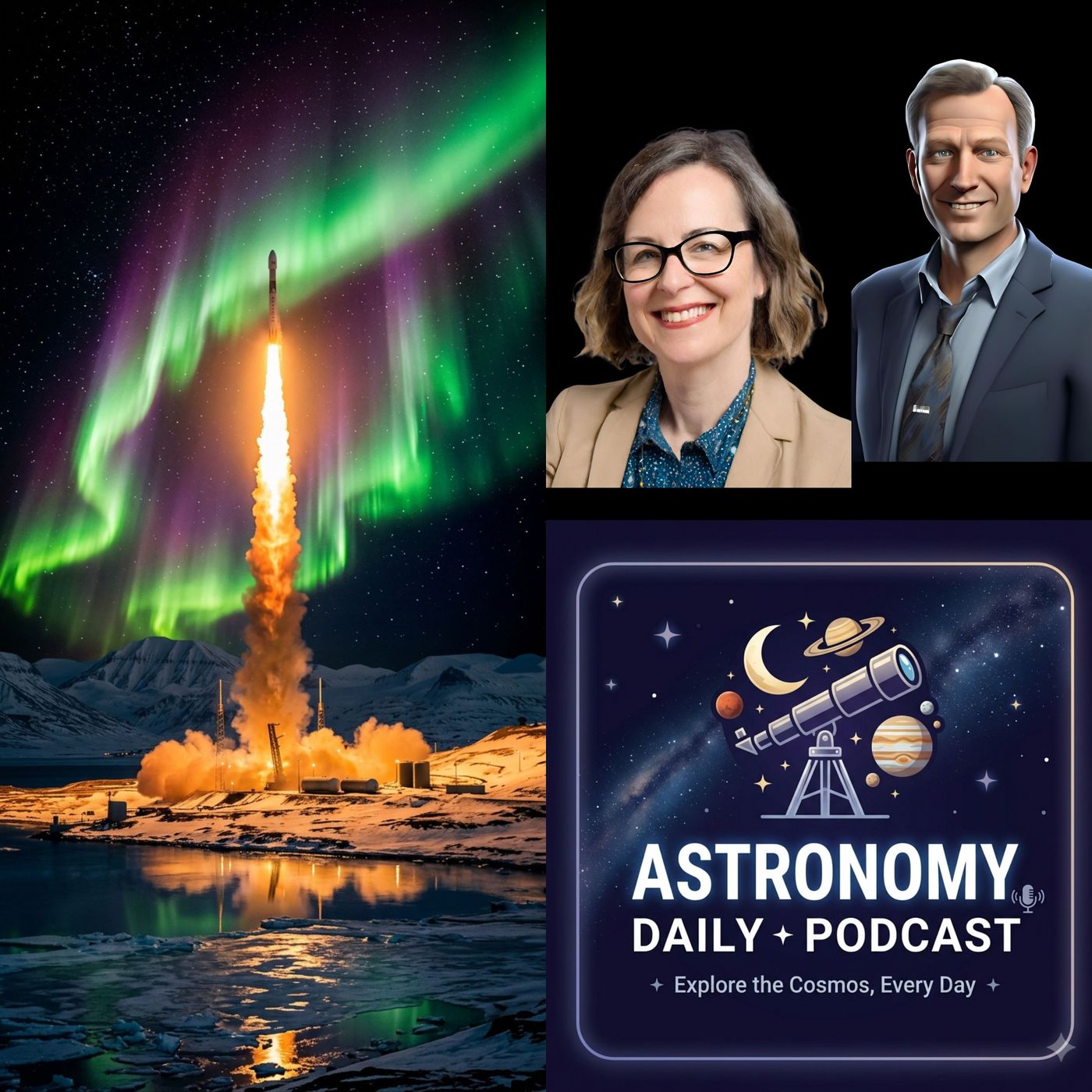
Europe Launches From Europe — And Two White Dwarfs Six Minutes Apart
In this episode
A German rocket lifted off from an Arctic island on Saturday and became the first vehicle ever to reach orbit from Western European soil. Plus: the gaps in stellar streams may not be dark matter after all, two white dwarfs circling every 374 seconds in the far southern sky, peptides that fold in concentrated sulfuric acid, and what Katalyst's LINK is actually doing next to Swift. Both-hemispheres skywatch, and a serious safety warning for tomorrow's daylight Jupiter occultation.Links & sources · Isar Aerospace — mission updates — https://isaraerospace.com/mission-updates-overview · ESA — Spectrum launches to orbit (imagery) — https://www.esa.int/ESA_Multimedia/Images/2026/09/Spectrum_launches_to_orbit · NASASpaceflight — Isar 'Onward and Upward' — https://www.nasaspaceflight.com/2026/09/isar-onward-and-upward/ · Space.com — Private German rocket makes history — https://www.space.com/space-exploration/launches-spacecraft/isar-aerospace-second-launch-norway-andoya-spaceport-spectrum-rocket · Space.com — Gilmour Space eyes a second orbital attempt — https://www.space.com/space-exploration/launches-spacecraft/australias-gilmour-space-not-going-to-give-up-as-it-eyes-2nd-orbital-launch-attempt-in-2026 · Sky & Telescope — Gaps in stellar streams may be common — https://skyandtelescope.org/astronomy-news/gaps-in-stellar-streams-common-not-sign-dark-matter/ · Arora et al. — Semianalytic modeling of subhalo encounters with thin stellar streams, ApJ — https://iopscience.iop.org/article/10.3847/1538-4357/adf740 · Sharma et al. — Rapid orbital decay in eRASSU J060839.5−704014 (arXiv) — https://arxiv.org/abs/2608.09341 · Maitra et al. — eRASSU J060839.5−704014 discovery paper, A&A (2024) — https://www.aanda.org/articles/aa/ref/2024/03/aa47811-23/aa47811-23.html · MIT News — Peptides can form well-defined structures in Venus-like conditions — https://news.mit.edu/2026/study-peptides-can-form-well-defined-structures-harsh-venus-conditions-0831 · NASA Swift blog — Commercial spacecraft for Swift boost continues tech demo — https://science.nasa.gov/blogs/swift/2026/09/04/commercial-spacecraft-for-nasas-swift-boost-continues-tech-demo/ · NASA Swift blog — LINK spacecraft recovery progressing — https://science.nasa.gov/blogs/swift/2026/08/06/link-spacecraft-recovery-progressing-for-nasas-swift-boost/ · EarthSky — Saturn at opposition, 4 October 2026 — https://earthsky.org/astronomy-essentials/saturn-at-opposition-closest-brightest-best/ · Star Walk — Astronomical events, September 2026 — https://starwalk.space/en/news/night-sky-tonight-september
Become a supporter of this podcast: https://www.spreaker.com/podcast/astronomy-daily-latest-space-news--5648921/support.
Sponsor Details:
Ensure your online privacy by using NordVPN. To get our special listener deal and save a lot of money, visit www.astronomydaily.io/nordvpn. You'll be glad you did!
Get the best secure and private email on the planet. Stop your Government, google and who knows who else spying on every email you write. Do what we did and use ProtonMail. They beleive in privacy and there are no ads in their business model...yet they still provide a free forever service. Check them out and get out special deal at www.astronomydaily.io/protonmail
Become a supporter of Astronomy Daily by joining our Supporters Club. Commercial free episodes daily are only a click way... <a...
Anna: Hello and welcome to Astronomy daily. It's Monday, September 7th, 2026. I'm Anna and this is series five, episode 187. Anna: And I'm Avery. Anna. Uh, we're starting the week with a rocket that finally worked. And it's not one of the usual suspects. Anna: It isn't. On Saturday morning our time, a German built rocket lifted off from an island inside the Arctic Circle and put six payloads into orbit. And in doing so, it became the first vehicle in history to reach orbit Anna: from western European soil 69 years into the space age.
Anna: 69 years into the space age. Europe has been launching for decades from South America. On Saturday, it launched from home. Anna: That's our lead then. Three pieces of science that all quietly tell you something about how hard measurement is. Astronomers have found that the gaps in stellar streams. One of our best tools for finding dark matter might not be dark matter at all. Anna: A pair of white dwarfs in the far southern sky are circling each other every six minutes and we can now watch the orbit shrinking.
That is gravity carrying energy away as waves measured with X rays. Anna: And on Venus, proteins, orbital or the beginnings of them, peptides that fold up properly and stay folded in concentrated sulfuric acid. Which is not what anybody expected then Anna: because a lot of you have written in about it. What on earth is Link actually doing up there? The Swift rescue that didn't rescue Swift has turned into something more interesting. And it's got about two weeks left, Anna: plus the sky for the week ahead, both hemispheres.
And there's an occultation tomorrow that comes with a serious safety warning attached. Anna: Big Monday. Anna: Let's go right, set the scene for me because I want to understand why this is a first when Europe has been in the launch business since the 70s. Anna: That's exactly the right question. And the answer is geography. Europe's launch site is Kourou in French Guiana on the northeast coast of South America. It's been Europe's spaceport since 1968. Ariane Vega album, all of it. Superb location, 5 degrees off the equator.
You get a free kick from the Earth's rotation. Anna: But it's 8,000 kilometres from Paris. Anna: 7,000 odd. And that's the point. Europe has had access to space for 50 years without having launch capability on its own continent. Every European satellite that went up on a European rocket went up from South America or from Cape Canaveral or for a long stretch from Kazakhstan on a Soyuz. Anna: And on Saturday that changed. Anna: On Saturday that changed. The company is Isar Aerospace, German, founded 2018.
Spun out of the technical University of Munich. The rocket is called Spectrum. It lifted off at 10:12 in the evening, Central European Time, on Friday the 5th, which is 6:12 on Saturday morning for those of us in Sydney from Andoya spaceport. Anna: And Andoya is where exactly? Anna: Northern Norway. An Island about 300 kilometres inside the Arctic Circle. It's been a sounding rocket range since 1962, so there's real heritage there. But this is its first orbital launch pad and it's a genuinely useful location.
You launch north over open ocean and you get straight into polar and sun synchronous orbits, which is where most Earth observation satellites want to be. Anna: Tell me about the rocket. Anna: Spectrum's a two stage vehicle, about 28 metres tall, 2 metres across. Nine engines on the first stage, one vacuum optimised engine on the second. And they're all the same engine. It's called Aquila and Isar built it in house. The propellant combination is the interesting bit. Liquid oxygen and propane. Anna: Propane, not kerosene, not methane, propane.
Anna: It sits between the two, denser than methane, cleaner burning than kerosene, and you can buy it anywhere. It's an unusual choice. And it's theirs. The second stage restarts, which matters in a minute. And the numbers are small, launcher numbers. About 700 kilogrammes to sun synchronous orbit out of Andoya, around a tonne to low Earth orbit, if they ever fly it from French Guiana. Anna: So this is not an Ariane competitor? Anna: Not remotely, and nobody's pretending it is. Ariane 6 lifts 20 tonnes.
This is the small satellite end of the market. The rocket lab electron end, roughly. But the strategic question was never about mass. It was about whether Europe could do this at all. From Europe, without asking anyone's permission. Anna: Now, this wasn't the first attempt. Anna: No, and I want to be fair about the first one. Spectrum's maiden flight was 30 March 2025, from the same pad. It flew for about 30 seconds, lost attitude control and came down. The cause was a vent valve that opened when it shouldn't have during the pitchover manoeuvre.
Isar spent the time since on software changes and on widening the vehicle's margins. Anna: 18 months between flights. Anna: 18 months and a, uh, run of scrubs this year. On top of that, a pressurisation valve in January weather, range issues. There were people writing them off as Anna: recently as last week and then Friday night. It just worked. Anna: It just worked. Nine engines lit clean. Ascent stage separation fairing away. And the second stage put itself into an elliptical orbit. Roughly 180 by 500 kilometres, then restarted and circularised.
That restart is the thing I'd point to. A lot of small launchers need a separate kick stage. To do that. Isar built the capability into the second stage. Anna: What was on board? Anna: Six payloads. And I love this manifest because it's so unglamorous in the best way. 5 cubesats from the technical University of Berlin, from NTNU in Norway, from the University of Maribor in Slovenia, from TU Wien in Austria, and one from endurosat, which is Bulgarian, plus a non deployable experiment from a German company called D Cubed that stayed bolted to the stage.
Universities, Universities mostly. They're testing things like radiation tolerant perovskite solar cells and how batteries cope with being hibernated in orbit. It is exactly the kind of payload that has spent the last decade queuing for a rideshare slot on somebody else's rocket, on somebody else's schedule. Anna: So the significance isn't the six satellites, it's the queue. Anna: The significance is the cue. And it's sovereignty, which is a word that's doing a lot of work in European space policy Right now.
ESA has been running a launcher challenge specifically to get more than one European company flying precisely because relying on a single vehicle or on somebody else's vehicle turned out to be uncomfortable when the geopolitics moved. Isar has raised well north of half a billion euros against that thesis and their Munich factory is built for more than 30 vehicles a year. Anna: Explain the geopolitics bit, because I think that's the piece people underestimate. Anna: It's not complicated, it's just uncomfortable.
For years, a good slice of European payloads flew on Russian Soyuz rockets, including out of Kourou. That ended abruptly in 2022 at almost exactly the same moment Ariane 5 retired and Ariane 6 wasn't ready and Vega C was grounded after a failure. So Europe spent a stretch of two or three years in the strange position of being a first rank space power that had to buy rides from SpaceX to launch its own science missions, including missions it built itself, including flagship missions it built itself.
That was the wake up. And the response wasn't to build one bigger rocket, it was to stop having a single point of failure, which is where a German startup flying from a Norwegian island fits in. It's not that spectrum replaces anything. It's that if you have three or four independent European ways to reach orbit, no single failure, retirement or foreign policy decision can ground the continent again. Anna: And Norway gets something out of this Anna: too, Norway gets a great deal out of it. Andoya Space is majority state owned and.
And Norway has just gone from hosting a sounding rocket range to hosting the only orbital launch site on the European mainland side of the Atlantic. There are two more pads planned there. If you're a European small satellite operator, that is suddenly a very short truck ride compared to shipping your spacecraft to South America. Anna: Which they now have to actually deliver. Anna: Which they now have to actually deliver. And that's the honest caveat. One successful flight is one successful flight.
Vehicles three through seven are in production. But Cadence is where small launchers historically go to die. Ask anyone who's watched that market for 10 years. Anna: Alright, Southern hemisphere angle. I know you have one. Anna: I do. And it's close to home because the storey Isar just wrote is the storey Gilmour Space is trying to write in Queensland. Anna: Eris. Anna: Eris, Australia's first home built orbital rocket, launched from the Bowen Orbital Spaceport in July last year. Flew for 14 seconds and came back down.
Adam Gilmour's line about it afterwards was that most companies need about three attempts to make orbit and that they're not going to give up. He said that at the International Astronautical Congress in Sydney. Anna: And Isar's second attempt made orbit after Anna: a first flight that lasted 30 seconds. Gilmour's first lasted 14. That is not a prediction. Rockets don't work by analogy. But if you want to know what the road out of a 14 second flight looks like, Friday night in Norway is a fairly encouraging map.
Anna: Same problem, opposite ends of the planet, Anna: and the same underlying argument. A country or a continent that can build satellites but can't launch them is a customer, not a space power. Norway just stopped being only a customer. Queensland is trying to Storey 2 and Anna: it's a bit of a spoiler for a method a lot of people were counting on. Anna, uh, remind everyone what a stellar stream is. Anna: So a globular cluster or a small satellite galaxy falls into the Milky Way and our galaxy's gravity pulls it apart.
What you're left with is a long, thin ribbon of stars strung out along the orbit the cluster used to have. There are dozens of them wrapped around our galaxy. GD1 is the famous one. Anna: And the reason people care is that they're delicate. Anna: Exactly. They're the most fragile structures in the galaxy, which makes them a detector. The idea has been if a clump of dark matter drifts through a stream, it gives the ribbon a gravitational kick and you get a gap or a kink or a little spur of stars.
Flung off to the side. Find the gaps and you've found dark matter you cannot otherwise see. Anna: That's a beautiful idea. Anna: It's a genuinely beautiful idea. And it's been the great hope for testing what dark matter is actually made of. And this is where the new work comes in. Arpit Aurora with Nora Shipp and colleagues at the University of Washington published in the astrophysical journal on the 27th of August. They simulated four Milky Way sized galaxies and inside them about 15,000 stellar streams evolving over 5 billion years.
Anna: And. Anna: And roughly 3/4 of the streams developed gaps, spurs or kinks. Only about 70 of the 15,000 stayed genuinely smooth from dark matter clumps. That's the point. No, from the galaxy itself. The bar in the middle, the disc, the spiral arms, the ordinary visible furniture of a spiral galaxy is enough to chew up a stellar stream all on its own. Aurora's line is that in their simulations the host galaxies alone cause the same kinds of irregularities we actually observe in real streams. Anna: So a, uh, gap is not evidence.
Anna: A gap on its own is not evidence. And they found the effect is worst for streams that formed closer to the galactic centre, which is where a lot of the observed ones are. Their honest conclusion is that at present we cannot tell you what made any particular gap. Anna: Is that the end of the method? Anna: No, and this is why I like the paper. Rather than finding it depressing. It's a recalibration, not a demolition. What it says is that you can't do this one stream at a time. You need the whole population statistically, how many gaps, how deep distributed how compared against simulations with dark matter and without, Anna: which needs a lot more streams and Anna: much better motions for the stars in them.
That is more or less a job description for the Vera Rubin Observatory in Chile, which is going to find streams by the dozen. And for the next Gaia class, astrometry. So the tool isn't broken, it just turns out to need a much bigger sample before it tells the truth. Alright, moving on. And Storey 3 is one of my favourite kinds of result. An object we already knew about that just did something we could measure. Anna: Give me the object. Anna: It has a name only a catalogue could love. Erasu J 060-8395 -704014.
We'll call it J0608. It's two white dwarfs orbiting each other and the orbital period is 374 seconds. Anna: 374 seconds. That's six minutes and change. Anna: Six minutes and 14 seconds. A complete year for that pair in the Time it takes to boil an egg badly. The whole system would fit comfortably inside our sun. Anna: How was it found? Anna: By Erosita, the German X ray telescope on the Spectre RG spacecraft. During its all sky surveys, it showed up as an X ray Source, pulsing every 374 seconds.
And the pulsing is dramatic. The flux goes to essentially zero and back about 50% on, 50% off. Then XMM Newton followed up in X rays and the Dark Energy Camera in Chile picked it up optically. Anna: So what's new this week? Anna: This week Rahul Sharma and colleagues published in the Astrophysical Journal Letters. And what they've measured is that the orbit is shrinking measurably. And the rate at which it's shrinking matches what general relativity says it should be if the system is radiating away energy as gravitational waves.
Anna: So we're watching gravitational waves carry energy off using an X ray telescope. Anna: That's precisely what's happening. And I think it's a lovely thing. We're not detecting the waves, we're watching the bill being paid. The energy leaves as gravitational radiation. The orbit tightens, the clock speeds up and you can time it. Anna: Which makes it useful to Lisa. Anna: Which makes it very useful to Lisa, the Space Based Gravitational Wave Observatory ESA is flying in the mid-2030s. Lisa is tuned to low frequencies and tight binaries like this sit right in its band.
The chirp mass here works out to about 0.43 solar masses, which makes J0608 one of the loudest known verification binaries, a source we already know the position and period of. So when LISA switches on, it should hear it. If it doesn't, something is wrong with the instrument, not the universe. Anna: A tuning fork. Anna: A tuning fork you build the observatory around. And here's our bit. J0608 sits at declination minus 70. It's in the direction of the Large Magellanic Cloud in front of it in our own galaxy's halo, somewhere between 1 and 5 kiloparsecs out, which means it is a southern hemisphere object.
It never rises for most of Europe and North America. It was found by an all sky survey confirmed from Chile. And if you're listening in Sydney or uh, Auckland or Cape Town, it is over your head and nobody else's. Anna: Storey 4 takes us to Venus and it picks up a thread. We were on last week, it does. Anna: On Friday we talked about the Venus Life Finder mission. MIT and Rocket Lab, the first privately funded mission to another planet, which is built and waiting on Neutron's first flight. This is the laboratory half of that storey and it lands very nicely.
Anna: Sara Seeger again. Anna: Sarah Seager's group at mit, published in the Proceedings of the National Academy of sciences released on 31 August. Here's the setup. Venus's cloud deck at 48 to 60 kilometres up has Earth like temperatures and pressures. It's the one genuinely temperate place on the planet. The problem is that the droplets up there are concentrated sulfuric acid, which we assume destroys everything and specifically destroys the molecules life needs. So the team took peptides, short chains of amino acids, the building blocks that fold into proteins, put three of them into 98% sulfuric acid and watched them with nuclear magnetic resonance and they survived.
They did better than survive. They folded, they took up stable, well defined three dimensional structures and held them for weeks. And the folding is the part that matters because. Because a protein that isn't folded correctly is just a string. Seeger's framing is that life needs specifically shaped proteins so they have a target they can latch onto. Shape is function. Anna: Why does the acid not shred them? Anna: Because there's no water. Our intuition about acid is really an intuition about acid dissolved in water.
Take the water out and the chemistry is a different animal. Concentrated sulfuric acid turns out to be a solvent that some molecules can be perfectly comfortable in. Anna: Now the caveat, because I can hear you winding up to one, you know Anna: me too well, this is not life on Venus. It is not evidence of life on Venus. Nobody in that group is claiming it is. What it removes is an objection. The standard reply to Venus cloud habitability was always the biochemistry simply cannot hold together in that environment.
This says for one important class of molecule and it can. That's a smaller claim and it's a much sturdier one. Anna: And it's the sort of thing you'd want to know before you spend money going there. Anna: It's exactly the sort of thing you'd want to know before you go. Which is why the timing is neat. The mission is sitting on the ground waiting for a rocket and the case for flying it just got firmer. Next storey five is here today because you asked for it. We've had a run of messages through the website about link, what happened to it, what it's doing now and whether Swift is going to be alright.
So let's do the whole thing properly. Anna: Start at the beginning. For anyone joining us late, the Neil Anna: Garrels Swift Observatory has been NASA's Rapid Response Gamma Ray Burst telescope since 2004. Brilliant machine, 22 years of service and one design limitation, no propulsion, it cannot raise its own orbit. It launched at around 600 kilometres and atmospheric drag has been quietly walking it down ever since. It's near 400 kilometres now and without help it re enters. Anna: So NASA hired someone.
Anna: In September last year, NASA gave Catalyst Space technologies a uh, $30 million contract to build a spacecraft, fly it up, grab Swift and push it higher. That Spacecraft is linked 425 kilogrammes, three robotic arms, hall effect thrusters six metres across when it's deployed. It launched on 3 July this year on a Pegasus XL Air launched out Anna: of Kwajalein Atoll, which was itself a storey Pegasus hadn't flown in years. Anna: Dusted off specially and then three weeks after launch, on the 25th of July, link lost attitude control and started tumbling.
When they worked out why it wasn't good, two of its three reaction wheels weren't working and the cold gas thruster system was degraded as well. Anna: Tumbling. How fast? Anna: About 9 degrees a second multi axis, which is fast enough that communications were dropping in and out. What the Catalyst team then did is the part of this storey I genuinely admire. They used the electric thrusters, which were never designed for attitude control, to take the spin down. By 5 August they had it to 1.47 degrees a second and then uploaded new flight software with attitude controllers written for a spacecraft that had lost half its hardware.
Anna: But they didn't go for the capture Anna: on the 19th of August they stood down from it. And that was the right call. Docking with a tumbling, uncontrolled 22 year old telescope using a spacecraft that has itself lost most of its attitude control is a way to make one problem into two. Anna: So where does that leave Swift doing science? Anna: Actually, Swift restarted two of its three instruments on 26 August and it's observing, it's just observing on a clock. It comes down when it comes down Anna: and Link, this is what people are asking.
Anna: This is the fresh part from NASA's Swift blog on Friday. Link has raised its own orbit. It has adjusted its plane to match Swift's. It has closed to within 12 to 15 kilometres of the telescope and it is deliberately going no closer. And in the last few days it has deployed all three robotic arms simultaneously and fired all three xenon thrusters at once. Anna: So it's running the mission it can run. Anna: Every one of those is a real in space servicing test that nobody had data on before, performed by a damaged spacecraft.
And NASA's framing is that they're collecting data to inform future servicing technology and operations. Catalyst Reckon Link has about two to three more weeks in orbit before they deorbit it, which is a, ah, genuinely Anna: different ending to the one we expected. Anna: It's uh, a much better ending than it broke. The rescue failed, the demonstration didn't. And in space servicing is a field where almost nobody has flown anything. So a fortnight of hard data from a wounded vehicle is worth having.
Keep the questions coming. That's what got this segment into today's episode. Anna: And that brings us to the sky for the week ahead. Anna, uh, this is a dark week. Anna: It's a dark week and that's the headline. New Moon is on Friday the 11th at about 3:30 in the morning Greenwich time. So that's early Friday afternoon in Sydney and Thursday evening across North America, which means from about Tuesday right through to next Monday you have properly dark skies. If you have been waiting for a night to go somewhere without streetlights, this is the week.
Anna: But before the dark, there's an event tomorrow and this one comes with a warning. Anna: It does, and I want to do the warning first. Tomorrow, 8th September, the moon passes in front of Jupiter. And for most of the places that can see it, this happens in broad daylight. That's parts of the United States, Canada, Greenland, eastern Russia and the North Pacific. Anna: Daylight with the sun in the sky. Anna: Daylight with the sun in the sky. And that is the whole safety issue. You will be sweeping around with binoculars or a telescope looking for a thin moon in a bright blue sky.
And the sun is not far away. Never point any optical instrument at or near the sun. If you want to look at the sun at any point, you need a proper solar filter that meets the ISO 123122 standard fitted over the front of the instrument, not a filter that screws into the eyepiece. And not sunglasses, welding glass, exposed film or a smoked plate. If you are not completely certain what you are pointing at, put the equipment down. An eclipse style pair of ISO 123122 glasses will not protect you when you are looking through magnifying optics either.
The safe way to do a daytime occultation is, is to set up in the shadow of a building so the sun is physically blocked and to know your Moon's position before you start. Anna: That said, if you do it safely, Anna: it's spectacular, it's genuinely wonderful. Jupiter is a tiny bright disc and you watch it wink out behind the Moon's limb and then reappear on the other side. Cheque the exact timings for your town because they vary enormously across that footprint. Anna: Right. Planets Southern hemisphere first this week.
Anna: For those of us down south, Venus is the one to catch, and there's urgency. It's low in the west after sunset and sinking, but it's brilliant and it's building toward Greatest Brilliancy on 18 September at magnitude -4.8. Find a clear western horizon. Look about 20 to 30 minutes after sunset from Sydney. That's around a quarter past six this week. Anna: And Saturn? Anna: Saturn is the evening planet for everybody. It rises in the east not long after dark, and it's up all night climbing toward opposition on the 4th of October.
So it gets better every week between now and then. Even a small telescope will show you the rings and they're opening back up after the ring plane crossing, so there's something to see again. Anna: Anything else worth being outside for down here? Anna: The galactic core. It's still high in the early evening through September from southern latitudes. And with a new moon on Friday, you're getting the last really good look at it for this year before it slides west. Sagittarius and Scorpius overhead.
Dark sky, no moon. Take the drive. Northern hemisphere northerners, your planets are in the morning. Mars and Jupiter are both well placed before dawn. Jupiter especially. And it's the same Jupiter the Moon covers tomorrow. Saturn is the same good evening object. It is everywhere. Venus is a much harder catch from the north this month. It's very low. There's also a minor meteor shower, the September Epsilon Perseids, peaking on the 9th at maybe 8 an hour under perfect skies. Northern favoured modest, but it's a dark week, so you may as well look up.
Anna: And one to diarize, one to diarize. Anna: On the 14th, the moon occults Venus, and that one's for Europe, Africa, the Middle east and southern and Southeast Asia. If that's you, look it up now. It's the better of the two occultations this week, and the same daylight safety rules apply. Anna: And that's Astronomy daily from Monday 7th Anna: September, a rocket from an Arctic island that made Europe a launching continent for the first time. A dark matter detector that turned out to be detecting the galaxy instead.
Two white dwarfs six minutes apart, paying their bill in gravitational waves over southern skies, Peptides folding in acid and a broken repair robot doing good science. Anna: Anyway, not a bad Monday. If you want the links to every paper and release we've talked about, they're all in the show notes and on the website. Anna: That's astronomydaily IO. The full back catalogue is there, along with the newsletter if you'd like this in your inbox and there's a contact form, which is how the link segment happened today.
So it does work. Anna: You'll find us on X at astrodaily Pod and wherever you get your podcasts, if you've got a minute. A, uh, rating helps more people find us than you'd think. Anna: We're back tomorrow. Until then, clear skies. And if you're anywhere with a dark one this week, use it. Anna: And remember, keep looking up. You just never know what you might see.
Anna: We told.
Anna: Storeys. We told.
Storeys to.
To
Anna: m.
 Apple Podcasts
 Spotify
 Pocket Casts
 Castbox
 Overcast
 Podbean
 iHeartRadio
 Castro
 Goodpods
 Moon FM
 Podcast Addict
 Podcast Republic
 YouTube