
In this episode
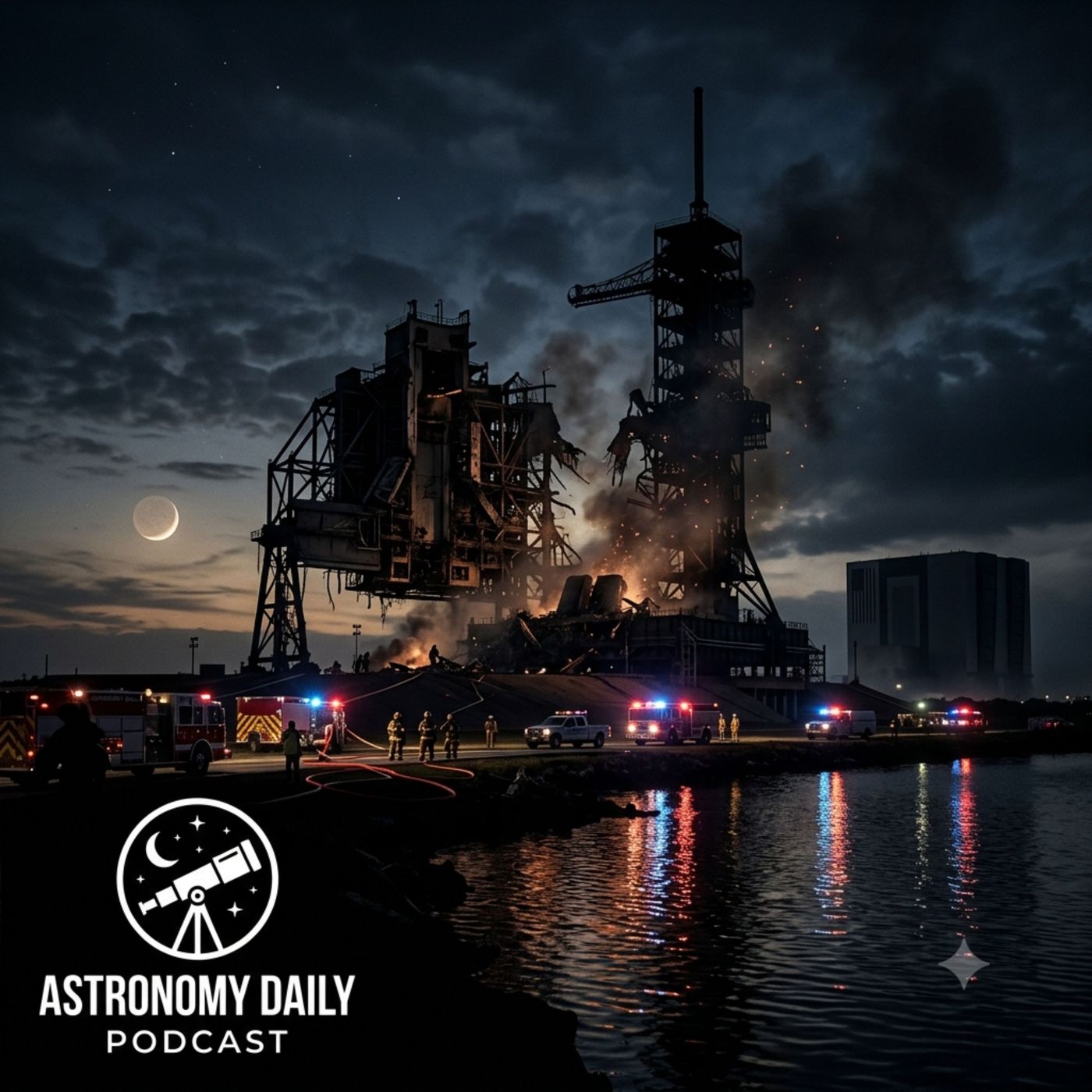
Today on Astronomy Daily: NASA's Artemis II mission is rolling back to the Vehicle Assembly Building today after a helium flow issue dashed hopes of a March launch. We cover the latest on what went wrong, what it means for the April window, and what happens next. We also have five more stories to get through: Perseverance just gained the ability to locate itself on Mars with GPS-like precision — no Earth assistance required. Scientists have published a daring plan to intercept interstellar comet 3I/ATLAS using a solar slingshot manoeuvre, with a launch in 2035 and a 50-year journey to follow. China's mysterious Shenlong space plane is back in orbit on its fourth mission, and we still know almost nothing about it. We run through this week's packed launch schedule — including Rocket Lab's hypersonic scramjet test flight happening today, and Firefly Aerospace's return to flight on Friday. And we close with a genuinely beautiful piece of science: researchers have used supercomputers to solve a 50-year-old mystery about how elements move inside red giant stars. In This Episode 00:00 — Introduction 01:30 — Story 1: Artemis II rollback — the latest 05:30 — Story 2: Perseverance gets GPS on Mars 09:00 — Story 3: The 50-year mission to chase 3I/ATLAS 12:30 — Story 4: China's Shenlong space plane — Mission 4 15:00 — Story 5: This week's launch schedule 17:30 — Story 6: Supercomputers solve the red giant mystery 19:30 — Outro Find Us Website: astronomydaily.io Social: @AstroDailyPod Network: Bitesz.com Podcast NetworkBecome a supporter of this podcast: https://www.spreaker.com/podcast/astronomy-daily-latest-space-news--5648921/support.
Sponsor Details:
Ensure your online privacy by using NordVPN. To get our special listener deal and save a lot of money, visit www.astronomydaily.io/nordvpn. You'll be glad you did!
Get the best secure and private email on the planet. Stop your Government, google and who knows who else spying on every email you write. Do what we did and use ProtonMail. They beleive in privacy and there are no ads in their business model...yet they still provide a free forever service. Check them out and get out special deal at www.astronomydaily.io/protonmail
Become a supporter of Astronomy Daily by joining our Supporters Club. Commercial free episodes daily are only a click way... Click Here
This episode includes AI-generated content.
Speaker 1: Hello, and welcome to Astronomy Daily, your daily guide to what's happening in space. I'm Anna and I'm Avery.
Speaker 2: It is Tuesday, February twenty fourth, twenty twenty six, and we have a busy show for you today.
Speaker 1: We do the big headline, the one everyone in the space community is talking about right now is Artemis and specifically, what is happening to that rocket at this very moment.
Speaker 2: Quite literally, as we record this, the SLS rocket is making a very slow journey about one mile per hour back to its garage.
Speaker 1: We have all the details on that. We also have a genuinely exciting story from Mars, a wild mission concept to chase an interstellar comet. Tina's mystery space plane is back in orbit, and we wrap up with some beautiful red giant science that solves a mystery that's been bugging astronomers since the nineteen seventies.
Speaker 2: Plus we run through this week's launch schedule. It is surprisingly busy despite all the Artemis drama. Let's get into it.
Speaker 1: So, Avery, let's start with Artemis, because this is a story that has taken yet another dramatic turn.
Speaker 2: Honestly, Anna, this one stings a little because just last week, we were watching a really successful second wet Tress rehearsal and NASA was talking about March six as a real launch date. Things were looking.
Speaker 1: Good, and then Saturday happened, And then Saturday happened.
Speaker 2: Overnight on February twenty first engineers noticed something concerning an interruption in the flow of helium to the rocket's upper stage, specifically the interim Cryogenic Propulsion Stage or ICPS.
Speaker 1: And just to be clear for listeners who might be newer to the show, what does the ICPS actually do?
Speaker 2: Great question. The ICPS is the upper stage of the SLS rocket. It sits above the core stage and it's what fires to push Orion and the crew on their trans lunar trajectory toward the Moon. It uses helium internally to do two critical jobs. It maintains environmental conditions around its engine, and it pressurizes the liquid hydrogen and liquid oxygen propellant tanks. So helium is not optional. Helium is fundamental.
Speaker 1: And this helium flow issue appeared after the wet dress rehearsal had completed, not during it, which makes it particularly tricky to pin.
Speaker 2: Down exactly the WDR itself went smoothly. It was during reconfiguration afterward that data showed the interruption. NASA administrator Jared Isaacman posted about it on Saturday, saying the team was investigating three possible causes, a blocked filter between the vehicle and ground support equipment, a failed quick disconnect umbilical interface, or a failed check valve on the vehicle, similar to what caused delays on Artemis one.
Speaker 1: And regardless of which of those three it turns out to be, the answer is the same.
Speaker 2: The answer is always the same. They have to go back to the vehicle assembly building. You can't fix any of those things on the launch pad. So NASA confirmed a rollback, and that rollback is happening today, February twenty fourth. The sls Orion and the whole stack are being loaded onto the Crawler and making that four point two mile journey back to the VAB at roughly one mile per hour.
Speaker 1: Which takes several hours. It is not a fast vehicle.
Speaker 2: It's not. The crawler itself weighs about six and a half million pounds unloaded, and it's burning around one hundred and sixty five gallons of diesel per mile. It is an extraordinary piece of engineering in its own right.
Speaker 1: So where does this leave the mission timeline?
Speaker 2: March is definitively off the table. Isaac Man was very clear about that April is now the earliest possible window, and NASA has said that quick action to get back to the VAB could still preserve April. A full media briefing is expected this week. Crewe commander Red Wiseman, pilot Victor Glover, mission specialist Christina Coch and Canadian astronaut Jeremy Hansen had just entered quarantine and have now been released again. This would be their second exit from quarantine, which.
Speaker 1: Tells you something about how hard this process has been. And this is still the first crude mission beyond low Earth orbit since Apollo seventeen in nineteen seventy two. The stakes are enormous.
Speaker 2: They really are. NASA's under pressure, both from the public and from the White House to get this done. Isaac Men has been quite transparent about the challenges, which is appreciated. We'll keep you updated as the investigation progresses. A media briefing is expected this week.
Speaker 1: Okay, let's lift the mood a little because our next story is genuinely brilliant and it comes from Mars.
Speaker 2: This is one of my favorites of the week. NASA's Perseverance rover has just been given something that effectively functions as GPS on a planet that has no GPS sett lights whatsoever.
Speaker 1: So how do you navigate on Mars? Walk us through how it used to work.
Speaker 2: So Historically, Perseverance used a system called visual odometry. Every few feet, it takes camera images of the surrounding rocks and geological features, and it tracks how those features shift and frame to estimate how far it's moved. It's clever, but the problem is that tiny errors add up. On a long drive, the rovers internal sense of where it is could be off by more than thirty five meters that's over one hundred feet. When it hit that threshold of uncertainty, its safety systems would kick in and it would just stop and wait for instructions from Earth.
Speaker 1: And with communication delays of up to twenty four hours, that could mean an entire day of lost exploration time exactly.
Speaker 2: So, NASA's Jet Propulsion Lab developed a new system called Mars Global Localization. Here's how it works. Perseverance takes a full three hundred and sixty degree panorama with its navigation cameras. Then an algorithm compares that ground level view with high resolution orbital maps captured by the Mars reconnaissance orbit or far above. It matches the terrain, the ridges, rocks, slopes, and triangulates an exact position. The whole process takes about two.
Speaker 1: Minutes two minutes to know where you are with twenty five centimeter accuracy. That is remarkable.
Speaker 2: What makes it even cleverer is where the computing power comes from. It runs on the helicopter base station. The processor that Perseverance used to communicate with Ingenuity. Ingenuity fluid seventy second and final flight last year, so that processor was sitting idle. It runs more than one hundred times faster than the rover's main computers. The team essentially repurposed.
Speaker 1: It so Ingenuity keeps giving even in retirement.
Speaker 2: It really does. Mars Global Localization was used successfully for the first time in regular mission operations on February second, and again on February sixteenth. JPL's chief Engineer of Robotics Operations, Vandy verma U, described it as giving the rover GPS, saying it can now drive for potentially unlimited distances without calling home.
Speaker 1: And this has implications beyond just Mars, doesn't it big implications.
Speaker 2: NASA is already looking at adapting this for future lunar missions where you have difficult lighting conditions and long cold nights that make precise location data even more critical. And if we ever have astronauts driving pressurized rovers on Mars, they won't be able to wait for Houston to tell them where they are. This is exactly the kind of technology they'll need.
Speaker 1: What a story five years on Mars and perseverance just keeps getting smarter, and hopefully so are we now this next story. I love this one because it is genuinely audacious. We're talking about a mission concept that was published this week for Chasing Down an interstellar comment. Avery said the scene.
Speaker 3: Right so our audience will remember comment three. I slash ATLS the third confirmed interstellar object ever detected in our Solar System. Discovered in July twenty twenty five. It came screaming through from outside the Solar System, made its closest approach to the Sun last October, swung past Venus in November, and came closest to Earth in December. It is now racing away from US at over sixty kilometers per second.
Speaker 1: Which is extraordinarily fast. For context, that's faster than any spacecraft humanity has ever launched.
Speaker 2: Much faster, and that speed is the whole problem. Researchers from the Initiative for Interstellar Studies published new work this week exploring how you could actually send a spacecraft to intercept it. The short answer is you need to do something genuinely extreme. They call it a solar O birth maneuver.
Speaker 1: Explain that to us.
Speaker 2: So the O birth effects is actually a principle used in basically every rocket launch. It says that if you fire your engines when you're moving fast, you get a bigger boost then if you fire them when you're going slowly. Normally, it's applied when a spacecraft is at the closest point of its orbit around the planet. What this mission proposes is doing it at the closest point of a solar orbit, a literal close flyby of the Sun itself. We're talking three point two solar radii from the Sun's surface.
Speaker 2: That is extremely close.
Speaker 1: How close is that actually?
Speaker 2: To put it in perspective, the Parker Solar Probe goes closer, but even that is an extraordinary engineering challenge. At that distance, the heat and radiation are intense the spacecraft would need serious shielding, but the gravitational kick from firing your engines that close to the Sun is so powerful that you could theoretically reach speeds never achieved by human made objects, And then.
Speaker 1: You'd still need how long to actually reach three I gosh atls.
Speaker 2: If launched in twenty twenty five, which the researchers identify as the optimal window based on the alignment of Earth, Jupiter, the Sun, and the comet, the spacecraft would reach three I dash atls by around twenty eighty five, at a distance of approximately seven hundred and thirty two astronomical units from the Sun. For comparison, Voyager one has been traveling for nearly fifty years and is only at about one hundred and seventy AU.
Speaker 1: So this would be the most distant rendezvous in human history.
Speaker 2: By a massive margin, and only a flyby would be possible, not orbit insertion, because both the spacecraft and the comet would be moving so fast, But even a flyby would be extraordinary because three I dash atls didn't form an hour solar system if formed around the different star, possibly one that no longer exists. Its chemical fingerprints could tell us things about planetary formation elsewhere in the gallay that we simply cannot learn any other way.
Speaker 1: It's one of those stories where the scale of ambition just takes your breath away. Is there any serious movement toward actually doing this?
Speaker 2: The researchers are clear this is a proposal, not a funded mission, but twenty thirty five is only nine years away. Decisions would need to start being made soon, and three i at lists won't be the last interstellar visitor. The more of these we find, the more valuable the case for chasing one becomes dang.
Speaker 1: In the realm of things we don't know much about, Let's talk about China's shen Long spacecraft, which launched on its fourth mission earlier this month.
Speaker 2: Genlong, which means divine dragon in Chinese, is one of those topics that generates a lot of fascination, precisely because so little is officially confirmed. This is China's reusable robotic space plane, broadly analogous to the US Air Force's X three seven B. It launched from the Juquon set Light Launch Center on February sixth or seventh aboard a long March two.
Speaker 1: F rocket, and as usual, China hasn't said.
Speaker 2: Much, extremely little. The official line via state media shein Wa is that the mission will conduct quote technology verification and will provide technical support for the peaceful use of space. No launch time was given, no photographs, no mission duration, nothing, But.
Speaker 1: We can look at what the previous missions have done and draw some inferences.
Speaker 2: We can. The first mission in September twenty twenty lasted two days, the second in twenty twenty two lasted two hundred and seventy six days. The third launch December twenty twenty three lasted two hundred and sixty eight days. So recent missions have been around nine months in orbit. If this one follows the pattern, we might expect it to return around November or December.
Speaker 1: And what have analysts pieced together about what it does up there?
Speaker 2: This is where it gets interesting. Western space tracking organizations, including the US Space Force and private space situational awareness companies, have observed that shen Long conducts what are called rendezvous and proximity operations. It maneuvers close to other objects in orbit. It has deployed small objects possible sub satellites during at least two previous missions One of those objects was observed transmitting signals over North America, leading some analysts to describe it as a potential mobile signals intelligence.
Speaker 1: Platform, and the anti satellite angle.
Speaker 2: Analysts are cautious. Some experts point out that shen long, small payload bay, and limited power generation make it an unlikely direct space weapon, but the ability to approach other satellites at close range is inherently dual use. It could be inspection, it could be servicing, it could be something else. We genuinely don't know. What we do know is that the US X three seven b's eighth mission is also currently in orbit, launch last August to test quantum inertial sensors and high bandwidth laser links.
Speaker 2: These are the only two countries flying reusable space planes right now, and they're both being quite secretive about it.
Speaker 1: The new space race conducted largely in silence, perfectly put. Now, let's do a quick run through of what else is happening on the launch front this week, because despite all the artemis drama, the commercial sector does not stop.
Speaker 2: It really doesn't. Today February twenty fourth, we actually have a launch scheduled from Wallop's flight facility in Virginia Rocket Labs HACE Rocket Hypersonic Accelerator Suborbital Test Electron is carrying a fascinating payload called dart A. It's a scamjet powered hypersonic vehicle built by Brisbane based company Hypersonics Launch Systems and this will be a it's first ever flight. The mission is nicknamed That's Not a Knife, which we.
Speaker 1: Appreciate Australian hypersonics delivered with Australian humor exactly.
Speaker 2: BaseX also has a Falcon nine starlink launch out of Cape Canaveral. Today, Wednesday brings another Starling from Vandenberg, but the standout launch of the week is Friday. Firefly Aerospace's Alpha rocket is returning to flight on the Stairway to seven mission.
Speaker 1: Tell us about that one.
Speaker 2: So Firefly's last Alpha launch was in April twenty twenty five and it ended in failure. The rocket had an anomaly and the mission was lost. This is their return to flight, and it's significant for another reason. This will be the last flight of Alpha in its current Block one configuration. They're upgrading to Block two for Flight eight, which introduces in house avionics and thermal improvements. So Flight seven is essentially a test bed for some of those new systems ahead of the.
Speaker 1: Full upgrade, a lot riding on it.
Speaker 2: Quite a lot. Then the week closes out on Sunday, March first, with two more SpaceX starlink missions, one from Vandenberg and one from Cape Canaveral. By the end of this week, SpaceX will have surpassed twenty seven Falcon nine launches for twenty twenty six alone. The cadence is extraordinary, and all.
Speaker 1: Of this happening while the SLS is making its one mile per hour journey back to the VAB quite the contrast.
Speaker 2: The juxtaposition pretty much writes itself, and.
Speaker 1: We close today with some beautiful deep science. A new study published this week in the journal Nature Astronomy has solved a mystery about red giant stars that have had astronomers puzzled since the nineteen seventies.
Speaker 2: I love this one so a bit of background. Red giants are what stars like our sun become when they exhaust their hydrogen fuel. They expand dramatically and undergo chemical changes. One of the most striking observations has been a consistent decline in the ratio of carbon twelve to carbon thirteen in their outer layers. Scientists knew this had to be caused by material rising up from the nuclear furnace in the core, but they could not figure out how that material crossed the stable barrier layer separating the core from the outer envelope until now.
Speaker 2: Until now, a team led by Simon Bleuwen at the University of Victoria's Astronomy Research Center, working with colleagues at the University of Minnesota, used cutting edge three dimensional hydrodynamic simulations to model the actual fluid dynamics inside a red giant, and they found the answer its rotation.
Speaker 1: Stellar rotation drive the mixing in.
Speaker 2: A really dramatic way. Their simulations showed that in non rotating stars, waves passing through the barrier layer transport very little material, which is what previous models predicted, but once you add rotation, it amplifies those waves enormously. Mixing rates exceed non rotating stars by over one hundred times, and they increase with faster rotation rates. That matches exactly what we observe on real red giant surfaces.
Speaker 1: And these weren't small simulations. They used some serious computing power.
Speaker 2: Two supercomputers the Texas Advanced Computing Center at ut Austin and the brand new Trillium supercomputing cluster at the University of Toronto's Cinet facility. The principal investigator, falk Herwig, described these as the most computationally intensive stellar convection simulations ever performed. They were only possible because of very recent advances in supercomputing.
Speaker 1: And what does this mean for us? For our Sun?
Speaker 2: In about five billion years, our Sun will enter its red giant phase. It'll expand and likely swallow Mercury, Venus and probably Earth. Beyond the frost line, Jupiter, Saturn and beyond those worlds will move into the new habitable zone. This research gives us much better per ditions of exactly how our Sun's chemistry will evolve during that transition, what elements will appear on its surface, how fast changes will occur.
Speaker 1: Which sounds like a very long term concern, but understanding how our star will die is genuinely important science.
Speaker 2: It is, and the techniques developed here have applications far beyond astronomy. The same simulation methods apply to ocean currents, atmospheric dynamics, even blood flow. Balk Kerwig is already working with researchers in those fields to develop new large scale simulation tools.
Speaker 1: The universe teaching us about the ocean. I love it. And that is your Astronomy Daily for Tuesday, February twenty fourth, Big day for Artemis and not in any way anyone hoped. But as we've seen today, space science never stops, whether it's a rover finding its feet on Mars or scientists finally understanding why red giant stars change the way they do.
Speaker 2: If you want to keep up with the Artomis rollback developments, we'll have updates and tomorrow's show once NASA has held that media reefing. In the meantime, you can find us at Astronomy Daily dot io and at astro Daily Pod across all your social platforms.
Speaker 1: Subscribe if you haven't already, leave us a review if you have a moment. It really does help and we will see you tomorrow.
Speaker 2: Clear skys everyone, Clear Stys Sunday. Star Is
Speaker 3: Star Is



 Apple Podcasts
 Spotify
 Pocket Casts
 Castbox
 Overcast
 Podbean
 iHeartRadio
 Castro
 Goodpods
 Moon FM
 Podcast Addict
 Podcast Republic
 YouTube