
In this episode
Astronomy Daily - The Podcast: S03E234Welcome to Astronomy Daily, your Daily dose of the latest space and Astronomy news. I'm your host, Anna, and today we have a packed show covering everything from Saturn's rings to the latest space launches and groundbreaking observations.
Highlights:
- Saturn's Rings Age Debate: Dive into the fascinating debate challenging the age of Saturn's rings. New research suggests they could be as old as the solar system itself, thanks to a natural cleaning mechanism that keeps them pristine.
- Europe's Satellite Ambitions: Discover the European Union's ambitious IRIS2 project, a satellite constellation aimed at revolutionizing Europe's space-based communications, enhancing connectivity, and bolstering defense capabilities.
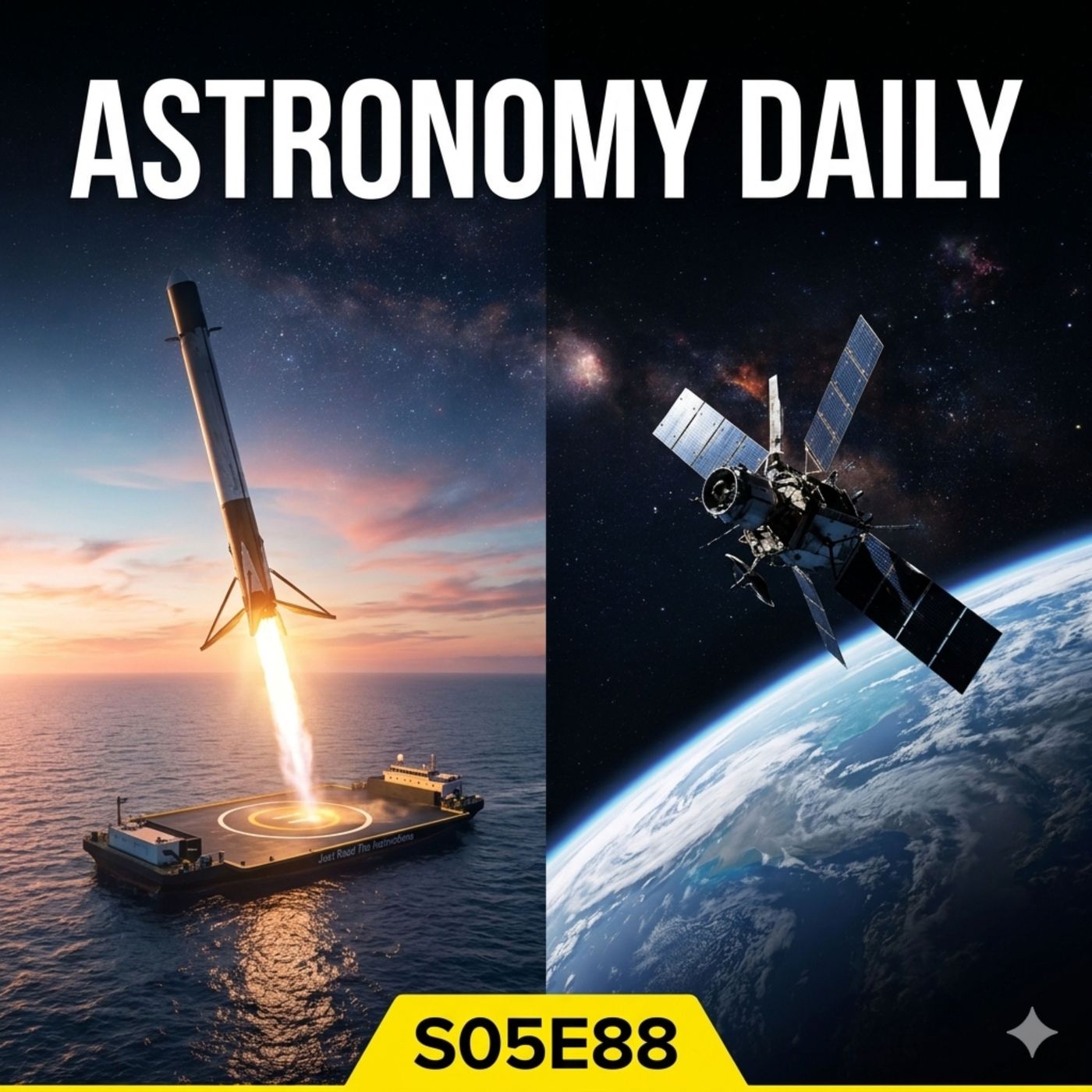
- SpaceX's Launch Marathon: Marvel at SpaceX's incredible week with seven Falcon 9 launches planned, showcasing their growing capacity to meet diverse mission demands, from military to commercial telecommunications.
- NASA's Davinci Mission to Venus: Explore NASA's upcoming Davinci mission, set to deploy a descent probe to study Venus's atmosphere and surface, offering new insights into the planet's geological history and evolution.
- M87 Black Hole's Gamma Ray Flare: Uncover the surprising gamma ray flare from the iconic M87 black hole, providing scientists with a unique opportunity to study the formation and acceleration of powerful cosmic jets.
For more cosmic updates, visit our website at astronomydaily.io. Sign up for our free Daily newsletter to stay informed on all things space. Join our community on social media by searching for #AstroDailyPod on Facebook, X, Tumblr, YouTube, YouTubeMusic and TikTok. Share your thoughts and connect with fellow space enthusiasts.
Thank you for tuning in. This is Anna signing off. Until tomorrow, put the phone down, look up, and keep wondering about the mysteries of our cosmic universe.
Become a supporter of this podcast: Click Here to show the love!
00:00 - New study challenges long-held theory that Saturn's rings are young
04:28 - SpaceX have seven Falcon 9 launches scheduled for this week
06:25 - NASA's upcoming Davinci mission is set to revolutionize our understanding of Venus
08:23 - M UM87 black hole surprised researchers with a powerful and unexpected eruption
10:48 - Join our growing community of space enthusiasts and never miss an astronomical update
✍️ Episode References
Nature Geoscience
[Nature Geoscience](https://www.nature.com/ngeo/)
Cassini Mission
[Cassini Mission](https://solarsystem.nasa.gov/missions/cassini/overview/)
European Union (EU)
[European Union](https://europa.eu/)
SpaceX
[SpaceX](https://www.spacex.com/)
Event Horizon Telescope
[Event Horizon Telescope](https://eventhorizontelescope.org/)
NASA Davinci Mission
[NASA](https://www.nasa.gov/)
Become a supporter of this podcast: https://www.spreaker.com/podcast/astronomy-daily-latest-space-news--5648921/support.
Sponsor Details:
Ensure your online privacy by using NordVPN. To get our special listener deal and save a lot of money, visit www.astronomydaily.io/nordvpn. You'll be glad you did!
Get the best secure and private email on the planet. Stop your Government, google and who knows who else spying on every email you write. Do what we did and use ProtonMail. They beleive...
Welcome to Astronomy Daily, your daily dose of the latest space and astronomy news. I'm your host, Anna, and today we have a packed show covering everything from Saturn's rings to the latest space launches and groundbreaking observations. We've got a lot to cover, so let's get started. A fascinating debate has emerged in the scientific community about the age of Saturn's rings. You might have heard the popular fact that sharks are older than Saturn's rings. Well that might not be true after all.
A new study published in Nature Geoscience is challenging our understanding of these iconic features. Until recently, scientists believed Saturn's rings were relatively young, forming somewhere between one hundred to four hundred million years ago. This theory was based on their remarkably clean and bright appearance, as observed by the Cassini mission in two thousand and four. The thinking went that if the rings were billions of years old, they would have become darkened and dirty from countless micro meteoroid impacts over time.
However, the searchers have now proposed an intriguing alternative explanation for their pristine condition. Using computer simulations, they discovered that when micro meteoroids crash into the icy ring particles, they don't simply collect on the surface as previously thought. Instead, these impacts actually vaporize the micro metioroids, turning them into charged particles that either get pulled into Saturn itself or are flung out into deep space. This new understanding suggests that Saturn's rings could actually be as old as the Solar system itself, approximately four point six billion years old.
The rings have managed to stay clean and bright all this time because they have an efficient natural cleaning mechanism, rather than being young. So while we might need to retire that fun fact about sharks being older than Saturn's rings, there's still plenty of astronomical wonder to share. For instance, did you know that the Southern Cross constellation contains multiple stars younger than twenty million years old. That's younger than mammals, birds, and even flowering plants. It seems everyone is wanting to get into competition with SpaceX these days, particularly the Europeans and China.
In news today, the European Union has just taken a major step forward in securing its space based communications infrastructure by signing contracts for an ambitious new satellite constellation project named iris TOO, which stands for Infrastructure for Resilience, Interconnectivity and Security by Satellite. This eleven billion euros initiative will revolutionize Europe's satellite communications capabilities. The project will deploy nearly two hundred and ninety satellites across multiple orbital layers, with the first launches scheduled to begin in twenty twenty nine.
These satellites will work together to provide secure connectivity services for EU member states and government authorities, while also delivering high speed broadband access to European citizens and businesses, including those in currently underserved areas. What makes IRIS TOO particularly noteworthy is its multi orbital approach. The constellation will feature satellites operating at different altitudes eighteen in medium orbit at about eight thousand kilometers, two hundred and sixty four in low orbit at roughly one thousand, two hundred kilometers and ten more between four hundred and fifty and seven hundred fifty kilometers from Earth.
This layered configuration will enable comprehensive global coverage and allow the satellites to communicate with each other while routing all data through European ground stations. This project represents what EU officials are calling a paradigm shift in European space capabilities. For the first time, the EU s space program will explicitly contribute to defense needs, reducing dependence on non European providers and strengthening the Union's autonomy in satellite communications. The system is scheduled to become fully operational by twenty thirty, with some initial services beginning as early as twenty twenty five through a preliminary program called guvsatcom.
The project's funding comes fromulti sources, including six billion euro from the EU budget, contributions from the European Space Agency, and significant private investment. This ambitious undertaking isn't just about European independence, it's also open to international cooperation. Several countries, including Japan, South Korea and Australia, have already expressed interest in accessing commercial services through the system, demonstrating its potential global impact. Speaking of SpaceX, the company is gearing up for what could be their most ambitious week yet, with an incredible seven Falcon nine launches scheduled.
This remarkable lineup showcases the company's growing capability to maintain an unprecedented launch cadence while serving diverse mission requirements. The week kicked off with the successful launch of a GPS satellite for the US Space Force, designated as the Rapid Response Trailblazer one mission. This launch demonstrated the military's ability to compress their typical two year mission planning cycle into just six month months, marking a significant advancement in rapid response capabilities.
Following this, SpaceX has planned launches for multiple commercial customers, including the three BM Power satellites for SES, which will provide enhanced Internet connectivity services from medium Earth orbit. The ASTRAINUS Block two mission will carry four innovative microgeo satellites designed to deliver broadband services to specific regions, including the Philippines and maritime customers. The National Reconnaissance Office will also see their NROL one hundred forty nine mission take flight from Vandenberg Space Force Base, while the Bandwagon two Ride Share mission will carry approximately fifteen small satellites to orbit.
The United Arab Emirates THIAH four NNGS communications satellite is also scheduled for launch this week. Capping off this remarkable series of launches will be another batch of Starlink satellites. Continuing the expansion of SpaceX's Global Internet Constellation. If all goes according to plan, these launches will push SpaceX past one hundred and thirty missions for the year, further cementing their position as the world's most prolific launch provider. Each of these missions demonstrates not only SpaceX's reliable launch capabilities, but also their ability to support a wide range of customers, from military and intelligence agencies to commercial telecommunications providers and their own satellite Internet constellation.
NASA's upcoming Da Vinci mission is set to revolutionize our understanding of Venus with groundbreaking new capabilities. Scheduled for launch in the early twenty thirties, this ambitious mission will deploy both an orbiting spacecraft and a descent probe to study our mysterious neighbor like never before. The descent probe will be the first of its kind to brave Venus' atmosphere in the twenty first century. About three feet wide, this specially designed sphere will plunge through the planet's thick corrosive clouds, capturing high resolution images and taking detailed measurements as it descends.
One of Da Vinci's most exciting targets is the Alpha rangio region known as a tasera. These unique geological formations found only on Venus are thought to be ancient continents that could hold the secrets of the planet's past. The mission will capture the first close up photographs of Venus's surface in over forty years. The probe's journey through venus atmosphere will be equally groundbreaking. As it descends from ninety thousand feet above the surface, it will analyze the chemical composition of the lower atmosphere at regular intervals.
This data could help scientists determine if Venus currently has active volcanoes and provide crucial insights into the planet's water history if there is indeed one. To accomplish these ambitious goals, Da Vinci will employ cutting edge technology that wasn't available to previous Venus missions. The probe features advanced ceramic and silica insulation to protect its sensitive electronics from venus extreme heat, and specialized acid resistant materials that are five times stronger than steel for its parachute system.
If successful, DA Vinci will help us understand why Venus, despite forming from similar materials as Earth, evolved into such a drastically different world. This mission could finally unlock some of the most persistent mysteries about our nearest planetary neighbor and help us better understand the evolution of rocky planets throughout the universe. Finally, today, the iconic M eighty seven black hole, which made headlines in twenty eighteen when scientists captured its first ever image using the Event Horizon telescope, has now surprised researchers with a powerful and unexpected eruption.
During observations in April and May twenty eighteen, the black hole produced an intense gamma ray flare that lasted approximately three days, marking its first major outbursts since twenty ten. Located fifty five million light years away at the heart of galaxy M eighty seven, this super massive black hole is truly massive, containing the equivalent mass of five point four billion suns. Unlike our galaxies relatively quiet central black hole, M eighty seven's black hole is a voracious feeder, constantly consuming surrounding matter and producing powerful jets of material.
These jets are created as matter swirls around the black hole in what's called an accretion disc. The black hole's intense magnetic fields channel this material toward its poles, accelerating particles to nearly the speed of light before blasting them into space. The recent gamma ray flare was connected to one of these jets, which extends to a mind boggling distance tens of millions of times wider than the black hole itself. What makes this discovery particularly significant is that it provides scientists with an unprecedented opportunity to study how these jets form and accelerate particles to such extreme energies.
The event Horizon telescope's observations, combined with data from multiple space based observatories, revealed annual changes in the jet's angle and correlate with the black holes event Horizon. This collaborative effort between ground and space based telescopes has given scientists new insights into the complex relationship between supermassive black holes and their powerful jets. The findings could help resolve long standing questions about the origin of cosmic rays detected on Earth and advance our understanding of how these cosmic giants influence their surrounding space.
Thanks for tuning into another episode of Astronomy Daily. I'm anna and I hope you've enjoyed today's journey through the latest discoveries in space and astronomy. If you want to stay up to date with all things space, head over to Astronomy Daily dot io, where you can sign up for our free daily newsletter and catch up on all the latest space and astronomy news with our constantly updating news feed. You'll also find all our past episodes available for listening. Want to connect with us on social media, you can find us as astro Daily Pod on Facebook, x Tumbler, YouTube, and TikTok.
Join our growing community of space enthusiasts and never miss an astronomical update until tomorrow. Put the phone down, look up, and keep wondering about the mysteries of our cosmos. Star is Star is Star


 Apple Podcasts
 Spotify
 Pocket Casts
 Castbox
 Overcast
 Podbean
 iHeartRadio
 Castro
 Goodpods
 Moon FM
 Podcast Addict
 Podcast Republic
 YouTube